–Ben Bernanke and the popular faith

An alternative to popular faith

According to the April 8, 2010 Wall Street Journal, “Federal Reserve Chairman Ben Bernanke said Wednesday that huge U.S. budget deficits threaten the nation’s long-term economic health and should be addressed soon.” That is the popular faith, with “faith” being defined as belief without scientific evidence.

By using the words “addressed” and “soon” Mr. Bernanke is relieved of the responsibility to provide a specific solution or a timetable.

The Journal said, “In remarks to the Dallas Chamber of Commerce, Mr. Bernanke agreed […] that the economy, while improving is still too weak to bear all the new taxes and spending cuts that would come with an aggressive deficit reduction campaign.” The Journal continued, “Cutting the deficit ultimately will mean choosing between cutting (Social Security and Medicare) entitlements, raising taxes or other spending cuts.

This is exactly correct. Federal deficits never have been shown to cause inflation (See: item #8. )or to have any other negative effect on people or on the economy in general. In fact, substantial evidence indicates that reducing deficits has caused nearly every recession and depression in our history. (See: Click here, items #3 and #4. )

By contrast, increasing taxes or cutting Medicare and Social Security benefits or cutting other expenses (defense, infrastructure, health care, food stamps, education, research, etc.) absolutely will have a negative effect on people and on the economy in general.

So which does a sane person choose, something not proven to have a negative effect or something proven to have a huge negative effect?

Mr. Bernanke worries large deficits cause high interest rates. He subscribes to the popular faith that low rates stimulate the economy, despite there being no historical relationship between interest rates and economic growth (See Item #10 ), as he should have learned from his, and his predecessor’s twenty futile rate cuts leading into the recession.

Quoting the Journal, “[…] higher rates push up borrowing costs for many businesses and consumers,” ignoring the many businesses and consumers who are lenders, and who benefit from higher rates. For every borrower there is a lender. All of you who own savings accounts, NOW accounts, money market accounts, corporate bonds and T-securities profit when rates are higher. It may surprise you to learn higher rates have been economically stimulative, because they’ve forced the government to pay more interest into the economy. Finally, some economic hypotheses indicate low rates were partly at fault for the housing bubble.

In summary, Mr. Bernanke promotes a goal with no proven benefit, provides neither a plan nor a timetable for achieving his goal, admits it would require tax increases and spending cuts, both of which hurt people and the economy, and he discusses a possible problem (high interest rates) history shows is more a benefit than a problem.

At long last, will someone please stand up and say, “The popular faith doesn’t seem to work. May we try something new?”

Rodger Malcolm Mitchell
http://www.rodgermitchell.com

— Government’s gain = economy’s loss

An alternative to popular faith

On 4/7/10, The New York Times wrote: “G.M. reiterated a commitment to pay off the balance of its debt to the American and Canadian governments by June. It made payments totaling $2.8 billion, including interest, in December and March toward an initial balance of $8.3 billion.”

That’s $8.3 billion leaving the U.S. economy and disappearing into the American and Canadian governments’ maws, never to be used or even seen, again. Financially, this is an $8.3 billion invisible tax increase – about $28 taken from the pockets of every man, woman and child in America.

The New York Times article continued, “Most of the $50 billion G.M. borrowed was converted to a 61 percent equity stake held by the Treasury Department. The only way the Treasury can recover that debt is through the sale of its stock. (Chief Financial Officer Chris) Liddell said a public stock offering would occur ‘as soon as it makes sense,’ but only “when the markets and the company are ready.”

The private sector will lose whatever the government receives for its stock – another invisible tax increase. The $50 billion will amount to $166 in stealth taxes taken from each American. In addition, the stock sale will depress the value of privately held stock, a loss for American shareholders.

Question: What is the difference between a federal government profit and a tax increase? Answer: Essentially none, if the profit comes out of the U.S. economy.

Moral: The federal government, as the creator of money, never should take money from the private sector. Ask your Congressperson: “If the deficit spending, for which you voted, stimulates the economy, what will be the effect of taking all those billions back out of the economy?”

Amazingly, the media and the politicians, and even some economists, will ignore the pain experienced by people in the private sector and cheer the government’s not taking a loss.

And that is why we have a recession every five or six years, in America.

Rodger Malcolm Mitchell
http://www.rodgermitchell.com

–Federal deficit spending doesn’t cause inflation; oil does

An alternative to popular faith

Ask a debt hawk why he hates federal deficits and he will give you four main reasons:

1. Federal debt must be paid back by taxpayers. (But, because the federal government has the unlimited power to create the money to pay its bills, taxpayers do not fund federal spending.)

2. Federal debt adds to the government’s interest-paying burden. (Again, interest is no burden to a entity having the unlimited ability to create money.)

3. Federal debt uses up lending funds that otherwise would go to private needs. (But, federal spending adds money to the economy, making more, not less, funds available for private lending.)

4. By increasing the money supply, federal deficits reduce the value of money, thereby causing inflation. Readers of this blog have seen the graph (below) which shows no relationship between federal deficits — even large federal deficits — and inflation.

Note how the peaks and valleys of deficit growth do not match the peaks and valleys of inflation growth:

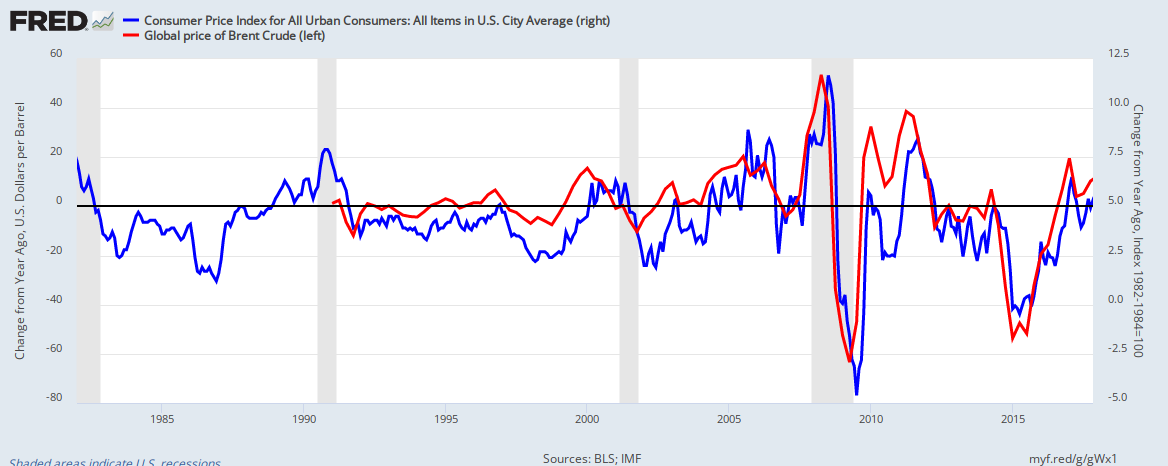
If deficits don’t cause inflation, what does? In a previous post “Is inflation too much money chasing too few goods”, we answered that question (“No.”), and we presented a graph indicating the real cause of inflation may be energy prices, more specifically, oil prices. See below:

The extreme movements of energy prices corresponding with the more modest movement of overall inflation, seem to indicate that energy costs “pull” inflation in either direction.

We can see this parallelism better by magnifing the CPI movement with a different vertical axis:

Monetary Sovereignty

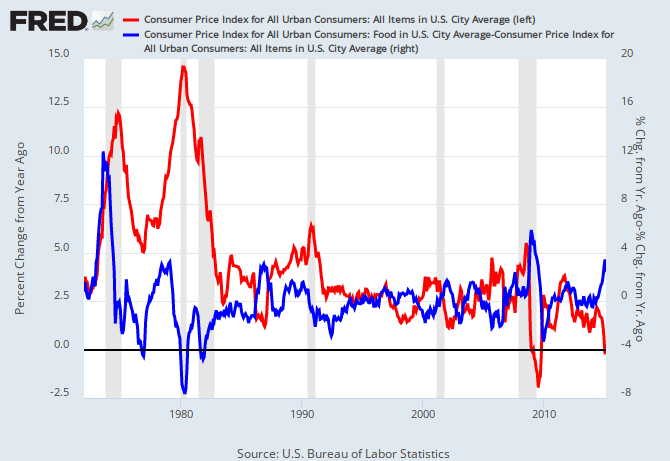
Now here is another graph that may substantiate the hypothesis that energy prices pull CPI:

monetary sovereignty

It compares inflation movements (red line) with the movement of energy prices less the movement of inflation (blue line). Notice how closely the two lines correspond.

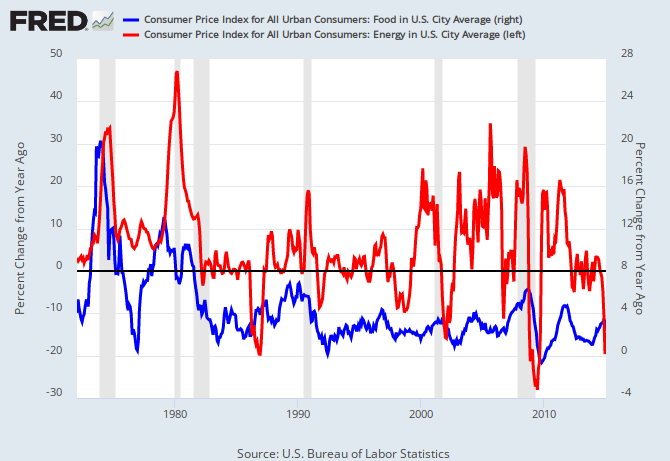
Compare that graph with the graph below. This graph is the same as the one above, except rather than comparing energy price changes with inflation, it compares food price changes. See how there is much less correlation.

monetary sovereignty

Food price changes do not seem to be the key inflation-causing factor. In fact, energy price changes seem to cause food price changes:

monetary sovereignty

Inflations are not caused by too much money. Inflations are caused by shortages.

Energy, and more specifically oil is, aside from food and water, the one universal need. It is the only commodity, the shortage of which, affects the prices of all other goods and services.

Rodger Malcolm Mitchell
http://www.rodgermitchell.com

No nation can tax itself into prosperity. Those who say the stimulus “didn’t work” remind me of the guy whose house is on fire. A neighbor runs with a garden hose and starts spraying, but the fire continues. The neighbor wants to call the fire department, which would bring the big hoses, but the guy says, “Don’t call. As you can see, water doesn’t put out fires.”

–Cuts to Medicare vs deficit spending

An alternative to popular faith

I just received a note from Mark Kirk, Republican Congressman, listing the cuts to be made in Medicare. I don’t know how factual they all are, because frankly the new program not only is complex, but evolving.

In any event, this is what the Republicans (and Democrats) should work on, rather than the “repeal and replace” political effort that has no chance to succeed. Forget the McCain, “There will be no cooperation for the rest of the year” attitude. Focus on correcting the negatives rather than throwing out the baby with the bathwater.

By the way, every one of these cuts could be eliminated if wrongheaded, deficit paranoia were eliminated. The federal government can and should pay, via deficit spending, to eliminate all these cuts. Consideration of real damages to real people should take precedence over imaginary, unproven damage from federal deficits

Here is what Rep. Kirk wrote:

2010: Medicare Cuts to Hospitals: The federal government will reduce Medicare reimbursements for hospitals who provide seniors with long-term and inpatient and rehabilitation care.

2011:Medicare Advantage Cuts Begin: Approximately 121,000 Illinois seniors will be dropped from their chosen Medicare Advantage coverage. Drug Discounts for those in Medicare Part D “donut hole” begin: The federal government will impose a new requirement on pharmaceutical companies to provide a 50% discount on “brand name” prescriptions. Increased Medicare Part D Premiums: Seniors with incomes above $85,000 for individuals and $170,000 for couples will be forced to pay higher Medicare Part D premiums. Medicare Imaging Cuts: The federal government will cut Medicare reimbursements for seniors who use MRI and CT scans. Medicare Cuts to Ambulance Services and Durable Medical Equipment: The federal government will begin cutting Medicare reimbursements for seniors who use ambulances or durable medical equipment.

2012: Medicare Cuts for Hospitals with Readmissions: The federal government will cut Medicare reimbursements to any hospital with a high readmission rate. Medicare Cuts for Hospice Care: The federal government will cut Medicare reimbursements for seniors on hospice care. Medicare Cuts for Dialysis Care: The federal government will cut Medicare reimbursements for Americans – both youth and seniors – on dialysis.

2014: Medicare Board Cuts: The federal government will establish an Independent Payment Advisory Board with powers to make further cuts to seniors on Medicare.

2015: Medicare Home Health Cuts: The federal government will cut Medicare reimbursements for seniors who depend on home health care.

I’d be interested in hearing from those of you who think reducing federal deficits is more important than eliminating these cuts, together with your evidence that deficits are harmful in any way.

Rodger Malcolm Mitchell
http://www.rodgermitchell.com