The debt hawks are to economics as the creationists are to biology.
I strongly recommend this one-page piece: Randall Wray
Rodger Malcolm Mitchell
http://www.rodgermitchell.com

No nation can tax itself into prosperity
#Monetary Sovereignty – Mitchell
Economics, Money and Debt
The debt hawks are to economics as the creationists are to biology.
I strongly recommend this one-page piece: Randall Wray
Rodger Malcolm Mitchell
http://www.rodgermitchell.com
No nation can tax itself into prosperity
The debt hawks are to economics as the creationists are to biology.
Generally, I prefer to state a problem, then propose a solution. But when one solution addresses several problems, perhaps the reverse sequence is appropriate. The solution is: The federal government should pay all students – elementary school, middle school, high school, college and post grad – a salary.
Let’s first dispense with the debt-hawk, knee-jerk reaction that this will increase the federal debt and cause inflation. We have discussed the so-called “debt problem” numerous places in this blog, and don’t need to repeat the discussion, here. If you want a refresher, please go through some of the posts listed to the left.
Before we get into details, here are some of the problems the solution could address:
1. Reduce the school dropout rate. Many students enter the employment world early for a simple, practical reason. They need the money. Some families encourage their children to do this, for the same practical reason. Even with scholarships, many families simply cannot afford to send their children to high school, let alone college and beyond.
2. Grow the economy I: During a recession, an economy is starved for money. Unquestionably, the various stimulus payments have helped us recover from the recession and have increased economic growth. While there is substantial disagreement about how much these payments have accomplished, there is scant belief that economic growth was not helped at all. Salary payments to students would add growth money to the economy by providing jobs. (In this case, the job is to attend school.) Even without a recession, added jobs and added salaries help the economy grow.
3. Grow the economy II: A more educated population will be better equipped to deal with tomorrow’s more advanced economies. The 30 occupations with the largest employment declines, 2008-18 all involved unskilled or semi-skilled labor, with no college education required. In contrast, the majority of The 30 fastest-growing occupations, 2008-18 required college or advanced degrees.
4. Grow the economy III: A more educated population will be better equipped to create tomorrow’s more advanced economies. Most technological advancements come from college-educated people. Nations have suffered because of a so-called “brain drain,” meaning when the most educated people leave, the country has difficulty progressing. Clearly, there is a relationship between education and economic growth. For America not to fall behind, we continuously must create more and better-educated people.
5. Improve our quality of life: America needs more doctors, nurses, scientists, chemists, architects and engineers of all types. These are the people who will care for us and who will develop the medicines and medical techniques, the medical equipment and modern hospitals to improve our lives.
6. Reduce the crime level. High school drop outs are inordinately involved in crime. One could argue this is not cause/effect, but rather the type of person who drops out also is the type who has criminal tendencies. I disagree it’s a matter of type. Rather, the high school dropout has fewer, attractive employment opportunities, and as a result, is drawn into crime. Crime may seem the only opportunity to have money. Take those young people off the street corners, put them in school and pay them money, and the crime rate will decline.
7. Improve our laws: Educated people probably read more and understand more. As a result, they may be more astute voters, more able to make intelligent judgments about the relative qualities of various office holders and candidates. They probably write more letters to politicians and to the media, and are more able to be effective members of school boards, political offices and other leadership roles. The educated may be better able to analyze political promises and activities.
As with all ideas, the devil is in the details, some of which are:
1. Pay a salary to attend what kinds of school? An accredited school as opposed to a diploma mill or home schooling. Because we suggest paying a salary to students, rather than making a payment to a school, we can include religious schools, which sometimes are the best schools in a given area.
2. How much salary? The salary can be lowest for the lowest grades and increase stepwise through post graduate. It might vary according to average local salaries, with the student’s home being the determinant. For high school and above, the salary should be above the single person’s poverty guideline for each geographic area.
Many federal programs already use the poverty guidelines as a starting point: “Programs using the guidelines (or percentage multiples of the guidelines — for instance, 125 percent or 185 percent of the guidelines) in determining eligibility include Head Start, the Food Stamp Program, the National School Lunch Program, the Low-Income Home Energy Assistance Program, and the Children’s Health Insurance Program.” (U.S. Department of Health and Human Services)
3. Should wealth, income or other federal benefits be considered? No, the only considerations should be geographic area and level of education. Rich or poor, all Americans should receive the same benefit.
4. What about “professional students.” They will continue to exist. The salaries should not be so high as overly to encourage this behavior. We might think about time limits, depending on the student’s major. But we should not consider age limits. A person, who becomes unemployed at age 50, and who wishes to attend school, should be encouraged to do so.
5. What about scholarships? Schools should not be allowed to consider this salary among their criteria for scholarships. I also would not allow for taxing of this salary, but that may be too much to hope for.
6. Who would administer the program? The states should administer it, and the federal government should pay for it. The states could delegate administration to specific school districts within the states. There is no need to invent a massive federal bureaucracy when local bureaucracies exist, and are most knowledgeable about local situations.
That’s the bare outline. I look forward to hearing your thoughts and ideas.
Rodger Malcolm Mitchell
http://www.rodgermitchell.com
No nation can tax itself into prosperity
Mitchell’s laws:
●Those, who do not understand the differences between Monetary Sovereignty and monetary non-sovereignty, do not understand economics.
●The more federal budgets are cut and taxes increased, the weaker an economy becomes. .
●Liberals think the purpose of government is to protect the poor and powerless from the rich and powerful. Conservatives think the purpose of government is to protect the rich and powerful from the poor and powerless.
●The single most important problem in economics is the gap between rich and poor.
●Austerity is the government’s method for widening the gap between rich and poor.
●Until the 99% understand the need for federal deficits, the upper 1% will rule.
●To survive long term, a monetarily non-sovereign government must have a positive balance of payments.
●Everything in economics devolves to motive, and the motive is the Gap.
=========================================================================================================================================================================================================================
Today’s headline: “Fears grow as millions lose jobless benefits”
Body copy: Senate Republican leader, Mitch McConnell of Kentucky, said: “The fastest-growing parts of this Democrat economy aren’t jobs — they’re the crushing burden of the national debt and the size of the federal government.”
The “crushing burden” is not national debt, which crushes no one. The crushing burden is the false belief the national debt is a crushing burden.
As a result of this false belief, millions will lose jobless benefits, taxes will be increased, Medicare doctors will receive less than they should, Social Security payments will begin later, Medicaid payments will be cut, defense spending will be reduced, federal funding of K-12 education and school breakfast programs will be cut, mass transit funding will be cut and federal assistance to the states will be reduced — all because of a myth with no factual support.
So you, dear reader, will suffer a significantly degraded life style, all because the debt hawks say the federal debt is a crushing burden and the debt causes inflation, neither of which is supported by any data.
Go to any debt hawk web site and ask them for data proving the U.S. federal debt is unsustainable or causes inflation. If they answer you at all (unlikely), they merely will give you statistics regarding the size of the debt, but no evidence it has a negative effect on America.
Here are a couple debt hawk sites you can visit:
Concord Coalition
The Cato Insitute
The Heritage Foundation
The Manhattan Institute
The Hoover Institution
Go ahead. Contact any of them. Despite impressive doctoral credentials, and oodles of statistics, they have no evidence to back their claims. Why? No such evidence exists, though massive evidence shows the misnamed “debt” (should be called “net money created”) is necessary for economic growth.
Rodger Malcolm Mitchell
http://www.rodgermitchell.com
No nation can tax itself into prosperity
Mitchell’s laws:
●Those, who do not understand the differences between Monetary Sovereignty and monetary non-sovereignty, do not understand economics.
●The more federal budgets are cut and taxes increased, the weaker an economy becomes. .
●Liberals think the purpose of government is to protect the poor and powerless from the rich and powerful. Conservatives think the purpose of government is to protect the rich and powerful from the poor and powerless.
●The single most important problem in economics is the gap between rich and poor.
●Austerity is the government’s method for widening the gap between rich and poor.
●Until the 99% understand the need for federal deficits, the upper 1% will rule.
●To survive long term, a monetarily non-sovereign government must have a positive balance of payments.
●Everything in economics devolves to motive, and the motive is the Gap.
=========================================================================================================================================================================================================================
The debt hawks are to economics as the creationists are to biology.
==========================================================================================================================
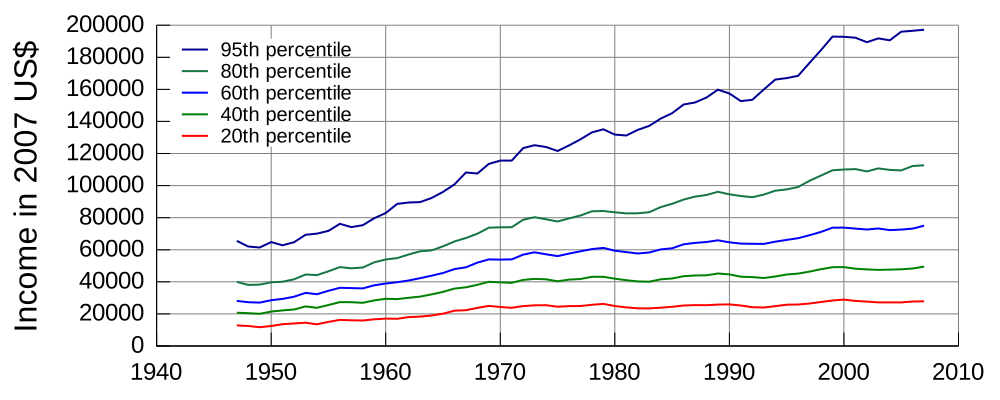
Graph of United States income distribution from 1947 through 2007 inclusive, normalized to 2007 dollars. The data source is “Table F-1. Income Limits for Each Fifth and Top 5 Percent of Families (All Races): 1947 to 2007”, U.S. Census Bureau, Current Population Survey, Annual Social and Economic Supplements.
In Closing the financial gap, I showed how direct money transfers don’t close the gap, and I asked, “Is closing the gap economically wise? That is, would our economy grow better, and would our population live better, happier, more rewarding lives overall, if there were little or no gap?”
I believe attention paid to closing the gap, by bringing down the rich, is a diversion from the real economic and moral questions that surround poverty. Concern about the rich feeds on that commonly felt class jealousy to which politicians respond with counter-productive laws, which do nothing for the poor or for the economy.
Classic example: Inheritance taxes. They have little effect on tax collections, and to the degree they would affect tax collections, they also would reduce economic growth. And they do nothing to improve the lot of the poor. These, and all other attempts to reduce the gap, by punishing the rich, tend to hurt the economy and the people who most want the gap reduced.
Punishing the rich should not be the goal, but rather we should try to lift our poorest, regardless of whether or not that closes or even opens the gap. In the previous post I suggested that just as government pays for elementary school, middle school and high school, why not have the government pay for college and even advanced degrees? This would give the poor a better opportunity to lift themselves.
One reader expressed concern this actually could have an adverse effect on the economy: “The world still needs ditch diggers,” he wrote.
My response: “The world does not need ditch diggers. The world needs ditches to be dug. Slowly, inexorably, society is moving away from dumb human labor and toward smart machine labor. Those people who do not have an education will not just be relegated to the lowest jobs. They will have no jobs at all. There simply will be no ditch-digging work available.”
While I agree with Modern Monetary Theory (MMT) in many ways, one of my disagreements is its dual goal of price stability and full employment. MMT calls for the government to be the employer of last resort, so that everyone who wants a job, has a job. But MMT ignores job quality in its quasi-charity approach. Giving jobs to everyone surely would devolve to giving money to everyone for little or no work at all.
While unemployment seems to correspond with recessionary times, I see no evidence that unemployment causes recessionary times. Some might even say that unemployment helps stimulate the prevention and cure of recessions just as hunger feelings help stimulate the prevention and cure of starvation. In fact, that is the very purpose of hunger feelings.
In short, unemployment may be only a symptom, just as hunger is a symptom of starvation. Curing the hunger symptom does not cure the starvation disease, as any anorexic should know. Focusing on the symptom may divert attention from the fundamental problem, which is acquisition ability (AA)– people’s ability to acquire what they want.
MMT may claim full employment is not a symptom, but rather a path toward the AA goal. MMT wants the government to achieve full employment by providing a job to anyone who wants one, and apparently the job can be anything. But I suspect a nation of Walmart greeters is not desirable.
So what about a nation of college grads? Is that better? Despite the typical “Who-will-dig-the-ditches?” questions, the answer may be, “Yes.”
A college grad, digging ditches, may be more likely to think of better ditch-digging methods, to the benefit of society. This is an extreme example, and I’ve left the psychology of job satisfaction out of the mix, but I speculate that education will lift the economy, meaning MMT’s focus on jobs is fundamentally wrong.
Rather than the government being the employer of last resort, perhaps the government should be the educator of first resort. That might do more to lift the poor and lift America, than giving people low level, dead-end jobs.
In summary, the problem is not specifically the gap, but poverty. The partial solution is not low end jobs, but education.
Rodger Malcolm Mitchell
http://www.rodgermitchell.com
No nation can tax itself into prosperity
 #Monetary Sovereignty - Mitchell