Your handy recession predictors

Mitchell’s laws:
●The more federal budgets are cut and taxes increased, the weaker an economy becomes.
●Austerity is the government’s method for widening the gap between rich and poor,
which leads to civil disorder.
●Until the 99% understand the need for federal deficits, the upper 1% will rule.
●To survive long term, a monetarily non-sovereign government must have a positive balance of payments.
●Those, who do not understand the differences between Monetary Sovereignty and monetary non-sovereignty, do not understand economics.

●The penalty for ignorance is slavery.
==========================================================================================================================================

Here are your handy recession predictors. Save the link to this page. The graphs automatically will update.

We tend to have recessions when the year-to-year percentage change of Gross Private Domestic Investment goes down, especially when it falls below zero:
Monetary Sovereignty
We tend not to have recessions when the percentage change is rising.

We tend to have recessions when the total of Private Investment and Saving is on the downswing:
Monetary Sovereignty

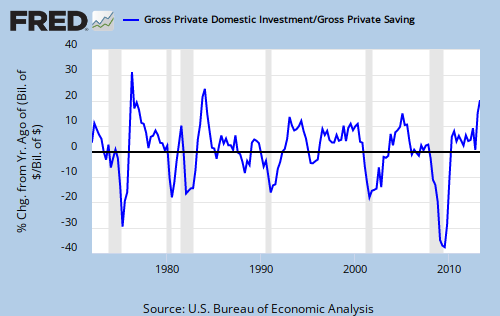
We tend to have recessions when the percentage change in the annual ratio between Gross Private Domestic Investment and Gross Private Savings is falling, especially when it falls below zero.
Monetary Sovereignty

And, as we’ve seen in past articles, recessions tend to follow years of decreasing Federal Debt:
Monetary Sovereignty.

Finally, Federal Deficits – Net Imports = Net Private Savings
and
Gross Domestic Product = Federal Spending + Private Investment and Consumption – Net Imports

Given that the federal government is determined to reduce the federal deficit, which will involve reducing Federal Spending and increasing federal taxing, what do you think will happen to Gross Private Investment, the total of Investment and Saving, the ratio between Investment and Saving, and Federal Debt? What effect will there be on GDP?

You can pose that question to your favorite Congressperson and newspaper.

Rodger Malcolm Mitchell
Monetary Sovereignty

====================================================================================================================================================

Nine Steps to Prosperity:
1. Eliminate FICA (Click here)
2. Medicare — parts A, B & D — for everyone
3. Send every American citizen an annual check for $5,000 or give every state $5,000 per capita (Click here)
4. Long-term nursing care for everyone
5. Free education (including post-grad) for everyone
6. Salary for attending school (Click here)
7. Eliminate corporate taxes
8. Increase the standard income tax deduction annually
9. Increase federal spending on the myriad initiatives that benefit America’s 99%

No nation can tax itself into prosperity, nor grow without money growth. Monetary Sovereignty: Cutting federal deficits to grow the economy is like applying leeches to cure anemia. Two key equations in economics:
Federal Deficits – Net Imports = Net Private Savings
Gross Domestic Product = Federal Spending + Private Investment and Consumption – Net Imports

#MONETARY SOVEREIGNTY

–Deficit reduction (austerity) destroys more American lives and families than war.

Mitchell’s laws:
●The more federal budgets are cut and taxes increased, the weaker an economy becomes.
●Austerity is the government’s method for widening the gap between rich and poor,
which leads to civil disorder.
●Until the 99% understand the need for federal deficits, the upper 1% will rule.
●To survive long term, a monetarily non-sovereign government must have a positive balance of payments.
●Those, who do not understand the differences between Monetary Sovereignty and monetary non-sovereignty, do not understand economics.

●The penalty for ignorance is slavery.
==========================================================================================================================================

Excerpted from the Washington Post:
The GOP’s problem: The cuts they want aren’t the cuts they can get
Posted by Ezra Klein on December 13, 2012

The Republicans know President Barack Obama will not agree to cut in the area they want to cut: aid to the poor. Obama is willing to cut Medicare and Social Security, and Republicans are internally conflicted over those programs.

Translation: “We politicians are employed by the rich, so we don’t care that every day, Americans die from inadequate health care, and every day, families are destroyed by poverty – more death and destruction than are caused by war.

“The Republicans want to start with the lowest income group and work their way up. Unfortunately, a poor person can vote – though the Republicans have been attempting to change that.

“The Democrats want to cut the old people first, and screw the poor later. Unfortunately, those old people insist on voting.”

Think back to Mitt Romney’s proposed budget. The only big cuts Romney ever proposed were to programs that aid the poor. He wanted to cut Medicaid, food stamps, and housing assistance. He wanted to get rid of the tax cuts enacted in the stimulus to help the poor — his tax plan raised taxes on the poorest Americans. He wanted to repeal all the spending in Obamacare, most of which goes to lower-income Americans.

About two-thirds of the cuts in Rep. Paul Ryan’s budget came from programs for the poor.

That leaves Medicare and Social Security. It’s possible that the negotiators will enact a backdoor, but significant, cut to Social Security by changing the government’s measure of inflation. But they’re not going to come at Social Security from the front. It’s too politically potent. Even Ryan’s budget left Social Security alone.

Just imagine if the politicians had the courage and the honesty to admit that deficit reduction (austerity) destroys more American lives and families than war. There would be no need to cut Medicare, no need to cut Social Security, no need to cut food stamps, housing assistance or other aids to the poor, no need for crumbling roads, bridges and dams, no need to cut public broadcasting – and no need for high federal taxes. . .

Every man, woman and child could have good health care insurance, adequate food and shelter, a good education. America’s roads, bridges and dams could be repaired. The hurricane damaged East Coast would not have to suffer the Republicans’ delay in providing funds. Our military could upgrade. The post office would not have to cut service and employees. More intensive financial supervision could eliminate crooked banks and brokers.

All these and more, would be possible. Instead, we watch as our nation is whittled down by the budget cutters, whose goal is not to strengthen America, not to “save” Security and Medicare, not to “get our fiscal house in order” – no, the sole purpose is to increase the gap between the rich and the rest.

We have a chance to make a difference. We can spread the truth . We can influence the future of America. Write, call, march, demand, threaten. Make our feelings known. We can keep the rich from taking over our lives.

Or we can just follow along and let it happen to us. Just as the wealthy want.

“Never send to know for whom the bell tolls; It tolls for thee.”

Rodger Malcolm Mitchell
Monetary Sovereignty

====================================================================================================================================================

Nine Steps to Prosperity:
1. Eliminate FICA (Click here)
2. Medicare — parts A, B & D — for everyone
3. Send every American citizen an annual check for $5,000 or give every state $5,000 per capita (Click here)
4. Long-term nursing care for everyone
5. Free education (including post-grad) for everyone
6. Salary for attending school (Click here)
7. Eliminate corporate taxes
8. Increase the standard income tax deduction annually
9. Increase federal spending on the myriad initiatives that benefit America’s 99%

No nation can tax itself into prosperity, nor grow without money growth. Monetary Sovereignty: Cutting federal deficits to grow the economy is like applying leeches to cure anemia. Two key equations in economics:
Federal Deficits – Net Imports = Net Private Savings
Gross Domestic Product = Federal Spending + Private Investment and Consumption – Net Imports

#MONETARY SOVEREIGNTY

–What is the purpose of the charitable tax deduction? Who will be hurt if it’s reduced?

Mitchell’s laws:
●The more federal budgets are cut and taxes increased, the weaker an economy becomes.
●Austerity is the government’s method for widening the gap between rich and poor,
which leads to civil disorder.
●Until the 99% understand the need for federal deficits, the upper 1% will rule.
●To survive long term, a monetarily non-sovereign government must have a positive balance of payments.
●Those, who do not understand the differences between Monetary Sovereignty and monetary non-sovereignty, do not understand economics.

●The penalty for ignorance is slavery.
==========================================================================================================================================

One might think reducing the charity tax deduction punishes rich. Nonsense. The rich will continue to give the same net (gross donation – tax deduction) dollars. Sadly, a greater share of those dollars will go to the federal government.

A billionaire giving ten million dollars, and paying the highest marginal tax rate, receives a $3.5 million tax deduction. It’s the net contribution of $6.5 million that actually comes out of his pocket. The rich know what their net outflow will be and what they will have left after making their contributions. They have people who keep track of those things.

Reduce the tax deduction, and the rich won’t absorb the loss. They simply will give less and the government will receive more. The charities would absorb the loss. So President Obama’s desire to reduce the charitable tax deduction for the rich, merely will reduce net contributions to charities.

And to whom do charities give: The poor, the needy, the 99.9%.

So while some of the 99.9% might exult at seeing the charitable reduction reduced for the rich ($250 thousand a year is “rich”???), in fact this means nothing to the rich. It is the middle and lower classes that will suffer.

Thus, we have another in a long string of Obama initiatives to widen he income gap between the rich and the rest.

But there is a fundamental question that never seems to be addressed. What has been the historical purpose of the charitable tax deduction? The answer: To encourage private charitable giving.

Those who hate “big government,” and who believe the private sector is best equipped to determine which charities are most beneficial to the nation, logically should want the charitable deduction to be even bigger. But even the conservatives don’t understand what’s happening.

There are only three alternatives:
1. More help from the private sector
2. More help from the federal government
3. Less help for the needy.

By reducing the charitable deduction, and cutting federal spending, which direction will we go? No rocket science necessary.

Washington Post
White House, nonprofit groups battle over charitable deductions
By Jerry Markon and Peter Wallsten, Thursday, December 13, 11:06 AM

The White House and the nation’s most prominent charities are embroiled in a tense, behind-the-scenes debate over President Obama’s push to scale back the nearly century-old tax deduction on donations that the charities say is crucial for their financial health.

In a series of recent meetings and calls, top White House aides have pressed nonprofit groups to line up behind the president’s plan for reducing the federal deficit and averting the year-end “fiscal cliff,” according to people familiar with the talks.

In part, the White House is seeking to win the support of nonprofit groups for Obama’s central demand that income tax rates rise for upper-end taxpayers. There are early signs that several charities, whose boards often include the wealthy, are willing to endorse this change.

Why would any charities endorse deficit reduction? It’s in the last sentence: “. . . boards often include the wealthy.” Yes, as we have seen in previous posts, deficit reduction (austerity) widens the income gap between the rich and the rest.

But the White House is also looking to limit the charitable deduction for high-income earners, and that has prompted frustration and resistance, with leaders of major nonprofit organizations, such as the United Way, the American Red Cross and Lutheran Services of America, closing ranks in opposing any change to the deduction.

Studies have shown that people would donate less if the deduction were reduced but estimates of the effect vary widely

“It would be devastating,’’ said Jatrice Martel Gaiter, executive vice president for external affairs at Volunteers of America, which has paid Patton Boggs — Washington’s most lucrative lobby shop — nearly $200,000 to lobby on the charitable deduction and other issues in the past year. “Of course people want to say they are giving out of the goodness of their hearts, and of course they are, but the tax deduction makes our heart larger and our goodness even better.’’

Many people would continue to give the same – mostly members of the lower 99.9% income groups. They still would drop a dollar into the Salvation Army kettle; they still would give $100 to the church. But unquestionably, the big donations would shrink.

Obama has proposed capping the value of deductions for individuals earning more than $200,000 ($250,000 for families) at 28 percent, regardless of their tax bracket. This would include deductions for mortgage interest and state and local taxes, along with charitable contributions.

Currently, the tax code allows people who itemize deductions to deduct their charitable contributions at their maximum marginal tax rate. So, for example, if someone in the highest tax bracket — now a 35 percent tax rate — gives $100 to charity, the donor saves $35 in taxes. If the deduction were capped at 28 percent, the donor would save only $28 dollars.

Ultimately, people are concerned with what they have left in their own pockets, after all expenses and contributions. Tax them more for contributions and they’ll contribute less.

Capping deductions at 28 percent — including those for charitable contributions, mortgage interest and state and local taxes — would raise $574 billion in new federal tax revenue over 10 years, according to White House estimates.

This transfers $574 billion out of the private sector, most of it coming from charities and their beneficiaries, the poor.

Obama has dismissed the charities’ contention that his plan would substantially damage their fundraising. White House officials, including Chief of Staff Jacob Lew and senior adviser Valerie Jarrett, have recently been telling nonprofit leaders they would face far graver danger under Republican deficit-reduction plans.

“You see, our plan only cuts off one of your feet, unnecessarily; the Republicans would cut off both of your feet, unnecessarily. So you should be happy with our plan.

Obama aides this week also signaled a willingness to overhaul corporate taxes as an enticement for the chief executives of major U.S. companies to speak out in favor of raising individual income taxes, and a number of prominent executives have begun backing the tax plan in recent days.

Can you believe it? “Prominent executives” like the idea of reducing corporate taxes while increasing individual taxes. Who’d a thunk?

Frustration stems in part from what some nonprofit leaders describe as a philosophical disagreement between Obama and the non-profit sector. The president has framed the tax deduction as a benefit for the wealthy, they say, while in their view the deduction is a benefit for charities that use the money to help the needy.

Reduce the tax deduction, and the rich will give less. No harm to the rich. All the harm is to the charities and ultimately to the people who need service from charities. Once again, Obama, the great liberal, works to widen the gap between rich and poor.

“Obama said. “Well, if you eliminated charitable deductions, that means every hospital and university and not-for-profit agency across the country would suddenly find themselves on the verge of collapse.”

A flat-out admission that reducing the charitable deduction will impact charities and as a result, impact those who need charities. But wait, here’s Obama making the opposite claim:

When the president proposed reducing the charitable deduction in 2009, initially to help pay for his health-care overhaul initiative, he said there was “very little evidence” that the change would significantly affect giving. Speaking at a press conference, he said the deduction “shouldn’t be a determining factor as to whether you’re given that $100 to the homeless shelter down the street.’’

So, according to Obama, charitable deductions are vital but not very important. Got it?

And finally, there is the Bill and Melinda Gates Foundation, to which Warren Buffett has contributed massively:

Buffett’s gift came with three conditions for the Gates foundation: Bill or Melinda Gates must be alive and active in its administration; it must continue to qualify as a charity; and each year it must give away an amount equal to the previous year’s Berkshire gift, plus another 5 percent of net assets.

Do you think tax considerations aren’t important to charitable givers? Warren Buffett sure thinks they are.

Bottom line: The greater the tax deduction, the more the private sector will determine charitable giving. Reducing the charitable tax deduction will not hurt the rich. It will hurt the middle an lower classes, who benefit from charities. It will increase the gap between rich and poor. Federal bureaucrats will have greater power over charities. America will be diminished.

Yet another needless casualty of austerity.

Rodger Malcolm Mitchell
Monetary Sovereignty

====================================================================================================================================================

Nine Steps to Prosperity:
1. Eliminate FICA (Click here)
2. Medicare — parts A, B & D — for everyone
3. Send every American citizen an annual check for $5,000 or give every state $5,000 per capita (Click here)
4. Long-term nursing care for everyone
5. Free education (including post-grad) for everyone
6. Salary for attending school (Click here)
7. Eliminate corporate taxes
8. Increase the standard income tax deduction annually
9. Increase federal spending on the myriad initiatives that benefit America’s 99%

No nation can tax itself into prosperity, nor grow without money growth. Monetary Sovereignty: Cutting federal deficits to grow the economy is like applying leeches to cure anemia. Two key equations in economics:
Federal Deficits – Net Imports = Net Private Savings
Gross Domestic Product = Federal Spending + Private Investment and Consumption – Net Imports

#MONETARY SOVEREIGNTY
–Fed embraces madness: Repeatedly does the same thing, expecting a different result

Mitchell’s laws:
●The more federal budgets are cut and taxes increased, the weaker an economy becomes.
●Austerity is the government’s method for widening the gap between rich and poor,
which leads to civil disorder.
●Until the 99% understand the need for federal deficits, the upper 1% will rule.
●To survive long term, a monetarily non-sovereign government must have a positive balance of payments.
●Those, who do not understand the differences between Monetary Sovereignty and monetary non-sovereignty, do not understand economics.

●The penalty for ignorance is slavery.
==========================================================================================================================================

Never before have I reprinted a posting from this blog, but I will do it now, because it is even more appropriate today than it was when first published, three years ago. First, please read the following article from Yahoo News:

Market enthusiasm over Fed’s latest easing fades as US budget discussions continue
By Pan Pylas, AP Business Writer | Associated Press; 12/13/12

LONDON (AP) — Any enthusiasm over another monetary stimulus from the Federal Reserve faded Thursday as investors monitored the progress of budget discussions in the U.S. As had been widely predicted, the Fed said Wednesday it will spend $85 billion a month on bond purchases to drive down long-term borrowing costs and stimulate economic growth.

The total includes the replacement of an expiring Fed program with a commitment to purchase $45 billion a month on long-term Treasurys. Those purchases, and the Fed’s renewed commitment to keep interest rates low until unemployment falls to a more normal level, are intended to spur borrowing and spending in an economy still growing only modestly since the financial crisis of 2008.

So, there will be no monetary stimulus. Instead, the Fed will drive down long-term interest rates. (Short-term rates have been near zero, and that has accomplished nothing, so the focus shifts to long-term rates.)

Here is the article published September 9, 2009, titled “The low interest rate/GDP growth fallacy”

The article contains a graph which has been brought up to date:

================================================================================================================================================================================================================================================================================
THE LOW INTEREST RATE / GDP GROWTH FALLACY

       The Fed raises interest rates to fight inflation. To fight recession, the Fed does the opposite. It cuts interest rates.
      This may sound logical except for one, very small detail. The opposite of inflation is not recession. The opposite of inflation is deflation. So doing the opposite of what you would do to counter inflation makes no sense when trying to counter a recession.
      We could have a recession with deflation. We could have a recession with inflation, which is called “stagflation.” The history of Fed rate cuts, as a way to stimulate the economy, is not a good one. The Fed, under Chairman Greenspan, instituted numerous rate cuts. The result: A recession that President Bush’s tax cuts cured.
      The Fed, under Chairman Bernanke, instituted numerous rate cuts. The result: The 2008 recession.
      Why does popular faith hold that cutting interest rates stimulates the economy? Because popular faith views only one side of the equation. For each dollar borrowed a dollar is lent. $B = $L. That much is trivial.
      Cutting interest rates does cost borrowers less. So, the theory is, a business needing $100 million would be more likely to borrow if interest rates are low than when they are high. Further, consumers are more likely to spend when borrowing is less costly. So making borrowing less costly stimulates business growth and consumer buying. At least, that is the theory.
      What seems to be ignored is the lending side of the equation. When interest rates are low, lenders receive less money. And who are the lenders? Businesses and consumers.
      You are a lender when you buy a CD or a bond, or put money into your savings account. When interest rates are low, you receive less money, which means you have less money to spend on goods and service — which means less stimulus for the economy.
      In short, interest rates flow through the economy, with some people and businesses paying and some receiving. Domestically, it’s a zero-sum game.
      A growing economy requires a growing supply of money. Cutting interest rates does not add money to the economy. That is why there is no historical correlation between interest rates and economic growth. During periods of high rates, GDP growth is not inhibited. During periods of low rates, GDP growth is not stimulated.

Please review the following graph:

Interest vs GDP

Blue is interest rates. Red is GDP growth. Not only are low interest rates not associated with high economic growth, but the opposite seems to be true. There seems to be a correlation between high interest rates and high GDP growth. How can this be?
      When interest rates are high, the federal government pays more interest on T-securities, which pumps more money into the economy. This additional money stimulates the economy.
      This shows why the Fed’s repeated rate cuts do not seem to stimulate the economy. The action has been shown, time and again, to be counter-productive. Cutting interest rates to stimulate the economy is like pouring water on a drowning man.
      Do you remember these headlines: “Employers slashed 80,000 jobs in March.” “The U.S. central bank has lowered rates by 3 percentage points since mid-September” “The loss of jobs signals another interest rate cut by the Federal Reserve later this month.” “Federal Reserve Chairman Ben Bernanke acknowledged Wednesday that the country could be heading toward a recession, saying federal policymakers are ‘fighting against the wind’ in combating it.”
      Rate cut after rate cut did nothing. So what was the Fed’s plan? More rate cuts. During the previous recession, the Fed also attempted rate cut after rate cut, also to no avail. The recession, finally ended with the Bush tax cuts. The Fed has not learned from experience, but stubbornly adheres to the popular faith that interest rate cuts stimulate the economy.
Rate cuts do not stimulate the economy. They never have. They never will.
      “Stimulating” an economy means making it larger. A large economy requires more money than does a smaller economy. Therefore, the only thing that stimulates the economy is the addition of money.
      Rate cuts, by reducing the amount of interest the federal government pays, actually reduce the supply of money.
We are on the edge of a recession, because the economy is starved for money. The coming “stimulus” checks will help, but they are too little and too late. This should have been done months ago, and the amounts should be far larger.
      The only way to prevent or cure a recession: Federal deficit spending. There is no excuse for recession or inflation. These problems are not economic failures. They are leadership failures.

You also might find another post, “Low interest rates: The sneak tax on you” of interest.

Rodger Malcolm Mitchell
Monetary Sovereignty

====================================================================================================================================================

Nine Steps to Prosperity:
1. Eliminate FICA (Click here)
2. Medicare — parts A, B & D — for everyone
3. Send every American citizen an annual check for $5,000 or give every state $5,000 per capita (Click here)
4. Long-term nursing care for everyone
5. Free education (including post-grad) for everyone
6. Salary for attending school (Click here)
7. Eliminate corporate taxes
8. Increase the standard income tax deduction annually
9. Increase federal spending on the myriad initiatives that benefit America’s 99%

No nation can tax itself into prosperity, nor grow without money growth. Monetary Sovereignty: Cutting federal deficits to grow the economy is like applying leeches to cure anemia. Two key equations in economics:
Federal Deficits – Net Imports = Net Private Savings
Gross Domestic Product = Federal Spending + Private Investment and Consumption – Net Imports

#MONETARY SOVEREIGNTY