–Is America better off today than it was when Obama took office?

Mitchell’s laws:
●The more budgets are cut and taxes increased, the weaker an economy becomes.
●Austerity is the government’s method for widening the gap between rich and poor,
which leads to civil disorder.
●Until the 99% understand the need for federal deficits, the upper 1% will rule.
●To survive long term, a monetarily non-sovereign government must have a positive balance of payments.
●Those, who do not understand the differences between Monetary Sovereignty and monetary non-sovereignty, do not understand economics.

==========================================================================================================================================

The Republicans ask, “Are you better off than you were four years ago?” The implication is that we are not better off, and perhaps even worse off.

There are many criteria for “better off,” two of which are Gross Domestic Product and Unemployment. To my knowledge, the Republicans have not been specific about what measure they are using.

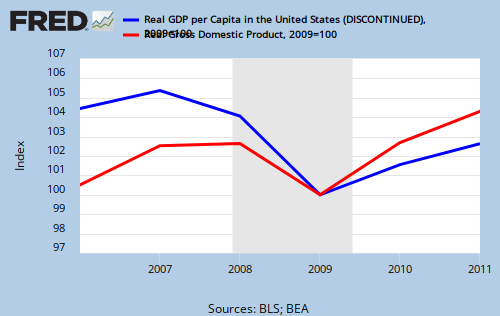
President Obama took office in January, 2009. The following graph shows the trends for real Gross Domestic product (red line) and real per-capita GDP figures (blue line).

Monetary Sovereignty

The economy seems to have hit its low point at the very beginning of Obama’s term, and has grown, since.

Monetary Sovereignty

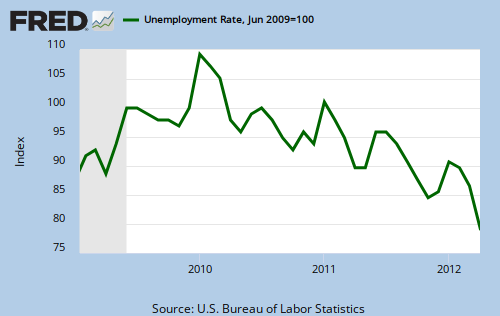
The civilian unemployment rate (green line) rose during Obama’s first year in office, reaching its peak in 2010, and has fallen since, to below where it was when he took office.

As I said, there are many measures of “better off,” but GDP and Unemployment seem to be the most referenced, and by those measures, the answer to the questions would be, “Yes, we are better off.”

That said, other data point in both directions. The poverty level is rising. Obamacare will reduce the number of people who have no health insurance. Real Disposable Personal Income is up.

Monetary Sovereignty

All signs point to the unpleasant fact that the gap between the 1% and the 99% is growing. The rich are better off; the poor are worse off and growing more numerous. And historically, this has led to revolution.

Note to the rich: Cut taxes on the 99%. Increase social benefits — Social Security, Medicare, Medicaid, aid to education, aid to the poor — help the states, help small business, reduce working hours. Follow the 9 steps, below.

If you want to keep what you have, close the gap, or the people will rise up and take what you have, away.

Rodger Malcolm Mitchell
Monetary Sovereignty

====================================================================================================================================================

Nine Steps to Prosperity:
1. Eliminate FICA (Click here)
2. Medicare — parts A, B & D — for everyone
3. Send every American citizen an annual check for $5,000 or give every state $5,000 per capita (Click here)
4. Long-term nursing care for everyone
5. Free education (including post-grad) for everyone
6. Salary for attending school (Click here)
7. Eliminate corporate taxes
8. Increase the standard income tax deduction annually
9. Increase federal spending on the myriad initiatives that benefit America’s 99%

No nation can tax itself into prosperity, nor grow without money growth. Monetary Sovereignty: Cutting federal deficits to grow the economy is like applying leeches to cure anemia. Two key equations in economics:
Federal Deficits – Net Imports = Net Private Savings
Gross Domestic Product = Federal Spending + Private Investment and Consumption – Net Imports

#MONETARY SOVEREIGNTY

–We are in a never-ending war. On which side are you?

Mitchell’s laws:
●The more budgets are cut and taxes increased, the weaker an economy becomes.
●Austerity is the government’s method for widening the gap between rich and poor

●Austerity starves the economy to feed the government, and leads to civil disorder.
●Until the 99% understand the need for federal deficits, the upper 1% will rule.
●To survive long term, a monetarily non-sovereign government must have a positive balance of payments.
●Those, who do not understand the differences between Monetary Sovereignty and monetary non-sovereignty, do not understand economics.

==========================================================================================================================================

We are at war. Since the beginning of civilizations, we have been at war. The war is between our ruling class and the rest of us.

Governments rule and are ruled. There are many forms of government: Democracies of various kinds, dictatorships, theocracies, tribal. The list is endless, as every form has subdivisions, exhibiting sometimes subtle differences. But all have certain similarities.

They all have a ruling class, whose power depends on gaps between them and the general populace. The greater the gaps, the greater the power held by the ruling class. And just as power corrupts, widening the gaps corrupts.

Gaps come in many flavors. Examples are: financial (rich vs. poor), police/military (strong vs. weak), moral (good vs. evil), informational (educated vs. uneducated), gender (male vs. female) or some combinations thereof. In all cases, the goal is to set the ruling class further and further apart from the ruled.

Consider a theocracy: It takes money from its followers, enriching itself at the expense of the donors. Poorer people are told to give their money to wealthy churches, widening the financial gap.

A theocracy makes laws that followers (but not the leaders) are compelled to follow, lest they be punished by ostracism, torture or death. Thereby, the police/military gap is widened.

Theocratic leaders claim morality, with all others being labeled “sinners.” And the religious leaders create, then translate, religious documents (Bible, Koran, et al) according to their whim, making them the educated ones, while all others are ignorant. Finally, theocracies almost universally have been misogynist, anti-gay and xenophobic, with “outsiders” viewed as threats to the power of the domestic elite.

Consider the United States federal government: It taxes its citizens, though being Monetarily Sovereign, it has neither need for, nor use of, tax money. The US makes the laws we all must follow (based on its sole interpretation of morality). It enlists into the army and police, men and women from the private sector to enforce those laws, strengthening itself at the expense of the private sector, both morally and physically.

As now seen in Syria, (and in America, whenever the #Occupy movement protests), and indeed in every nation where tread-upon people demand redress from their leaders, the ruling class demands a strong police/military, to enforce “law and order.”

At the direction of the ruling class, the U.S. government controls the dissemination of information; it lies, denies and omits facts, thus creating, then preying upon, the ignorance of the populace.

The U.S. remains a male-dominated society, as witness the makeup of Congress (16% female) and CEOs of Fortune 500 companies (4% female).

Thus, the US ruling class covers many gaps: financial, police/military, moral, informational and gender. The wall between the U.S. and Mexico, and the various anti-immigrant, anti-minority state laws are symbols of a renewing xenophobia — a typical gap.

The question often is asked: If the United States government has the unlimited ability to create dollars, why does it siphon tax dollars out of the private sector? It has no need to widen the financial gap, since that gap is infinite.

The reason: The leaders of the US government are supported by, and beholden to, the wealthiest among us. And to these wealthy people, widening the financial gap is paramount. Psychologically, the financial gap is more important than the score. You might think you would be happy to earn $1 million per year, especially if everyone you knew earned “only” $50K per year. But how would you feel if all your friends earned $100 million per year, and you still earned “only” $1 million?

Salaried people are more concerned about the income gap between them and their co-workers, than their salary itself. Give them a $100 raise and they are happy– until they learn another worker was given a $200 raise. Meanwhile, the boss cares very little about any gap between employee A and employee B. He might even use it as leverage against them. He is more interested in the gap between him and his peers – and his workers. The U.S. is the wealthiest nation on earth, that gap being of great pride to us all.

Our ruling class “encourages” taxes favorable to themselves. They own newspapers and television stations that falsely tell the public social benefits must be reduced or taxes increased, lest these benefits “go bankrupt.”

Not only do our leaders maintain the most damaging and regressive tax in American history (FICA), but they even tax the Social Security benefits people ostensibly have “paid for,” and repeatedly delay providing those benefits – all because the ruling-class owns and controls the media and the politicians, who lie that Social Security can go bankrupt.

Our Monetarily Sovereign federal government easily could provide health care insurance to every man, woman and child in America. Instead, our politicians, at the behest of the ruling class, tell the 99% their own benefits must be reduced. Our Monetarily Sovereign government easily could support every retired person in America, without FICA. Instead, our politicians, at the behest of the ruling class, tell the 99% such support would cause inflation, bankrupt the system, and be “unsustainable” (a favorite word of the rulers).

The power of the people begins with population. If the Syrian revolution succeeds, it will be because the people are able to sustain greater losses and continue to fight. The ruling class is few in number. In a democracy, the power of the people comes is expressed with the ballot. But that power can be subverted by misinformation, a tactic the 1% have used for millennia.

The purpose of this blog is to provide information. Because of previous brainwashing, many people initially resist anything that counters the propaganda of the ruling class (as delivered by the politicians and the media.).

So we continue to pound away at the facts: The U.S. government never can run short of dollars, never can go bankrupt. The government can pay for Social Security and Medicare for everyone. FICA is harmful, unnecessary and saps the strength of the middle- and lower-classes. Federal taxes take dollars from the economy, do not support the government and should be reduced.. Federal deficits are necessary to grow the economy. Inflation easily can be controlled, even with massive, deficit spending.

When people ask me, “If taxes are not necessary, why does the government levy them?” my only thought is, “Don’t you get it? We’re in a war. It’s like asking why your enemies are shooting at you. The ruling class wants to defeat you. Don’t let them convince you to give them your bullets.”

When you vote in any election, ask yourself which candidate is more likely to widen the gap between the ruling class and you. Ask:

●Which candidate and party is more closely aligned with the ruling class and more likely to increase the gap between rich and middle classes?
●Which one makes greater demands for a strong police to enforce “law and order” against public protest?
●Which candidate and party is less likely to support citizen movements like unions and #Occupy?
●Which one is more likely to reduce legal protections for the 99% via “deregulation”?
●Which one leans more toward theocratic and religious extremism?
●Which candidate backs “widening the tax base” (increasing the number of poor people paying tax), while cutting taxes on the rich?
●For which candidate and party are the ruling-class owners of newspapers and TV stations more likely to vote?
●Which candidate favors reduced federal support for social programs – Medicare, Social Security, Medicaid, food stamps and other poverty programs?
●Which one is less xenophobic, favoring an easier path to citizenship (adding to the population of the 99%) and better relations with foreign nations?
●Which candidate and party leans more toward women’s rights and the rights of minorities?

And finally, ask yourself:
●Which candidate has more consistently advocated the positions I want?

We are in a war. Like it or not, you are a soldier in one of the armies. Which is your army? Cast your vote accordingly.

Rodger Malcolm Mitchell
Monetary Sovereignty

====================================================================================================================================================

Nine Steps to Prosperity:
1. Eliminate FICA (Click here)
2. Medicare — parts A, B & D — for everyone
3. Send every American citizen an annual check for $5,000 or give every state $5,000 per capita (Click here)
4. Long-term nursing care for everyone
5. Free education (including post-grad) for everyone
6. Salary for attending school (Click here)
7. Eliminate corporate taxes
8. Increase the standard income tax deduction annually
9. Increase federal spending on the myriad initiatives that benefit America

No nation can tax itself into prosperity, nor grow without money growth. Monetary Sovereignty: Cutting federal deficits to grow the economy is like applying leeches to cure anemia. Two key equations in economics:
Federal Deficits – Net Imports = Net Private Savings
Gross Domestic Product = Federal Spending + Private Investment and Consumption – Net Imports

#MONETARY SOVEREIGNTY
–Sucking Up: Has an Eminent Economist Sacrificed His Honor and Credibility to Grovel for a Job?

Mitchell’s laws:
●The more budgets are cut and taxes increased, the weaker an economy becomes.

●Austerity starves the economy to feed the government, and leads to civil disorder.
●Until the 99% understand the need for federal deficits, the upper 1% will rule.
●To survive long term, a monetarily non-sovereign government must have a positive balance of payments.
●Those, who do not understand the differences between Monetary Sovereignty and monetary non-sovereignty, do not understand economics.

==========================================================================================================================================

Your mind knows he is lying to you, but your heart hopes somewhere, buried in all the lies, rests a kernel of truth. That is the leeway you give to your favorite politician.

Your mind knows they have no plan, but your heart hopes somewhere in all the flipping and flopping there is hidden a secret proposal to save you. That is the permission you give to your favorite political party.

Your mind tells you the words say, in very plain English, they care nothing for you, and what they do will hurt you and your family. But you close your mind when listening to their speeches, and follow the hope in your heart. That is the free pass you give to politics.

If you are a Republican, the amazing lies heard from Republican speakers, especially from Paul Ryan, do not trouble you at all. “Just politics,” you say, “and anyway, Obama lies, too.”

So, when both Ryan and Romney pledge to “broaden the tax base,” a euphemism for “raise taxes on the poor and cut taxes on the rich,” you nod and smile. “Just politics. He doesn’t really mean that. Just politics. And anyway, Obama will do that, too.” “And anyway . . . And anyway . . . “

You repeatedly forgive the politicians, but your mind and your heart expect more from academics, who ostensibly are not running for office, and so, should be honest and dispassionate. And that is where reality enters the room:

Romney Adviser: Yes, We’re Going To Slash Taxes Without Increasing The Deficit
By Henry Blodget | Daily Ticker – Wed, Aug 29, 2012

Republican nominee Mitt Romney has not shared many specifics of his (economic) plan, but the basic outline has emerged: Romney wants to cut taxes radically across the board.

One of the big mysteries of Romney’s plan, meanwhile, is how he will manage to cut tax rates across the board without radically increasing the deficit. Romney economic advisor Glenn Hubbard . . . says Romney is committed to making his tax cuts “revenue neutral”–in other words, not leading to an increase in the deficit.

When I asked how this was possible, given the magnitude of the cuts (20% across the board on personal income taxes, along with a 10-point cut to corporate income taxes), Hubbard explained that the cuts would be offset by: Stronger economic growth, and “Broadening the base” of taxpayers (in other words, having poor and lower-middle-income Americans pay income tax.)

Earlier this year, the Tax Policy Center concluded that it would be impossible for Romney to cut income taxes across the board and make the cuts “revenue neutral” without also effectively increasing taxes on the lowest-income Americans.

Professor Hubbard maintains that Romney’s tax plan will not only accelerate economic growth–which it almost certainly would–but will do it without increasing the deficit and without changing the ratio of total taxes paid by any income group.

Using back-of-the-envelope math, this seems very hard to believe.

“Revenue neutral” means the government does not increase its deficit spending. Here is why “revenue neutral” absolutely forces a yearly reduction in Gross Domestic Product, leading to recession and depression:

The most common measure of an economy is Gross Domestic Product (GDP), which is calculated like this:

GDP = Federal Spending + Non-federal spending – Net Imports.

So to accomplish a GDP growth of only $1, someone has to increase spending by at least $1 or Net Imports must decrease. But, if the federal government can’t spend that extra dollar (remember, it’s revenue neutral), the non-federal sector has no source for that additional dollar. While the non-federal sector can borrow, then repay, ultimately the federal government is the source of all dollars.

Ignoring for the moment, the disaster of “revenue neutral,” why would Hubbard, a respected economist, risk his reputation, credibility and his legacy by making such a ridiculous claim? According to Wikipedia, here are Hubbard’s credentials:

Hubbard received his B.A. and B.S. degrees summa cum laude from the University of Central Florida in 1979, and his Ph.D. in economics from Harvard University in 1983.

He is currently the Dean of the Columbia University Graduate School of Business, where he is also Russell L. Carson Professor of Finance and Economics. Hubbard previously served as Deputy Assistant Secretary at the U.S. Department of the Treasury from 1991 to 1993, and Chairman of the Council of Economic Advisors from 2001 to 2003. Hubbard is a Visiting Scholar at the conservative American Enterprise Institute, where he studies tax policy and health care.

Pretty impressive credentials, wouldn’t you say? So again, why would such an eminent scholar tell such an obvious lie, especially in his own field of expertise, economics? Here is a clue, again from Wikipedia:

He was tipped by some media outlets to be a candidate for the position of Chairman of the Federal Reserve when Alan Greenspan retired, although he was not nominated for the position. In August 2012, Politico claimed Hubbard to be “a likely Romney appointee as Federal Reserve chairman or Treasury secretary

So you decide. Has Glenn Hubbard, the man of many degrees and honors, sold his soul to the devil, hoping it will bring him the honor of Fed Chairman or Treasury secretary? Like a boot-licking lackey, is he ready to say anything no matter how outrageous, to be appointed? Is he so desperate for a high level job, as to sacrifice his honor?

We forgive the Romneys and the Ryans of the world for lying to us. We already know they are scum.

But must we also forgive academics who display unrestrained, shameful, lying ambition, to grovel for jobs?

Rodger Malcolm Mitchell
Monetary Sovereignty

====================================================================================================================================================

Nine Steps to Prosperity:
1. Eliminate FICA (Click here)
2. Medicare — parts A, B & D — for everyone
3. Send every American citizen an annual check for $5,000 or give every state $5,000 per capita (Click here)
4. Long-term nursing care for everyone
5. Free education (including post-grad) for everyone
6. Salary for attending school (Click here)
7. Eliminate corporate taxes
8. Increase the standard income tax deduction annually
9. Increase federal spending on the myriad initiatives that benefit America

No nation can tax itself into prosperity, nor grow without money growth. Monetary Sovereignty: Cutting federal deficits to grow the economy is like applying leeches to cure anemia. Two key equations in economics:
Federal Deficits – Net Imports = Net Private Savings
Gross Domestic Product = Federal Spending + Private Investment and Consumption – Net Imports

#MONETARY SOVEREIGNTY
–An unrecognized problem in American education

Mitchell’s laws:
●The more budgets are cut and taxes increased, the weaker an economy becomes.

●Austerity starves the economy to feed the government, and leads to civil disorder.
●Until the 99% understand the need for federal deficits, the upper 1% will rule.
●To survive long term, a monetarily non-sovereign government must have a positive balance of payments.
●Those, who do not understand the differences between Monetary Sovereignty and monetary non-sovereignty, do not understand economics.

==========================================================================================================================================

Regular readers of this blog know I advocate 100% free, federally supported education for all Americans. By “education” I mean not only grades K through 12 (which insufficiently are local-government supported) but also college and post graduate. As the world transitions from physical work to mental work, education becomes ever more important, and high school simply isn’t enough to keep America competitive.

Our great and powerful nation is dying from the inside. Local school districts are short of the money necessary to attract the best teachers and provide the best physical resources. College is far too expensive, causing students to go deeply into debt, and that financial burden is minimal compared with the cost of post-graduate work. American education, from K through 16 and beyond, has reached a crisis. We are falling further and further behind, while inept politicians worry more about the so-called “deficit” than the future of America.

In that connection, I have reprinted a recent article by Sara Kendzior,* in its entirety (with her permission). It provides one more reason why federal financial support of colleges not only would be beneficial, but is necessary for our future.

by Sarah Kendzior*
The closing of American academia
The plight of adjunct professors highlights the end of higher education as a means to prosperity.

Last Modified: 20 Aug 2012

67 per cent of American university faculty are part-time employees on short-term contracts [AP]

It is 2011 and I’m sitting in the Palais des Congres in Montreal, watching anthropologists talk about structural inequality.

The American Anthropological Association meeting is held annually to showcase research from around the world, and like thousands of other anthropologists, I am paying to play: $650 for airfare, $400 for three nights in a “student” hotel, $70 for membership, and $94 for admission. The latter two fees are student rates. If I were an unemployed or underemployed scholar, the rates would double.

The theme of this year’s meeting is “Traces, Tidemarks and Legacies.” According to the explanation on the American Anthropological Association website, we live in a time when “the meaning and location of differences, both intellectually and morally, have been rearranged”. As the conference progresses, I begin to see what they mean. I am listening to the speaker bemoan the exploitative practices of the neoliberal model when a friend of mine taps me on the shoulder.
“I spent almost my entire salary to be here,” she says.

My friend is an adjunct. She has a PhD in anthropology and teaches at a university, where she is paid $2100 per course. While she is a professor, she is not a Professor. She is, like 67 per cent of American university faculty, a part-time employee on a contract that may or may not be renewed each semester. She receives no benefits or health care.

According to the Adjunct Project, a crowdsourced website revealing adjunct wages – data which universities have long kept under wraps – her salary is about average. If she taught five classes a year, a typical full-time faculty course load, she would make $10,500, well below the poverty line. Some adjuncts make more. I have one friend who was offered $5000 per course, but he turned it down and requested less so that his children would still qualify for food stamps.

Why is my friend, a smart woman with no money, spending nearly $2000 to attend a conference she cannot afford? She is looking for a way out. In America, academic hiring is rigid and seasonal. Each discipline has a conference, usually held in the fall, where interviews take place. These interviews can be announced days or even hours in advance, so most people book beforehand, often to receive no interviews at all.

The American Anthropological Association tends to hold its meetings in America’s most expensive cities, although they do have one stipulation: “AAA staff responsible for negotiating and administering annual meeting contracts shall show preference to locales with living wage ordinances.” This rule does not apply, unfortunately, to those in attendance.

In most professions, salaries below the poverty line would be cause for alarm. In academia, they are treated as a source of gratitude. Volunteerism is par for the course – literally. Teaching is touted as a “calling”, with compensation an afterthought. One American research university offers its PhD students a salary of $1000 per semester for the “opportunity” to design and teach a course for undergraduates, who are each paying about $50,000 in tuition. The university calls this position “Senior Teaching Assistant” because paying an instructor so far below minimum wage is probably illegal.

In addition to teaching, academics conduct research and publish, but they are not paid for this work either. Instead, all proceeds go to for-profit academic publishers, who block academic articles from the public through exorbitant download and subscription fees, making millions for themselves in the process. If authors want to make their research public, they have to pay the publisher an average of $3000 per article. Without an institutional affiliation, an academic cannot access scholarly research without paying, even for articles written by the scholar itself.

It may be hard to summon sympathy for people who walk willingly into such working conditions. “Bart, don’t make fun of grad students,” Marge told her son on an oft-quoted episode of The Simpsons. “They just made a terrible life choice.”

But all Americans should be concerned about adjuncts, and not only because adjuncts are the ones teaching our youth. The adjunct problem is emblematic of broader trends in American employment: the end of higher education as a means to prosperity, and the severing of opportunity to all but the most privileged.

In a searing commentary, political analyst Joshua Foust notes that the unpaid internships that were once limited to show business have now spread to nearly every industry. “It’s almost impossible to get a job working on policy in this town without an unpaid internship,” he writes from Washington DC, one of the most expensive cities in the country. Even law, once a safety net for American strivers, is now a profession where jobs pay as little as $10,000 a year – unfeasible for all but the wealthy, and devastating for those who have invested more than $100,000 into their degrees. One after another, the occupations that shape American society are becoming impossible for all but the most elite to enter.

Academia is vaunted for being a meritocracy. Publications are judged on blind review, and good graduate programs offer free tuition and a decent stipend. But its reliance on adjuncts makes it no different than professions that cater to the elite through unpaid internships.

Anthropologists are known for their attentiveness to social inequality, but few have acknowledged the plight of their peers. When I expressed doubt about the job market to one colleague, she advised me, with total seriousness, to “re-evaluate what work means” and to consider “post-work imaginaries”. A popular video on post-graduate employment cuts to the chase: “Why don’t you tap into your trust fund?”

In May 2012, I received my PhD, but I still do not know what to do with it. I struggle with the closed off nature of academic work, which I think should be accessible to everyone, but most of all I struggle with the limited opportunities in academia for Americans like me, people for whom education was once a path out of poverty, and not a way into it.

My father, the first person in his family to go to college, tries to tell me my degree has value. “Our family came here with nothing,” he says of my great-grandparents, who fled Poland a century ago. “Do you know how incredible it is that you did this, how proud they would be?”

And my heart broke a little when he said that, because his illusion is so touching – so revealing of the values of his generation, and so alien to the experience of mine.

*Sarah Kendzior is an anthropologist who recently received her PhD from Washington University in St Louis.

Rodger Malcolm Mitchell
Monetary Sovereignty

====================================================================================================================================================

Nine Steps to Prosperity:
1. Eliminate FICA (Click here)
2. Medicare — parts A, B & D — for everyone
3. Send every American citizen an annual check for $5,000 or give every state $5,000 per capita (Click here)
4. Long-term nursing care for everyone
5. Free education (including post-grad) for everyone
6. Salary for attending school (Click here)
7. Eliminate corporate taxes
8. Increase the standard income tax deduction annually
9. Increase federal spending on the myriad initiatives that benefit America

No nation can tax itself into prosperity, nor grow without money growth. Monetary Sovereignty: Cutting federal deficits to grow the economy is like applying leeches to cure anemia. Two key equations in economics:
Federal Deficits – Net Imports = Net Private Savings
Gross Domestic Product = Federal Spending + Private Investment and Consumption – Net Imports

#MONETARY SOVEREIGNTY