–Travel to Spain to see a culture of dependency

Mitchell’s laws:
●The more budgets are cut and taxes increased, the weaker an economy becomes.
●Austerity is the government’s method for widening the gap between rich and poor,
which leads to civil disorder.
●Until the 99% understand the need for federal deficits, the upper 1% will rule.
●To survive long term, a monetarily non-sovereign government must have a positive balance of payments.
●Those, who do not understand the differences between Monetary Sovereignty and monetary non-sovereignty, do not understand economics.

==========================================================================================================================================

In case you didn’t know it, “deficit reduction” is identical with“austerity.” Here is what austerity, aka deficit reduction, has brought to Spain:

Excerpts from the New York Times
Spain Recoils as Its Hungry Forage Trash Bins for a Next Meal

MADRID — On a recent evening, a hip-looking young woman was sorting through a stack of crates outside a fruit and vegetable store here in the working-class neighborhood of Vallecas as it shut down for the night.

The woman, 33, said that she had once worked at the post office but that her unemployment benefits had run out and she was living now on 400 euros a month, about $520. She was squatting with some friends in a building that still had water and electricity, while collecting “a little of everything” from the garbage after stores closed and the streets were dark and quiet.

She is one of the people the U.S. religious right wing disparages as lazy, free loaders – people who have adopted what wealthy Mitt Romney sneeringly calls “the culture of dependency.” It’s the rich guy’s way to blame the victim.

As Spain tries desperately to meet its budget targets, it has been forced to embark on the same path as Greece, introducing one austerity measure after another, cutting jobs, salaries, pensions and benefits, even as the economy continues to shrink.

Sound familiar? This is exactly what the budget cutters in the U.S. are doing. The difference – and a major difference it is: The U.S. is Monetarily Sovereign. It controls its sovereign currency the dollar. So we do not need to cut spending.

Spain is monetarily non-sovereign — like our states and cities. Spain has no sovereign currency. So it needs to live within its ability to tax, just as you, being monetarily non-sovereign, need to live within your ability to earn.

Most recently, the government raised the value-added tax three percentage points, to 21 percent, on most goods, and two percentage points on many food items, making life just that much harder for those on the edge.

The value added (VA) tax is a consumption tax. It is designed to punish the poor, those people who spend a greater percentage of their income on taxable items. The rich, like Romney, don’t worry about a tax on consumables; the rich spend most of their money on investments. No tax there.

At the huge wholesale fruit and vegetable market on the outskirts of this city, men and women furtively collect items that had rolled into the gutter.

“It’s against the dignity of these people to have to look for food in this manner,” said Eduardo Berloso, an official in Girona, the city that padlocked its supermarket trash bins. Mr. Berloso proposed the measure last month after hearing from social workers and seeing for himself one evening “the humiliating gesture of a mother with children looking around before digging into the bins.”

Mr. Berloso prefers that people starve rather than be humiliated.

The Caritas report also found that 22 percent of Spanish households were living in poverty and that about 600,000 had no income whatsoever. All these numbers are expected to continue to get worse in the coming months.

Last fall, the U.S. Census Bureau, reported the percentage of Americans living below the poverty line last year, 15.1 percent, was the highest level since 1993. (The poverty line in 2010 for a family of four was $22,314.)

The report also said, “The past decade was also marked by a growing gap between the very top and very bottom of the income ladder. This year is not likely to be any better. Stimulus money has largely ended, and state and local governments have made deep cuts to staff and to budgets for social programs, both likely to move economically fragile families closer to poverty.”

Yes, these lazy people have adopted a “culture of dependency.”

In Girona, Mr. Berloso said his aim in locking down the bins was to keep people healthy and push them to get food at licensed pantries and soup kitchens. He said 80 to 100 people had been regularly sorting through the bins before he took action, with a strong likelihood that many more were relying on thrown-away food to get by.

But Mr. Berloso’s locks created something of an uproar across Spain, where the economic crisis is fueling more and more protests highlighting hunger. A group of mayors and unionists in southern Spain, where unemployment rates are far above the average, recently staged Robin Hood raids on two supermarkets, loading carts with basic foods and pressing them to donate more food to the needy.

The dumpster locks help keep people from that “culture of dependency,” and move them toward the self-sufficiency of starvation.

Some politicians say Girona’s locks are really all about protecting Girona’s image. The city of about 100,000 derives most of its income from tourism.

“The social workers or civil agents could refer people to the food distribution center without having to lock bins,” said Pia Bosch, a Socialist councilor in Girona. “It’s like killing a fly with a cannonball.”

But referring people to food distribution centers, where they can obtain free food, just fosters that dreaded “culture of dependency.”

The unemployment rate is still relatively low in Girona — 14 percent over all, compared with 25 percent for the country as a whole. But more and more families have no income. Of the 7,700 unemployed in Girona, Mr. Berloso said, 40 percent have now run out of benefits.

Many, he said, were “people who never expected to find themselves in this position.”

On a recent morning, Juan Javier, 29, who had come to collect milk, pasta, vegetables and eggs from one of the distribution centers, was one of the few clients who would discuss his circumstances. A former printer, he has been out of work for two years. “I would like to have a job,” he said, “and not be here.”

In a nearby soup kitchen, Toni López, 36, waited quietly for a free lunch with his girlfriend, Monica Vargas, 46, a beautician. The couple recently became homeless when they fell two months behind on their rent. “All our lives we have been working people,” Mr. Lopez said. “We are only here because we are decent people. The landlord was knocking on the door demanding the rent, so we said, ‘Here, here are the keys.’”

Think this can’t happen to you, in America? It shouldn’t, but it can. Our politicians, funded by the richest 1%, are determined to cut federal spending: Fire federal workers (that already has begun). Cut Social Security benefits and tax the ones that remain. (That too, already has begun.)

Cut Medicare. (Romney vowed to do that.) Reduce the military (The vast majority of its expenses are for salaries).

Deficit reduction, wherever it is implemented, always, always, always causes a downward economic helix, in which suffering is in inverse relationship to money. Those with the least suffer the most.

The richest 1%, with the help of the politicians, the media and the compliant economists, have brainwashed the 99% into believing federal financing is like personal, kitchen-table financing, where affordability is an ever-present issue. But for the Monetarily Sovereign U.S. government — unlike the governments of Spain, Italy, Illinois, Chicago et al — affordability never is an issue.

For the U.S. government, there is no amount of spending that is “unsustainable.” The U.S. government does not need to “live within its means.” These are concepts appropriate to you and me — we don’t have a sovereign currency — but not appropriate to a government having a currency over which it is sovereign.

The federal deficit is not too high; it is too low. Economic growth requires a growing federal deficit. One of the most basic equations in economics is:

Gross Domestic Product = Federal Spending + Non-federal Spending – Net Imports.

To grow GDP we always must increase Federal Spending and/or increase Non-federal Spending. That requires increasing the deficit. Straightforward mathematics the 1% hopes you never understand.

Every depression in U.S. history began with a reduction in deficit spending.

From 1919 to 1929, the U.S. ran either a surplus or a balanced budget. During that time, we had 3 recessions, culminating in the Great Depression — cured by spending for World War II:
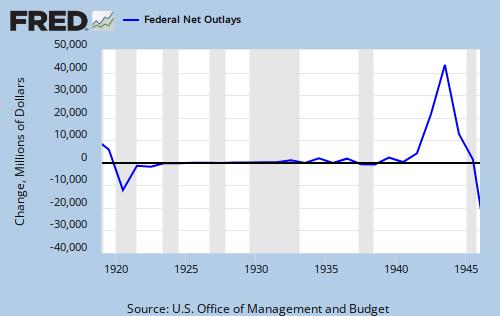
Monetary Sovereignty

Today, the politicians, the media and the old line economists, all under the thumb of the 1%, want us to take more of that bitter, deficit-reduction medicine — the medicine that already has destroyed so many lives all over the world.

And like sheep, marching into the slaughterhouse, we willingly and without question, place our necks on the chopping block. In fact, some will fight angrily against any who dare to warn of our coming doom. You can page through this blog to see the outraged rebuttals.

It’s happening in Spain and Greece and other euro (monetarily non-sovereign) nations. The Spanish and Greeks are not victims of a “culture of dependency.” They are victims of their own governments. Before their leaders recklessly adopted the euro and became monetarily non-sovereign, which forced them into deficit reduction, these people were not eating out of dumpsters.

What happened was simple: They were told they needed to cut their government’s deficit spending. And they believed. And this belief has led to their downfall.

And it will happen here, if we naively accept the deficit reduction lie so willingly adopted by our fellow sheep, and if we demand to lay our own heads on the 1%’s chopping block.

Rodger Malcolm Mitchell
Monetary Sovereignty

====================================================================================================================================================

Nine Steps to Prosperity:
1. Eliminate FICA (Click here)
2. Medicare — parts A, B & D — for everyone
3. Send every American citizen an annual check for $5,000 or give every state $5,000 per capita (Click here)
4. Long-term nursing care for everyone
5. Free education (including post-grad) for everyone
6. Salary for attending school (Click here)
7. Eliminate corporate taxes
8. Increase the standard income tax deduction annually
9. Increase federal spending on the myriad initiatives that benefit America’s 99%

No nation can tax itself into prosperity, nor grow without money growth. Monetary Sovereignty: Cutting federal deficits to grow the economy is like applying leeches to cure anemia. Two key equations in economics:
Federal Deficits – Net Imports = Net Private Savings
Gross Domestic Product = Federal Spending + Private Investment and Consumption – Net Imports

#MONETARY SOVEREIGNTY

–How do they believe THIS if they believe THAT?

Mitchell’s laws:
●The more budgets are cut and taxes increased, the weaker an economy becomes.
●Austerity is the government’s method for widening the gap between rich and poor,
which leads to civil disorder.
●Until the 99% understand the need for federal deficits, the upper 1% will rule.
●To survive long term, a monetarily non-sovereign government must have a positive balance of payments.
●Those, who do not understand the differences between Monetary Sovereignty and monetary non-sovereignty, do not understand economics.

==========================================================================================================================================

Here are excerpts from a letter sent by six of the senators who voted for sequestration – the process by which automatic cuts in the federal deficit are made, because of the popular, wrong-headed belief federal deficits hurt the economy.

Remember now, these guys voted FOR sequestration.

September 21, 2012
Dear Majority Leader Reid and Republican Leader McConnell:

We face a critical challenge in the next few months: balancing the need to reduce the deficit with the need to safeguard important priorities, particularly protecting our national security, vital domestic programs, and our economic recovery. We believe it is imperative to enact a bipartisan deficit reduction package to avoid the severe economic damage that would result from the implementation of sequestration.

Translation: “Cutting the deficit will damage the economy, so we need to cut the deficit.”

Yes, cutting the deficit will damage the economy, because deficit cuts require spending cuts and/or tax increases. But a basic equation in economics shows that: Federal Spending + Non-federal spending – Net Imports = Gross Domestic Product (GDP).

All federal spending cuts reduce the 1st term of the above equation and all tax increases reduce the 2nd term. So, deficit cuts reduce GDP. Simple mathematics. Even $1 in deficit reduction reduces GDP, and the greater the deficit reduction, the greater the GDP reduction.

With a growing population, even a perfectly balanced budget (federal spending = federal taxes) reduces per-capital GDP, so for the economy to grow, there must be significant deficit growth. And these guys are talking about deficit reduction? Yikes!

Any deficit reduction package should be long term and should provide as much certainty as possible for businesses and consumers.

No problem. The certainty is this: Cutting federal deficits will cause a recession if we are lucky or a depression if we are not. Clinton’s federal surplus, beginning in 1998, caused the recession of 2001.

The Congressional Budget Office has already warned sequestration in combination with the expiration of current tax policy could send our fragile economy back into a recession and raise unemployment above 9 percent, and the administration agrees that sequestration “would be deeply destructive to national security, domestic investments, and core government functions.”

Translation: “Reducing the deficit will kill the economy, so let’s reduce the deficit.”

Failure to act to address the debt would result in sequestration taking effect in January 2013 with significant detrimental impact on our fragile economic recovery. According to a report done for the Aerospace Industries Association, if sequestration is allowed to occur in January, the nation will lose approximately 1 million jobs because of defense budget cuts and 1 million jobs because of domestic cuts in 2013.

Translation: “Reducing the deficit will add 2 million to the unemployment rolls, so let’s reduce the deficit.”

Make no mistake about the devastating impact of sequestration. According to Defense Secretary Leon Panetta, sequestration would leave our nation with its smallest ground force since 1940, smallest number of ships since 1915, and smallest Air Force in its history, and “would inflict severe damage to our national defense for generations.” The indiscriminate across-the-board defense cuts scheduled to start this January would result in a 9.4 percent reduction to defense discretionary funding and a 10 percent reduction to defense mandatory spending programs.

The administration reports that “sequestration would result in a reduction in readiness of many non-deployed units, delays in investments in new equipment and facilities, cutbacks in equipment repairs, declines in military research and development efforts, and reductions in base services for military families.” Specifically, the Army would see a $7 billion reduction in operations and maintenance (O&M) funding, and the Navy and Air Force would lose another $4.3 billion each in their O&M accounts.

Translation: “Reducing the deficit will reduce our ability to defend ourselves, so lets reduce the deficit.”

In addition, sequestration’s impact will be felt beyond the Department of Defense. On the non-defense spending side, the administration reports that sequestration would “undermine investments vital to economic growth, threaten the safety and security of the American people, and cause severe harm to programs that benefit the middle-class, seniors and children.

The National Institutes of Health would face a $2.5 billion cut and “would have to halt or curtail scientific research, including needed research into cancer and childhood diseases.”

The Centers for Disease Control and Prevention would see a $464 million cut, and states and local communities would lose billions in federal education funding for Title I, special education State grants, and other programs.

Translation: “Reducing the deficit will damage our investments, harm our security and damage our health and our children’s health, so let’s reduce the deficit.”

Based on this, we are committed to working together to help forge a balanced bipartisan deficit reduction package to avoid damage to our national security, important domestic priorities, and our economy.

Translation: “We need to reduce the deficit while not reducing the deficit.”

Sequestration will endanger the lives of America’s service members, threaten our national security, and impact vital domestic programs and services. Meeting this challenge will require real compromise, and we do not believe that Congress and the president can afford to wait until January to begin to develop a short term or long term sequestration alternative. All ideas should be put on the table and considered. Accordingly, we urge you to press between now and November the Congressional Budget Office and the Joint Committee on Taxation to score any bipartisan proposals forwarded to them so that Congress may evaluate these plans.

We believe it is important to send a strong signal of our bipartisan determination to avoid or delay sequestration and the resulting major damage to our national security, vital domestic priorities, and our economy.

Carl Levin
John McCain
Jeanne Shaheen
Lindsey Graham
Sheldon Whitehouse
Kelly Ayotte

Translation: “We voted for a monstrosity that will destroy America. Now someone else can do something about it. Maybe a bipartisan committee (to spread the blame) can figure out how to cut GDP, while simultaneously growing GDP. We want a little deficit reduction to reduce GDP a little, rather than a big deficit reduction, which will reduce GDP a lot. What’s wrong with that?”

Why does Congress, knowing that deficit reduction reduces GDP, want deficit reduction? Are they ignorant or evil?

Some are ignorant. But for the rest, the motive is simple evil: Reducing the deficit hurts the lower 99% income group far more than it hurts the upper 1%. In other words, it increases the gap between rich and the middle-to-low classes.

The rich don’t care how much money they have. They care how much MORE money they have than the lower income groups. Wealth is not an absolute; wealth is a comparative.

Because our politicians are puppets of the 1%, they pretend to believe the deficit is “unsustainable,” despite the fact that our Monetarily Sovereign nation can pay any bills of any size. They pretend a “fiscally prudent” government does not spend “more than it has,” despite the fact that “spending more than it has” is the only way to grow GDP.

People: You should know this: The politicians, in cahoots with the media and old-line economists, are lying to you. Reducing the federal deficit, even a balanced budget, will destroy the U.S. economy. Every depression and nearly every recession, has begun with deficit reduction.

The rich want to increase the income gap. They want to murder the middle and lower classes. That is the sole motivation and the only result of deficit reduction.

The rich want you to vote for your own murder.

And many of you will.

Rodger Malcolm Mitchell
Monetary Sovereignty

====================================================================================================================================================

Nine Steps to Prosperity:
1. Eliminate FICA (Click here)
2. Medicare — parts A, B & D — for everyone
3. Send every American citizen an annual check for $5,000 or give every state $5,000 per capita (Click here)
4. Long-term nursing care for everyone
5. Free education (including post-grad) for everyone
6. Salary for attending school (Click here)
7. Eliminate corporate taxes
8. Increase the standard income tax deduction annually
9. Increase federal spending on the myriad initiatives that benefit America’s 99%

No nation can tax itself into prosperity, nor grow without money growth. Monetary Sovereignty: Cutting federal deficits to grow the economy is like applying leeches to cure anemia. Two key equations in economics:
Federal Deficits – Net Imports = Net Private Savings
Gross Domestic Product = Federal Spending + Private Investment and Consumption – Net Imports

#MONETARY SOVEREIGNTY

–How Paul Volcker depleted his legacy in 5 minutes

Mitchell’s laws:
●The more budgets are cut and taxes increased, the weaker an economy becomes.
●Austerity is the government’s method for widening the gap between rich and poor,
which leads to civil disorder.
●Until the 99% understand the need for federal deficits, the upper 1% will rule.
●To survive long term, a monetarily non-sovereign government must have a positive balance of payments.
●Those, who do not understand the differences between Monetary Sovereignty and monetary non-sovereignty, do not understand economics.

==========================================================================================================================================

I’ve liked Paul Volcker. He cured the inflation of 1979 through 1983, by raising interest rates (which increased the demand for dollar-denominated securities, thereby increasing the value of the dollar.)

[Aside: This is an area of disagreement between Monetary Sovereignty and MMT, which claims high interest rates increase business costs, thereby forcing prices up – an inflationary effect. MS agrees this is true, but claims the increased reward for owning dollars has a much greater, anti-inflationary effect.

The dueling claims are discussed in more detail at: Preventing and Curing Inflation: Modern Monetary Theory vs. Monetary Sovereignty]

I also like the “Volcker Rule, part of the Dodd–Frank Wall Street Reform and Consumer Protection Act. The Rule limits bank speculation on investments that risk customer deposits, and don’t benefit customers. (I’d prefer that all banks be federally owned. The Volcker Rule is a short step in the right direction.)

But, even a well-respected Fed Chairman can go astray when discussing basic economics. The September issue of MONEY magazine, contained an interview with Volcker, relevant excerpts of which are:

Question: Which vision on how to fix the U.S. economy makes more sense to you: the Paul Ryan plan of tax cuts for the wealthy and deep bites into federal spending, or Simpson-Bowles [the presidential commission that offered a major deficit-reduction plan by increasing some taxes and cutting spending], which increases taxes for the wealthy with far less dramatic reductions in federal expenditures?

Volcker: Well if you’re just aiming for a balanced budget—it would be extremely difficult to achieve without some significant reform in the entitlement area. We’ve also got to take some look at the defense area, where expenditures are so large relative to the rest of the world that there might be some room for savings. But on top of that, you’re going to need some additional revenues. It’s not possible right now, but we need a real structural reform in our tax system if we’re going to approach equilibrium between spending and taxation. In addition, we’ve got great budget pressure on state and local governments.

Sadly, Volcker discusses how to achieve a balanced federal budget, rather than saying (as he should have): “If you’re talking about balancing the federal budget, that is a sure path to recession or depression. Balancing the budget requires spending decreases and/or tax increases.

But, Federal Spending + Non-federal spending – Net Imports = GDP. Spending decreases reduce the 1st term in that equation and tax increases reduce the 2nd term. So together, they reduce GDP.” Volcker should understand this basic truth of economics.

Question: So what would you do on taxes?

Volcker: To put it bluntly, we have to move more toward a consumption tax. There are different ways you could do that, but that’s what we ought to be doing.

Because lower income people spend a greater percentage of income on consumption than do higher income people, Volcker’s recommended tax would increase the gap between the rich and the not-so-rich. Hard to believe Volcker doesn’t realize this.

Question: Would you get rid of the Bush tax cuts?

Volcker: In the short run, you’ve got to deal with your income taxes. You can do that either by repealing the Bush tax cuts, at least for some people, or by rearranging the exemptions and loopholes, all those things people talk about adopting, something along the lines of Simpson-Bowles.

Every income tax increase reduces the “Non-federal spending” part of the GDP equation, thereby leading us to recession. Simpson-Bowles is a guaranteed plan for recession or depression.

How has Obama done in handling the economic recovery?

Volcker: Everybody thinks it would be nice if the administration were more effective in promoting a balanced package on taxes and spending. The problem is that the political system has been so ideologically divided, and the congressional situation is such that it’s been hard to get any degree of consensus on any sensible program.

Yet another Volcker claim that a disastrous balanced budget would be beneficial.

Question: Do you think that some version of Simpson-Bowles or Rivlin-Domenici [another bipartisan panel putting forth a deficit-reduction plan] is the best we can do?

Volcker: Yes, absolutely. I wish Mr. Obama would do it today. Those two approaches have the essentials. Neither has the kind of tax restructuring that I envision, though Rivlin-Domenici had a little bit of it. Ironically, the easiest thing to do, politically and otherwise, is Social Security reform. Such reform would be important as an example of what we can do in the medium and longer run.

“Social Security reform” is a code phrase meaning: “Cut benefits and/or increase taxes, because the government can’t afford to pay for Social Security.” Cutting benefits and/or increasing taxes punishes the lower income people, thereby increasing the gap. It also would lead to recession.

Further, the government, being Monetarily Sovereign, and having the unlimited ability to pay any size bills at any time, could afford to pay all Social Security benefits, even without FICA.

Question: Is the Federal Reserve Bank living up to its charter of maintaining price stability and promoting full employment?

Volcker: I’ll be radical and say this dual mandate confuses the issue. The most important thing the Federal Reserve can do over time is maintain price stability. Obviously when you’re in the midst of a recession to start they can maintain price stability and provide a lot of stimulus at the same time.

I agree, completely. The primary job of the Fed is to prevent and cure inflation. Stimulating the economy is the job of Congress and the President. Sadly, the politicians have abdicated their economic responsibilities, so have tossed the hot potato to the Fed, which is ill equipped for the job.

In short, Volcker was a good Fed Chairman, but a lousy economist.

Hmmm . . . Is that even possible?

Rodger Malcolm Mitchell
Monetary Sovereignty

====================================================================================================================================================

Nine Steps to Prosperity:
1. Eliminate FICA (Click here)
2. Medicare — parts A, B & D — for everyone
3. Send every American citizen an annual check for $5,000 or give every state $5,000 per capita (Click here)
4. Long-term nursing care for everyone
5. Free education (including post-grad) for everyone
6. Salary for attending school (Click here)
7. Eliminate corporate taxes
8. Increase the standard income tax deduction annually
9. Increase federal spending on the myriad initiatives that benefit America’s 99%

No nation can tax itself into prosperity, nor grow without money growth. Monetary Sovereignty: Cutting federal deficits to grow the economy is like applying leeches to cure anemia. Two key equations in economics:
Federal Deficits – Net Imports = Net Private Savings
Gross Domestic Product = Federal Spending + Private Investment and Consumption – Net Imports

#MONETARY SOVEREIGNTY

–Romney’s fake tax return

Mitchell’s laws:
●The more budgets are cut and taxes increased, the weaker an economy becomes.
●Austerity is the government’s method for widening the gap between rich and poor,
which leads to civil disorder.
●Until the 99% understand the need for federal deficits, the upper 1% will rule.
●To survive long term, a monetarily non-sovereign government must have a positive balance of payments.
●Those, who do not understand the differences between Monetary Sovereignty and monetary non-sovereignty, do not understand economics.

==========================================================================================================================================

Mitt Romney released a fake tax return. I’ll tell you why it’s fake, but first a bit of background. According to FOX News (my bible):

Romney released his final tax return for 2011 on Friday. That document shows the Romneys paid $1.9 million in taxes on nearly $14 million in income, mostly from investments, giving them an effective tax rate of 14.1 percent.

There must be a powerful reason why he refuses to disclose the past 10 years of tax returns, though he did disclose them to Sen. John McCain, in an attempt to be the Vice-Presidential nominee.

After seeing the returns, McCain rejected Romney and chose Sarah Palin. There may be no relationship between those two events, but to be rejected in favor of Sarah Palin! Yikes!

At any rate, see that 14% number? Here’s why it was important. According to the Wall Street Journal:

Their $4 million donation proved to be so large that it threatened to drive their effective tax rate to near 10%. That would have exacerbated a critique from Democrats that says America’s wealthiest don’t pay their “fair” share.

So the Romneys decided to simply give up a large chunk of their $4 million deduction, taking only $2.25 million instead. In effect, it was another gift, but this time to the federal government.

Here’s why that tax return is a fake. Immediately after the election, no matter who wins, there is absolutely nothing to prevent Romney from flip-flopping once again and filing an amended return, to claim his full charitable deductions, and any other deductions he “accidentally” omitted.

He has three years in which to file an amended return (which may relate to why his earlier returns were not disclosed).

Consider that 2011 tax return a mere bit of political showmanship. Remember, there is no penalty for filing a false return showing you owe too much.

Rodger Malcolm Mitchell
Monetary Sovereignty

====================================================================================================================================================

Nine Steps to Prosperity:
1. Eliminate FICA (Click here)
2. Medicare — parts A, B & D — for everyone
3. Send every American citizen an annual check for $5,000 or give every state $5,000 per capita (Click here)
4. Long-term nursing care for everyone
5. Free education (including post-grad) for everyone
6. Salary for attending school (Click here)
7. Eliminate corporate taxes
8. Increase the standard income tax deduction annually
9. Increase federal spending on the myriad initiatives that benefit America’s 99%

No nation can tax itself into prosperity, nor grow without money growth. Monetary Sovereignty: Cutting federal deficits to grow the economy is like applying leeches to cure anemia. Two key equations in economics:
Federal Deficits – Net Imports = Net Private Savings
Gross Domestic Product = Federal Spending + Private Investment and Consumption – Net Imports

#MONETARY SOVEREIGNTY