The great semantic misunderstandings of our time: Debt, deficit, fundamentalists, originalists–

The debt hawks are to economics as the creationists are to biology. Those, who do not understand monetary sovereignty, do not understand economics. Cutting the federal deficit is the most ignorant and damaging step the federal government could take. It ranks ahead of the Hawley-Smoot Tariff.
======================================================================================================================================================

Debt / deficit

I’ve mentioned previously that all of mainstream economics is based on a simple semantic misunderstanding, specifically the misunderstanding of the word “debt,” and by reference, the word “deficit.”

In everyday life, “debt” generally is a pejorative. Having debt, meaning owing money (as opposed to owning debt, i.e. being a creditor) is seen as dangerous, and having too much debt can be financially fatal. The recent (or current?) recession was caused by too much debt without the means to pay what is owed to creditors. “Deficit,” the precedent for debt, is equally feared, by anyone whose means are limited, which includes every man, woman and child, every business, every state, every county and every city, town and village in America.

All are of limited means, even Bill Gates and Warren Buffett. We simply do not have the unlimited ability to create money enough to service unlimited debt. The U.S. federal government, being Monetarily Sovereign, does have this ability, which is why, for the federal government, the words “debt” and “deficit” mean something entirely different than when applied to people, and therein lies the confusion.

In federal financing terms, “debt” means the net total of T-securities created out of thin air, since the beginnings of this nation. Because current law requires that T-securities be issued in parallel with federal deficit spending, the net total of T-securities happens to equal the net total of federal deficit spending for the past 200+ years. Rather than “debt,” we should call it “T-securities sold,” which may remove its negative connotations.

“Deficit” means the arithmetic difference between federal tax collections and federal spending in any one year, though there actually is no financial connection between the two. Federal spending does not require federal taxing. Either may proceed without the other.

Since federal spending creates money, while taxing destroys money, we should replace the word “deficit” with “net money created.” That not only might relieve the confusion, but because our actions are ruled by semantics, such a change might put us on the right economic paths. Rather than fearing federal debt and deficits, we would welcome them as necessary for our economic well-being.

Which brings us to the second semantic misunderstanding

Fundamentalist / Originalist

In every religion there are fundamentalists – people who accept the literal interpretation of their holy documents. A fundamental Jew is an Ultra Orthodox. He believes in the strict word of God as written in the Torah (the first five books of the bible). By way of example, he will not even touch an object that is being touched by a woman not his wife.

Of most importance, he believes the bible should not be interpreted according to current mores, but rather should be read and followed according to the original meaning of the original words. He is an “originalist.”

Fundamental Muslims believe in the original words of the Koran. Those who do not are infidels, and murdering infidels seems to be an approved fundamental act. Fundamentalists do not believe any allowance should be made for centuries of human progress. Fundamentalists are originalists.

For many people, fundamentalism may seem a “better” or “purer” form of belief, as though any departure from strict dogma represents a lapse, tantamount to sin. In a sense, this is the club fundamentalists hold over our heads, the appearance they are closer to God are than the rest of us.

In the U.S. we have our legal fundamentalists. They are the Supreme Court, self-styled, “originalists,” most notably Antonin Scalia and Clarence Thomas. They subscribe to “original intent” and its close cousin, “original meaning.”

“Original intent” means the Constitution should be interpreted according to what the founding fathers intended to mean, regardless of subsequent events. “Original meaning” means how people, who lived when the Constitution was adopted, would have interpreted the words of the Constitution. Scalia and Thomas generally are considered to be in the “original meaning” camp. Had Scalia been Abraham, he might well have sacrificed his son, and surely he would have stoned sinners, especially women.

While most Americans frown on of the excesses of religious fundamentalism, especially as practiced by extremist groups like the Taliban, legal fundamentalism is admired by those closest to what is called the political “right.” They may not recognize that the excesses of fundamentalism, not only are practiced in religion, but also in politics. They also may not recognize that fundamentalism, taken to its logical end, is totalitarianism, where the one God is the dictator. The similarities between religious fundamentalism and legal fundamentalism (aka originalism), may explain why the religious right tends to be fundamental. The mind-set is the same.

People become fundamentalists (or originalists) for many reasons, but one reason may be ease. Fundamentalism requires less mental effort than does, for instance, liberalism. All decisions have been made. One need only to obey the Word, unquestioningly and unwaveringly. There need be no second thoughts; there need be no thoughts at all. What was, is. And what is, will be. Simple.

While the Constitution was a masterwork, it was not created by omniscient gods. It was created by fallible humans, who were capable of error and who could not see two hundred years into the future, and who had individual, political agenda. So, to consider the Constitution a perfect instrument, from which variance is forbidden, is foolish at best and harmful at worst. That belief represents a dereliction of judicial duty, for if a judge cannot consider circumstance, he/she is a judicial automaton, unworthy of the title, “judge.”.

Of course, one could say that where the Constitution becomes obsolete is should be modified, which would give moral shelter to the fundamentalists, who decry “activist” courts. But the amending process is so lengthy and so difficult, very little can be done to modernize it. For all practical purposes, we remain locked into a document that year by year becomes less appropriate to the times, which puts greater responsibility on the three branches of our government.

It is time our citizens recognize the dangers in all sorts of fundamentalism, religious, legal and political, and insist that our lawmakers do the same. It is time our jurists realize they were chosen for their judgment (root word, “judge), and not for their ability to parrot 200+ year old phrases or to see into the minds of men long dead.

Otherwise, let the stoning of infidels begin.

Rodger Malcolm Mitchell
http://www.rodgermitchell.com

No nation can tax itself into prosperity. Those who say the stimulus “didn’t work” remind me of the guy whose house is on fire. A neighbor runs with a garden hose and starts spraying, but the fire continues. The neighbor wants to call the fire department, which would bring the big hoses, but the guy says, “Don’t call. As you can see, water doesn’t put out fires.”
–Ignorance: Why you will pay more taxes and receive less service in the coming years.

The debt hawks are to economics as the creationists are to biology. Those, who do not understand monetary sovereignty, do not understand economics. Cutting the federal deficit is the most ignorant and damaging step the federal government could take. It ranks ahead of the Hawley-Smoot Tariff.
======================================================================================================================================================

Here is an article from the Washington Post, demonstrating how ignorance of Monetary Sovereignty is destroying our economy.

Recession-bruised states’ revenue sank 30 percent in 2009, Census Bureau reports

By Michael A. Fletcher, Washington Post Staff Writer , Wednesday, January 5, 2011; 11:09 PM

The recession blew a huge hole in the already shaky finances of state governments, causing them to lose nearly one-third of their revenue in 2009, according to a Census Bureau report released Wednesday. . .

At the same time, states are grappling with swollen social service caseloads, underfunded pension funds and flat revenue – a situation that will worsen as federal stimulus aid comes to a halt in the coming months.

Future federal help is considered highly unlikely, as Congress and President Obama have put a greater emphasis on reducing spending and trimming the huge federal budget deficit.

The new census report adds to the bleak portrait that has emerged from other studies documenting the damage caused by the economic downturn, while making plain that states are likely to continue struggling fiscally for years.

“This report paints a fairly compelling picture of the impact of the recession on states,” said Susan K. Urahn, managing director of the Pew Center on the States. “There are many states predicting that they’re not going to return to pre-recession levels of revenue until 2014.”

Our Monetarily Sovereign, federal government, which has the unlimited ability to create money and pay bills of any size, refuses to give the states the support they need. Meanwhile the monetarily non-sovereign states, which do not have money-creating ability, suffer, and more importantly, we citizens suffer from reduced services and increased taxes.

Education, police and fire protection, roads and bridges, medical services, pensions and on and on, all reduced while our federal government sits on its unlimited pile of cash. Our federal leaders believe they are being fiscally prudent, while in fact, they are destroying America.

Their ignorance hurts us all.

Rodger Malcolm Mitchell
http://www.rodgermitchell.com

No nation can tax itself into prosperity. Those who say the stimulus “didn’t work” remind me of the guy whose house is on fire. A neighbor runs with a garden hose and starts spraying, but the fire continues. The neighbor wants to call the fire department, which would bring the big hoses, but the guy says, “Don’t call. As you can see, water doesn’t put out fires.”
–When will the economy recover?

The debt hawks are to economics as the creationists are to biology. Those, who do not understand monetary sovereignty, do not understand economics. Cutting the federal deficit is the most ignorant and damaging step the federal government could take. It ranks ahead of the Hawley-Smoot Tariff.
======================================================================================================================================================================

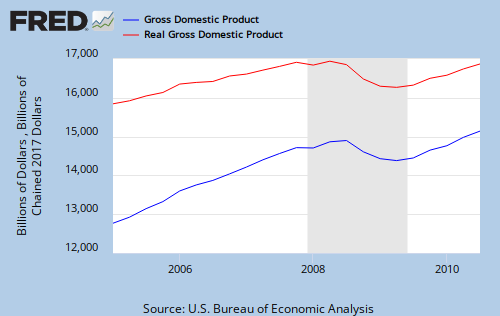
At long last, when will the economy recover? Wait a minute. Look at this graph:

graph 1

Considering that the data only goes through September, 2010, one easily can infer that the economy already has recovered. Yes, the stock market has not recovered, but that could be good news. It could mean it still has plenty of recovery left in it.

And yes, unemployment still is a big problem:

But that could be a good thing, too (although not for those who are unemployed.) A high level of unemployment mitigates against inflation. The government could continue to use its infinite spending ability and not be concerned it was causing inflation. For instance, FICA could be eliminated, as it should be, rather than the tentative, temporary step now taken. And the standard deduction could be raised, also as it should be. And Social Security benefits could be increased, and Medicare could be expanded, again as they should be.

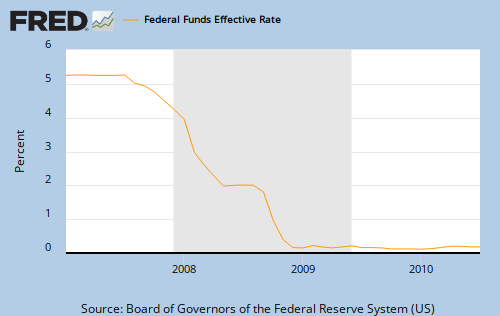
And interest rates have stayed way down:

graph 3

And that’s another good thing, because it means the Fed has plenty of room (not that “room” really is needed) to raise rates if inflation should rear its ugly head.

There are plenty of leading indicators one might explore, but these graphs give me cause for optimism, if only the federal government will seize the moment.

Rodger Malcolm Mitchell
http://www.rodgermitchell.com

No nation can tax itself into prosperity. Those who say the stimulus “didn’t work” remind me of the guy whose house is on fire. A neighbor runs with a garden hose and starts spraying, but the fire continues. The neighbor wants to call the fire department, which would bring the big hoses, but the guy says, “Don’t call. As you can see, water doesn’t put out fires.”

–A personal musing. What is the future of jobs? Do jobs matter?

The debt hawks are to economics as the creationists are to biology. Those, who do not understand monetary sovereignty, do not understand economics. Cutting the federal deficit is the most ignorant and damaging step the federal government could take. It ranks ahead of the Hawley-Smoot Tariff.
==============================================================================================================================================

A personal musing. What is the future of jobs? Are we wrong to focus on job creation? Here is an excerpt from an article that ran last year:

CBS Reports; WALLINGFORD, CT., Jan. 5, 2009
The Future of Jobs in America; Innovation, R&D, and Education are Keys to Job Creation, By Anthony Mason

For 23 straight months now, the U.S. economy has been hemorrhaging jobs. . . One in six Americans, 17 percent, is underemployed. That’s nearly 25 million people who are out of work, have given up looking, or been forced to take a part time job. The recession has wiped out 15 percent of our manufacturing workforce. That’s more than 2 million jobs that will likely never come back.

Here is an excerpt from a recent article:

Jobs in China, By ANDREW JACOBS, The New York Times, 12/12/2010
In 1998 . . . Chinese colleges produced 830,000 graduates. . . . Last May, that number was more than six million and rising. . . The economy, despite its robust growth, does not generate enough good professional jobs to absorb the influx of highly educated young adults. And many of them bear the inflated expectations of their parents, who emptied their bank accounts to buy them the good life that a higher education is presumed to guarantee.

It widely is believed America suffers from a shortage of jobs. I suggest that may not be true. Rather, America suffers from a shortage of money.

It began with the Industrial Revolution. Since then, machines have done more work that people once did. Machines chased people off labor-intensive farms to manufacturing and white collar work. Then, machines run by people, chased people off those jobs. Soon, machines run by computers began to take over. But someone had to build and program the computers, so jobs in electronics industries expanded. Now computers have begun to build and program computers.

So from where will the next jobs come? And does it matter?

Most people really don’t want a job; they want money. Yes, some jobs may offer personal satisfaction, and may occupy otherwise dull hours, but for most people seeking jobs, money is the primary goal.

Wait, Rodger. People do not want money. They want what money will buy. They want more security, better shelter, food, clothing, health care, education. They want admiration. They want envy. They want accomplishment. They want to win.

O.K.., money can’t buy everything, but it can buy much of what people want. A jobs is a means to obtain money, which in turn is a means to obtain the things we want. And that Rube Goldbergian “means-to-a-means-to-a-means” connection is being superseded by machines.

Those who have seen the “Star Trek, The Next Generation” TV series are familiar with the “replicator.” It can synthesize any non-living product, seemingly out of thin air. If such a device existed today, our money and job needs would decline radically. Yes, we might continue to work for satisfaction, for creativity, or to fill otherwise-empty hours – but not so much for money, since there would be little need for money other than perhaps to pay for some services. The replicator could supply our product needs.

Replicators may seem far off, but we are evolving in that direction, where machines supply more and more of our product needs. And as that happens we butt up against what will be increasingly difficult questions: Why must we work to obtain money – and why must people struggle to find jobs to obtain money – especially since money is free?

That’s right. Money is free. The U.S. federal government has the infinite ability to create money out of thin air. In essence, the U.S. government is a “money replicator.” At the touch of a button, the government could supply each of us with unlimited money. Want $1 trillion? No problem. Here, take $2 trillion. There is no physical money; it’s all just data, and data is infinite.

Extreme amounts of money creation would reduce the value of money (aka “inflation”), but the point is this: There is no fundamental reason why anyone in America should lack food, clothing, shelter, education, health care simply for lack of a job. There is no job-related reason for poverty in America. Our “money-replicator” government has the power to lift everyone from poverty and supply all their basic needs.

This brings us to an important difference between why people want to work and why the economy wants people to work. While people work to obtain goods and services, the economy wants people to work to create goods and services. If we all owned replicators, and if no one worked, eventually we would have no progress and no services, and the economy would collapse.

There may be a compromise, between where we are today and an economy with no jobs at all. I’m not sure exactly where that compromise is, and surely it would change over time, but here are a couple of “what-ifs.” What if:

–The government’s “money replicator” gave every man, woman and child enough to pay for food, clothing, home, health care, entertainment and education through college — i.e. ended poverty?
–Those who wanted more than basics could work, but the standard, legal work days were lowered from 8 hours to 6 hours to 4 hours or less, providing more jobs for all who wanted them?
–Federal taxes, being unnecessary, were phased out?

Of course, the devil is in the details. What about Inflation? Motivation? Progress? International relations? I have some thoughts on these, which I plan to provide in later posts. I believe we eventually will loosen the connection between jobs to money to goods and services. It won’t be “if” but “when,” and it will be an improvement over our current situation of too much joblessness, poverty, illiteracy, homelessness, sickness and struggle.

Time and energy devoted to the creation of jobs may take us down the wrong path. Perhaps we should focus on the creation and distribution of money.

What are your thoughts?

Rodger Malcolm Mitchell
http://www.rodgermitchell.com

No nation can tax itself into prosperity. Those who say the stimulus “didn’t work” remind me of the guy whose house is on fire. A neighbor runs with a garden hose and starts spraying, but the fire continues. The neighbor wants to call the fire department, which would bring the big hoses, but the guy says, “Don’t call. As you can see, water doesn’t put out fires.”