The inflation myths debunked. It’s never “money-printing.” It’s always shortages.

The purpose of any government is to protect and improve the lives of the people. However, when proposals are made to achieve these goals, we are often met with two main objections:

  1. The government can’t afford it, and
  2. It will cause inflation.

The “can’t afford it” objection often leads to name-calling, such as “socialism,” “communism,” and “anti-capitalism.” This name-calling serves as a substitute for genuine thought. Labeling something doesn’t prove whether it’s good or bad.

It just demonstrates that the name-caller doesn’t want to discuss facts and believes the name alone is sufficient.

Some individuals who prefer not to engage in name-calling yet are concerned about federal budgets can be persuaded by the facts surrounding Monetary Sovereignty. This concept highlights that the federal government can create an unlimited amount of dollars instantly and spend them in any manner it chooses.

These individuals recognize that the federal government differs from state and local governments, which are not monetarily sovereign. Federal deficits and debt do not limit its spending capacity. Economic growth requires federal deficits, as they inject growth dollars into the economy.

Insufficient federal deficit spending has caused every recession and depression in U.S. history.

Reduced deficits (red) lead to recessions (vertical gray bars). Recessions are cured by increased deficits. U.S. depressions come on the heels of federal surpluses.

1804-1812: U. S. Federal Debt reduced 48%. Depression began 1807.
1817-1821: U. S. Federal Debt reduced 29%. Depression began 1819.
1823-1836: U. S. Federal Debt reduced 99%. Depression began 1837.
1852-1857: U. S. Federal Debt reduced 59%. Depression began 1857.
1867-1873: U. S. Federal Debt reduced 27%. Depression began 1873.
1880-1893: U. S. Federal Debt reduced 57%. Depression began 1893.
1920-1930: U. S. Federal Debt reduced 36%. Depression began 1929.
1997-2001: U. S. Federal Debt reduced 15%. Recession began 2001.

Gross Domestic Product (blue) parallels federal deficits (red).

There are several programs that a government, having infinite money, easily can afford. Among them are:

  • End FICA
  • Comprehensive, no-deductible, free Medicare for every American, regardless of age and medical history
  • Social Security for every American
  • Free college for all Americans who want it.
  • Housing subsidies for all
  • Food subsidies for all

Though such programs would cost trillions, the federal government can create trillions simply by voting and then pressing computer keys.

Once debt worriers see that the government can’t run out of dollars and that deficit spending is necessary to fulfill the federal government’s obligations of “protect and improve,” they resort to their final objection: “But it would cause inflation.”

Does Federal  Deficit Spending Cause Inflation?

There are no major historical inflations that were primarily caused by a Monetarily Sovereign government spending “too much.”

Every severe inflation episode traces back to real shortages, production collapses, or exchange-rate breakdowns, not to government deficits.

Here are some of the major inflations people think were caused by excessive spending — and why that belief is wrong:

1. Weimar Germany (1921–1923): Popular myth: runaway printing caused inflation.
Reality: Germany lost its industrial Ruhr region during the French occupation. This led to a massive drop in coal and steel output. Reparations required payment in foreign currency. The government was forced to buy foreign currency at any price. Workers were paid NOT to work during Ruhr resistance. Production collapsed.

Cause: Severe loss of real output + currency collapse, not spending.

2. Zimbabwe (2000s): Popular myth: reckless printing for government spending.
Reality: Mugabe’s land reforms destroyed commercial farming, which resulted in a 40%–60% drop in agricultural output. Corn and tobacco production collapsed. Drought worsened food supply.

Cause: Food shortage.

3. Hungary (1945–46): Worst hyperinflation ever/ Popular myth: runaway spending after WWII.
Reality: Production collapsed from war damage. Transportation, factories, and agriculture all were destroyed. Occupying Soviet forces extracted resources.

Cause: War-induced physical destruction and confiscation of supplies, causing massive shortages.

4. United States (1970s): Popular myth: The government spent too much during Vietnam and the Great Society.
Reality: The OPEC oil embargo in 1973 and the second oil shock in 1979. Oil prices quadrupled, which led to cost increases everywhere. Inflation tracked energy prices almost perfectly.

Cause: Energy shortage.

5. Post-COVID Inflation (2021–2022): Popular Myth: Stimulus checks “overheated” the economy.
Reality: Factory shutdowns caused durable goods shortages. Global shipping breakdown caused container-related shortages. Semiconductor shortages led to car and truck shortages. Energy price spikes. Labor shortages.

Cause: Widespread shortages of virtually all supplies and means of production.

6. Latin American inflations: Argentina, Brazil (various decades) Popular myth: Populist spending,
Reality: Debt denominated in foreign currency. Currency crises make imports unaffordable. Prices rise because supply shrinks.

Cause: Currency crisis leads to supply failures.

7. Confederate States of America (Civil War): Popular myth: Currency printing.
Reality: Massive destruction of productive capacity. The Union blockade cut off imports. Farms and railroads were destroyed.

Cause: War shortages

Conclusion: There is no major historical example where government spending caused inflation. Every well-studied inflation is rooted in:  Energy shortages, food shortages, and the loss of production capacity,

8. Yugoslavia, 1992–1994: Popular myth: Excessive government spending.
Reality: Civil war shortages: Slovenia had only ~8% of Yugoslavia’s population but produced about 20%+ of total GDP and an even larger share of high-value industrial output. Lost production capacity of electronics, electrical machinery, pharmaceuticals, metals and machinery. UN santions caused loss of imports (fuel, food, medicines). Breakup of supply chains between republics.

Cause: War shortages, sanctions, economic isolation.

SUMMARY
A Monetarily Sovereign government cannot unintentionally run short of its sovereign currency. It can pay for anything denominated in its currency, provided that currency is accepted by the populace.

Inflation is not caused by “too much money chasing too few goods.” Instead, it results from a scarcity of essential goods, particularly energy and food.

Typically, inflation is caused by:

  1. War shortages
  2. Oil producer price gouging
  3. Pandemic shortages of labor, goods, and services.
  4. Weather that affects food production
  5. Government mismanagement of supply sources.
  6. Shipping interference
  7. Monetary non-sovereignty causing a money shortage

No high inflation in world history was driven primarily by deficits in a Monetary Sovereign nation. The mechanism is always real resource scarcity, not the nominal size of the money supply.

HYPERINFLATION

Hyperinflation is a very rapid general increase in the prices of goods and services, exceeding 50% per month. Prices increase when goods and services are in short supply.

Here is a brief background on hyperinflations since 1900:

War & Occupation
Germany (1921–1923) –Sortages of coal and industrial output collapsed after the Ruhr occupation; food imports were scarce.

Hungary (1945–1946) – Post-WWII destruction left food and housing in extreme shortage.

Greece (1941–1946) – Axis occupation caused famine; food and fuel were critically short.

China (1948–1949) – Civil war disrupted grain supply and transport; rice shortages drove inflation.

Philippines (1942–1944) – Japanese occupation currency collapsed as rice and basic goods disappeared.

State Collapse & Civil War
Yugoslavia (1992–1994) – Sanctions and war cut off oil and food imports; shortages everywhere.

Zimbabwe (2007–2009) – Land seizures destroyed agriculture; maize and wheat shortages were central.

Congo/Zaire (1991–1996) – Civil war disrupted mining and food supply; fuel shortages were common.

Angola (1991–1999) – Civil war devastated agriculture; food and fuel were scarce.

Mozambique (1980s–1990s) – Civil war destroyed farming; food shortages drove inflation.

Nicaragua (1987–1991) – War and sanctions cut off imports; food and fuel shortages.

Commodity & External Shocks
Bolivia (1984–1986) – The Collapse of tin exports led to a foreign exchange shortage; imported fuel and food became unaffordable.

Peru (1988–1990) – Debt default plus falling exports; shortages of imported fuel and food.

Venezuela (2016–present) – Oil price collapse cut off foreign exchange; imports of food and medicine dried up.

Chronic Fiscal Mismanagement
Argentina (1989–1990) – Loss of confidence in the austral; shortages of imported fuel and consumer goods.

Brazil (1980s–1994) – Chronic deficits; shortages less acute, but inflation fed by wage-price spirals and import dependence.

Turkey (1990s–2001) – Fiscal deficits; not classic shortages, but reliance on imported energy created vulnerability.

Israel (1983–1985) – Fuel imports were a pressure point.

Post-Soviet Transition
Russia (1992–1994) – Collapse of Soviet supply chains; food and fuel shortages were widespread.

Ukraine (1993–1995) – Grain and energy shortages after the USSR’s collapse.

Georgia (1993–1995) – Energy shortages (electricity, fuel) and food scarcity.

Armenia (1992–1994) – Blockades caused fuel and food shortages.

Belarus (1994–2000) – Energy and food supply disruptions during transition.

Baltics (early 1990s) – Energy shortages after the Soviet breakup.

The Pattern
Food shortages dominate in war-torn or agrarian economies (Hungary, Greece, Zimbabwe, Nicaragua).

Energy shortages dominate in industrial economies or those reliant on imports (Germany, Yugoslavia, Venezuela, and post-Soviet states).

Export collapse (tin in Bolivia, oil in Venezuela, agriculture in Zimbabwe) removes foreign exchange, making imports of food and fuel impossible.

Rodger Malcolm Mitchell

Monetary Sovereignty

Twitter: @rodgermitchell

Search #monetarysovereignty

Facebook: Rodger Malcolm Mitchell;

MUCK RACK: https://muckrack.com/rodger-malcolm-mitchell;

https://www.academia.edu/


……………………………………………………………………..

A Government’s Sole Purpose is to Improve and Protect The People’s Lives.


MONETARY SOVEREIGNTY

This is important. I want your opinion. How would you vote regarding these religion-related questions?

The Constitution prohibits the government from supporting or opposing any religion.

Christians (e.g., Evangelicals, Baptists, Pentecostals, Later Day Saints, Jehovah’s Witnesses) are known for their proselytizing efforts. Others (e.g., Judaism, Hinduism, Buddhism, Shinto) are not.

The question becomes: Is a display of one or more versions of the Ten Commandments a form of support and proselytizing or merely education?

48 Inch Four Evangelists Wall Crucifix
Is this art or religion? Should it hang in any government-funded place?
Imagine you are a Supreme Court Justice. I would very much like your opinion regarding:
  1. Can something titled “The Ten Commandments” exist outside religion as purely secular?
  2. Should the government support teaching religious concepts purely as an educational exercise?
  3. Is there a bright line between religious and secular teaching that allows for teaching religious concepts?
  4. Would a secular course about “The life and teachings of Christ, Moses, and God” be allowed in a secular class.”
  5. In a public school class, do atheists have the right to teach that God does not exist? Should the words and beliefs of Siddhartha Gautama (the Buddha), or the words of Vedas, Upanishads, Mahabharata, Ramayana, or the words of Allah and prophet Muhammed be taught?
  6. How can we ensure that a secular approach to teaching about religions does not turn into the promotion of a single religion’s beliefs?
  7. Should displays of religious-themed artwork be allowed in a secular class? What about an art history class?
    Famous Religious Paintings: The Enthralling Biblical Artworks
    Is this art or religion? Should it be displayed in any government-funded place?
The following article appeared in the Florida Sun-Sentinel.

More Christianity in classrooms?

Trump’s victory may embolden efforts by lawmakers on right

Text of the Ten Commandments is posted with other documents June 20 at the Georgia Capitol in Atlanta. John Bazemore/AP By Moriah Balingit, Associated Press

FL_IC_1052010619_1052034372_003-0112_Education_Religion_in_Schools_57881--b2940.jpg
What is the “10 Commandments”? The above picture is shown in the article.

It is similar to the Protestant version of the “10 Commandments” because of the “graven image” line. The Catholic version does not mention graven images. There are other versions. It’s not clear whether others will be posted in the Georgia Capital.

WASHINGTON — Conservative lawmakers across the country are pushing to introduce more Christianity to public school classrooms, testing the separation of church and state by inserting Bible references into reading lessons and requiring teachers to post the Ten Commandments.

The efforts come as President-elect Donald Trump prepares to take office pledging to champion the First Amendment right to pray and read the Bible in school, practices that are already allowed as long as they are not government sponsored.

While the federal government is explicitly barred from directing states on what to teach, Trump can indirectly influence what is taught in public schools and his election may embolden state-level activists. Trump and his fellow Republicans support school choice, hoping to expand the practice of using taxpayer-funded vouchers to help parents send their children to religious schools.

Technically, federal spending is not taxpayer-funded. As Monetary Sovereignty teaches, federal spending is funded by federal money creation.

That said, what would you, as a SCOTUS justice, say about federal funding of vouchers for religious schools?

What about federal funding of secular schools that include one religious class? What about tax breaks for private schools that include one religious course?

What are your thoughts on the Pledge of Allegiance that young students often recite (sometimes getting the words wrong)? While it may not genuinely foster “allegiance,” it still seems to hold significance for some lawmakers.

I pledge allegiance to the Flag of the United States of America, and to the Republic for which it stands, one Nation under God, indivisible, with liberty and justice for all.”

It would be noteworthy to find even one person whose patriotism has been strengthened by this pledge. Yet, despite its lack of usefulness, it effectively excludes those who do not believe in God or who have a different understanding of divinity.

As a SCOTUS Justice, what is your opinion?

There is a push to incorporate more Christianity into the mainstream public schools that serve the overwhelming majority of students, including those of other faiths.

And with the help of judicial appointees from Trump’s first presidential term, courts have begun to bless the notion of more religion in the public sphere, including in schools.

5 rules Ivanka Trump and Jared Kushner's kids live by: healthy food choices at home, weekly 'meetings' at Trump Grill, and Mandarin, piano and ballet classes | South China Morning Post
Trump’s Jewish family. Are they concerned? Are Trump, SCOTUS, MAGA concerned? Is anyone?

“The effect of even Trump being the president-elect, let alone the president again, is Christian nationalists are emboldened like never before,” said Rachel Laser, the president and CEO of Americans United for Separation of Church and State.

One wonders what Trump’s Jewish daughter, Ivanka, and his Jewish grandchildren, Arabella, Joseph, and Theodore Kushner, think about all this Christian nationalism.
Large numbers of Americans believe the founders intended the U.S. to be a Christian nation.

A smaller group, part of a movement widely called Christian nationalism, champions a fusion of American and Christian identity and believes the U.S. has a mandate to build a Christian society.

Many historians argue the opposite, claiming the framers created the United States as an alternative to European monarchies with official state churches and oppression of religious minorities.

Efforts to introduce more Christianity into classrooms have taken hold in several states. In Louisiana, Republicans passed a law requiring every public school classroom to post the Ten Commandments. In Texas, officials approved a curriculum intertwining language arts with biblical lessons. And in Oklahoma, the state superintendent of education has called for lessons to incorporate the Bible from grades 5 through 12, a requirement schools have declined to follow. 

Utah state lawmakers designated the Ten Commandments a historical document, in the same category as the Declaration of Independence and the Constitution, so teachers could post it in their classrooms. And attorneys general from 17 GOP-led states recently filed a brief supporting Louisiana’s Ten Commandments mandate.

Schools are allowed — and even encouraged — to teach about religion and to expose students to religious texts. But some say the new measures are indoctrinating students, not educating them.

Some states have allowed teachers to use videos from Prager U, a nonprofit founded by a conservative talk show host, despite criticism that the videos positively highlight the spread of Christianity and include Christian nationalist talking points.

Trump commissioned the 1776 Project. It was panned by historians and scholars who said it credited Christianity for many of the positive turns in U.S. history without mentioning the religion’s role in perpetuating slavery, for example.

The project was developed into a curriculum and is now taught in a network of publicly funded charter schools supported. It also has influenced state standards in South Dakota.

Challenges to some state measures are now working their way through the courts, which have grown friendlier to religious interests thanks to Trump’s judicial appointments.

In 2022, a football coach was fired for praying with players at midfield after a game. The high court said a public school can’t restrict an employee’s religious activity just because it could be construed as an endorsement of religion, reversing a five-decade precedent.

Inquisition ‑ Spanish, Roman & Torture | HISTORY
In God’s name

“Could be construed” as an endorsement without actually being an endorsement? Who does the construing? What if a student construed it as an endorsement?

The ruling could pave the way for conservatives to introduce more Christianity in public schools, said Derek Black, a law professor at the University of South Carolina.  “Donald Trump’s judicial appointees have emboldened states” to test the separation of church and state, he said.

Joseph Davis of Becket, a public interest law firm focused on religious freedom that is defending Louisiana over its Ten Commandments mandate said the Supreme Court has endorsed the idea that “it’s OK to have religious expression in the public spaces,” Davis said, “and that we should sort of expect that … if it’s a big part of our history.”

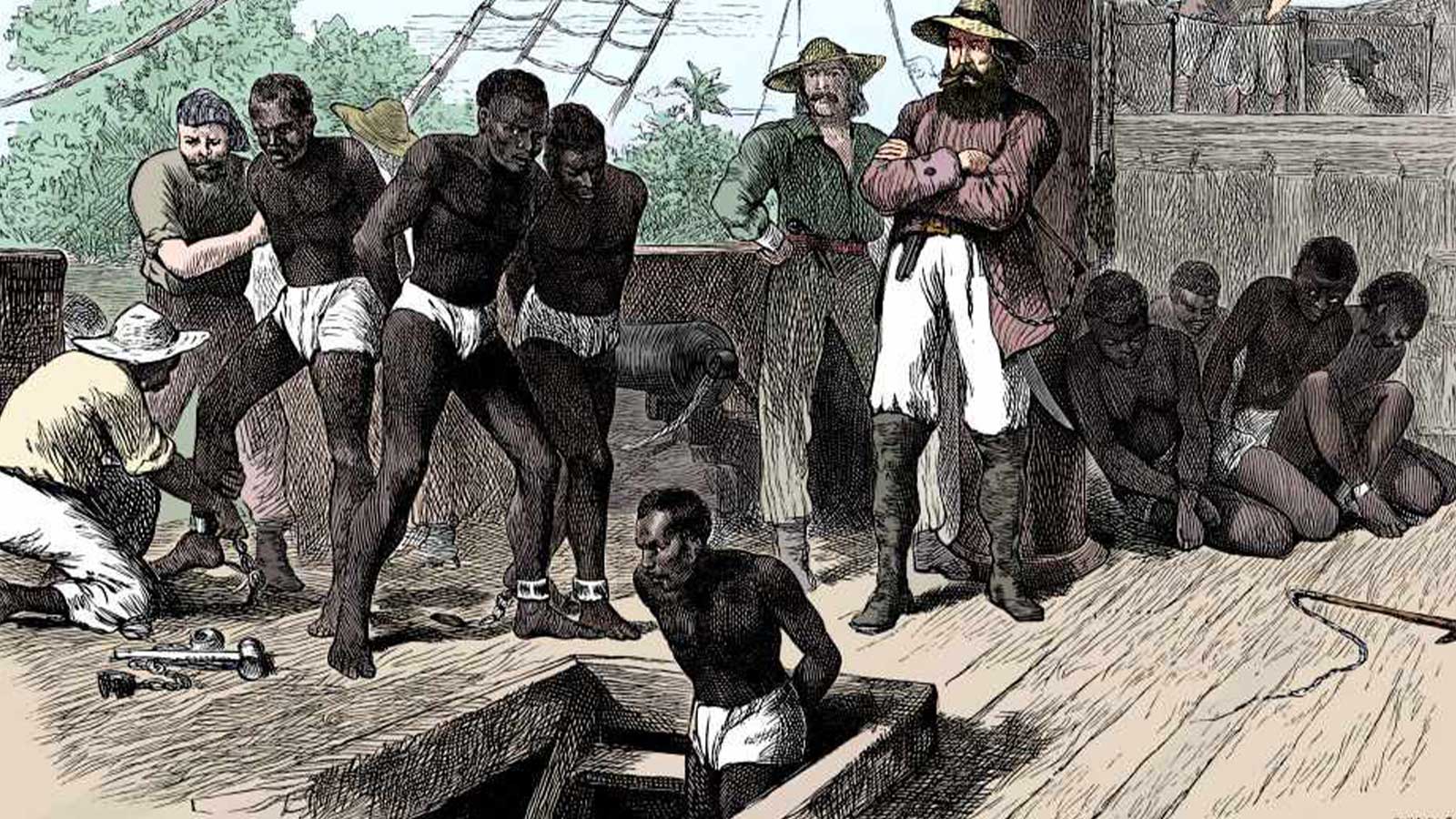
But critics say some measures to introduce more historical references to Christianity in classrooms have taken things too far, inserting biblical references gratuitously, while erasing the role Christianity played in justifying atrocities perpetuated by Americans, like genocide of Native people and slavery.

The background for the “separation of church and state” is based on history. A theocracy, where religious leaders wield governmental power, inevitably suppresses dissent by claiming divine authority. Questioning the government becomes tantamount to questioning the divine.

The Inquisition and the Puritan witch trials are instances where religious authority was used to justify persecution and maintain control. (Ironically, Trump often claims his criminal trials were “witch trials.”)

The Brattle Group's Report on Reparations for Transatlantic Chattel Slavery in the Americas and the Caribbean.
Part of American history anti-woke wishes to deny. It was approved by SCOTUS.

The separation of church and state is a foundational concept that protects religious liberty for all, not just a few.

Ironically, again, the governments that now wish to include Christian teaching in publicly funded places also wish to ban a related concept called “woke.”

Woke culture emphasizes the importance of addressing and rectifying social injustices, including systemic racism, sexism, and other forms of discrimination. “Woke” advocates for equal rights and opportunities for all individuals, regardless of their background, and promotes inclusivity in various aspects of society.

It encourages individuals, especially those from privileged backgrounds, to support marginalized groups.

If Jesus were to speak on the concept of being “woke,” it’s likely that His message would focus on the same empathy, justice, and love for all individuals, regardless of their background or circumstances that woke does.

“Woke” would seem to be identical to the values expressed by Jesus and most religions. 

Yet, the most pious Christians oppose “woke” because they feel it is overly sensitive, divisive, excessive in political correctness, and most importantly, critical of white-supported slavery.

The Christian right interprets “religious freedom” as meaning freedom for Christians to rule America. How would you, as a SCOTUS judge, interpret “Congress shall make no law respecting an establishment of religion, or prohibiting the free exercise thereof”?

In the next four years, interpretations of that simple sentence may become the most influential decisions by SCOTUS for America’s future democracy.

I’m interested in your opinion.

Rodger Malcolm Mitchell

Monetary Sovereignty

Twitter: @rodgermitchell

Search #monetarysovereignty

Facebook: Rodger Malcolm Mitchell;

MUCK RACK: https://muckrack.com/rodger-malcolm-mitchell; https://www.academia.edu/

……………………………………………………………………..

The Sole Purpose of Government Is to Improve and

Protect the Lives of the People.

MONETARY SOVEREIGNTY

Why the right-wing wants to cut benefits to the average American

The Libertarians (the cruel shills for the Republican Party) have a non-solution for a non-problem. The non-problem is that the U.S. federal government is running short of its sovereign currency, the U.S. dollar. The non-solution is to take dollars from the poor and middle-income people.

Welfare Cuts Are Inevitable Because Congress Won’t Touch Social Security Until Congress is willing to acknowledge that it makes no sense to send monthly checks to wealthy seniors, everything else will be on the chopping block. ERIC BOEHM | 9.27.2023 2:05 PM

The headline implies at least four lies: Lie #1. The federal government can’t afford to send money to the poor and middle-income people. Lie #2. The solution would be for the government to take dollars from Social Security. Lie #3. Congress doesn’t dare to take Social Security dollars from the poor and middle-income people. Lie #4. The only recourse is to take welfare dollars from the poor.

Amid the fractious debate over the federal budget, Speaker of the House Kevin McCarthy (R–Calif.) has outlined plans for cutting several prominent welfare programs to save about $150 billion annually.

According to The Washington Post, those cuts would affect a wide range of federal safety net programs, including food stamps and Meals on Wheels, which help feed needy families.

Other cuts would affect Federal Pell Grants for low-income college students, grants that help families afford housing, and a program that helps offset high heating bills.

Notice that none of the Libertarian non-solutions to the non-problem involve taking dollars from the rich by eliminating the kind of tax dodges that all people like Donald Trump to pay almost $0 federal taxes.

Regardless of whether you think the federal government should be in the business of funding any of those things in the first place, there’s no denying that sudden cuts to existing welfare programs can be disruptive to the individuals and families that have come to rely upon them.

Here, the Libertarian implies that the federal government should not help low-income college students, families that can’t afford housing, or low-income families that can’t pay their heating bills. This is typical for the heartless Libertarians and Republicans. They don’t give a damn about people but are concerned with just two things: Saving government money for a government that has infinite money and helping the rich grow richer.

Ben Bernanke: “The U.S. government has a technology, called a printing press (or, today, its electronic equivalent), that allows it to produce as many U.S. dollars as it wishes at essentially no cost.”

It’s also true that, as Reason’s Liz Wolfe points out in this morning’s newsletter, the proposed cuts reflect the reality of a government that has been living beyond its means for too long.

You and I can “live beyond our means.” but the federal government cannot. It has infinite “means.”

Alan Greenspan: “The United States can pay any debt it has because we can always print the money to do that.

“It’s not exactly a winning PR move to slash the programs that serve needy toddlers and first-generation college kids, but there’s an important fundamental truth at the heart of the fiscal hawks’ concerns: government spending simply cannot continue at current levels with no consequences,” Wolfe writes.

This lie has been told since at least 1940 and probably beyond. That was the first year I found that the federal debt, or deficit, was called a “ticking time bomb.” The phony bomb still is ticking after eighty-three years. And precisely what are the “consequences” to which Wolfe refers and Boehm agrees? You never will see that explained in any Libertarian screed. The reason: There are no consequences. Period.

That’s true. But here’s an element of this debate that doesn’t get talked about enough: Cutting welfare programs for needy families is necessary because Congress insists that relatively wealthy senior citizens get paid first.

And here it comes: The theory is that seniors are wealthy, and despite paying the useless FICA tax for their entire lives, they really don’t deserve anything for their investment. So, cut Social Security because that’s where the money — the infinitely available money — goes. And who cares about those old folks, anyway?

Budgeting is always, at its core, an exercise in priority-setting. That’s especially true when your budget is wildly out of whack, and you’ve been borrowing at an unsustainable rate, as Congress has done for years.

What part of budgeting is “wildly out of whack”? Would reducing the money going to the middle and the low be the best way to put the budget in “whack”? And then for two more lies in just five words (Is that a world record?) “Borrowing at an unsustainable rate.” Lie #5. The federal government borrows. No, the federal government does not borrow dollars. Why would it borrow when it has the infinite ability to create dollars?

Statement from the St. Louis Fed: “As the sole manufacturer of dollars, whose debt is denominated in dollars, the U.S. government can never become insolvent, i.e., unable to pay its bills. In this sense, the government is not dependent on credit markets to remain operational.”

The confusion arises because private sector bills, notes, and bonds differ entirely from T-bills, T-notes, and T-bonds The former have to do with borrowing. The latter have to do with depositing. A borrower receives from a lender money that the borrower uses. But the federal government doesn’t use or even touch the dollars deposited into T-security accounts. The federal government, unlike state/local governments, is Monetarily Sovereign. It pays all its creditors with newly created dollars, ad hoc. Despite Monetary Sovereignty being the single most important difference between federal and personal finances, you will never see those words in any discussion of federal budgeting being “unsustainable.” Lie #6. “Unsustainable rate.” No amount of spending is unsustainable for the federal government. It has the infinite ability to create dollars.

When there’s no longer enough money to go around, you’re faced with a difficult proposition: Who gets paid first, and who has to wait at the back of the line?

The federal government always has enough money to go around. It cannot run short of dollars. Ever. Boehm knows this.

Alan Greenspan: “There is nothing to prevent the federal government from creating as much money as it wants and paying it to somebody.”

In the federal budget, seniors get paid first. Everyone else has to wait.

Lie #7. No, the rich are paid first. They are paid by the tax loopholes that allow them not to pay taxes in the first place.

McCarthy and his fellow Republicans are not proposing any cuts or changes to Social Security and Medicaid, the Post notes. That’s despite the fact that the two major entitlement programs are driving most of the federal government’s long-term deficit.

The federal deficit is the government’s method for pumping growth dollars into the economy. If the government did not run deficits, we would have yearly recessions and depressions.

U.S. depressions tend to come on the heels of federal surpluses.

1804-1812: U. S. Federal Debt reduced 48%. Depression began 1807. 1817-1821: U. S. Federal Debt reduced 29%. Depression began 1819. 1823-1836: U. S. Federal Debt reduced 99%. Depression began 1837. 1852-1857: U. S. Federal Debt reduced 59%. Depression began 1857. 1867-1873: U. S. Federal Debt reduced 27%. Depression began 1873. 1880-1893: U. S. Federal Debt reduced 57%. Depression began 1893. 1920-1930: U. S. Federal Debt reduced 36%. Depression began 1929. 1997-2001: U. S. Federal Debt reduced 15%. Recession began 2001.

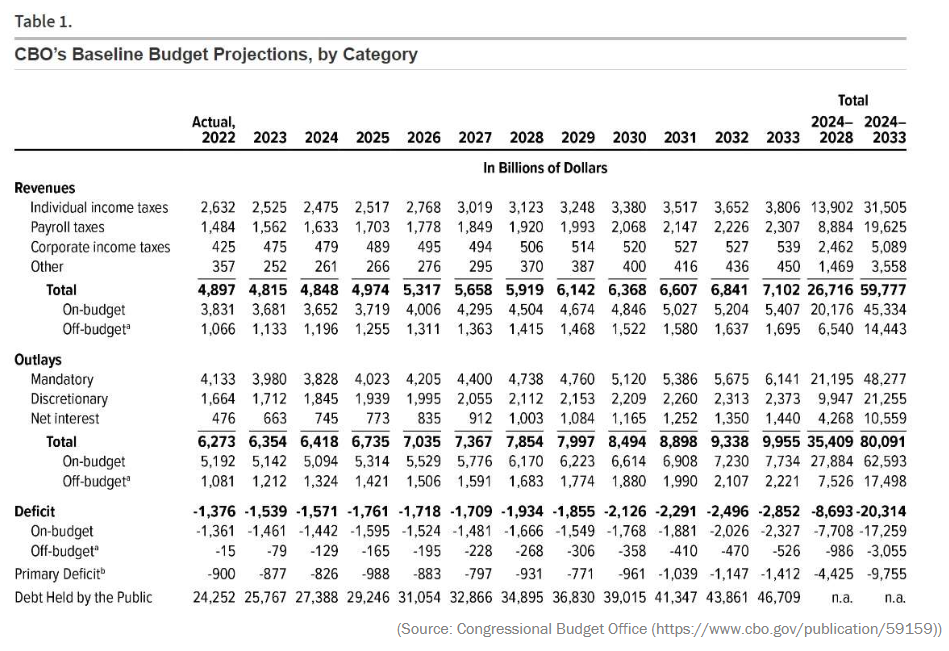
Over the next decade, discretionary spending—including those welfare programs the GOP aims to cut—is projected to decline relative to the size of the U.S. economy, according to the Congressional Budget Office’s (CBO) projections.

Meanwhile, Social Security and Medicare are growing, fast. By 2030, the CBO expects so-called “mandatory spending” on entitlement programs to consume more than 60 percent of the federal budget.

The federal budget is what Congress wishes it to be. If 60% is too much, the government merely can increase discretionary spending. This would reduce the meaningless percentage and increase the Gross Domestic Product. Economic growth is both a direct and indirect result of federal spending.  GDP=Federal Spending + Nonfederal Spending + Net Exports

Of course, because those programs are funded with a separate revenue stream—payroll taxes—it would be complicated for Congress to cut spending on Social Security to offset cuts on welfare programs.

Unlike state and local governments, the federal government does not fund programs via “revenue streams.” It supports all programs by creating new dollars, ad hoc. Tax dollars are destroyed upon receipt. Even if all federal tax collections totaled #0, the federal government could continue spending forever.

Even so, the ongoing refusal of either major party to consider any long-term changes to the two major entitlement programs tells you all you need to know about the priorities in Washington.

What tells me all I need to know about priorities in Washington is the failure of either party to get rid of tax dodges by the rich.

There is no shortage of alternative ideas out there.

Congress could fiddle with the specifics of Social Security to make the program less expensive over the long term—raising the retirement age, for example, or changing how contributions and disbursements work.

Yes, soaking the elderly is the Libertarian mantra. But they don’t ask the rich to pay more by closing tax loopholes. That would reduce those luscious political contributions the politicians love so much.

It could (and should) allow younger Americans to opt out of the system retirement.

Boehm exceeds his stupidity allowance by suggesting that younger Americans opt out of Social Security. I can’t even go into how cruel and ignorant that idea is other than saying it does not surprise me coming from Libertarian Eric Boehm. A pox on him and his descendants ten generations, hence. Rodger Malcolm Mitchell Monetary Sovereignty Twitter: @rodgermitchell Search #monetarysovereignty Facebook: Rodger Malcolm Mitchell

……………………………………………………………………..

The Sole Purpose of Government Is to Improve and Protect the Lives of the People.

MONETARY SOVEREIGNTY