The U.S. federal government is unlike state and local governments. It uniquely is Monetarily Sovereign. That means it has the infinite ability to create dollars simply by passing laws and pressing computer keys.
While state and local government can run short of dollars, the federal government cannot unintentionally run short.Not now. Not ever.
Federal Reserve Chairman Alan Greenspan: “A government cannot become insolvent with respect to obligations in its own currency. There is nothing to prevent the federal government from creating as much money as it wants and paying it to somebody. The United States can pay any debt it has because we can always print the money to do that.”
Federal Reserve Chairman Ben Bernanke: “The U.S. government has a technology, called a printing press (or, today, its electronic equivalent), that allows it to produce as many U.S. dollars as it wishes at essentially no cost. It’s not tax money… We simply use the computer to mark up the size of the account.”
Federal Reserve Chairman Jerome Powell stated, “As a central bank, we have the ability to create money digitally.”
Statement from the St. Louis Fed: “As the sole manufacturer of dollars, whose debt is denominated in dollars, the U.S. government can never become insolvent, i.e., unable to pay its bills. In this sense, the government is not dependent on credit markets to remain operational.”
Social Security is a federal agency. Like all federal agencies, including Congress, the Supreme Court, theWhite House, the military, et al, Social Security cannot run short of dollars unless Congress and the President will it.
Congress has the infinite power to create laws, and some of these laws create dollars from thin air. So long as Congress can create laws, the U.S. always will have enough dollars for any expenditure.
In June, 2001, Paul O’Neill, Secretary of the Treasury said, “I come to you as a managing trustee of Social Security. Today we have no assets in the trust fund. We have promises of the good faith and credit of the United States government that benefits will flow.”
The so-called Social Security “trust fund” (which is not a real trust fund) never has assets other than “promises of the good faith and credit of the United States government.”
Those promises are what we call “dollars.”< /br>< /br>
Look at a dollar “bill.” At the very top it says, “FEDERAL RESERVE NOTE.” Bills and notes are promises of payment.
All dollars are promises by the federal government that it will accept dollars as payment, and so will everyone else in America. In fact, that is stated on the dollar bill: “This note is legal tender for all debts, public and private.”
The federal government has the infinite ability to create legal tender to pay all debts.
If I were the federal government, some people would tell you I could run short of oranges. Those are the people who tell you Social Security, Medicare, and Medicaid can run short of dollars.
Because the federal government cannot unintentionally run short of dollars, how can we explain the following article from MSN?
As Social Security teeters on the brink of insolvency, the government is exploring various proposals to ensure its sustainability.
While the program is not expected to disappear, the amount future retirees will receive is uncertain.
Have you ever heard that the White House, Congress, or the Supreme Court are “teetering on the brink of insolvency“?
No?
For the fiscal year 2024, the United States Supreme Court had a discretionary budget request of $161.3 million. Where did it get the money? There is nothing like a FICA tax to supposedly support this federal agency.
For the fiscal year 2025, the U.S. Congress has an approximately $5.9 billion budget. This budget covers the operational expenses of the House of Representatives and the Senate, including salaries, office expenses, and other administrative costs. Where did it get the money? There is nothing like a FICA tax to supposedly support this federal agency.
The White House’s annual operating budget is part of the overall budget of the Executive Office of the President (EOP). For the fiscal year 2025, the EOP has a budget request of approximately $714 million. Where did it get the money? There is nothing like a FICA tax to supposedly support this federal agency.
The answer to the questions: All federal agencies get their spending money the same way. Congress votes; the President approves; and magically, the dollars are created from thin air.
Social Security is a federal agency. Like all other federal agencies, Social Security gets its money from Congress’s votes and the President’s approval.
Contrary to popular wisdom, Social Security does not get its spending money from the FICA tax or any other source. Those FICA dollars ripped from your paycheck are destroyed the moment they reach the U.S. Treasury.
The dollars originate in checking accounts as part of the “M2 money supply measure.” When they reach the Treasury, they instantly cease to be part of any money supply measure. Effectively, they are destroyed.
Among the proposed changes, some have sparked significant controversy and resistance among the American public. A survey by the National Academy of Social Insurance (NASI) highlights six proposals that have met with strong opposition.
One of the most debated proposals involves the taxable earnings cap. This cap determines the portion of a person’s income subject to Social Security payroll taxes.
In 2025, the cap is set at $176,100. Most Americans earn below this threshold, paying taxes on their entire income, while wealthier individuals do not.
Many advocate for raising or eliminating this cap to increase contributions from the wealthiest, though this alone won’t resolve the funding crisis. The NASI survey indicates that maintaining the current cap, with only minor inflation adjustments, is unpopular.
The taxable earnings cap is an invention of the rich, to widen the income/wealth/power Gap between the rich and the rest.
Another contentious proposal is gradually raising the full retirement age (FRA) to 69. The FRA, which determines eligibility for full benefits, was previously increased from 65 to 67.
Raising it further would effectively reduce benefits for younger workers by increasing penalties for early claims and decreasing delayed retirement credits. This change is seen as a benefit cut, particularly affecting those who claim benefits in their early-to-mid-60s.
This is the “work-’til-you-die” provision that Republicans love. It penalizes those who are not rich, because they are the ones who rely on SS to survive.
Reducing cost-of-living adjustments (COLAs) is also on the table. COLAs are annual adjustments to help benefits keep pace with inflation but also increase program costs. Many seniors oppose reducing COLAs, as Social Security’s buying power has already declined.
The Senior Citizens League reports a 20% loss in buying power since 2010. There’s a push to calculate COLAs based on the Consumer Price Index for the Elderly (CPI-E), which would likely result in higher adjustments but also increase expenses.
If you are hoping to receive SS, and are not rich, but you voted for Trump, you’re getting what you voted for: Delayed SS benefits.
Increasing benefits by $250 per month for all new beneficiaries is another proposal that hasn’t gained much support. This increase wouldn’t benefit current recipients or address the issue of COLAs not keeping up with inflation.
The NASI survey found this proposal less popular than others, such as raising COLAs.
It’s not clear how this would address the phony Social Security Trust Funds so-called “insolvency.” But handing out money is a good idea.
Raising the taxable earnings cap to $ 350,000, while paying wealthier beneficiaries more, is another controversial idea. Although many support raising the cap, they oppose larger checks for high earners.
The current benefit formula replaces a smaller portion of pre-retirement income for high earners. Altering the formula to prevent larger checks for those paying more into the program would require congressional action.
The real problem is with the words, “taxable earnings.” Currently, FICA is calculated against salaries but not other taxable earnings, such as capital gains. Most of the rich do not receive significant salaries. They are too smart for that. Their income is from capital gains, stock swaps, etc. — stuff you middle-class workers seldom enjoy.
Lastly, a bridge benefit for retired workers with declining health has been proposed. Thiswould reduce early claiming penalties for those in physically demanding jobs.
While there’s demand for this change, details on its implementation and criteria are lacking.
Ultimately, the solution to Social Security’s challengesmay involve some or none of these proposals, as Congress decides the best course of action.
The solutions to “Social Security’s challenges” are:
Learn the facts about federal finance and acknowledge the federal government’s infinite ability to create dollars and to determine their value (i.e. control inflation).
Eliminate FICA. Fund Social Security by Congressional vote, like nearly all federal agencies are funded. Get rid of the fake Social Security “trust fund.” It’s not a source of dollars but rather a limit on dollars and an excuse for cutting benefits to those who are not wealthy. It’s as illogical as the current debt-limit laws.
Pay everyone of all ages a Social Security benefit, regardless of income. Elon Musk would receive the same benefits as the poorest, homeless adult. It would mean nothing to Musk but be a life saver to the poor person. (My current suggestion is about $3,000 per month for each adult and $1,500 per month for each child, with subsequent additions for inflation.)
If you have any doubts about whether the Trump/Musk comedy team is honest and knows what it is doing, let’s disabuse you of those doubts. They aren’t and they don’t. Read the following article written by Carl Gibson in AlterNet:
But aside from the Coast Goard contract completed in 2005, the billionaire’s group has also committed several other glaring errors, casting doubt on the veracity of its claims of eliminating waste, fraud and abuse.
“These are not savings,” government spending tracker Lisa Shea Mundt told the Times.
“The money’s been spent. Period. Point blank.
”
Out of all the budget cuts DOGE (which is not yet an official federal agency authorized by Congress) has taken credit for, Musk has said five particular cuts saved taxpayers $10 billion.
One contract for U.S. Immigration and Customs Enforcement (ICE) that DOGE claimed was for $8 billionwas actually just for $8 million.
DOGE also erroneously counted a $655 million contract three times.
And the group also claimed to have cancelled a $232 million contract at the Social Security Administration, when in reality just one individual project was cancelled to the tune of $560 thousand.
Out of the $10 billion in purported cuts Musk claimed for these five line items, the actual savings was just $19 million,which is 99.8% smaller than the initial number DOGE proffered.
That’s a similar error to the Coast Guard contract, which was 99.7% less than what Musk claimed.
“It’s obvious that they don’t understand,” said Eric Franklin, who runs a firm that consults with the U.S. government on contracting procedures.
A $14 million contract with Franklin’s firm was actually on DOGE’s wall of receipts, even though it had been completed in 2021.
In just the first few minutes of the speech, Trump proclaimed that he won the 2024 election with “a mandate like has not been seen in many decades.”
New York Times reporter Kenneth Vogel pointed out that Trump won the popular voteby just a 1.48% margin, while Presidents Joe Biden and Barack Obama each had margins of victory of 4.45% and 7.27%, respectively.
This led Rep. Al Green (D-Texas) to stand up and shout that he has “no mandate to cut Medicaid.” House Speaker Mike Johnson (R-La.) then ordered the House sergeant-at-arms to remove the longtime lawmaker from the chamber. Aaron Fritschner, who is the deputy chief of staff for Rep. Don Beyer (D-Va.) posted the viral photoof Reps. Lauren Boebert (R-Colo.) and Marjorie Taylor Greene (R-Ga.) shouting during Biden’s State of the Union address with the text: “They weren’t removed.”
Trump also used a significant portion of his speech to falsely assert there was widespread fraud in the Social Security Administration (SSA), arguing that people well over 100 years old were receiving benefits. On Bluesky, Washington Post columnist Philip Bumpcalled that claim “total horses—“ and posted a link showing that
Trump was misreading data from the SSA. The agency has a database of every American who has been issued a Social Security number, but many of them don’t have a date of death listed, as they passed away before electronic records were put in place.Kansas University law professor Corey Rayburn Yung described the president’s remarksabout Social Security as “a lengthy diatribe that is all false.”
Mitchell’s laws: The more budgets are cut and taxes inceased, the weaker an economy becomes. Austerity = poverty and leads to civil disorder. Those, who do not understand the differences between Monetary Sovereignty and monetary non-sovereignty, do not understand economics.
This is an update of a post that ran in 2009.
Kermit the frog famously said, “It isn’t easy being green.” It also isn’t easy convincing people that traditional economics not only is hypothetically wrong, not only is factually wrong, but is wrong to such a degree it is extremely harmful to our economy.
The more extreme debt hawks believe the U.S. federal government should run a balanced budget or even have no debt at all. The more moderate debt hawks feel some debt may be necessary at times, but to them, federal debt is like bitter medicine you take only when absolutely necessary.
All debt hawks, whether extreme or moderate, are long on twisted “facts” but short on evidence.
Their “facts” inevitably include federal deficit and debt measures, projections for the future, debt/GDP ratios, and spending on Medicare and Social Security.
However, when they interpret the facts, they provide no evidence that their interpretations reflect reality.
By contrast, here are facts and a few opinions, which you may interpret for yourself.
1. Fact: Money is the way modern economies are measured. By definition, a large economy has a larger money supply than does a small economy. Therefore, a growing economy requires a growing supply of money. QED
The graph below shows the essentially parallel paths of GDP vs. perhaps the most comprehensive measure of the money supply, Domestic Non-Financial Debt:
One could argue that money begets production or that production begets money, and both would be correct. The point is that money supply (i.e. debt) and GDP go hand-in-hand. Reduced debt growth results in reduced economic growth.
Gross Domestic Product = Federal Spending + NonFederal Spending + Net Exports.
Thus, by formula, a cut in federal spending cuts GDP.
2. Fact: All money is debt and all financial debt is money. In addition to being state-sponsored, legal tender, there are four criteria for modern money:
–Monetarily Sovereign money must be defined in a standard unit of currency.
–MS money has no, or limited, intrinsic value.
–The demand for money is determined by its risk (danger of default or devaluation, i.e., inflation) and its reward (interest rates).
–To have value, money must be owned by an entity other than the entity that created it.
The above criteria describe many forms of money, including currency, bank accounts, T-securities, corporate bonds, and money markets. All forms of money are debt, and a growing economy requires a growing supply of debt/money.
2.a. Fact: Federal “deficit” is a statement of the net amount of money the federal government has created in one year. Opinion: The word “deficit” is pejorative. A more neutral description would be money “created” or “added,” as in, “The government has created $1 trillion,” or “The government has added $1 trillion to the economy.”
Compare the psychological meaning of those statements with the current phrasing, “The government has run a $1 trillion deficit.”
3. Fact: U.S. depressions tend to come on the heels of federal surpluses.
1804-1812: U. S. Federal Debt reduced 48%. Depression began 1807. 1817-1821: U. S. Federal Debt reduced 29%. Depression began 1819. 1823-1836: U. S. Federal Debt reduced 99%. Depression began 1837. 1852-1857: U. S. Federal Debt reduced 59%. Depression began 1857. 1867-1873: U. S. Federal Debt reduced 27%. Depression began 1873. 1880-1893: U. S. Federal Debt reduced 57%. Depression began 1893. 1920-1930: U. S. Federal Debt reduced 36%. Depression began 1929. 1997-2001: U. S. Federal Debt reduced 15%. Recession began 2001.
4. Fact: Recessions tend to follow reductions in federal debt/money growth (See graph below), while debt/money growth has increased when recessions are resolving.
Taxes reduce debt/money growth. No government can tax itself into prosperity, but many governments tax themselves into recession.
Recessions repeatedly come on the heels of deficit growth reductions, and are cured with deficit growth increases.
5. Fact: On August 15, 1971, the federal government gave itself the unlimited ability to create debt/money by completely abandoning the gold standard. This ability is called Monetary Sovereignty.
Because the federal government now has the unlimited ability to create dollars, it neither taxes or borrows in order to obtain dollars. It simply creates them ad hoc. Tax dollars are destroyed upon receipt.
When you pay your taxes, you take dollars from your checking account. These dollars were part of the M2 money supply measure.
When they reach the Treasury, they cease to be part of any money supply measure. They effectively are destroyed. To pay its bills, the federal government creates new dollars, ad hoc.
6. Fact: Federal “debt” is the total of outstanding Treasury Securities. Here is how Treasury Securities, incorrectly termed “borrowing” come into existence.
–You tell the government to debit your checking account and credit your Treasury security account by the same amount. The process is similar to transferring money from your checking account to your bank savings account.
To “pay off” the Treasury Security, the government simply debits your T-security account and credits your checking account.
Thus, the government could pay off all its so-called “debt” tomorrow simply by debiting all T-security accounts and crediting the T-Security owners’ checking accounts.
The entire process neither adds nor subtracts money from the economy (but for interest paid).
Our Monetarily Sovereign government does not borrow the money it has already created but rather exchanges one form of U.S. money (T-securities) for another (dollars). The entire “borrowing” process is nothing more than an asset exchange.
Do T-securities have any benefit? Yes, federal interest payments add to the money supply, an economically stimulative event. Federal interest payments help the government control interest rates and the dollar’s value. (The higher the interest, the greater the value of the dollar, and the more the economy receives in growth dollars.)
The most important purpose of T-securities is to provide a safe place to store unused dollars. This stabilizes the dollar while increasing its value.
T-securities (debt) are not functionally related to the difference between taxes and spending (deficits). They are related only by laws requiring the Treasury to create T-securities in the amount of the deficit.
The Treasury can create T-securities (debt) without a deficit, and the government can run a deficit without creating T-securities. Federal debt is not functionally the total of federal deficits.
The federal government could pay off the entire so-called “debt” today, merely by returning the dollars to the T-security depositors.
7. Fact: Federal taxes, as a money-raising tool, are unnecessary, harmful and futile:
— unnecessary because since 1971 (when the U.S. government became fully Monetarily Sovereign), the government has had the unlimited ability to create money without taxes,
— harmful because taxes reduce the money supply, which reduction leads to recessions and depressions, and
–futile because tax money sent to the government is destroyed upon receipt by the U.S. Treasury.
When you send taxes to the government, you are sending M2 dollars, but when they reach the Treasury, they cease to be part of any money supply measure. They effectively are destroyed.
Our Monetarily Sovereign government does not store dollars for future use. It can create unlimited dollars ad hoc by paying bills.
The so-called “debt” merely accounts for the total outstanding T-securities created out of thin air by the federal government.
The government decides to create T-securities equal to the deficit, but this requirement became obsolete in 1971 when we went off the gold standard and became Monetarily Sovereign.
Today, the federal government creates money by spending, i.e. it credits checking accounts to pay its bills. This crediting of checking accounts adds dollars to the economy.
The federal “deficit” is the net money created in one year and the federal “surplus” is the net money destroyed in one year. In short, deficit spending creates money and taxing destroys money. If taxes fell to $0 or rose to $100 trillion, this would not affect by even one dollar, the federal government’s ability to spend.
Further, (opinion)all tax (money-destroying) systems are unfair. See: http://rodgermitchell.com/FairTaxes.html. For a country with the unlimited power to create money, spending is not related in any way to taxing.
8. Fact: Contrary to popular myth, there is no post-gold standard relationship between federal debt and inflation. (See graph, below)
Also, contrary to popular myth, inflation is not caused by “excessive federal spending.” Inflation is caused by shortages of crucial goods and services, most often oil and/or food. (See the graph, below)
In this regard, hyperinflations are not caused by “money-printing,” but rather by shortages. So-called “money printing” (ala Zimabwe and Germany), were the governments’ response to hyperinflation, not the cause.
The Zimbabwe inflation was caused by food shortages. (The government stole land from farmers and gave it to non-farmers.) Money “printing” was the faulty response to inflation, not the cause.
The most recent inflation was caused by COVID-related shortages of oil, food, shipping, computer chips, metal, housing, lumber, and labor, among other things. As the shortages have been reduced, so has the inflation.
WWII Context: During World War II, many consumer goods were in short supply because production was focused on the war effort. When the war ended, the supply of goods resumed, and the previously unmet demandwas suddenly able to be fulfilled.
Oil Crises: Similarly, during the oil crises of the 1970s, the reduced supply of oil caused prices to spike, not because of a sudden increase in demand, but because the existing demand couldn’t be met.
COVID-19 Pandemic: Supply chain disruptions and production bottlenecks during the pandemic created shortages in various goods, leading to price increasesonce supply constraints eased and the pent-up demand was met.
While the underlying demand might have been consistent, the ability to fulfill that demand was constrained by supply issues. When supply bottlenecks were removed, the previously suppressed demand could finally be expressed, leading to price increases.
Latent Demand: The concept of latent demand suggests that consumers’ desire for goods remains constant, but it is the availability of those goods that fluctuates.
Supply Constraints: Supply-side constraints create temporary mismatches between demand and supply, leading to inflationary pressures once those constraints are lifted.
Observing changes over time can reveal the true causes of economic phenomena. By examining what happens just before and during an inflationary period, we often find that supply-side disruptions are the primary drivers.
Gradual Demand Changes: Demand usually changes slowly, giving the economy time to adjust. This gradual change rarely leads to significant price fluctuations on its own.
Sudden Supply Changes: Supply-side shocks, such as natural disasters, geopolitical events, or production bottlenecks, can occur rapidly and unpredictably. The economy struggles to adjust quickly to these disruptions, leading to price increases as a balancing mechanism.
9. Fact: There is no post-gold standard relationship between federal debt and your taxes.
Unlike state/local governments, which are monetarily non-sovereign, the federal government does not use tax dollars to pay its bills. It creates new dollars, from thin air, every time it pays a creditor.
The sole purposes of federal taxes are:
–To control the economy by taxing what the government wishes to discourage and by giving tax breaks to what the government wishes to reward.
–To assure demand for the U.S. dollar by requiring all federal taxes to be paid in dollars.
Taxes do not pay for federal spending. Federal spending creates dollars.
9.a. Fact: Federal deficit spending does not use “taxpayers’ money.” Federal spending creates money ad hoc.
When the government spends it credits bank accounts. No taxes involved. By definition, deficit spending means taxes do not equal this year’s spending let alone previous year’s spending. Only surpluses use taxpayers’ money, by causing recessions.
For the above reasons, our children and grandchildren will not pay for today’s money creation. Still, they will benefit from today’s deficit spending — better infrastructure, army, education, R&D, safety, security, health, and retirement.
Any time you hear or read about the federal government spending “taxpayers’ money,” know that the person is ignorant about Monetary Sovereignty. The federal government doesn’t spend taxpayers’ money. Period.
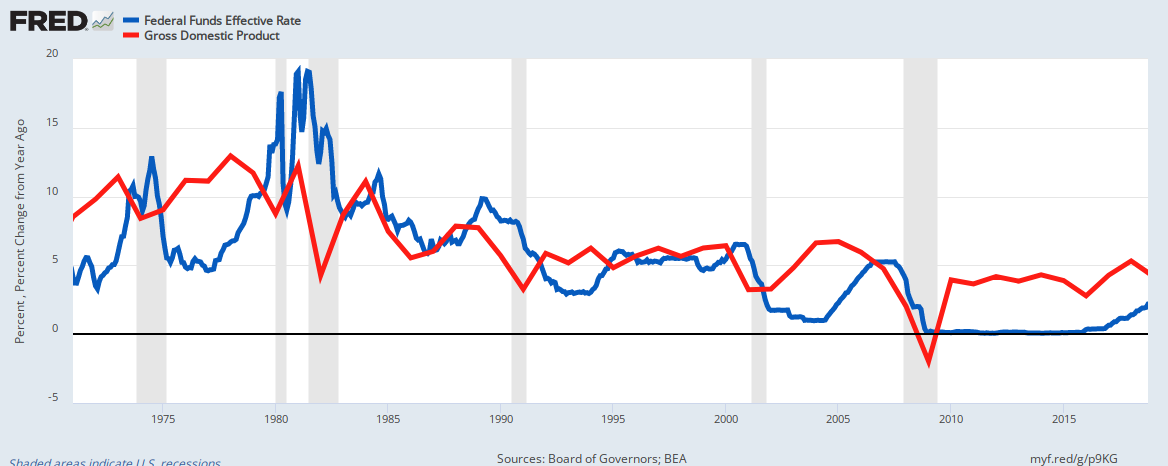
10. Fact: There is no post-gold standard relationship between low interest rates and high GDP growth. Opinion: The opposite seems true:
The interest rate and economic growth lines move in opposite directions.
Why do high interest rates stimulate? Opinion: High rates force the federal government to pay more interest, pumping more money into the economy.
The Fed increases interest rates to fight inflation. But increasing interest rates increases the prices of goods and services, i.e. causes inflation.
The Fed, in a sense, is using leeches to fight anemia.
11. Fact: The Federal debt/GDP ratio is a meaningless fraction, because it measures two, mathematically incompatible pieces of data. It’s an apples/oranges comparison. GDP is a one-year measure of output; federal debt is the net outstanding T-securities created since the nation’s birth.
The T-securities created years ago affect this year’s debt in the debt/GDP ratio, while even last year’s GDP does not affect this ratio. See: Debt/GDP
Because federal debt is the total of T-securities, and the federal government has the functional ability to stop creating T-securities at any time, the Debt/GDP ratio easily could fall to 0, depending on federal law.
11.a. Fact: The debt/GDP ratio does not measure the federal government’s ability to pay its bills. The government does not pay bills with GDP; it creates the money ad hoc to pay its bills.
Were GDP to be $0, the government still could pay bills of any size, simply by crediting the bank accounts of its creditors.
12. Facts: In 1979, gross federal debt was $800 billion. In 2009 it reached $12 trillion, a 1400% increase in 30 years. During that period, GPD rose 440% (annual rate of 5.5%>) with acceptable inflation. The same 1400% increase would put the debt at $180 trillion in 2039, a mean annual deficit of $5+ trillion.
This calculates to a 9.5% annual debt increase for the past 30 years. Repeating that growth rate would put the 2010 deficit at about $1.14 trillion, and the 2011 deficit at about $1.25 trillion. The deficit for year 2039 would be about $15.8 trillion.
Opinion: I know of no reason why the results would not be the same as they have been in the past 30 years. However, increasing the debt growth rate above 9.5% might show even better results:
In the 10 year period, 1980 – 1989, federal debt grew 210%, from $900 billion to $2.8 trillion (a 12% annual debt increase), while GDP grew .96% from $2.8 trillion to $5.5 trillion (a 7% annual increase). During that same period, inflation fell from 14.5% in 1980 to 5.2% in 1989. See graph, below.
The peaks and valleys of federal deficits (blue) generally correspond to the peaks and valleys of real (inflation adjusted) Gross Domestic Product growth. The reason: GDP = Federal Spending + Nonfederal Spending + Net Exports
Facts: In summary, large deficits have coincided with real (inflation adjusted) GDP growth
12. Facts: Any health insurance proposal that covers more people will cost more money. Extracting that money from doctors, hospitals, pharmaceutical companies, by necessity, would reduce the availability of health care.
Increasing taxes on any individuals (even the wealthy) or on businesses, will depress the economy by removing money from the economy. Only the federal government can supply additional money while stimulating the economy.
13. Fact: Social Security is supported neither by FICA nor by a trust fund. Were FICA eliminated, and benefits doubled, Social Security still would not go bankrupt unless Congress decided to make this happen.
In June, 2001, Paul O’Neill, Secretary of the Treasury said, “I come to you as a managing trustee of Social Security. Today we have no assets in the trust fund. We have promises of the good faith and credit of the United States government that benefits will flow.“
Yet, SS continues to pay benefits. Your Social Security check comes from a mythical trust fund that contains no money and receives no money.
Social Security (and Medicare) benefits are paid ad hoc by the U.S. government, not from a trust fund, and are not dependent on FICA taxes. which (opinion:) can and should be eliminated. See: FICA
14. Fact: The finances of the federal government are different from yours and mine and businesses’ and state, county and city government finances.
Unlike the federal government, which is Monetarily Sovereign, we cannot create unlimited amounts of money to pay our bills. We first need to acquire money, either by borrowing or by saving, to spend.
The federal government does not acquire money. It creates money by spending. As an accounting principle, the tax money you send to the government is destroyed upon receipt. Then the federal government creates new money to pay its bills. The government has no fund from which it pays bills.
Fact: Were taxes to decrease to zero, this would not change by even one penny, the federal government’s ability to spend.
Opinion: The failure to recognize the difference between the Monetarily Sovereign federal government and all other entities, which are monetarily non-sovereign, is the primary reason for recessions and depressions.
15. Fact: The federal government has the unlimited ability to create the dollars to pay any bill of any size. It never can run short of dollars; it never can go broke.
Opinion: The federal government should distribute dollars to each monetarily non-sovereign state, on a per capita basis.
The states would determine how they distribute the dollars (to counties, cities and/or taxpayers). I suggest a distribution of $5,000 per person or a total of $1.5 trillion.
Fact: In 1971, the U.S. went off the gold standard, thereby becoming a Monetarily Sovereign nation, and at that moment, all economics textbooks became obsolete. Sadly, mainstream economists, the politicians and the media have not yet caught up.
Summary: So there you have a list of facts, plus a few opinions, which I have noted. Read the facts and draw your own inferences.
You can find a great number of debt-hawk sites (i.e. Concord Coalition, Committee for a Responsible Federal Budget), which in essence are privately funded think tanks, paid to influence popular belief, with propaganda masquerading as data.
There, you will see data showing the size of the federal debt. These data are presented in a way designed to imply that the debt (money created) is too large.
But you will find no proof of these ideas. You will see no historical graphs equating debt with any negative economic outcome, simply because such graphs do not exist. Debt hawks believe federal deficits are so obviously bad, no proof is needed.
Yet, despite lacking proof, debt-hawks have foisted their opinions on the media, the politicians, weak-minded economists, and the public, much to the detriment of our economy.
The prevention and cure for a loss of democracy is an informed and energized electorate.
With Donald Trump ripping the government and the economy apart, here is what you should know during the two years before casting your vote in the next Congressional elections.
If you voted Republican in previous elections, you probably thought you were voting for conservatives, not those big spending, big taxing bleeding heart liberals. You were fooled.
It’s almost like falling in love with a beautiful, kind, intelligent, compassionate college girl, and today you are shocked and dismayed to discover she has become a gnarly, mean-spirited, ugly wicked witch.
WHAT IS CONSERVATISM?
Conservatives support reduced government spending to limit the size and scope of government. They push for cuts to social programs and other non-defense discretionary spending.
Conservatives prioritize balancing the budget and reducing deficits. They support tax cuts, simplifying the tax code, and measures like a flat or national sales tax.
They are concerned about the national debt and argue that high debt levels can lead to higher interest rates, reduced economic growth, and increased vulnerability to financial crises. They propose measures to reduce spending and reform entitlement programs to address this.
TODAY’S REPUBLICAN PARTY
There was a time when the Republican Party was conservative. However, under Trump, there has been some slippage.
They still favor reduced spending, but only when the reductions don’t touch the very rich. They want to cut (they call it “reform”) Medicare, Medicaid, Social Security, school lunches, and other programs that primarily benefit the middle and the poor.
They still favor tax cuts and tax simplification, but only tax cuts that benefit the rich. And the simplification should not affect those complex tax loopholes that allowed billionaire Donald Trump to pay $500 a year in taxes.
The still claim to worry about the federal debt, but here is the sticking point. To give their millionaire and billionaire voting base those juicy tax cuts, the GOP has to cut other spending or increase the federal debt. But there isn’t enough “other spending” to cut, unless the radically cut all the social programs the majority of voters treasure.
They sent out Mad Dog Musk mindlessly to fire hundreds of thousands of good working people (without considering them as individuals), to take dollars from their pockets and to line the pockets of the millionaires and billionaires.
But even with those dollars stolen from the poor and middle-income families, there isn’t enough money to satisfy the rapacious rich.
Ah, what to do? What to do? While always lacking ideas to help poor and middle-income people, the Republicans never lack for ideas to enrich the rich. Here is the latest:
THE CURRENT POLICY BASELINE
Imagine that your credit card spending is $10,000 a year. Based on your income, you say, I can handle that. I’ll be able to pay it.” But you don’t. So, at the end of the year, you owe &10,000.
The following year, again your credit card spending will be $10,000, and you say, “Last year, I spent $10,000 and my income stayed the same, so I can spend another $10,000 this year.” Do you see anything wrong with that?
That is “Current PolicyBaseline,” and it is the gimmick being proposed by fake conservatives to claim they still are being conservative, by following last year’s policies again this year. They want you to forget that the debt grows while the deficit remains the same.
There is a huge difference between the “Current LAW Baseline and the Current POLICYBaseline, Here is the argument proposed by the U.S. Chamber of Commerce:
Under a current-lawbaseline, preventing the scheduled expiration of key individual, business, and estate tax policies enacted in the 2017 Tax Cuts and Jobs Act (TCJA) would be considered to cost around $4 trillion over 10 years.
Consider a family that paid $10,000 in federal taxes for 2025 but for whom, under existing law, tax rates are scheduled to double in 2026, meaning the family would have to pay $20,000 in federal taxes that year. A current-law baseline would assume this planned change in the law.
But if Congress later decides to increase tax rates by only 50%, using a current-law baseline would count the family as having received a $5,000 tax cut.
Of course, in the real world, the family didn’t receive a tax cut at all; they got a $5,000 tax increase.
Get it? Congress passes a law that calls for a $10,000 tax increase, a later passes a new law that calls for “only” a $5,000 tax increase. Under the “current law” baseline, they could tell the voters they just cut taxes by $5,000.
MAGAs might believe it, but would you?
Suppose Congress adopts a current-law baseline in its FY 2025 budget resolution. In that case, it is all but certain that most—if not all—of the TCJA’s temporary tax provisions would once again have to be sunset to comply with the Senate’s Byrd rule, under which titles in reconciliation bills cannot increase the deficit in years beyond the usual 10-year budget window.
This is because making the TCJA’s temporary provisions permanent would be considered to increase the deficit when measured against current law.
If, on the other hand, Congress were to adopt a current-policy baseline, then lawmakers would have a real chance to deliver permanent tax relief to American families and employers because extending the TCJA’s temporary provisions would not increase the deficit relative to current policy.
It’s all hocus-pocus designed to confuse you, allowing the Republicans falsely to claim they are not increasing the federal deficit while it and the federal debt rises massively.
I AGREE WITH THE DECEPTION OF THE CURRENT POLICY BASELINE
Yes, I agree with the deception because:
1.The federal debt and deficit are not burdens on the government, the taxpayers, or the economy.
The so-called “federal debt” is neither federal nor debt. It is the total of deposits into Treasury Security accounts. These deposits are, and remain, owned by depositors who want a safe interest-paying place to store otherwise unused dollars.
The accounts resemble bank safe deposit boxes in that ownership never passes to the government, which only holds the dollars for safekeeping.
Our Monetarily Sovereign government does not offer these deposits to acquire spending money; the government already has infinite spending money. The sole purpose of T-security accounts is to provide a safe storage place for those unused dollars (which stabilizes the U.S. dollar) and to help the Fed regulate interest rates (by providing a base rate).
Taxpayers do not pay for the debt. Upon maturity, the stored money is returned to the depositors along with interest created by a government computer. Federal taxes don’t fund federal spending.
2.Federal deficit spending benefits the economy by adding growth dollars to GDP.
What does Congress do whenever we have a recession or even a threat of recession? It spends more to stimulate growth.
We have recessions when federal deficit spending growth (blue) declines (vertical gray bars). The government cures these recessions by increasing deficit spending growth.
Nine consecutive recessions have followed this pattern:
Spending growth declines
Recession begins
Spending growth increases
Recession is cured.
It is not a coincidence. It’s simple cause and effect.
SUMMARY
A growing economy requires an increasing supply of money. The so-called “federal debt” (should be termed “economic income”) is not a burden on taxpayers, the government or the economy. Concerns about the so-called “federal debt” and federal deficits hinder economic growth.
Under the “fight fire with fire” concept, I agree with deceiving the public about the Current Policy Baseline not increasing the deficit, because deficit increases are necessary for a healthy economy.
It’s like telling your kids that spinach will make them as strong as Popeye. It won’t, but the spinach is good for them, so . . . I see the current policy baseline as a white lie meant to accomplish a good purpose, though it exposes the hypocrisy of the GOP.








 #Monetary Sovereignty - Mitchell
