–A personal musing. What is the future of jobs? Do jobs matter?

The debt hawks are to economics as the creationists are to biology. Those, who do not understand monetary sovereignty, do not understand economics. Cutting the federal deficit is the most ignorant and damaging step the federal government could take. It ranks ahead of the Hawley-Smoot Tariff.
==============================================================================================================================================

A personal musing. What is the future of jobs? Are we wrong to focus on job creation? Here is an excerpt from an article that ran last year:

CBS Reports; WALLINGFORD, CT., Jan. 5, 2009
The Future of Jobs in America; Innovation, R&D, and Education are Keys to Job Creation, By Anthony Mason

For 23 straight months now, the U.S. economy has been hemorrhaging jobs. . . One in six Americans, 17 percent, is underemployed. That’s nearly 25 million people who are out of work, have given up looking, or been forced to take a part time job. The recession has wiped out 15 percent of our manufacturing workforce. That’s more than 2 million jobs that will likely never come back.

Here is an excerpt from a recent article:

Jobs in China, By ANDREW JACOBS, The New York Times, 12/12/2010
In 1998 . . . Chinese colleges produced 830,000 graduates. . . . Last May, that number was more than six million and rising. . . The economy, despite its robust growth, does not generate enough good professional jobs to absorb the influx of highly educated young adults. And many of them bear the inflated expectations of their parents, who emptied their bank accounts to buy them the good life that a higher education is presumed to guarantee.

It widely is believed America suffers from a shortage of jobs. I suggest that may not be true. Rather, America suffers from a shortage of money.

It began with the Industrial Revolution. Since then, machines have done more work that people once did. Machines chased people off labor-intensive farms to manufacturing and white collar work. Then, machines run by people, chased people off those jobs. Soon, machines run by computers began to take over. But someone had to build and program the computers, so jobs in electronics industries expanded. Now computers have begun to build and program computers.

So from where will the next jobs come? And does it matter?

Most people really don’t want a job; they want money. Yes, some jobs may offer personal satisfaction, and may occupy otherwise dull hours, but for most people seeking jobs, money is the primary goal.

Wait, Rodger. People do not want money. They want what money will buy. They want more security, better shelter, food, clothing, health care, education. They want admiration. They want envy. They want accomplishment. They want to win.

O.K.., money can’t buy everything, but it can buy much of what people want. A jobs is a means to obtain money, which in turn is a means to obtain the things we want. And that Rube Goldbergian “means-to-a-means-to-a-means” connection is being superseded by machines.

Those who have seen the “Star Trek, The Next Generation” TV series are familiar with the “replicator.” It can synthesize any non-living product, seemingly out of thin air. If such a device existed today, our money and job needs would decline radically. Yes, we might continue to work for satisfaction, for creativity, or to fill otherwise-empty hours – but not so much for money, since there would be little need for money other than perhaps to pay for some services. The replicator could supply our product needs.

Replicators may seem far off, but we are evolving in that direction, where machines supply more and more of our product needs. And as that happens we butt up against what will be increasingly difficult questions: Why must we work to obtain money – and why must people struggle to find jobs to obtain money – especially since money is free?

That’s right. Money is free. The U.S. federal government has the infinite ability to create money out of thin air. In essence, the U.S. government is a “money replicator.” At the touch of a button, the government could supply each of us with unlimited money. Want $1 trillion? No problem. Here, take $2 trillion. There is no physical money; it’s all just data, and data is infinite.

Extreme amounts of money creation would reduce the value of money (aka “inflation”), but the point is this: There is no fundamental reason why anyone in America should lack food, clothing, shelter, education, health care simply for lack of a job. There is no job-related reason for poverty in America. Our “money-replicator” government has the power to lift everyone from poverty and supply all their basic needs.

This brings us to an important difference between why people want to work and why the economy wants people to work. While people work to obtain goods and services, the economy wants people to work to create goods and services. If we all owned replicators, and if no one worked, eventually we would have no progress and no services, and the economy would collapse.

There may be a compromise, between where we are today and an economy with no jobs at all. I’m not sure exactly where that compromise is, and surely it would change over time, but here are a couple of “what-ifs.” What if:

–The government’s “money replicator” gave every man, woman and child enough to pay for food, clothing, home, health care, entertainment and education through college — i.e. ended poverty?
–Those who wanted more than basics could work, but the standard, legal work days were lowered from 8 hours to 6 hours to 4 hours or less, providing more jobs for all who wanted them?
–Federal taxes, being unnecessary, were phased out?

Of course, the devil is in the details. What about Inflation? Motivation? Progress? International relations? I have some thoughts on these, which I plan to provide in later posts. I believe we eventually will loosen the connection between jobs to money to goods and services. It won’t be “if” but “when,” and it will be an improvement over our current situation of too much joblessness, poverty, illiteracy, homelessness, sickness and struggle.

Time and energy devoted to the creation of jobs may take us down the wrong path. Perhaps we should focus on the creation and distribution of money.

What are your thoughts?

Rodger Malcolm Mitchell
http://www.rodgermitchell.com

No nation can tax itself into prosperity. Those who say the stimulus “didn’t work” remind me of the guy whose house is on fire. A neighbor runs with a garden hose and starts spraying, but the fire continues. The neighbor wants to call the fire department, which would bring the big hoses, but the guy says, “Don’t call. As you can see, water doesn’t put out fires.”
–Democrats eagerly embrace suicide mentality

The debt hawks are to economics as the creationists are to biology. Those, who do not understand monetary sovereignty, do not understand economics. Cutting the federal deficit is the most ignorant and damaging step the federal government could take. It ranks ahead of the Hawley-Smoot Tariff.
==========================================================================================================================================

Question: What can save the Democrats in the 2012 elections?
Answer: Economic growth.

Question: What will stimulate economic growth?
Answer: Tax benefits, better unemployment benefits, business benefits.

Question: What will provide tax benefits, more unemployment benefits, business benefits?
Answer: The deal President Obama worked out with GOP leaders. It has lots of tax benefits for everyone. The Bush tax reductions remain. Capital gains and dividend taxes remain at 15%. FICA is reduced. The “death tax” didn’t go as high as people feared. Unemployment benefits were lengthened.

Question: What has the Democrats angry?
Answer: The deal President Obama worked out with GOP leaders.

Question: Why are the Democrats angry at the one bill that can get them re-elected in 2012?
Answer: They campaigned on the pledge to stick it to the wealthy. This bill doesn’t stick it to the wealthy — at least not enough. This bill moderately benefits the entire country. The Democrats now are in the “Cut-my-nose-to-spite-my-face” mode, except they also are willing to spite all of America. There was a time when we all could laugh at ignorant politicians. Today, when they actively aim to harm America, they aren’t quite as funny.

By the way, did you notice how they slid in that reduction in FICA, which we recommended 15 months ago (Ten Reasons to Eliminate FICA ) and which my book, FREE MONEY, recommended 12 years ago. But hey, better late than never. As usual, they did only a partial job, but what can you expect?

Anyway, soon you’ll see all the misguided debt-hawk columnists prattle on about how this FICA reduction will make Social Security go bankrupt sooner. Tell me, who understands economics less, the columnists or the politicians?

Rodger Malcolm Mitchell
http://www.rodgermitchell.com

No nation can tax itself into prosperity. Those who say the stimulus “didn’t work” remind me of the guy whose house is on fire. A neighbor runs with a garden hose and starts spraying, but the fire continues. The neighbor wants to call the fire department, which would bring the big hoses, but the guy says, “Don’t call. As you can see, water doesn’t put out fires.”

–An “investigative” newspaper comments on the new tax agreement

The debt hawks are to economics as the creationists are to biology. Those, who do not understand monetary sovereignty, do not understand economics. Cutting the federal deficit is the most ignorant and damaging step the federal government could take. It ranks ahead of the Hawley-Smoot Tariff.
====================================================================================================================================================================================
For reasons I cannot even begin to imagine, the Chicago Tribune, which prides itself on being an investigative newspaper, refuses to investigate facts before or even after, writing about the economy. I have contacted them often, and they never have displayed even a modicum of interest in learning anything about how the economy works. Instead, they rely solely on popular myth.

Here is a verbatum copy of an Email I sent to editors and others at the Tribune:

“Today’s (12/7/10) Chicago Tribune editorial titled, “Tax Dealing” contains a mixture of truth and myths.

1. Truth: “ . . .raising marginal (tax) rates, especially with the tax year ending an a matter of weeks, would hurt an economic recover still on life support. Obama knows he needs all the growth he can get.” Translation: Yes, taxes hurt the economy because they remove money from the economy. A growing economy requires a growing supply of money.

2. Myth: ” . . . nobody is reducing the cost of government to make up the lost revenue.” Fact: Federal spending is not constrained by taxes, nor do taxes pay for federal spending. Tax money is destroyed (i.e. “lost”) upon receipt and is not stored anywhere.

3. Truth: “The (commission on debt reduction) work can be a catalyst for historic change.” Yes, if we follow the commission’s debt reduction advice, we will have a depression of historic proportions. See item #1, above.

4. Truth: “The panel’s plan involves cutting everything from defense to Social Security . . . Everyone from senior citizens to post-office customers have complained about the pain involved if the plan were enacted.” Yes, it’s a plan that hurts everyone and benefits no one. It’s all pain and no gain.

5. Myth: “That’s unavoidable. Everyone is going to feel some pain when the nation makes its government live within its means.” Fact: Causing economic pain neither is unavoidable nor praiseworthy. As for the government “living within its means,” the Tribune demonstrates it does not know the difference between monetarily sovereign finances (U.S. Government) and monetarily non-sovereign finances (everyone else). You and I have “means.” We must have a source of money before we spend. We are limited in how much we can spend. The federal government is not limited. It creates money by spending. It alone has the unlimited ability to pay any bills of any size. It has no “means.”

6. Myth: You repeated Sen. Durbin’s comment, “Borrowing 40 cents out of every dollar we spend for missiles or food stamps is unsustainable.” Fact: The federal government does not need to borrow even one cent. Borrowing the money the federal government originally created, and can continue to create endlessly, makes no economic sense. It is a relic of the gold standard days, when federal borrowing was necessary. The government does not spend borrowed money. As for federal spending being “unsustainable,” this myth has been bandied about since 1980 (See: Unsustainable) It is no more true today than it was 30 years ago.

7. Myth: “It’s irresponsible for our nation to go on accumulating unaffordable debts that will force even more painful cuts down the line.” What makes the debt “unaffordable”? The Tribune has no idea. In fact, “federal debt” merely is a synonym for “federal money created.” Without federal debt there would be no money and no economy. The Tribune makes the nonsensical complaint that money is unaffordable.

8. Myth: “The coming agreement on tax cuts will avoid an unwelcome shock to the U.S. economy. It will buy time. But it has to lead to an agreement on long-term deficit reduction.” The Tribune editors do not realize that the first part of this paragraph contradicts the second part. If increasing deficits will help the economy, why do the Tribune editors want to decrease deficits? Ever?

In summary, the Tribune editors continue to parrot the myths of the day. Not once do they even make an attempt to provide evidence supporting their beliefs. So I’ll leave you with a couple of questions, you may or may not wish to answer:

–Exactly what do you mean by “make up for lost revenue.” Do you mean that without this “lost revenue” the federal government will be unable to pay its bills?
–Why do you feel economic pain is beneficial. Has the economic pain we already have felt proved beneficial?
–Why do you feel cutting defense will benefit the economy and American security?
–Why do you feel cutting Social Security benefits will benefit the economy?
–Why do you feel reducing postal service will benefit the economy?
–What is the definition of “means,” when you say the government must live within its means. What has happened because the government has not lived within its “means.”
–What do you mean by ‘unaffordable debts.” Do you think a government with the unlimited power to create money, cannot afford to pay for the T-securities it creates out of thin air? Similarly, what do you mean by “unsustainable”?
–Does the Tribune feel any concern about spreading false information that could damage your readers and the entire American economy?
–Is the Tribune interested in learning the facts?

If any of you are readers of the Chicago Tribune, you may wish to write to them. Perhaps mutiple voices would help. I write to:
Zoll, Yerak, Dold, Japsen, Page, Greising, Letters, Ponpei, Delama, Kern, , Oliphant, Hirt, Business, Knowles, Kass, Lythcott, McHolt, O’Brien, Epodmolik, Lev, Doneal
Hughlett, Nicholas, Widder, Jones, Hunter, Wong

Rodger Malcolm Mitchell
http://www.rodgermitchell.com

No nation can tax itself into prosperity. Those who say the stimulus “didn’t work” remind me of the guy whose house is on fire. A neighbor runs with a garden hose and starts spraying, but the fire continues. The neighbor wants to call the fire department, which would bring the big hoses, but the guy says, “Don’t call. As you can see, water doesn’t put out fires.”

–How to fight inflation and how not to.

The debt hawks are to economics as the creationists are to biology. Those, who do not understand monetary sovereignty, do not understand economics. Cutting the federal deficit is the most ignorant and damaging step the federal government could take. It ranks ahead of the Hawley-Smoot Tariff.
==================================================================================================================================
I know this is a strange time to talk about fighting inflation. Recently we struggled up from a minus inflation (aka “deflation”) and now are at a puny 1% level. But too often, when I say that federal deficit spending should increase, a debt-hysteric concern expressed to me, is not just inflation, but the typical debt-hawk exaggeration: hyperinflation!

The debt-hawks seem to be the kind of folks who, upon seeing a starving child, would not feed that child for fear the food would cause obesity. Today, our economy is starved for money, but the debt hawks fear monetary obesity (aka “inflation”) and they warn us of wheelbarrows full of money. They give silly speeches about what they term “fiscal prudence” and what I term, “starving the baby.”

So as long as we must face debt hysteria, and the hysteria has to do with a non-existent though dreaded inflation, we might as well talk about preventing and curing inflation. Inflation is the loss in value of money compared to the value of goods and services.

So, there are two fundamental methods for curing inflation: Reduce the supply of money or increase the demand for money. Both methods increase the value of money vs the value of goods and services. (In theory, increasing the supply of goods and services or decreasing the demand for goods and services also would work, but there is no known method for accomplishing this without changing the money supply.)

Ideally, any anti-inflationary activity should be effective, quick to activate, quick to take effect, incremental, easy to rescind and not damaging to the economy. But while tax increases remove money from the economy, and so can be effective, they fail all the other tests. They are highly political; They are slow to pass through Congress. They take effect slowly, because taxes are collected slowly. They cannot be passed and implemented incrementally. They are difficult to undo. And they damage the economy. The require answers to difficult questions: Exactly which taxes should be increased? By how much? Should we have a tax increase during a stagflation? How do we calibrate an incremental tax increase?

Compare this approach with another approach: Interest rate increases. Interestingly, interest rate increases have both pro-inflation and anti-inflation effects. Pro inflation: Increase in business costs and increase in the money supply due to increased federal interest payments. Anti-inflation: Increase in the demand for money vs the demand for non-money.

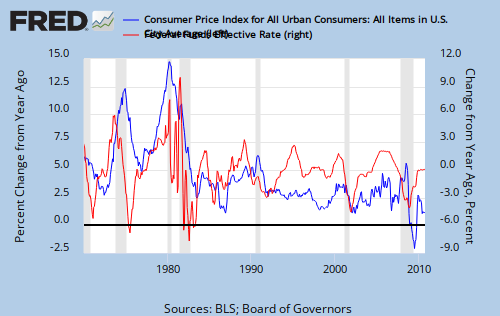
On balance, the anti-inflation effects are stronger. One hint is this graph: graph 1that seems to indicate interest rate increases are followed about one year later by inflation decreases.
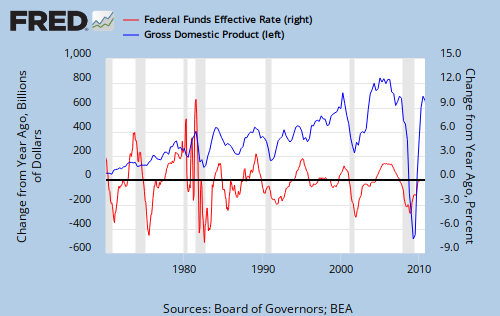
The other hint is the Fed’s ongoing success in controlling inflation despite massive increases in the money supply. Interest rate increases actually work.

Interest rate increases can be done quickly and in small or large increments — just what is needed for inflation control. And contrary to popular faith, high interest rates do not negatively affect GDP growth. See: Interest

In summary:
–We are nowhere near inflation
–We can control inflation by raising interest rates
–High interest rates do not negatively affect GDP growth

We can and should feed the starving economy without letting unfounded worries about our ability to prevent or cure the economy’s obesity, prevent us from saving the child.

Rodger Malcolm Mitchell
http://www.rodgermitchell.com

No nation can tax itself into prosperity. Those who say the stimulus “didn’t work” remind me of the guy whose house is on fire. A neighbor runs with a garden hose and starts spraying, but the fire continues. The neighbor wants to call the fire department, which would bring the big hoses, but the guy says, “Don’t call. As you can see, water doesn’t put out fires.”