–When will the economy recover?

The debt hawks are to economics as the creationists are to biology. Those, who do not understand monetary sovereignty, do not understand economics. Cutting the federal deficit is the most ignorant and damaging step the federal government could take. It ranks ahead of the Hawley-Smoot Tariff.
======================================================================================================================================================================

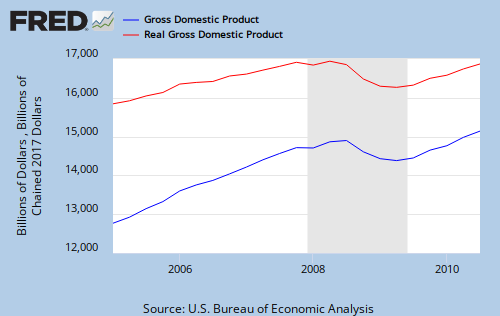
At long last, when will the economy recover? Wait a minute. Look at this graph:

graph 1

Considering that the data only goes through September, 2010, one easily can infer that the economy already has recovered. Yes, the stock market has not recovered, but that could be good news. It could mean it still has plenty of recovery left in it.

And yes, unemployment still is a big problem:

But that could be a good thing, too (although not for those who are unemployed.) A high level of unemployment mitigates against inflation. The government could continue to use its infinite spending ability and not be concerned it was causing inflation. For instance, FICA could be eliminated, as it should be, rather than the tentative, temporary step now taken. And the standard deduction could be raised, also as it should be. And Social Security benefits could be increased, and Medicare could be expanded, again as they should be.

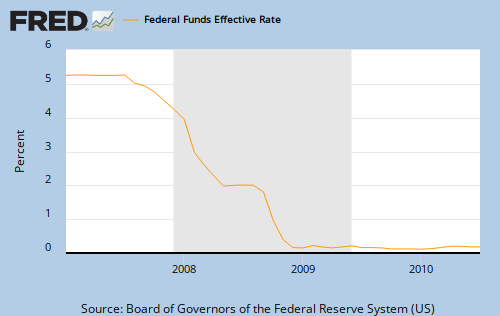
And interest rates have stayed way down:

graph 3

And that’s another good thing, because it means the Fed has plenty of room (not that “room” really is needed) to raise rates if inflation should rear its ugly head.

There are plenty of leading indicators one might explore, but these graphs give me cause for optimism, if only the federal government will seize the moment.

Rodger Malcolm Mitchell
http://www.rodgermitchell.com

No nation can tax itself into prosperity. Those who say the stimulus “didn’t work” remind me of the guy whose house is on fire. A neighbor runs with a garden hose and starts spraying, but the fire continues. The neighbor wants to call the fire department, which would bring the big hoses, but the guy says, “Don’t call. As you can see, water doesn’t put out fires.”

–What will help the poor? Taxes vs. Spending

The debt hawks are to economics as the creationists are to biology. Those, who do not understand monetary sovereignty, do not understand economics. Cutting the federal deficit is the most ignorant and damaging step the federal government could take. It ranks ahead of the Hawley-Smoot Tariff.
==========================================================================================================================================================================

Now that the new tax bill has passed, three related issues will remain in the news:

1. Will tax reductions cause inflation? (In the unlikely event they do, the Fed will prevent/cure inflation by raising interest rates)

2. Will tax reductions bankrupt Social Security and Medicare? (No. Because the federal government is Monetarily Sovereign, federal spending is not constrained by taxes. If FICA were reduced to $0, this would not affect by even one penny the federal government’s ability to support Social Security and Medicare. Tax reductions cannot bankrupt the U.S. or any of its agencies.)

3. Should taxes on the rich be increased as soon as the current law expires? That is the question discussed in this post.

Some people favor higher taxes on the rich, because they believe this somehow will help the poor. The concept is that by taxing the rich, we close the “gap” between rich and poor, and this closed gap benefits the poor.

I discuss this “gap” further at Closing the Gap and at A Partial Solution for the Gap.

I strongly empathize with the desire to aid the poor. But bringing down the rich is not the way. Whether Bill Gates has $50 billion or is brought down to “only” $10 billion, does not affect the poor. We have had 90% top tax rates, and that did nothing to help the poor. In fact, increasing taxes on anyone, rich or poor, removes money from the economy, which slows the economy. Slowed economic growth always hurts the poor more than the rich, as witness the most recent recession. Who was hurt most, the rich or the poor?

As I mentioned, the federal government does not spend tax money. Unlike state and local governments, which are not Monetarily Sovereign, the federal government spends money it creates ad hoc. If the wealthy were taxed at the 99.99% rate, this would not increase by even one cent, the federal government’s ability to spend, i.e. to help the poor.

The poor benefit most when the economy is growing fastest, because that increases the availability of jobs and money. So to help the poor, we must stimulate the economy. That is, if we want to help the poor, we very simply should help the poor. The Federal government could:

–Increase Social Security benefits.
–Initiate free universal health care insurance.
–Increase unemployment benefits.
–Pay a salary to all students. ( SALARY)
–Eliminate FICA. (FICA)
–Increase the standard deduction on income taxes.
–Allow home rent to be tax deductible.
–Increase food stamps.
–Pay states and cities to reduce sales taxes

There are many ways to help the poor. We should focus on that, not on punishing the rich, which may provide some emotional satisfactions, but does not provide financial benefits to anyone. Let me see some of your ideas for helping the poor.

Rodger Malcolm Mitchell
http://www.rodgermitchell.com

No nation can tax itself into prosperity. Those who say the stimulus “didn’t work” remind me of the guy whose house is on fire. A neighbor runs with a garden hose and starts spraying, but the fire continues. The neighbor wants to call the fire department, which would bring the big hoses, but the guy says, “Don’t call. As you can see, water doesn’t put out fires.”

–An “investigative” newspaper comments on the new tax agreement

The debt hawks are to economics as the creationists are to biology. Those, who do not understand monetary sovereignty, do not understand economics. Cutting the federal deficit is the most ignorant and damaging step the federal government could take. It ranks ahead of the Hawley-Smoot Tariff.
====================================================================================================================================================================================
For reasons I cannot even begin to imagine, the Chicago Tribune, which prides itself on being an investigative newspaper, refuses to investigate facts before or even after, writing about the economy. I have contacted them often, and they never have displayed even a modicum of interest in learning anything about how the economy works. Instead, they rely solely on popular myth.

Here is a verbatum copy of an Email I sent to editors and others at the Tribune:

“Today’s (12/7/10) Chicago Tribune editorial titled, “Tax Dealing” contains a mixture of truth and myths.

1. Truth: “ . . .raising marginal (tax) rates, especially with the tax year ending an a matter of weeks, would hurt an economic recover still on life support. Obama knows he needs all the growth he can get.” Translation: Yes, taxes hurt the economy because they remove money from the economy. A growing economy requires a growing supply of money.

2. Myth: ” . . . nobody is reducing the cost of government to make up the lost revenue.” Fact: Federal spending is not constrained by taxes, nor do taxes pay for federal spending. Tax money is destroyed (i.e. “lost”) upon receipt and is not stored anywhere.

3. Truth: “The (commission on debt reduction) work can be a catalyst for historic change.” Yes, if we follow the commission’s debt reduction advice, we will have a depression of historic proportions. See item #1, above.

4. Truth: “The panel’s plan involves cutting everything from defense to Social Security . . . Everyone from senior citizens to post-office customers have complained about the pain involved if the plan were enacted.” Yes, it’s a plan that hurts everyone and benefits no one. It’s all pain and no gain.

5. Myth: “That’s unavoidable. Everyone is going to feel some pain when the nation makes its government live within its means.” Fact: Causing economic pain neither is unavoidable nor praiseworthy. As for the government “living within its means,” the Tribune demonstrates it does not know the difference between monetarily sovereign finances (U.S. Government) and monetarily non-sovereign finances (everyone else). You and I have “means.” We must have a source of money before we spend. We are limited in how much we can spend. The federal government is not limited. It creates money by spending. It alone has the unlimited ability to pay any bills of any size. It has no “means.”

6. Myth: You repeated Sen. Durbin’s comment, “Borrowing 40 cents out of every dollar we spend for missiles or food stamps is unsustainable.” Fact: The federal government does not need to borrow even one cent. Borrowing the money the federal government originally created, and can continue to create endlessly, makes no economic sense. It is a relic of the gold standard days, when federal borrowing was necessary. The government does not spend borrowed money. As for federal spending being “unsustainable,” this myth has been bandied about since 1980 (See: Unsustainable) It is no more true today than it was 30 years ago.

7. Myth: “It’s irresponsible for our nation to go on accumulating unaffordable debts that will force even more painful cuts down the line.” What makes the debt “unaffordable”? The Tribune has no idea. In fact, “federal debt” merely is a synonym for “federal money created.” Without federal debt there would be no money and no economy. The Tribune makes the nonsensical complaint that money is unaffordable.

8. Myth: “The coming agreement on tax cuts will avoid an unwelcome shock to the U.S. economy. It will buy time. But it has to lead to an agreement on long-term deficit reduction.” The Tribune editors do not realize that the first part of this paragraph contradicts the second part. If increasing deficits will help the economy, why do the Tribune editors want to decrease deficits? Ever?

In summary, the Tribune editors continue to parrot the myths of the day. Not once do they even make an attempt to provide evidence supporting their beliefs. So I’ll leave you with a couple of questions, you may or may not wish to answer:

–Exactly what do you mean by “make up for lost revenue.” Do you mean that without this “lost revenue” the federal government will be unable to pay its bills?
–Why do you feel economic pain is beneficial. Has the economic pain we already have felt proved beneficial?
–Why do you feel cutting defense will benefit the economy and American security?
–Why do you feel cutting Social Security benefits will benefit the economy?
–Why do you feel reducing postal service will benefit the economy?
–What is the definition of “means,” when you say the government must live within its means. What has happened because the government has not lived within its “means.”
–What do you mean by ‘unaffordable debts.” Do you think a government with the unlimited power to create money, cannot afford to pay for the T-securities it creates out of thin air? Similarly, what do you mean by “unsustainable”?
–Does the Tribune feel any concern about spreading false information that could damage your readers and the entire American economy?
–Is the Tribune interested in learning the facts?

If any of you are readers of the Chicago Tribune, you may wish to write to them. Perhaps mutiple voices would help. I write to:
Zoll, Yerak, Dold, Japsen, Page, Greising, Letters, Ponpei, Delama, Kern, , Oliphant, Hirt, Business, Knowles, Kass, Lythcott, McHolt, O’Brien, Epodmolik, Lev, Doneal
Hughlett, Nicholas, Widder, Jones, Hunter, Wong

Rodger Malcolm Mitchell
http://www.rodgermitchell.com

No nation can tax itself into prosperity. Those who say the stimulus “didn’t work” remind me of the guy whose house is on fire. A neighbor runs with a garden hose and starts spraying, but the fire continues. The neighbor wants to call the fire department, which would bring the big hoses, but the guy says, “Don’t call. As you can see, water doesn’t put out fires.”

–Senator Durbin wanders in Fantasyland

The debt hawks are to economics as the creationists are to biology. Those, who do not understand monetary sovereignty, do not understand economics. Cutting the federal deficit is the most ignorant and damaging step the federal government could take. It ranks ahead of the Hawley-Smoot Tariff.

Read about Senator Durbin’s wanderings in Fantasyland. Today, 12/3/10, the Chicago Tribune published an article by Dick Durbin, the senior Senator (D) from Illinois. The title: “Why I’m voting ‘yes.” Here are some quotes from the article, and my comments.

“On Friday, when President Brach Obama’s National Commission on Fiscal Responsibility and Reform gathers to consider a plan to bring our national debt under control, I will be voting yes. . . . America needs to grow our economy and reduce our $13.trillion debt. “

Never mind that almost 30% of that debt is merely one government department owing another government department. (Think of your checking account owing your savings account.) We can forgive that “minor” arithmetic error, because the good Senator makes a much larger one.

It mathematically is impossible to cut the debt and grow the economy at the same time. Money not only is the engine, but also the measure, of economic growth. GDP is a money measure. Cutting the debt requires taking money out of the economy, either by raising taxes or with reduced spending, or both. When you take money out of the economy, there is no mechanism by which you can grow the economy. There are no caveats about efficiency or savings or reducing waste or any other supposedly mitigating concepts. It simply is 100% impossible to grow an economy while reducing the money supply.

It’s like telling someone to take a lower paying job so he can buy a bigger house. The arithmetic doesn’t work.

Apparently Senator Durbin realizes this, because later he says:

“I worked (to) make certain that the (recommended) spending cuts do not start until 2013. We cannot run the risk of hitting the brakes in the midst of this recession, driving more people into unemployment and shredding the safety net to protect our families.”

So let’s see if we understand his thinking. Spending cuts “hit the brakes and drive people into unemployment.” We don’t want to do that now, but we do want to do it in 2013. Huh?

Then he said:

“I also insisted on two things to spark the economy: a payroll tax holiday that can create up to 900,000 jobs and a longer-term investment of $100 billion in infrastructure, education and reserach and development – key investments for long-term economic growth.”

Hmmm. So he wants to cut the deficit, but realizing that deficits stimulate the economy, he wants to increase the deficit with a payroll tax holiday and $100 billion investment.

So tell us again, Senator Durbin why do you want to cut the deficit? Oh sorry, you never told us the first time. Could it be because you have no reason? None at all?

“Borrowing 40 cents out of every dollar we spend for missiles or food stamps is unsustainable.”

Ah yes, the old “unsustainable” line. Back in February 7, 1982, almost 30 years ago, when the Federal Debt Held by Private Investors was $733 billion, President Ronald Reagan referred to the, “rapid, unsustainable expansion of Federal spending and money growth.” (See: Unsustainable) Today, the FDHBPIN is $7.9 trillion, having increased an astounding 1,000% in only 29 years, and politicians continue to refer to it as “unsustainable” – while we keep sustaining it with no difficulty whatsoever. When you say that something we have done, actually since the 1930s, is impossible, at some point you must question yourself. If it’s unsustainable, how have we sustained it?

Senator Durbin is yet another politician who does not understand monetary sovereignty. He does not understand that the U.S. can “sustain” any spending of any amount. Its spending is not constrained by deficits, debt or taxes, but rather by inflation – the inflation the Fed easily controls, the inflation from which we are a long, long way.

And he does not understand the federal government does not need to borrow the dollars it previously created, and does not need to borrow what it can create in unlimited quantities.

How frightening it is that Senator Durbin expresses the false beliefs held by the majority, not only of Congress but of the American people. One only can imagine how Galileo felt.

Rodger Malcolm Mitchell
http://www.rodgermitchell.com

No nation can tax itself into prosperity. Those who say the stimulus “didn’t work” remind me of the guy whose house is on fire. A neighbor runs with a garden hose and starts spraying, but the fire continues. The neighbor wants to call the fire department, which would bring the big hoses, but the guy says, “Don’t call. As you can see, water doesn’t put out fires.”