–Why bank lending leads to recessions. A counter-intuitive finding.

Those, who do not understand the differences between Monetary Sovereignty and monetary non-sovereignty, do not understand economics.
================================================================================================================================================================================================================
Thirteen months ago, I published a post titled, “Is federal money better than other money.” I believed it was one of the more interesting posts in this long series, because it showed that while reduced federal debt growth led to recessions, increased non-federal debt growth also led to recessions.

At the time, the data stopped at February, 2002. I now have brought the data forward, and am republishing. These new data support the previous findings.

In other posts on this blog, we have discussed how reductions in federal debt growth, as shown by the following graph, “Federal Debt Held By Private Investors,” immediately precede recessions. This comes as no surprise, since a growing economy requires a growing supply of money, and deficit spending is the federal government’s method for adding money to the economy.
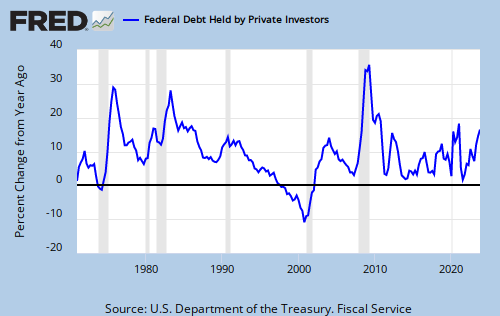
Federal debt

Clearly, federal debt/money growth is essential to keep us out of recessions. Yet, when we look at “Debt Outstanding Domestic Nonfinancial Sectors” which includes not only Federal debt, but also outstanding credit market debt of state and local governments, and private nonfinancial sectors (tan line), we do not see the same pattern.

In fact, when we subtract federal debt from total debt, leaving only state, local and private debt, we see the opposite pattern. Recessions follow increases in state, local and private debt!

4
STATE, LOCAL AND PRIVATE DEBT, PERCENT CHANGE FROM YEAR AGO

Now in one sense, money is money. Your buying on your credit card creates debt/money, just as federal deficit spending creates debt/money. Presumably, both should have the same stimulative effect on the economy. They do, but not long term. Why?

Because, unlike the federal government, you, your business and local governments cannot create new money endlessly to service your debts. Your debts can pile up to the point where you must liquidate them by paying them off or by going bankrupt. When non-federal debts become too large, a growing number of people, states, cities and businesses must pull back and stop further borrowing, i.e. stop creating money, or even destroy money by paying off loans. When that happens, we have a recession.

(As an aside, this is one reason the early stimulus efforts had so little effect. People used the stimulus money to pay off loans, so while the federal deficit spending created money, the loan pay-downs destroyed it. Debt reduction destroys debt/money.)

During the recession, and for a short time after, we tend to cut back on our personal borrowing and liquidate debt/money. Then we begin to resume borrowing, more and more, until again, we hit our personal limits and cut back, causing yet another recession. The sole prevention of this cycle, which averages about 5 years in length, is to make sure that federal deficit spending grows sufficiently to offset periodic money destruction by the private sector.

In summary, federal deficit spending is good for the economy, always good, endlessly good (up to the point of inflation). Private and local government spending/borrowing also is good, but not endlessly. Unlike the federal government, the private and local-government sectors eventually reach a point where debt is unaffordable and unsustainable.

To prevent recessions, the government continuously must provide stimulus spending, then provide added stimulus spending to offset the periodic reduction of money creation by the private sector.
__________________________________________________________________________________________________________________________
These data call into question the popular belief that encouraging bank lending stimulates the economy. While short-term effects may be positive, long-term bank lending seems to lead to recessions, as servicing loans becomes ever more onerous for the monetarily non-sovereign sectors. In contrast, Federal deficit spending easily is serviced by the government, and therefore is preferable to private borrowing as a stimulus.
__________________________________________________________________________________________________________________________
Rodger Malcolm Mitchell
http://www.rodgermitchell.com


==========================================================================================================================================
No nation can tax itself into prosperity, nor grow without money growth. Monetary Sovereignty says: Cutting federal deficits to grow the economy is like applying leeches to cure anemia.

MONETARY SOVEREIGNTY

–Why the Democrats’ ignorant plan is better than the Tea/Republicans’ ignorant plan

The debt hawks are to economics as the creationists are to biology. Those, who do not understand Monetary Sovereignty, do not understand economics. If you understand the following, simple statement, you are ahead of most economists, politicians and media writers in America: Our government, being Monetarily Sovereign, has the unlimited ability to create the dollars to pay its bills.
======================================================================================================================================================

The Tea (formerly Republican) Party wants lower taxes (good) and less federal spending (bad). The Tea Party hero of the day, Rand Paul is an ardent follower of Ayn Rand. Yes, that Ayn Rand, the one who believes the rich are gods who deserve more, while the poor are leeches who deserve less.

He has couched his beliefs in Tea appeals to tax cuts, patriotism and freedom from government interference, as in freedom from health care, freedom from military protection, freedom from good roads and safe bridges, freedom from healthful medicines and food, freedom to discriminate against gays, freedom from safe banks, freedom from a good education, freedom from clean air, freedom from energy saving, freedom from police protection, freedom from Social Security, freedom from safe air travel, and the many other freedoms we so ardently desire.

But the Tea night is ending, and the dawn of realization has begun.

Washington Post: by Jon Cohen and Dan Balz, Wednesday, April 20, 2011. “Despite growing concerns about the country’s long-term fiscal problems and an intensifying debate in Washington about how to deal with them, Americans strongly oppose some of the major remedies under consideration, according to a new Washington Post-ABC News poll.

“The survey finds that Americans prefer to keep Medicare just the way it is. Most also oppose cuts in Medicaid and the defense budget. More than half say they are against small, across-the-board tax increases combined with modest reductions in Medicare and Social Security benefits. Only President Obama’s call to raise tax rates on the wealthiest Americans enjoys solid support.”

Now, as we Americans awaken to the fact that the Tea/Republican plan to reduce federal spending amounts to the reduction of all the things we want, as well as benefitting those hated rich people, somehow President Reagan’s “government is the problem” mantra doesn’t seem so attractive.

Of course, increasing taxes on anyone, rich or poor, is a typically bad, Democratic idea. All taxes remove money from the economy, and removing money from the economy causes recessions and depressions. Further, this removal of money always hurts the poor more than it hurts the rich. See: Taxing the rich hurts the poor.

That said, I favor Obama’s plan to the Tea/Republican “plan.” Before you faint, let me explain. Both plans are equally ignorant in that they begin with the false assumption federal deficit spending must be reduced. In the Economics Common Sense and Knowledge race, both parties come in last.

However, they have convinced the innocent public of this falsehood, which forces on us a lesser-of-two-evils choice, and Obama’s plan is less evil. Why? Because raising tax rates on the rich not only will satisfy the jealous public, and not only will preserve the various benefits of federal spending, but in reality, will not collect much more in taxes.

We already have learned that higher taxes beget better tax “loopholes.” Remember, rich people know how to bribe politicians better than do poor people. So as those rates rise, the deductions will rise, too. A (for instance) 10% increase in tax rates on those making more than $250K per year, will not net a 10% increase in taxes collected from the rich – maybe not even 5%. Depending on the effectiveness of the bribery, a tax rate increase actually could net less money, because better deductions could be worth more than the marginal rate.

Bottom line, the Obama plan will make everyone happier. The poor will benefit; the rich won’t care and the economy will be less injured by losing money.

As an aside, if I were running for office, my opponent would tell the voters I voted in favor of tax increases, and this is why the politicians find themselves surrendering to their party, rather than thinking.

Rodger Malcolm Mitchell
http://www.rodgermitchell.com


==========================================================================================================================================
No nation can tax itself into prosperity, nor grow without money growth. It’s been 40 years since the U.S. became Monetarily Sovereign, and neither Congress, nor the President, nor the Fed, nor the vast majority of economists and economics bloggers, nor the preponderance of the media, nor the most famous educational institutions, nor the Nobel committee, nor the International Monetary Fund have yet acquired even the slightest notion of what that means.

Remember that the next time you’re tempted to ask a dopey teenager, “What were you thinking?” He’s liable to respond, “Pretty much what your generation was thinking when it screwed up the economy.”

MONETARY SOVEREIGNTY

–Economic disaster: Congress in agreement

The debt hawks are to economics as the creationists are to biology.

By Z. BYRON WOLF ABC News; July 27, 2010; “Debt Commission: Dealing With Federal Debt Likely To Require Tax Hikes, Spending Cuts. On both sides of the aisle, lawmakers are coming to terms with hard political fact: services are going to have to be cut and taxes are going to have to go up to keep the $13 trillion-plus national debt from skyrocketing into infinity and beyond.”

Our leaders have no idea what they are talking about. Cutting services and raising taxes is not a “hard political fact.” These are the absolute worst steps we could take, not just unnecessary, but massively harmful to our economy. The infamous DEBT COMMISSION, whose assignment it is to reduce the economy’s money supply, is akin to a “blood commission,” whose job it is to reduce the blood supply. Money is the lifeblood of an economy.

The same people who complain there are not enough jobs, also want to reduce money creation, the very thing that creates jobs. Our leaders act like doctors, who apply leeches to cure anemia. The country needs lower taxes, not higher. The country needs more federal spending, not less. These politicians, totally ignorant about economics, make economic decisions with the expected result.

And don’t be fooled by statements that taxes only will be increased on the rich. That simply is not true. All taxes destroy money. Period. Destroying any money, whether currently owned by rich or poor, decreases the total money supply, which hurts the entire American economy. You cannot drain water from only one end of a bathtub. A tax on Bill Gates hurts us all. It benefits no one.

And what are the “unnecessary” services that will be cut? See: SERVICES, and decide what we should eliminate — remembering that eliminating any federal spending reduces the money supply.

I cannot express in stronger terms how outrageously harmful this all will be. I urge you to contact your Senators, your Representatives and your media, and tell them to learn economics before making these terrible economic decisions that absolutely, positively will injure us all.

If Congress were employed by Al-Qaeda, they could not hurt America more than they now wish to do. If someone told you, “I have a plan to destroy billions or even trillions of American dollars,” you rightfully would brand him a traitor. More countries die from enemies within than from enemies without.

Rodger Malcolm Mitchell
http://www.rodgermitchell.com

No nation can tax itself into prosperity