–John Mauldin defines “too much debt”

The debt hawks are to economics as the creationists are to biology.

John Mauldin responded to my comment on his post, “Pushing on a String”

“I don’t know why you think I would not respond. Just happened to see this on Google alerts.

I have been quite clear on what is too much debt. I have done whole e-letters on it. It is debt growth above nominal GDP on a consistent basis, which ends up in a Greece like state. In fact, I will have a book out in January called The Endgame which goes into hundreds of pages of detail about the problems with debt and debt crises.

Now, I do not want private businesses or people borrowing beyond their own means or banks lending if they do not think there is reason to believe they will be repaid. And there is a limit to how much countires can borrow. To assert that the US can borrow without limit is rather absurd. You write:
‘And here is the government, which can service a debt of any size, and functionally is incapable of bankruptcy, and the debt hawks want to restrict debt.’

Go read Rogoff and Reinhart. 266 crises in 60 countries over the last few hundred years, from countries that can print their own money to gold standard currencies. Everything was fine until the last moment. There are more than one ways to default on debt, and one way is to print the money and debase the money supply. Inflation ruins pensioners and savers. If that is your ideal future, then by all means, run up that debt!

John”

First John, you have my apology. You responded, and did so without name-calling, which not only is commendable, but a rarity in the debt hawk world. Unfortunately, you didn’t offer any facts, so I will supply one.

Again, you said,“I have been quite clear on what is too much debt . . . It is debt growth above nominal GDP on a consistent basis, which ends up in a Greece like state.”

Here is a graph you might find interesting:
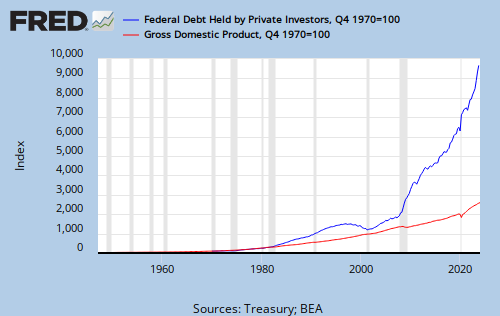
Graph

It shows that in the past 40 years GDP has risen less than 1,400% while federal debt has risen 3,500% — well more than double the rate. I would call that “debt growth above nominal GDP on a consistent basis,” wouldn’t you? Yet, where is the inflation?

The last big inflation was in 1979, at a time when debt growth did not exceed GDP growth.

Also, ” . . . ends up in a Greece like state . . .” makes no sense, whatsoever. The U.S. is monetarily sovereign. Greece is not. It functionally is impossible for a monetarily sovereign nation magically to transform itself into a “Greece like state.”

The debt hawk inflation bogeyman emerges every time deficit spending is mentioned. I’m surprised you didn’t offer pre-war Germany or Zimbabwe as examples. But that bogeyman has hurt the lives of real people. It has prevented universal health care. It has restricted Social Security and Medicare benefits. It has given us a monster, wasteful, unnecessary federal tax system. And all because the debt hawks tell us that eventually — eventually — we will have inflation.

Yet, money debasement is not related only to money supply, but more importantly to money demand (interest rates), which is why in the past 40 years, there has been no relationship between federal deficits and inflation.

Again, I do appreciate your comments and your courage, but because you do not understand monetary sovereignty, you simply are wrong.

Rodger Malcolm Mitchell
http://www.rodgermitchell.com

No nation can tax itself into prosperity.

–John Mauldin spreads the old myths

The debt hawks are to economics as the creationists are to biology.

You may have heard of John Mauldin, self described “investment writer/analyst.” He distributes an E-letter in which he discusses economics. I assume he has many readers who believe what he tells them. More’s the pity, because Mr. Mauldin seems to know little-to-nothing about economics.

Recently I received one of his E-letters, this one titled, “The Dark Side of Deficits.” Here are some direct quotes: “The research of Reinhardt and Rogoff demonstrates that when the government debt-to-GDP level gets to about 90%, trend growth seems to drop by about 1%. They do not offer an explanation, just an observation. My speculation is that it might be government spending and debt crowding out private savings, not leaving enough for productive private investment.

Perhaps neither Reinhardt nor Rogoff offers an explanation simply because there is none. As readers of this blog know, the federal debt/GDP ratio is totally meaningless. “Federal debt” is the total accumulation of all federal debt for every year since the beginning of this nation; GDP is a one-year measure. Anyone quoting this ratio should stop, immediately. It is a nonsensical apples/oranges statistic.

At last count, Japan’s debt/GDP ratio was 210%, and according to a June, 2010 Associated Press article, “Earlier in the month, Japan upgraded its economic growth in the January-March quarter to an annualized pace of 5 percent from 4.9 percent in a preliminary report.” That’s with a 210% for the phony debt/GDP ratio!

Further, there is no economic mechanism for “government spending and debt to crowd out private savings.” The exact opposite is true. Federal deficit spending, which adds money to the economy, increases savings. The “crowding out” myth is so outrageously wrong, I never know whether to laugh at the ignorance or cry at the result of such beliefs.

Further quoting Mr. Mauldin, “. . . if we do not get control of our deficit spending, we (in the US) risk putting our growth in jeopardy.” Deficit spending adds money to the economy, and this economy is starved for money, but Mr. Mauldin suggests reducing the amount of money coming into the economy. Talk about putting our growth in jeopardy!

And here is a hint about the fundamental cause of Mr. Mauldin’s confusion. He says, “There are those among us who are like teenagers, wanting to make the easy choice and avoid the pain today, not worrying about the consequences down the road.” He seems to adopt the puritanical belief that anything easy or painless inevitably will have dire consequences. So he opts for the most painful solution to our recession — presumably some combination of painful tax increases and painful reduced federal support for things like Medicare, Social Security, infrastructure, environment, defense and education. I assume he has his teeth filled without novocaine.

Note to Mr. Mauldin: When someone is starving, the easiest, least painful choice is to feed them, not to remove food as you suggest. Money is the food of our economy, and adding money to a starving economy is the only sensible act.

But, of all the foolish comments in Mr. Mauldin’s E-letter, perhaps the most frightening was this one, describing his travels: “. . . back to Dallas for a speech to the local Tiger 21 group. Then, starting September 11, I fly to Amsterdam for the International Broadcasting Conference, then to Malta, Zurich, Mallorca, Denmark (speech open to public), and London, home for one day, and then off for a speech to Cambridge Brokers on the 24th. Then I’m in Houston on October 1 for another public speech.

Good heavens, the man is going to innoculate and indoctrinate all those people with nonsense, and those people will tell others, who will tell others, and soon a huge number will believe they know something about economics, when in fact, they know less than nothing. They know wrong.

If you read Mr. Mauldin’s writings, just for laughs, then enjoy. But if you read for his economic analyses and his market predictions, be cautious.

Rodger Malcolm Mitchell
http://www.rodgermitchell.com

No nation can tax itself into prosperity

–Open letter to John Mauldin re. his myths

      John Mauldin is President of Millennium Wave Advisors, LLC (MWA) which is an investment advisory firm registered with multiple states. He also is a registered representative of Millennium Wave Securities, LLC, (MWS) an NASD registered broker-dealer. He is the author of Thoughts from the Frontline, a blog at Mauldin.
      Recently, Mr. Mauldin wrote an article for his blog, and I wrote to him with a critique, as follows:

5/9/10
Mr. Mauldin:

      This note is sent to you in the spirit of helpfulness. Your article titled “The Center Cannot Hold,” quoting G. Cecchetti, M. S. Mohanty, and Fabrizio Zampolli contains several widely quoted, commonly believed myths. For example:

      Myth: “Long before we get to the place where we in the US are paying 20% of our GDP in interest (which would be about 80% of our tax collections, even with much higher tax rates) the bond market, not to mention taxpayers, will revolt. The paper’s authors clearly show that the current course is not sustainable.”
      Fact: Federal borrowing no longer (after 1971) is necessary nor even desirable. See: How to Eliminate Federal Deficits

      Myth: “A higher level of public debt implies that a larger share of society’s resources is permanently being spent servicing the debt. This means that a government intent on maintaining a given level of public services and transfers must raise taxes as debt increases.”
      Fact: Society’s resources do not service federal debt. See: Taxes do not pay for federal spending.

      Myth: “And if government debt crowds out private investment, then there is lower growth.”
      Fact: This also commonly is stated, “Government debt crowds out private borrowing” and government debt crowds out private lending.” There is no mechanism by which federal spending can crowd out investment, borrowing or lending. On the contrary, federal spending adds to the money supply, which stimulates investment, borrowing and lending. See: Why spending stimulates investment

      Myth: “A government cannot run deficits in times of crisis to offset the affects of the crisis, if they already are running large deficits and have a large debt. In effect, fiscal policy is hamstrung.”
      Fact: This is the strangest myth, since running deficits in a time of crisis is exactly what the U.S. government has been doing. It would be true of Greece and the other EU nations, but not of then U.S., Canada, Australia, China and other monetarily sovereign systems. See: Greece’s solution

      Myth: “[…] the current leadership of the Fed knows it cannot print money.”
      Fact: This myth is even stranger than the above “strangest” myth, since printing money is exactly what the Fed does. See: Unsustainable debt.

      Myth: “As frightening as it is to consider public debt increasing to more than 100% of GDP, an even greater danger arises from a rapidly aging population.”
      Fact: The famous federal debt/GDP ratio is completely meaningless – a classic apples/oranges comparison – that neither describes the health of the economy, nor measures the government’s ability to pay its bills nor has any other meaningful purpose. See: The Debt/GDP ratio

      If you would like to see more common myths about our economy, go to: Common economic myths

Rodger Malcolm Mitchell