-A prediction about stagflation


An alternative to popular faith

        Next year, the Fed may be faced with stagflation, the simultaneous occurrence of economic stagnation and inflation. Sadly, the Fed cannot cure stagflation.
        You’ll find a more complete discussion of this phenomenon at http://rodgermitchell.com/inflation.html, but here is a quick overview:
        Money is the lifeblood of an economy. During a recession, an economy suffers from “anemia,” a shortage of money. The treatment for anemia is to increase the blood supply. But typically, the Fed tries to cure recession by cutting interest rates and tries to cure inflation by doing the opposite, i.e. increasing interest rates. Since recession is not the opposite of inflation, doing the opposite doesn’t work, and changing interest rates does not fix the money shortage.
        To cure inflation it is necessary to raise interest rates. To cure stagnation it is necessary to treat the anemia, i.e to deficit spend. The former is the task of the Fed. The later is the task of Congress. That’s why the Fed alone cannot cure stagflation.
        Unfortunately, the Fed wrongly believes high interest rates slow the economy, so when stagflation appears, the Fed will urge a reduction in deficit spending (bleeding the anemic), which they consider “fiscally prudent,” while only reluctantly and incrementally raising interest rates.
        This will continue the Greenspan and Bernanke policies, which will extend or worsen the recession.

Rodger Malcolm Mitchell

-Peter Schiff and the money-supply myth

The debt hawks are to economics as the creationists are to biology. Those, who do not understand Monetary Sovereignty, do not understand economics. If you understand the following, simple statement, you are ahead of most economists, politicians and media writers in America: Our government, being Monetarily Sovereign, has the unlimited ability to create the dollars to pay its bills.
==========================================================================================================================================================================================================

         Peter Schiff, who is running for one of Connecticut’s Senate seats and is president of Euro Pacific Capital, writes: “Almost every dictionary defines inflation as an expansion of the money supply, not rising prices.”
         Untrue. I have no idea what dictionary this guy is using, but he probably is using the libertarian “inflation is monetary inflation,” meaning supply = inflation.

        Money is a commodity. It is a surrogate in what otherwise would be a barter transaction.
         Inflation is the loss of money’s value compared with the value of goods and services. Like all commodities, the value of money is based on supply and demand. Increasing the supply does not cause inflation if the demand (interest rates) increases proportionately.

        [Note: Schiff may be influenced by the widely discredited and essentially worthless Austrian school of economics definition for inflation, a definition that has no real-world value, in that it does not include actual price changes.]
         Schiff also says, “Although more money may not immediately translate into rising prices, over time the correlation is extremely reliable.”

monetary sovereignty

        There is no historical relationship between M3 (green) or M2 (red) growth and inflation (blue). The reason: Money supply is only half the demand/supply story.
        When the Fed gets a whiff of inflation it raises interest rates, which by increasing the demand for money, increases the value of money (i.e. prevents/cures inflation).

Rodger Malcolm Mitchell
http://www.rodgermitchell.com


==========================================================================================================================================
No nation can tax itself into prosperity, nor grow without money growth. It’s been 40 years since the U.S. became Monetary Sovereign, , and neither Congress, nor the President, nor the Fed, nor the vast majority of economists and economics bloggers, nor the preponderance of the media, nor the most famous educational institutions, nor the Nobel committee, nor the International Monetary Fund have yet acquired even the slightest notion of what that means.

Remember that the next time you’re tempted to ask a dopey teenager, “What were you thinking?” He’s liable to respond, “Pretty much what your generation was thinking when it screwed up my future.”

MONETARY SOVEREIGNTY

–Deficits, inflation and hyperinflation

The debt hawks are to economics as the creationists are to biology. Those, who do not understand monetary sovereignty, do not understand economics. Cutting the federal deficit is the most ignorant and damaging step the federal government could take. It ranks ahead of the Hawley-Smoot Tariff.
==========================================================================================================================================

      It commonly is believed large federal deficits cause inflation. Examples often are given of Germany, China, Brazil, Italy and other nations that experienced hyperinflation.

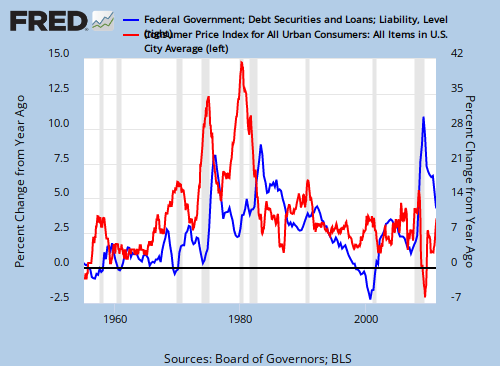
So it might be useful to see what the experience in America has been. Here’s a graph created by the St. Louis Federal Reserve. The blue line is deficit growth. The red line is inflation.

In the past 50 years at least, deficit growth has not been associated with inflation.

Inflation is more closely related to special factors than to deficits; such things as oil shortages, wars and weather are the main culprits.

Deficits vs inflation

I do not suggest the government should create an unlimited amount of money, though it has the power to do so. In 1979, gross federal debt was $800 billion. In 2009 it reached $12 trillion, a 1400% increase in 30 years.

During that period, GPD rose 440% (annual rate of 5.5%) with acceptable inflation throughout. The same 1400% increase would put the debt at $180 trillion in 2039, a mean deficit of $5+ trillion.

This calculates to a 9.5% annual debt increase for the past 30 years. Repeating that growth rate would put the 2010 deficit at about $1.14 trillion, and the 2011 deficit at about $1.25 trillion.

The deficit for year 2039 would be about $15.8 trillion. I know of no reason why the results would not be the same as they have been in the past 30 years.

However, increasing the debt growth rate above 9.5% might show even better results. In the 10 year period, 1980 – 1989, federal debt grew 210%, from $900 billion to $2.8 trillion (a 12% annual debt increase), while GDP grew .96% from $2.8 trillion to $5.5 trillion (a 7% annual increase).

During that same period, inflation fell from 14.5% in 1980 to 5.2% in 1989.
In summary, large deficits have led to GDP growth, while not causing unacceptable levels of inflation. Those are the bare bones.

For more information, see http://www.rodgermitchell.com