–Ignorance: Why you will pay more taxes and receive less service in the coming years.

The debt hawks are to economics as the creationists are to biology. Those, who do not understand monetary sovereignty, do not understand economics. Cutting the federal deficit is the most ignorant and damaging step the federal government could take. It ranks ahead of the Hawley-Smoot Tariff.
======================================================================================================================================================

Here is an article from the Washington Post, demonstrating how ignorance of Monetary Sovereignty is destroying our economy.

Recession-bruised states’ revenue sank 30 percent in 2009, Census Bureau reports

By Michael A. Fletcher, Washington Post Staff Writer , Wednesday, January 5, 2011; 11:09 PM

The recession blew a huge hole in the already shaky finances of state governments, causing them to lose nearly one-third of their revenue in 2009, according to a Census Bureau report released Wednesday. . .

At the same time, states are grappling with swollen social service caseloads, underfunded pension funds and flat revenue – a situation that will worsen as federal stimulus aid comes to a halt in the coming months.

Future federal help is considered highly unlikely, as Congress and President Obama have put a greater emphasis on reducing spending and trimming the huge federal budget deficit.

The new census report adds to the bleak portrait that has emerged from other studies documenting the damage caused by the economic downturn, while making plain that states are likely to continue struggling fiscally for years.

“This report paints a fairly compelling picture of the impact of the recession on states,” said Susan K. Urahn, managing director of the Pew Center on the States. “There are many states predicting that they’re not going to return to pre-recession levels of revenue until 2014.”

Our Monetarily Sovereign, federal government, which has the unlimited ability to create money and pay bills of any size, refuses to give the states the support they need. Meanwhile the monetarily non-sovereign states, which do not have money-creating ability, suffer, and more importantly, we citizens suffer from reduced services and increased taxes.

Education, police and fire protection, roads and bridges, medical services, pensions and on and on, all reduced while our federal government sits on its unlimited pile of cash. Our federal leaders believe they are being fiscally prudent, while in fact, they are destroying America.

Their ignorance hurts us all.

Rodger Malcolm Mitchell
http://www.rodgermitchell.com

No nation can tax itself into prosperity. Those who say the stimulus “didn’t work” remind me of the guy whose house is on fire. A neighbor runs with a garden hose and starts spraying, but the fire continues. The neighbor wants to call the fire department, which would bring the big hoses, but the guy says, “Don’t call. As you can see, water doesn’t put out fires.”

–When will the economy recover?

The debt hawks are to economics as the creationists are to biology. Those, who do not understand monetary sovereignty, do not understand economics. Cutting the federal deficit is the most ignorant and damaging step the federal government could take. It ranks ahead of the Hawley-Smoot Tariff.
======================================================================================================================================================================

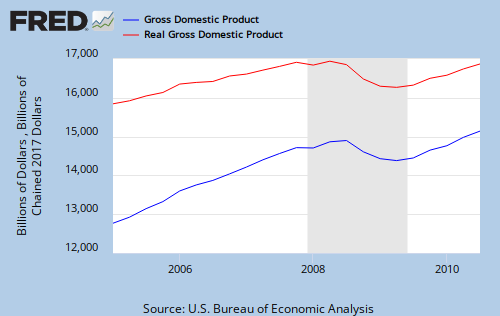
At long last, when will the economy recover? Wait a minute. Look at this graph:

graph 1

Considering that the data only goes through September, 2010, one easily can infer that the economy already has recovered. Yes, the stock market has not recovered, but that could be good news. It could mean it still has plenty of recovery left in it.

And yes, unemployment still is a big problem:

But that could be a good thing, too (although not for those who are unemployed.) A high level of unemployment mitigates against inflation. The government could continue to use its infinite spending ability and not be concerned it was causing inflation. For instance, FICA could be eliminated, as it should be, rather than the tentative, temporary step now taken. And the standard deduction could be raised, also as it should be. And Social Security benefits could be increased, and Medicare could be expanded, again as they should be.

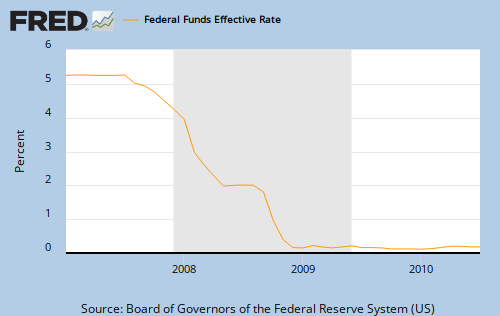
And interest rates have stayed way down:

graph 3

And that’s another good thing, because it means the Fed has plenty of room (not that “room” really is needed) to raise rates if inflation should rear its ugly head.

There are plenty of leading indicators one might explore, but these graphs give me cause for optimism, if only the federal government will seize the moment.

Rodger Malcolm Mitchell
http://www.rodgermitchell.com

No nation can tax itself into prosperity. Those who say the stimulus “didn’t work” remind me of the guy whose house is on fire. A neighbor runs with a garden hose and starts spraying, but the fire continues. The neighbor wants to call the fire department, which would bring the big hoses, but the guy says, “Don’t call. As you can see, water doesn’t put out fires.”

–Which Taxes Are Fairest? Which Taxes are Least Fair?

The debt hawks are to economics as the creationists are to biology.

Lately, there has been more talk about revising our taxes to be more “fair.” There even is an organization that calls itself FairTax.org, which promotes a national sales tax, a first cousin to the European style value-added tax.

All federal taxes remove money from our economy, and for that reason, all federal taxes hurt our economy. Unfortunately, the belief that federal taxes are necessary (They are not) is so powerfully ingrained, it is impossible to have a rational discussion on the subject.

So we are left with repeated attempts to fix the unfixable.

Tax fairness often is confused with tax simplification.

The U.S. Tax Code contains 50 Chapters. Each chapter is divided into Sub Chapters, each of which is divided into Parts, and then into Paragraphs, all of which are subject to interpretation by Congress, the Internal Revenue Service and the courts.

Because all elements of our economy are intertwined, the interpretation of one paragraph impacts the interpretations of other paragraphs, which then require further interpretations, which impact other paragraphs and ad infinitum. Thus, our Tax Code has acquired infinite complexity, which one could argue is unfair.

Supposedly there was a king who nailed laws too high to be read, then punished those who broke the laws. Would that have been fair?

Tax complexity is inevitable. Imagine the simplest possible tax idea: Tax every man, woman and child $1,000 per year. Period. Simple enough? Fair?

How long would it be before “modifications” would be made? Reduce this tax on the poor. Increase it on the rich. Multiple definitions of “poor” and “rich.” Various payment requirements (monthly? quarterly? annually?).

Charitable deductions allowed? Do businesses pay? Definitions of “business” vs. “person.” Even the simplest possible tax idea soon will turn ever more complex and so, unfair.

The American ethic is based on “getting ahead” and on “fairness.” However, being ahead seems unfair to those who are behind.

Taxes can be levied in a variety of ways, all justifiable as “fair” and all condemned as “unfair.” For instance:

A unit tax on individuals: Each person pays the same tax (similar to an airport departure tax). This tax is fair, because it treats every individual equally. This tax is unfair, because it takes as much from the poor as from the rich.

“Sin” or luxury taxes on cigarettes, liquor, entertainment, gambling, restaurants, travel, etc. are fair, because they tax things we do not need. These taxes are unfair, because they arbitrarily designate certain items as not being needed. (Is an apple “needed?”)

FICA is fair, because the people who pay are the people who receive Social Security and Medicare. This tax is unfair, because it is a regressive tax.

Sales taxes are fair, because each person pays according to his consumption. Sales taxes are unfair, because they place a burden on low income people, who spend a greater percentage of their income and save/invest less.

Flat-rate income tax is fair, because each person pays the same rate. These taxes are unfair, because the poor cannot afford to pay as high a rate as the wealthy. They also are unfair, because some people will pay more than others.

Progressive rate income tax is fair, because high earners can afford to pay a higher rate. This tax is unfair, because even at a flat rate, higher earners would pay more. A progressive rate compounds the unfairness.

Tax on Social Security benefits is fair, because social security is just another form of income. These taxes are unfair, because income tax already was paid on Social Security deposits. It is a double tax.

Tax on Medicare benefits. See above.

Inheritance tax is fair, because wealthy families can afford to pay more. This tax is unfair, because taxes already have been paid on the assets being inherited. It is a double tax.

Personal property tax is fair, because the wealthy can afford to pay more. This tax is unfair, because taxes already have been paid on the earnings needed to acquire the assets. It is another double tax.

Tax on stock dividends is fair, because dividends are no different from any other income. This tax is unfair, because companies cannot deduct the cost and already have paid taxes on the earnings. It is one more double tax.

Taxes on corporations are fair because business should pay its share. These taxes are unfair, because they penalize workers by reducing corporations’ ability to hire and to pay salaries and benefits.

All taxes are fair and unfair, depending on whose toes are pinched. Discussions of tax fairness are sophistry, demagoguery or both. If you hear someone arguing that one federal tax is fairer while another is unfair, mark that person as a liar or a fool.

The question of federal tax fairness is not an appropriate subject for economics’ discussions. No tax is fair, and the federal government doesn’t need tax money. Perhaps the discussion is more appropriate for a psychology seminar.

If taxes are wrongly to be collected for anti-inflation purposes, the real question should be: How harmful is it to the overall economy?

In nearly all cases, the tax will be harmful. (Exceptions may be taxes collected to curtail harmful items that politically cannot be eliminated by law. These include taxes on guns, drugs, cigarettes, etc.)

I submit that the most harmful taxes tend to be those most likely to widen the Gap between the rich and the rest, i.e. the most regressive taxes.

Rodger Malcolm Mitchell
http://www.rodgermitchell.com

No nation can tax itself into prosperity. Those who say the stimulus “didn’t work” remind me of the guy whose house is on fire. A neighbor runs with a garden hose and starts spraying, but the fire continues. The neighbor wants to call the fire department, which would bring the big hoses, but the guy says, “Don’t call. As you can see, water doesn’t put out fires.”
 

–Professor Black and the secret plot to defeat Obama

The debt hawks are to economics as the creationists are to biology. Those, who do not understand monetary sovereignty, do not understand economics. Cutting the federal deficit is the most ignorant and damaging step the federal government could take. It ranks ahead of the Hawley-Smoot Tariff.
==============================================================================================================================================

On Monday, December 13, 2010, William Black, associate professor of economics and law at the University of Missouri-Kansas City, wrote a post on his blog, New Economic Perspectives, titled, “Obama haters praise his tax policies because they believe those policies will make him fail” (I once spoke at the UMKC, and have great respect for the professors of economics whom I met there. I still correspond with Professor Randall Wray, one of the more brilliant minds in economics.)

The thrust of Professor Black’s post was summarized in his first paragraph:

Like the Sirens reputed to lure sailors onto rocks, a series of columnists who want President Obama to fail are praising Obama’s capitulation on extending the Bush tax cuts for the wealthy. The motif of these comments has three common characteristics – all designed to destroy the Obama presidency. First, and the chutzpah of this aspect is wondrous, those that hate Obama’s policies are telling Obama he is demonstrating his strength by surrendering on the Bush tax cuts to the wealthy. Second, they claim that Obama “moved to the center” by agreeing to support tax cuts for the wealthy. Third, they claim that Obama’s attacks on his strongest supporters are brilliant politics essential to saving his Presidency.

Professor Black’s fundamental complaint was:

Obama’s promise to end the Bush tax cuts for the wealthy was supported by a strong majority of Americans. . . The people who want Obama to fail consistently push him to abandon policies that are desirable and broadly supported by the public. . .

I commented on Professor Black’s post, and the essence of my comments was:

“A couple of problems. First, because the public does not understand monetary sovereignty, and so does not understand economics, the beliefs held by the public do not necessarily constitute ‘policies that are desirable.’

“Second, increasing taxes on any group, rich or poor, removes money from the economy, and so is anti-growth. There is zero economic benefit from increasing taxes on the rich, despite the emotional satisfaction it may give the poor.

“Obama was dragged kicking and screaming into exactly the right action, i.e. he didn’t increase any taxes other than the ‘death tax,’ and that went up less than feared.

“In total, his ‘capitulation’ is predicted to give us a continuation of the Bush tax rates, a reduction in FICA and a lesser increase in the death tax. Assuming this bill passes, we will have a much better chance of exiting the recession. If that’s ‘losing|,’ I’ll take losing over winning every time.”

I was quite surprised to read Professor Black’s post. Because he teaches at UMKC, I innocently had expected he would have a better understanding of federal finance and monetary sovereignty. Perhaps, the word has not yet had time to float around the hallowed halls.

Rodger Malcolm Mitchell
http://www.rodgermitchell.com

No nation can tax itself into prosperity. Those who say the stimulus “didn’t work” remind me of the guy whose house is on fire. A neighbor runs with a garden hose and starts spraying, but the fire continues. The neighbor wants to call the fire department, which would bring the big hoses, but the guy says, “Don’t call. As you can see, water doesn’t put out fires.”