–Chicago Tribune reminds us why our nation is in trouble.

The debt hawks are to economics as the creationists are to biology. Those, who do not understand Monetary Sovereignty, do not understand economics. If you understand the following, simple statement, you are ahead of most economists, politicians and media writers in America: Our government, being Monetarily Sovereign, has the unlimited ability to create the dollars to pay its bills.
========================================================================================================================

Thank heaven for the Chicago Tribune. Without them and their ilk, I might have nothing to write. Despite frequent letters from me, they continue to display an almost supernatural reluctance to understand what they write about. These folks simply refuse to learn economics, and they seem proud of it. Here’s their latest:

“S&P didn’t wait for the hot air to finish blowing before raising the prospect that at some point, the U.S. government may not be able to keep paying interest on its bonds.”

Ah, yes, the old “at some point.” Add it to “eventually,” “someday,” “some time,” “soon,” “ticking time bomb,” “unsustainable,” “over time,” and other confident predictions about an unknown future.

The federal government is Monetarily Sovereign. It has the unlimited ability to credit checking accounts. In the space of one minute, the federal government could credit every bond holder’s checking account, not only for interest, but for principal. Further, because a government with the unlimited ability to create dollars does not need to borrow dollars, all federal debt could disappear in that one minute. And none of this would affect federal spending by even one cent.

Imagine. A nation without debt, and it easily can be accomplished without adding even one dollar to the money supply, so there are no inflation implications. What would the Tea (formerly Republican) Party have to scream about then?

Anyway, what does the Tribune mean when it says the U.S. government may not be able to keep paying interest? Ask them. Let me know if ever they answer.

“A rating cut almost certainly would push interest rates higher, undermining the Federal Reserve’s efforts to pump up the economy by printing money.”

Perhaps, the Tribune editors can be excused for not knowing it mostly is the Treasury that “prints money.” (Actually, credits checking accounts. Physical printing is a minuscule part of dollar creation.) But the Trib cannot be excused for thinking interest rates affect a Monetarily Sovereign nation’s ability to create money. Even were interest rates 200%, the government easily could continue creating dollars. Not that we recommend such a thing, but the physical ability exists.

“Unable to borrow on reasonable terms, America would have no choice but to win back the market’s confidence by jacking up taxes and slashing programs.”

I’ve asked the Tribune on many occasions, “Why would a nation, with the unlimited ability to create dollars, need to borrow dollars?” They never answer, so once again I’ll try to educate the ineducable. The federal government does not need to create T-securities, then trade them for dollars it previously created. T-securities could disappear (as could taxes), and this would not affect the federal government’s ability to spend. (Yes, yes, I know. There are inflation implications to the instant elimination of taxes, but not to the elimination of T-securities)

“It’s the federal government that can’t stop borrowing more than $4 billion a day to pay for politicians’ priorities.”

Federal borrowing pays for absolutely nothing. And excuse me, but do you consider Medicare, Social Security, Medicaid, food stamps, the military, the infrastructure, R&D, education, etc., etc., etc., to be politicians’ priorities? How about people’s priorities?

“(The U.S. is ) much more diversified and adaptable than the smaller European countries now in severe distress. But even the world’s most powerful nation can’t buy time forever when it’s running up a tab it hasn’t got the money to pay.”

Here the Tribune editors show they don’t understand the difference between the Monetary Sovereignty of the U.S. and the monetary non-sovereignty of “smaller European countries.” And as for, “. . . it hasn’t got the money to pay,” if that were true, how have we been paying it? (And please, please don’t say, “by borrowing.”)

Actually, this isn’t the worst Tribune editorial. It’s pretty much average on the ignorance meter. But it provides a reminder of how astray our media have helped lead America. The only solution is for the media to receive letters, lots and lots of letters, urging them to open their minds to learning. If you want to contribute to the effort, here are some people you may wish to contact:

Gerould W. Kern at ctc-editor@tribune.com
R. Bruce Dold, Editorial Page Editor at bdold@tribune.com
Jane Hirt, VP/Managing Editor at jhirt@tribune.com
Joycelyn Winnecke, VP/Associate Editor at jwinnecke@tribune.com

Perhaps, if enough of us write, the message will begin to penetrate.

Rodger Malcolm Mitchell
http://www.rodgermitchell.com


==========================================================================================================================================
No nation can tax itself into prosperity, nor grow without money growth. It’s been 40 years since the U.S. became Monetarily Sovereign, and neither Congress, nor the President, nor the Fed, nor the vast majority of economists and economics bloggers, nor the preponderance of the media, nor the most famous educational institutions, nor the Nobel committee, nor the International Monetary Fund have yet acquired even the slightest notion of what that means.

Remember that the next time you’re tempted to ask a dopey teenager, “What were you thinking?” He’s liable to respond, “Pretty much what your generation was thinking when it screwed up the economy.”
–How Monetary Sovereignty differs from Modern Monetary Theory — simplified

The debt hawks are to economics as the creationists are to biology. Those, who do not understand Monetary Sovereignty, do not understand economics. If you understand the following, simple statement, you are ahead of most economists, politicians and media writers in America: Our government, being Monetarily Sovereign, has the unlimited ability to create the dollars to pay its bills.
==========================================================================================================================================

Some have asked what is the difference between Monetary Sovereignty (MS) and Modern Monetary Theory (MMT). Others use the terms interchangeably.

Actually, while both share many features, there are differences. Both understand that the U.S. federal government is Monetarily Sovereign, while euro nations, and U.S. states counties and cities are monetarily non-sovereign. Monetarily Sovereign governments uniquely:

–Have the unlimited ability to credit bank accounts (pay bills), including their own
–Neither need nor use taxes or borrowed funds to support spending
–Rely on continually increased deficits, rather than on exports, to support economic growth

And, there are additional similarities, related to, and/or derived from, the above.

Two differences should be noted, one not particularly important and one quite important. Of lesser importance: MMT says the purpose of taxes is to create demand for money. The requirement that taxpayers use dollars creates the need for taxpayers to accept dollars as payment for debts.

MS doesn’t deny that taxes help create demand for dollars, though other factors may be sufficient. Perhaps the most important factors are: Dollars are legal tender and dollars are commonly used and accepted by the vast majority of Americans and the world (which does not pay U.S. taxes).

Yet, even were the MMT position to be correct, it is clear that federal taxes are not necessary for demand purposes, as there are adequate state and local taxes, all of which are paid in dollars, making the point moot. After some discussion, I believe MMT now accepts the position that federal taxes are not necessary to create demand for dollars.

The more important difference between MS and MMT is the handling of inflation. MS suggests increasing interest rates when inflation threatens. MMT holds that increasing interest rates exacerbates inflation by increasing costs, and that the correct prevention/cure for inflation is to reduce federal deficits, with higher taxes and/or with reduced federal spending.

MS says:

1. Deficits have not been related to inflation for at least 40 years. Instead, inflation has been related to oil prices. Since deficits have not been the cause, reducing deficits is not the cure.

2. Reduced federal deficits lead to recessions and depressions, meaning the MMT approach leaves a poor choice between inflation and recession, or a very difficult balancing act between the two.

3. Reducing federal deficits cannot be done quickly or incrementally. The questions surrounding which taxes to raise or which spending to cut are slow, difficult, cumbersome and politically charged, as witness the repeated battles over the debt ceiling. Deficit control is ill suited to inflation fighting, which needs fast, incremental action.

4. Interest is a minor cost for most businesses, and an increase in interest rates represents a minuscule increase in business costs – not enough to affect pricing significantly.

5. Money is a commodity, the value of which is determined by supply and demand. Demand is determined by risk and reward. The reward for owning money is interest, so when interest rates increase, investment tends to flow to money (i.e. bonds, CDs, money markets), increasing the value of money. When interest rates fall, investment tends to flow to non-money (stocks, real estate), reducing the value of money. Increased money value is the prevention/cure for inflation.

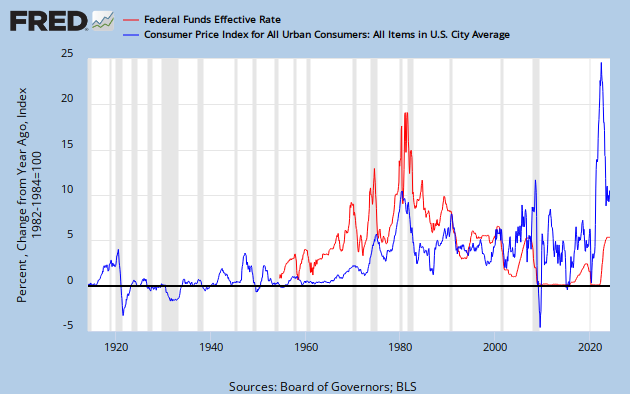
There isn’t definitive evidence supporting either the MMT or MS position, though there are some hints. There actually is something of a parallel between higher Fed Funds rates and higher inflation, which at first glance might support the MMT position.

test

However, because the Fed raises interest rates in anticipation of inflation, this parallel is to be expected. Timing is key. If high rates fight inflation, one would expect to see rates rise as inflation rises, with the highest rates followed by reductions in inflation. The above graph seems to show a Fed raising interest rates in anticipation of inflation, then reducing rates as inflation moderates.

(Unfortunately, the picture is blurred by the Fed’s use of interest rates not just to cure inflation but in a misguided attempt to stimulate the economy.)

In any event, the Fed’s following of the raise-rates-to-prevent/cure-inflation prescription seems to have been successful. Despite massive deficits in the past, particularly during and after the Reagan administration, and despite significant increases in the price of oil (the prime driver for inflation) the Fed has been able to keep inflation close to its 2%-3% annual goal. Tax policy has not been involved.

Though substantial reductions in deficits could cut inflation (by causing recessions or depressions), I’ve encountered no good arguments this would be a wise strategy. Recessions and depressions are a poor solution for inflation.

I do see historical evidence that interest rate control has been an effective means for inflation control.

Rodger Malcolm Mitchell
http://www.rodgermitchell.com


==========================================================================================================================================
No nation can tax itself into prosperity, nor grow without money growth. It’s been 40 years since the U.S. became Monetarily Sovereign, and neither Congress, nor the President, nor the Fed, nor the vast majority of economists and economics bloggers, nor the preponderance of the media, nor the most famous educational institutions, nor the Nobel committee, nor the International Monetary Fund have yet acquired even the slightest notion of what that means.

Remember that the next time you’re tempted to ask a dopey teenager, “What were you thinking?” He’s liable to respond, “Pretty much what your generation was thinking when it screwed up the economy.”

MONETARY SOVEREIGNTY

Are there good deficits and bad deficits?

The debt hawks are to economics as the creationists are to biology. Those, who do not understand Monetary Sovereignty, do not understand economics. Cutting the federal deficit is the most ignorant and damaging step the federal government could take. It ranks ahead of the Hawley-Smoot Tariff.
====================================================================================================================================================================================

While Congress struggles with plans to cut federal deficits (i.e. cut federal money creation), and simultaneously tries to encourage banks to lend (i.e increase private money creation), it might be instructive to see why this is exactly the wrong approach. Please go to a post I wrote last June (since updated), titled, Is federal money better than other money?

Rodger Malcolm Mitchell
http://www.rodgermitchell.com

No nation can tax itself into prosperity, nor grow without money growth.

–Economic policy that’s stuck in reverse, by Senator Jeff Sessions

The debt hawks are to economics as the creationists are to biology. Those, who do not understand monetary sovereignty, do not understand economics. Cutting the federal deficit is the most ignorant and damaging step the federal government could take. It ranks ahead of the Hawley-Smoot Tariff.

Here are some excerpts from an article titled, “Economic policy that’s stuck in reverse,” by Senator Jeff Sessions

Monday, January 24, 2011

As record levels of federal spending bring us ever closer to a tipping point, the Obama administration blissfully continues business as usual. We have seen no real plan, no strong leadership, no apparent willingness to confront the growing danger on the horizon.

At no point in his article does Senator Sessions say exactly what that “tipping point” or the “danger on the horizon” is. Will the federal government run out of money? Will we have uncontrollable inflation? Will taxes be forced up? The Senator never says, perhaps because the answer to all three questions is a resounding, “No.” Or perhaps because Senator Sessions has no idea what the answer is, and enjoys using scare words.

Last month, President Obama would agree to maintain current tax rates only if Congress would agree to increase federal deficit spending. We are headed toward a cliff, yet the president hits the accelerator.

Again, no explanation of “the cliff.” Does he mean he economic accelerator, the last thing the party not in power ever wants?

Meanwhile, others are moving in the opposite direction. England has a plan to cut its deficit by 86 percent in just four years. New Jersey Gov. Chris Christie has a plan to close his state’s funding gap without raising taxes. Even California’s new liberal governor has put forward a plan to cut state spending by 9 percent.

Here Senator Sessions demonstrates he does not understand the implications of Monetary Sovereignty. New Jersey and California are not monetarily sovereign, so cannot survive on tax money alone. They need to reduce spending or increase taxes. England is Monetarily Sovereign, but their politicians know as little about economics as do our politicians. If England ever were to reduce its deficit by 85%, they will have a recession or depression. (Worldwide, the nation with the smartest economists and politicians may be Monetarily Sovereign China, which so far has shown no fear of deficits, and thus has had the fastest recovery.)

Just days ago, former Federal Reserve chairman Alan Greenspan ominously warned that U.S. debt may lead to a bond market crisis in two to three years.

Reminder to Senator Sessions: This is the same Alan Greenspan, under whose financial leadership, the nation went into the worst recession since the Great Depression. He has no credibility, nor do the people who quote him. Imagine a Fed chairman who is unaware the U.S. federal government does not need to create T-securities out of thin air, because it already has the power to create dollars out of thin air.

A debt crisis continues to spread through Europe that could reach our financial markets any moment. Now is the time to act. Yet the president continues to resist any meaningful steps to secure our financial future.

Specifically what has the European monetarily non-sovereign debt crisis to do with U.S. budgets? How will reducing our budgets stave off the European debt crisis? Senator Sessions never says, because presumably he has no idea.

To begin turning the corner, I propose that any effort to raise the debt ceiling be tied to no less than a sustained 10 percent reduction of current discretionary spending. Though this is only a first step, it would finally be a step in the right direction – one the country can easily absorb.

A “reduction in spending” is a synonym for a “reduction in money creation,” which invariably has led to recessions and depressions. See: Growth summary. Senator Sessions doesn’t read history. But, O.K., he has me sold. Let’s start with cutting Congressional salaries and perks. Let’s eliminate Congressional health insurance, and let those folks pay for it themselves. No more “fact-finding” junkets to warm climates in winter. Reasonable, Senator?

On Tuesday, President Obama will deliver his State of the Union address. Soon after, he will come forward with a new budget. This is a defining moment for his presidency. His proposals cannot be timid. And he must demonstrate that he is at last willing to shed his Keynesian worldview.

Guarantee: Senator Sessions has no idea what a “Keynsian worldview” is. But it makes him sound learned.

As we enter the annual budget season, Washington will need to consider the kind of change this country has not accomplished since 1997 – when a strong Republican Congress passed a budget that converted soaring deficits into surpluses.

Hmm. Wasn’t it a Republican president named Reagan, who instituted our greatest post-war deficits? And is he really taking credit for the Democratic Clinton surpluses, which caused the Republican Bush recession? Ah, details, details.

We need a budget with a bold vision – like those unveiled in Britain and New Jersey; one that reduces both the size of the deficit and the size of the government. We need a budget that does not require tax increases as the price for spending cuts – because while the spending cuts may disappear, the economic drain of higher taxes will not. And we need a budget that turns us back from the cliff so we can head down a new road – toward leaner government, responsible spending and a thriving private sector.

Again, the cliff? What is that cliff? Will we ever be told? Probably not. Anyway, what we really need is Congressional leaders who understand economics, so we wouldn’t continue to average one recession every five years. Is that too much to hope for, at least from the ranking Republican on the Senate Budget Committee?

By the way, I recently was interviewed on radio station WNZF by Abby Romaine. Click this link to hear the show: Radio Interview

Rodger Malcolm Mitchell
http://www.rodgermitchell.com

No nation can tax itself into prosperity.