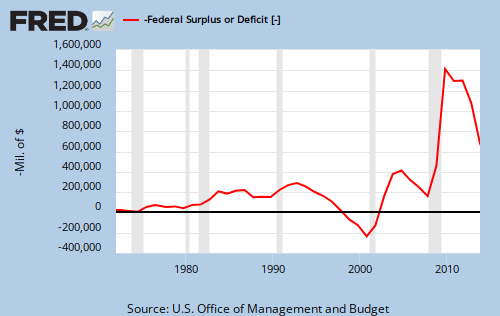
–What thrilling things happen to federal deficits in the years preceding recessions?

Twitter: @rodgermitchell; Search #monetarysovereignty
Facebook: Rodger Malcolm Mitchell

Mitchell’s laws:
●The more federal budgets are cut and taxes increased, the weaker an economy becomes.
●Austerity is the government’s method for widening the gap between rich and poor,
which ultimately leads to civil disorder.
●Until the 99% understand the need for federal deficits, the upper 1% will rule.
To survive long term, a monetarily non-sovereign government must have a positive balance of payments.
●Those, who do not understand the differences between Monetary Sovereignty and monetary non-sovereignty, do not understand economics.
●The penalty for ignorance is slavery.
●Everything in economics devolves to motive.

======================================================================================================================================================================================
Two questions:

1. What happens to the federal deficit in the years preceding recessions?

2. What happens to the federal deficit during recoveries?

Monetary Sovereignty

————————–FYFSD is the federal deficit————————–

Inspect at the above graph, and consider your answers to those two questions as you read these excerpts from a Washington Times article:

Federal deficit below $1 trillion for first time in Obama’s tenure
By Stephen Dinan

Powered by tax increases and deep budget cuts that held spending in check, the federal deficit dropped to $680 billion in fiscal year 2013. Taxes grew to $2.774 trillion, marking an all-time high.

All those who think tax increases stimulate the economy, please raise your hands.

All those who think reduced federal spending stimulates the economy, please raise your hands.

The deficit is less than half the record $1.413 trillion figure Mr. Obama and President George W. Bush shared in fiscal year 2009.

That is still higher than economists say is healthy, but it’s far more manageable than at the height of the recession.

All those who can explain how deficits “at the height of the recession” were not manageable, please raise your hands.

All those, in classes taught by the above-mentioned economists, please tell me their names and contact info.

White House budget director Sylvia Mathews Burwell said the figures mean Mr. Obama has made good on his pledge to cut the deficit in half.

She said the credit belongs to Mr. Obama for fighting to raise taxes in the January “fiscal cliff” deal, and for drawing down troops in Afghanistan.

All those who wish to give Mr. Obama a nice, big pat on the back, for starving our economy of money, please raise your hands.

The 2013 deficit figure would have been worse if the government hadn’t borrowed nearly $40 billion from the Social Security trust funds.

The deficit also benefited from a $83.5 billion credit from federally backed housing programs Fannie Mae and Freddie Mac.

First translation: In government-speak, “worse” actually means “better,” as in, “If the government had not borrowed from the Social Security trust funds, $40 billion more dollars would have entered the U.S. economy. Somehow, this would have made the economy “worse.”

Second translation: “Deficit benefited” actually means “economy injured,” as in Fannie and Freddie pulled $83.5 billion out of the private sector, which injured the economy.

Now for a bit of irony: Fed Chairman Bernanke falsely claims the Fed stimulates the economy by purchasing $85 billion worth of T-securities each month. The world believes him, and panics when he threatens to stop.

(The claim is that this causes $85 billion new dollars to enter the economy every month.) If the claim were true (It isn’t), adding all those dollars would be quite stimulative.

But (here’s the irony), while bragging about how stimulative the Fed is, with its phony $85 billion supposedly entering the economy every month, the government also brags about more than a trillion dollars leaving the economy, via increased taxes and reduced federal spending.

The populace is thrilled about the Fed adding dollars to the economy, and equally thrilled about Obama taking dollars from the economy.

And no one, including those economists mentioned above, sees anything contradictory about this.

That’s why we’re so thrilled with reduced deficits. We hate deficits but we are O.K. with unemployment, poverty, recessions and depressions.

It’s what we’ve been taught.

Rodger Malcolm Mitchell
Monetary Sovereignty

====================================================================================================================================================
Nine Steps to Prosperity:
1. Eliminate FICA (Click here)
2. Medicare — parts A, B & D plus long term nursing care — for everyone (Click here)
3. Send every American citizen an annual check for $5,000 or give every state $5,000 per capita (Click here)
4. Free education (including post-grad) for everyone. Click here
5. Salary for attending school (Click here)
6. Eliminate corporate taxes (Click here)
7. Increase the standard income tax deduction annually
8. Increase federal spending on the myriad initiatives that benefit America’s 99% (Click here)
9. Federal ownership of all banks (Click here)

—–

10 Steps to Economic Misery: (Click here:)
1. Maintain or increase the FICA tax..
2. Spread the myth Social Security, Medicare and the U.S. government are insolvent.
3. Cut federal employment in the military, post office, other federal agencies.
4. Broaden the income tax base so more lower income people will pay.
5. Cut financial assistance to the states.
6. Spread the myth federal taxes pay for federal spending.
7. Allow banks to trade for their own accounts; save them when their investments go sour.
8. Never prosecute any banker for criminal activity.
9. Nominate arch conservatives to the Supreme Court.
10. Reduce the federal deficit and debt

No nation can tax itself into prosperity, nor grow without money growth. Monetary Sovereignty: Cutting federal deficits to grow the economy is like applying leeches to cure anemia.
Two key equations in economics:
1. Federal Deficits – Net Imports = Net Private Savings
2. Gross Domestic Product = Federal Spending + Private Investment and Consumption – Net Imports

THE RECESSION CLOCK
Monetary Sovereignty Monetary Sovereignty

As the federal deficit growth lines drop, we approach recession, which will be cured only when the lines rise.

#MONETARY SOVEREIGNTY

Blackmail Party: “Play me or I’ll take my ball and go home.”

Twitter: @rodgermitchell; Search #monetarysovereignty
Facebook: Rodger Malcolm Mitchell

Mitchell’s laws:
●The more federal budgets are cut and taxes increased, the weaker an economy becomes.
●Austerity is the government’s method for widening the gap between rich and poor,
which ultimately leads to civil disorder.
●Until the 99% understand the need for federal deficits, the upper 1% will rule.
To survive long term, a monetarily non-sovereign government must have a positive balance of payments.
●Those, who do not understand the differences between Monetary Sovereignty and monetary non-sovereignty, do not understand economics.
●The penalty for ignorance is slavery.
●Everything in economics devolves to motive.

======================================================================================================================================================================================

Here’s a variation on the proverbial story of the fat, little kid, who can’t play a lick of baseball, but does own the ball, so you either play him — at shortstop, no less — or he’ll take his ball and go home. See, he can’t get the “votes” of the other players, so he resorts to extortion.

Based on recent history, one can assume the Blackmail Party is composed of fat little guys, who learned at an early age, that extortion was a good way to get what they want.

So today, it isn’t enough that the Blackmail Party’s extortion tactics cost thousands of struggling Americans their jobs and cost a struggling American economy billions of dollars, for no good reason. It isn’t enough that the Blackmail Party, having lost 48 separate votes to wreck the Affordable Care Act, decided to shut down the government, when Congress and the President refused to reverse their votes.

No, the Blackmail Party, feeling that extortion is the the way to overcome the realities of the democratic process (as well as the Democratic Party), has decided to amp up the extortion:

Talking Point Memo
McCain Threatens To Hold Yellen Nomination Over Benghazi Details
Catherine Thompson — October 31, 2013

Sen. John McCain (R-AZ) said Wednesday that he and Sen. Lindsay Graham (R-SC) plan to delay the nomination of Janet Yellen to chair the Federal Reserve in order to obtain information on the 2012 Benghazi attacks from the Obama administration, the Wall Street Journal reported.

You may wonder what does Janet Yellen have to do with Benghazi, and of course, the answer is: Absolutely nothing. But Senator McCain has decided his desire to continue the useless Benghazi inquisition is more important than having a Chairman of the Federal Reserve.

Perhaps, he was a fat, little kid, who learned that stealing the game ball was a good way to force everyone to let him play.

But it gets worse for the Blackmail Party:

Graham Threatens to Block All Nominations Without Benghazi Answers

WASHINGTON — Sen. Lindsey Graham threatened Monday to hold up all nominations for federal government positions until survivors of last year’s deadly attack on the diplomatic post in Libya appear before Congress.

Yes, not only will the nomination of the Chairman of the Federal Reserve be held up, but ALL nominations for federal government positions will be stalled until Lindsey gets his way — another fat little kid who couldn’t play ball, but sure can play the extortion game.

But the Blackmail Party wasn’t finished:

Huff Post
Rand Paul Threatens To Hold Up James Comey FBI Nomination Over Drones
By Bradley Klapper 07/10/13 AP

WASHINGTON — Sen. Rand Paul is threatening to block approval of President Barack Obama’s nominee as the next FBI director until he gets answers about drone use inside the United States.

The Kentucky Republican says he has written the FBI twice seeking the agency’s rules for domestic drone use. He says he has told the FBI he’ll put a hold on James Comey’s nomination until his questions are answered.

Comey spent 15 years as federal prosecutor before serving in Bush administration. Obama has nominated him to replace outgoing FBI Director Robert Mueller.

And so we hear from yet another member of the Blackmail Party that doesn’t believe in the democratic process, and for certain, never will believe in the Democratic process.

And the beat goes on. Here’s one from early this year:

Senator to ‘Hold’ Nominee for CIA Director
FEB 13, 2013

Senator Rand Paul is pledging to “hold” John Brennan’s nomination for CIA director, a statement from his Senate office reports.

“I have asked Mr. Brennan if he believed that the President has the power to authorize lethal force, such as a drone strike, against a U.S. citizen on U.S. soil, and my question remains unanswered. I will not allow a vote on this nomination until Mr. Brennan openly responds to the questions and concerns my colleagues and I share.” Paul’s statement reads.

“These issues must be discussed openly so that the American people can understand what constraints exist on the government’s power to use lethal force against its citizens. Before confirming Mr. Brennan as the head of the CIA, it must be apparent that he understands and will honor the protections provided to every American by the Constitution.”

Well, at least the extortion is relevant, but really — no vote until the guy who spent four years as Deputy National Security Advisor for Homeland Security and Counterterrorism, and Assistant to the President, until he “answers some questions”?

And whether or not Brennan believed such constraints exist was, as Sen. Paul knows, irrelevant. Brennan doesn’t make policy. He follows policy. This is just another Rand Paul publicity stunt.

Presumably, there is a value to America in having an FBI director and a CIA director. Sen. Paul doesn’t care about that. He just wants his name in the papers.

Anyway, what have we learned from all this:

1. Congressional voting doesn’t matter.
2. Passed laws doesn’t matter.
3. Supreme Court decisions don’t matter.
4. The American economy doesn’t matter.
5. American jobs don’t matter.
6. The American people don’t matter
7. FBI and CIA directors don’t matter
8. Federal tasks don’t matter.

So, what matters? Sticking it to the opposition party and getting your name in the papers.

The Blackmail Party tells us extortion, not votes, is the way we will run our government. It’s a terrible lesson.

Rodger Malcolm Mitchell
Monetary Sovereignty

====================================================================================================================================================
Nine Steps to Prosperity:
1. Eliminate FICA (Click here)
2. Medicare — parts A, B & D plus long term nursing care — for everyone (Click here)
3. Send every American citizen an annual check for $5,000 or give every state $5,000 per capita (Click here)
4. Free education (including post-grad) for everyone. Click here
5. Salary for attending school (Click here)
6. Eliminate corporate taxes (Click here)
7. Increase the standard income tax deduction annually
8. Increase federal spending on the myriad initiatives that benefit America’s 99% (Click here)
9. Federal ownership of all banks (Click here)

—–

10 Steps to Economic Misery: (Click here:)
1. Maintain or increase the FICA tax..
2. Spread the myth Social Security, Medicare and the U.S. government are insolvent.
3. Cut federal employment in the military, post office, other federal agencies.
4. Broaden the income tax base so more lower income people will pay.
5. Cut financial assistance to the states.
6. Spread the myth federal taxes pay for federal spending.
7. Allow banks to trade for their own accounts; save them when their investments go sour.
8. Never prosecute any banker for criminal activity.
9. Nominate arch conservatives to the Supreme Court.
10. Reduce the federal deficit and debt

No nation can tax itself into prosperity, nor grow without money growth. Monetary Sovereignty: Cutting federal deficits to grow the economy is like applying leeches to cure anemia.
Two key equations in economics:
1. Federal Deficits – Net Imports = Net Private Savings
2. Gross Domestic Product = Federal Spending + Private Investment and Consumption – Net Imports

THE RECESSION CLOCK
Monetary Sovereignty Monetary Sovereignty

As the federal deficit growth lines drop, we approach recession, which will be cured only when the lines rise.

#MONETARY SOVEREIGNTY

–What really will cause the revolution?

Twitter: @rodgermitchell; Search #monetarysovereignty
Facebook: Rodger Malcolm Mitchell

Mitchell’s laws:
●The more federal budgets are cut and taxes increased, the weaker an economy becomes.
●Austerity is the government’s method for widening the gap between rich and poor,
which ultimately leads to civil disorder.
●Until the 99% understand the need for federal deficits, the upper 1% will rule.
To survive long term, a monetarily non-sovereign government must have a positive balance of payments.
●Those, who do not understand the differences between Monetary Sovereignty and monetary non-sovereignty, do not understand economics.
●The penalty for ignorance is slavery.
●Everything in economics devolves to motive.

======================================================================================================================================================================================

Many posts in this blog describe the following cause and effect:

The income/wealth gap between the rich and the rest is what makes the rich rich. If there were no gap, by definition, we all would be the same, so no matter how much we would make or have, no one would be rich.

If everyone on the planet had $1 million, none of us would be considered rich. But if one person had just $100, while the rest of us had $1, that one person would be rich. The wider the gap, the richer are the rich.

For those reasons, it is not absolute income or wealth that concerns the rich. It is the gap.

For me to be richer, I need only to increase my income relative to yours, or to decrease your income, relative to mine. Either approach accomplishes the same ends of making me richer.

In their ongoing desire to become ever richer, the rich bribe politicians, media writers and economists. The politicians are bribed via campaign contributions and promises of lucrative employment later. The media, being owned by the rich, bribe their writers )(with jobs) to mislead the public and the economist, who work for universities bribed by rich donors, write articles designed to improve tenure.

The result of all this bribery is to convince the public that federal deficit spending should be reduced. The reason: Federal deficit spending primarily benefits the non-rich, and so, narrows the income/wealth gap.

In summary, the cause is the desire of the rich to widen the gap, who use the “BIG LIE,” the false statement that austerity benefits the economy. Austerity, by reducing federal benefits spending and/or increasing taxes on lower incomes (FICA being a prime example), widens the gap.

Or, that is what I have written on many occasions. One example: Tax “expenditures,” “broadening” the base, and other lies to widen the gap Friday, Jul 26 2013.

Recently, however, I came upon a somewhat different scenario. It was in an article in the October 10, 2013 NewScientist Magazine. Here are a few excerpts (Updated 17:01 10 October 2013 by Debora MacKenzie):

The government of the most powerful country on earth has shut down and is dangerously close to defaulting on its debt. Its people and economy are feeling the consequences, and a new global financial crisis might not be far behind.

For Peter Turchin, a mathematical ecologist at the University of Connecticut in Storrs, the stand-off was predictable. He is one of a small group of people applying the mathematics of complex systems to political instability. They have been anticipating events just like this.

Turchin has found what he believes to be historical cycles, two to three centuries long, of political instability and breakdown affecting states and empires from Rome to Russia.

Workers or employees make up the bulk of any society, with a minority of employers constituting the top few per cent of earners. By mathematically modelling historical data, Turchin finds that as population grows, workers start to outnumber available jobs, driving down wages. The wealthy elite then end up with an even greater share of the economic pie, and inequality soars.

This process also creates new avenues – such as increased access to higher education – that allow a few workers to join the elite, swelling their ranks. Eventually this results in what Turchin calls “elite overproduction” – there being more people in the elite than there are top jobs. ”

The richest continue to become richer, existing advantage feeds back positively to create yet more. Elite overproduction explains why competition becomes so bitter, with no one willing to compromise. This means the squabbling in Congress is a symptom of societal forces at work, rather than the primary problem.

Such political acrimony is paralleled by rising discontent among workers left with less and less, and increasing state bankruptcy as spending by the elite who control the government coffers spirals. Ultimately, the situation gets so bad that order cannot be maintained and the state collapses.

In Turchin’s theory, this phase in the cycle should also be marked by political polarisation and rising government debt – both current crises in Washington.

According to Turchin, the cause of economic disorder does not begin with the rich wanting a larger gap, but rather, begins with increased population, not only among the not-rich, but later among the rich, themselves.

Turchin finds that a simple mathematical model, combining economic output per person, the balance of labour demand and supply, and changes in attitudes towards redistributing wealth – the minimum wage level is one proxy for this – generates a curve that exactly matches the change in real wages since 1930, including complex rises and falls since 1980.

The statistics show we are in another phase of rising instability that began in the 1970s, just when, as his theory predicts, labour supply started outstripping demand.

Such close agreement between model and reality is exceptional in social sciences, says Turchin, and shows that all three factors control the rise of inequality, as predicted.

Let’s take a moment to catch our breath. First the “close agreement between model and reality” might be explained by “reverse engineering” of the model. When a model contains many variables, each of which has a different weight and change rate, finding “close agreement” with reality could mean fiddling with each variable until an overall mathematical match is found.

This is called “predicting the past.”

Commodity price chartists, run into this problem all the time. They look for a formula that has predicted the past, only to discover it doesn’t predict the future.

Further, when Turchin talks about, “increasing state bankruptcy, as spending by the elite who control the government coffers, spirals,” and “rising government debt (a) current crisis in Washington,” he is demonstrating an ignorance of Monetary Sovereignty.

Rising government debt is not a crisis, but a growth necessity, and the U.S. neither is closer to, nor further from, bankruptcy, than we have been for 40 years. Yet, the gap has grown massively.

But when Turchin says productivity (economic output per person) is one of the variables leading to economic disorder, this seems to agree both with logic and data — if we assume unemployment is a predictive signal for economic disorder.

monetary sovereignty

The red line is annual, real Gross Domestic Product, per capita growth. The blue line is unemployment (shown in the negative).

When fewer people can produce more, fewer people are needed — at all levels of income — unless demand grows even faster.

But government spending is an important part of demand and demand growth is inhibited by deficit growth reduction.

Bottom line, we find ourselves in an endless downward helix:

1. Productivity and population both increase..

2. When fewer of an increasing population are needed to produce goods and services, unemployment will increase unless more and more goods and services are demanded.

3. The federal government’s purchases are an important part of overall demand, so reductions in federal deficit growth reduce demand growth, leading to unemployment growth.

4. Meanwhile, the populace is brainwashed by the rich-owned politicians, the rich-owned media and the rich-owned, university-employed, mainstream economists into believing federal deficit spending should be reduced.

5. Not only does deficit growth reduction reduce demand (see #3), but it reduces the direct income of the not-rich, as the vast majority of deficit spending benefits the not-rich more than it benefits the rich. (Social Security, Medicare, Medicaid, poverty aid, employment by federal suppliers, etc.)

6. Greater unemployment together with reduced social benefits spending, increases poverty.

7. Such tax “reform” proposals as “broadening the tax base,” increases in FICA and all sales-related taxes, have a greater impact on the not-rich than the rich.

8. As unemployment increases, relative tax collections decrease, stimulating the government to apply even greater cuts to federal spending, which then reduces the services most needed by the not-rich.

What does a cholera outbreak in Mexico have to do with the US government shutdown? Plenty. The Centers for Disease Control and Prevention (CDC) in Atlanta, Georgia, would normally monitor the situation to help prevent the disease spreading across the border. But the shutdown has put the agency out of action. Cholera could therefore spread in the US for some time undetected, warns an epidemiology consultancy that is tracking the Mexican outbreak.

9. Because of what Turchin terms “elite overproduction,” the very rich work even harder to widen the gap between them and the not-quite-as-rich, who in turn, work to widen the gap between the middle — and down the line to the destitute.

(Turchin) believes our current experience also reflects something new: technology has brought about the emergence of a complex, networked society, one that, he argues, existing democratic institutions are too simplistic to govern.

In summary, what is the cause of our misery, and how can it be resolved? Turchin seems to feel the cause is population and productivity growth, and it can be resolved if (quote) “citizens evolve decentralised, networked institutions more suited to managing complexity.

I believe the cause is the insatiable desire to widen the income/wealth gap, and can resolve when a powerful and trusted leader, who has compassion for the underclasses (a F.D. Roosevelt? J. Kennedy? L. Johnson?), and understands Monetary Sovereignty, educates the populace and reverses the drive for austerity.

Or, as more people are driven to destitution, there will be a revolution.

Food Stamp Cuts Coming For Everyone — Including Nearly A Million Veterans
October 28th, 2013, Jason Sattler

Nearly 48 million families will see a cut in their Supplemental Nutritional Assistance Program (SNAP) benefits this Friday, resulting in a reduction of 16 meals a month for a family of three. These cuts to food stamps, as SNAP is more commonly known, are the result of expiring stimulus programs and are likely to be compounded by further cuts in the upcoming federal budget agreement and restrictions being implemented by the states.

This cut will affect all SNAP beneficiaries — children, seniors, people with disabilities — including an estimated 900,000 veterans. More than 80 percent of these Americans are living in poverty.

Are 48 million, angry, hungry families enough to begin the revolution?

Rodger Malcolm Mitchell
Monetary Sovereignty

====================================================================================================================================================
Nine Steps to Prosperity:
1. Eliminate FICA (Click here)
2. Medicare — parts A, B & D plus long term nursing care — for everyone (Click here)
3. Send every American citizen an annual check for $5,000 or give every state $5,000 per capita (Click here)
4. Free education (including post-grad) for everyone. Click here
5. Salary for attending school (Click here)
6. Eliminate corporate taxes (Click here)
7. Increase the standard income tax deduction annually
8. Increase federal spending on the myriad initiatives that benefit America’s 99% (Click here)
9. Federal ownership of all banks (Click here)

—–

10 Steps to Economic Misery: (Click here:)
1. Maintain or increase the FICA tax..
2. Spread the myth Social Security, Medicare and the U.S. government are insolvent.
3. Cut federal employment in the military, post office, other federal agencies.
4. Broaden the income tax base so more lower income people will pay.
5. Cut financial assistance to the states.
6. Spread the myth federal taxes pay for federal spending.
7. Allow banks to trade for their own accounts; save them when their investments go sour.
8. Never prosecute any banker for criminal activity.
9. Nominate arch conservatives to the Supreme Court.
10. Reduce the federal deficit and debt

No nation can tax itself into prosperity, nor grow without money growth. Monetary Sovereignty: Cutting federal deficits to grow the economy is like applying leeches to cure anemia.
Two key equations in economics:
1. Federal Deficits – Net Imports = Net Private Savings
2. Gross Domestic Product = Federal Spending + Private Investment and Consumption – Net Imports

THE RECESSION CLOCK
Monetary Sovereignty Monetary Sovereignty

As the federal deficit growth lines drop, we approach recession, which will be cured only when the lines rise.

#MONETARY SOVEREIGNTY

–A Study in Contrasts: A President and a Governor

Twitter: @rodgermitchell; Search #monetarysovereignty
Facebook: Rodger Malcolm Mitchell

Mitchell’s laws:
●The more federal budgets are cut and taxes increased, the weaker an economy becomes.
●Austerity is the government’s method for widening the gap between rich and poor,
which ultimately leads to civil disorder.
●Until the 99% understand the need for federal deficits, the upper 1% will rule.
To survive long term, a monetarily non-sovereign government must have a positive balance of payments.
●Those, who do not understand the differences between Monetary Sovereignty and monetary non-sovereignty, do not understand economics.
●The penalty for ignorance is slavery.
●Everything in economics devolves to motive.

======================================================================================================================================================================================

This is a study in contrasts.

The U.S. government invented its sovereign currency, the dollar. It authored from thin air, all the laws that made the dollar possible and continue to make the dollar what it is, today.

With its unlimited ability to change those laws at will, the government has 100% control over the dollar.

The government creates as many dollars as it wishes, simply by paying bills. It destroys as many dollars as it wishes, simply by taxing. It can change its laws to give the dollar any value it wishes, thereby preventing or causing inflation or deflation.

Having given itself these legal powers, the U.S. government does not need to ask anyone for dollars — not you, not me, not China, not Europe, not any banks.

The U.S. government does not need to tax or to borrow dollars. The government is the absolute sovereign over the dollar. There is nothing the U.S. government cannot afford. By its own lawmaking powers, it is Monetarily Sovereign.

In contrast, the dollar is not the State of Vermont’s sovereign currency. Vermont needs to tax and borrow dollars or it could run short of dollars. Vermont has no more control over the dollar than it has over the euro, the yen or the renminbi. All are “alien” currencies for Vermont.

Like you and me and like every busines and every state, county and village in America, Vermont is monetarily non-sovereign.

Which is why the following is both amazing and discouraging:

The Washington Times
Vermont plans launch of ‘universal’ health care system: It’s a ‘right and not a privilege’
By Associated Press

(Vermont) has a planned 2017 launch of the nation’s first universal health care system, a sort of modified Medicare-for-all that has long been a dream for many liberals.

The plan is especially ambitious in the current atmosphere surrounding health care in the United States. Republicans in Congress balk at the federal health overhaul years after it was signed into law. States are still negotiating their terms for implementing it.

(The plan) combines universal coverage with new cost controls in an effort to move away from a system in which the more procedures doctors and hospitals perform, the more they get paid, to one in which providers have a set budget to care for a set number of patients.

The result will be health care that’s “a right and not a privilege,” Gov. Peter Shumlin said.

He said he expects a payroll tax to be a main source of funding, giving for the first time a look at how he expects the plan to be paid for.

Think about it. The United States government, having the legal ability to create unlimited dollars and the further ability to give those dollars any value it wishes, does not provide its citizens with universal health care.

But little Vermont, with limited resources, amazingly will try to do just that.

Several times in recent years, hundreds of people have rallied in Montpelier for a campaign advocating that health care is a human right.

Vermont’s small size also is often credited with helping preserve its communitarian spirit. People in its towns know one another and are willing to help in times of need.

Compare that with America at large, where one party leadership, sneers at the poor and sick and uninsured as “leeches” and “sloths” who “always are looking for a handout,” while the other party leadership claims this Monetarily Sovereign nation “cannot afford” to provide health care for its people.

Will Vermont succeed? The problem it faces is money, a huge problem indeed. Universal health care is expensive, and a monetarily non-sovereign’s ability to pay is limited. But the Governor and the people of Vermont are trying, because they recognize their human duty, to care for their fellow citizens.

By contrast, that convoluted, complex, tangled labyrinth known as the Affordable Care Act (nee Heritagecare, nee Romneycare, now Obamacare), covers some people more and some people less, with deductions for all sorts of contingencies — that plan — not Medicare for All — is the best the President of the United States, given unlimited resources, can propose.

Discouraging.

Why are the Americans in Vermont different from Americans as a whole? They aren’t. The difference is in their leadership.

Vermont is led by a group of courageous, compassionate giants, whose primary concern is the well-being of their fellow human beings. America is led by a group of frightened, means-spirited, little people, whose primary concern is their wealthy contributors, their own future incomes and a future Presidential Library.

Would that Governor Peter Shumlin were President, and not that other guy. How great this nation could become.

It’s a study in contrasts.

Rodger Malcolm Mitchell
Monetary Sovereignty

====================================================================================================================================================
Nine Steps to Prosperity:
1. Eliminate FICA (Click here)
2. Medicare — parts A, B & D plus long term nursing care — for everyone (Click here)
3. Send every American citizen an annual check for $5,000 or give every state $5,000 per capita (Click here)
4. Free education (including post-grad) for everyone. Click here
5. Salary for attending school (Click here)
6. Eliminate corporate taxes (Click here)
7. Increase the standard income tax deduction annually
8. Increase federal spending on the myriad initiatives that benefit America’s 99% (Click here)
9. Federal ownership of all banks (Click here)

—–

10 Steps to Economic Misery: (Click here:)
1. Maintain or increase the FICA tax..
2. Spread the myth Social Security, Medicare and the U.S. government are insolvent.
3. Cut federal employment in the military, post office, other federal agencies.
4. Broaden the income tax base so more lower income people will pay.
5. Cut financial assistance to the states.
6. Spread the myth federal taxes pay for federal spending.
7. Allow banks to trade for their own accounts; save them when their investments go sour.
8. Never prosecute any banker for criminal activity.
9. Nominate arch conservatives to the Supreme Court.
10. Reduce the federal deficit and debt

No nation can tax itself into prosperity, nor grow without money growth. Monetary Sovereignty: Cutting federal deficits to grow the economy is like applying leeches to cure anemia.
Two key equations in economics:
1. Federal Deficits – Net Imports = Net Private Savings
2. Gross Domestic Product = Federal Spending + Private Investment and Consumption – Net Imports

THE RECESSION CLOCK
Monetary Sovereignty Monetary Sovereignty

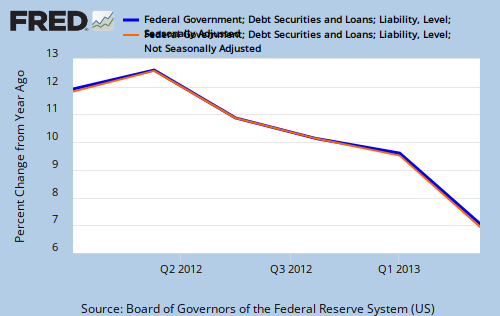
As the federal deficit growth lines drop, we approach recession, which will be cured only when the lines rise.

#MONETARY SOVEREIGNTY