–The five little words that doom the American middle class

Twitter: @rodgermitchell; Search #monetarysovereignty
Facebook: Rodger Malcolm Mitchell

Mitchell’s laws:
●The more federal budgets are cut and taxes increased, the weaker an economy becomes.
●Austerity is the government’s method for widening the gap between rich and poor,
which ultimately leads to civil disorder.
●Until the 99% understand the need for federal deficits, the upper 1% will rule.
To survive long term, a monetarily non-sovereign government must have a positive balance of payments.
●Those, who do not understand the differences between Monetary Sovereignty and monetary non-sovereignty, do not understand economics.
●The penalty for ignorance is slavery.
●Everything in economics devolves to motive.

======================================================================================================================================================================================

Recently, someone asked me, “What’s wrong with the economy”?

I’ve been at this for almost 20 years, and that little, five-word question, stopped me. I’ve written two books and almost 1200 posts on this blog, given talks, argued, discussed — all trying to answer that question. And now I was fumbling for a succinct answer.

You know how sometimes a long story can be summarized in a single great line? I was looking for that great line.

The ethic of reciprocity (aka the “Golden Rule”) is the basis for most religions. (In 100 BC, Hillel the Elder said, “That which is hateful to you, do not do to your fellow. That is the whole Torah; the rest is the explanation.“) The Golden Rule is a great line.

When General Sherman said, “War is hell,” he told the entire story of war. Everything else is the details.

Abraham Lincoln said, “If slavery is not wrong, nothing is wrong,” which says all one needs to know about slavery and slave holders.

A personal favorite is, “Happy wife; happy life,” which is the shortest formula I know, for a successful marriage.

And then came John Boehner who, in December, 2012 said these five little words: “Let’s be honest. We’re broke.”

The irony of John Boehner mouthing the words “Let’s be honest,” cannot be improved upon, except when followed by the Big Lie, “We’re broke” — what a perfect description of the fall of the American middle class and the increased gap between the rich and the rest.

“Let’s be honest,” meaning, “All this time I haven’t been honest, but at long last I’m going to be honest,” only to be followed by yet another lie. And the public again believes it.

Think of Lucy repeatedly pulling the football away, just as Charlie Brown tries to kick it. Charlie never learns. The American public never learns, in fact, refuses to learn.

Five little words tell of bribed politicians, smug in their confidence they can lie and lie and lie, knowing there will be no punishment — knowing they will be rewarded by their real constituency, the super-rich.

Five little words speak of a media, bought, paid for and owned by the super rich — a media that long ago has forgotten they exist to inform, and now believes they exist only to make money.

Five little words tell of scientists — university and media economists — so cowed from top to bottom, they can’t bring themselves to fight the “company” line. University and media economists so slavishly act as mouthpieces for the rich, they refuse to rise up and tell the truth.

The truth: Our Monetarily Sovereign U.S. government is not “broke,” cannot be “broke,” and never will be “broke.” Its finances are not at all like your finances. The U.S. government, unlike Greece, Italy and local governments, has the infinite ability to pay its bills, and even could do so without collecting a penny of tax from you or from your grandchildren, or by borrowing a penny from China. Austerity is the way to widen the gap between the rich and the rest. That is the truth.

But, in a second irony, if “broke” means “broken,” Boehner actually would be correct. The government has been broken by the rich, the likes of the Koch brothers, Pete Peterson et al, who bribe the media, the politicians and the universities. The government has been twisted and broken by a dishonest Supreme Court, which long ago gave up any pretense of following law, but rather invents law to widen the gap between the rich and the rest.

And then, in yet a final irony, “We’re broke” comes around as the truth, only now the “we’re” doesn’t refer to the government, as Boehner intended, but rather refers to the American people.

We the American people are broke. Lucy continues to pull the football away, and we continue to fall for it. Our wealth has been taken from us. We no longer resist. The Big Lie has taken its toll. We have no strength. We accept our fate.

Let’s be honest. We’re broke.

Rodger Malcolm Mitchell
Monetary Sovereignty

====================================================================================================================================================
Nine Steps to Prosperity:
1. Eliminate FICA (Click here)
2. Federally funded Medicare — parts A, B & D plus long term nursing care — for everyone (Click here)
3. Send every American citizen an annual check for $5,000 or give every state $5,000 per capita (Click here)
4. Free education (including post-grad) for everyone. Click here
5. Salary for attending school (Click here)
6. Eliminate corporate taxes (Click here)
7. Increase the standard income tax deduction annually
8. Increase federal spending on the myriad initiatives that benefit America’s 99% (Click here)
9. Federal ownership of all banks (Click here)

—–

10 Steps to Economic Misery: (Click here:)
1. Maintain or increase the FICA tax..
2. Spread the myth Social Security, Medicare and the U.S. government are insolvent.
3. Cut federal employment in the military, post office, other federal agencies.
4. Broaden the income tax base so more lower income people will pay.
5. Cut financial assistance to the states.
6. Spread the myth federal taxes pay for federal spending.
7. Allow banks to trade for their own accounts; save them when their investments go sour.
8. Never prosecute any banker for criminal activity.
9. Nominate arch conservatives to the Supreme Court.
10. Reduce the federal deficit and debt

No nation can tax itself into prosperity, nor grow without money growth. Monetary Sovereignty: Cutting federal deficits to grow the economy is like applying leeches to cure anemia.
Two key equations in economics:
1. Federal Deficits – Net Imports = Net Private Savings
2. Gross Domestic Product = Federal Spending + Private Investment and Consumption – Net Imports

THE RECESSION CLOCK
Monetary Sovereignty Monetary Sovereignty

As the federal deficit growth lines drop, we approach recession, which will be cured only when the lines rise.

#MONETARY SOVEREIGNTY

The 5 ways to eliminate wasteful federal spending.

Twitter: @rodgermitchell; Search #monetarysovereignty
Facebook: Rodger Malcolm Mitchell

Mitchell’s laws:
●The more federal budgets are cut and taxes increased, the weaker an economy becomes.
●Austerity is the government’s method for widening the gap between rich and poor,
which ultimately leads to civil disorder.
●Until the 99% understand the need for federal deficits, the upper 1% will rule.
To survive long term, a monetarily non-sovereign government must have a positive balance of payments.
●Those, who do not understand the differences between Monetary Sovereignty and monetary non-sovereignty, do not understand economics.
●The penalty for ignorance is slavery.
●Everything in economics devolves to motive.

======================================================================================================================================================================================

Two questions:

Exactly, what is federal wasteful spending, and why is it bad?

Imagine there are only two men in America. Our Monetarily Sovereign, federal government pays one man $10 to dig a hole, and pays the other man $10 to fill it in. Is this an example of wasteful spending? If so, why?

.

The word “wasteful” is a pejorative. Anything labeled “wasteful” is bad by definition. So yes, wasteful federal spending would be bad — if it existed. But does wasteful federal spending really exist?

Keep in mind that our federal government is Monetarily Sovereign. This means:

*The federal government, unlike state and local governments, has the unlimited ability to create dollars. It never can be forced to run short of dollars.

*The federal government creates dollars by spending. To pay a bill, the government instructs vendors’ banks to increase the balance in the vendors’ checking accounts. This is how the federal government creates dollars.

*Thus, unlike state and local taxes, federal taxes do not pay for federal spending. Even if federal taxes were $0, the federal government could continue to instruct vendors’ banks to increase the balance in vendors’ checking accounts, i.e. the federal government could pay its bills.

*Therefore, taxpayers do not pay for federal spending.

*And federal spending for one purpose does not replace federal spending for another purpose.

So again, exactly what is federal “wasteful” spending?

The Heritage Foundation, a mouthpiece for the notorious, right-wing, billionaire activist Koch brothers, offers:

Six Categories of Waste

1. Programs that should be devolved to state and local governments;
2. Programs that could be better performed by the private sector;
3. Mistargeted programs whose recipients should not be entitled to government benefits;
4. Outdated and unnecessary programs;
5. Duplicative programs; and
6. Inefficiency, mismanagement, and fraud.

Numbers 1 and 2 merely represent the Koch’s attempt to shift spending from the federal government (which can afford anything) to burden the state and local governments and the private sector with unaffordable spending. The purpose: To widen the gap between the rich and the rest by eliminating government spending, the vast majority of which benefits the non-rich.

Widening the gap gives the rich even more power over the rest, and power is what the rich want.

Number 3 reveals its purpose by the use of the word “entitled.” To the rich, no one but the rich is entitled to anything. Social Security, Medicare, Medicaid, food stamps and other aids to the middle and poor all are “mistargeted entitlements.”

But surely, “outdated,” “unnecessary,” “duplicative,” “inefficient” and “mismanaged” programs must be examples of federal wasteful spending, and they would be except for one detail, and that goes back to the first question in this post: Exactly, what is federal wasteful spending?

Or said another way: Is it possible to “waste” something for which there is an unlimited supply?

Your rowboat floats in the middle of Lake Michigan. You have a bucket of fresh water, which you now use for cleaning your boat. Have you “wasted” the fresh water?

Or: Your boat floats in the middle of the Atlantic ocean. Again you use your bucket of fresh water to clean your boat. Have you wasted the fresh water?

In the first case, there is no waste. You’re in the middle of a giant lake, having unlimited fresh water, and you now have a clean boat. In the second case, there is waste, because you’re in the middle of a salt-water ocean, and that lost fresh water is irreplaceable. It was wasted.

And that is how the Monetary Sovereignty of the federal government differs from the monetary non-sovereignty of state and local governments and the private sector.

I submit that the term “wasteful” cannot apply to federal spending. Yes, some federal spending may be more productive than other federal spending, but no federal spending precludes other federal spending. It simply is not correct to say that federal spending for “A” could have been used for “B.”

All federal spending has one huge advantage for the economy: All federal spending adds dollars to the economy, which grows the economy. (GDP = Federal Spending + Non-federal Spending + Net Exports)

What about Heritage/Koch’s final caveat, “fraud”? Is fraud an example of wasteful spending?

It depends. If the fraud steals dollars from someone in the private sector, it is wasteful. But if the fraud steals dollars from the federal government, it may be criminal, but it isn’t wasteful. In fact, it adds dollars to the economy.

Even counterfeit dollars grow the economy. So long as they are not caught, they add to private sector buying power.

Let’s get to motivation. Why does Heritage/Koch, and all the bought-and-paid-for politicians and equally bought-and-paid-for university economists stress about federal waste?

The primary financial motivation of the rich is to widen the gap between themselves and the non-rich. It is the gap that makes them rich. Without the gap, no one would be rich, and the wider the gap, the richer they are. What the rich call “waste,” are benefits to the non-rich.

As Heritage/Koch said,

“It is possible to reduce spending and balance the budget. In the 1980s and 1990s, Washington consistently spent $21,000 per household. Simply returning to that level would balance the budget by 2012 without any tax hikes.

The Kochs et al, want reduced federal spending — reduced Social Security, reduced Medicare, etc., etc., etc. The goal is to deprive the non-rich and to widen the gap.

The best way to rationalize reduced federal spending is to call it “wasteful.” Nobody likes waste. Even the people most affected by cuts in federal programs feel obliged to agree that “waste” must be eliminated. As Heritage/Koch says:

“Lawmakers seeking to rein in spending and budget deficits should begin by eliminating this least justifiable spending while also addressing long-term entitlement costs.”

And there you have it: “Long term entitlement costs.” Get rid of entitlements and the rich will have even more power over the rest.

Should there be any limit to so-called “wasteful” spending by the federal government? Yes, that limit is an inflation that cannot be prevented or cured by interest rate increases.

So, what are the 5 ways to eliminate wasteful federal spending?

1. Target all federal spending toward the goal of narrowing the gap between the rich and the rest.

There are 4 additional ways, but to recite them would be wasteful.

Rodger Malcolm Mitchell
Monetary Sovereignty

====================================================================================================================================================
Nine Steps to Prosperity:
1. Eliminate FICA (Click here)
2. Federally funded Medicare — parts A, B & D plus long term nursing care — for everyone (Click here)
3. Send every American citizen an annual check for $5,000 or give every state $5,000 per capita (Click here)
4. Free education (including post-grad) for everyone. Click here
5. Salary for attending school (Click here)
6. Eliminate corporate taxes (Click here)
7. Increase the standard income tax deduction annually
8. Increase federal spending on the myriad initiatives that benefit America’s 99% (Click here)
9. Federal ownership of all banks (Click here)

—–

10 Steps to Economic Misery: (Click here:)
1. Maintain or increase the FICA tax..
2. Spread the myth Social Security, Medicare and the U.S. government are insolvent.
3. Cut federal employment in the military, post office, other federal agencies.
4. Broaden the income tax base so more lower income people will pay.
5. Cut financial assistance to the states.
6. Spread the myth federal taxes pay for federal spending.
7. Allow banks to trade for their own accounts; save them when their investments go sour.
8. Never prosecute any banker for criminal activity.
9. Nominate arch conservatives to the Supreme Court.
10. Reduce the federal deficit and debt

No nation can tax itself into prosperity, nor grow without money growth. Monetary Sovereignty: Cutting federal deficits to grow the economy is like applying leeches to cure anemia.
Two key equations in economics:
1. Federal Deficits – Net Imports = Net Private Savings
2. Gross Domestic Product = Federal Spending + Private Investment and Consumption – Net Imports

THE RECESSION CLOCK
Monetary Sovereignty Monetary Sovereignty

As the federal deficit growth lines drop, we approach recession, which will be cured only when the lines rise.

#MONETARY SOVEREIGNTY

Government spending is good. Government taxing is good. It’s all good.

Twitter: @rodgermitchell; Search #monetarysovereignty
Facebook: Rodger Malcolm Mitchell

Mitchell’s laws:
●The more federal budgets are cut and taxes increased, the weaker an economy becomes.
●Austerity is the government’s method for widening the gap between rich and poor,
which ultimately leads to civil disorder.
●Until the 99% understand the need for federal deficits, the upper 1% will rule.
To survive long term, a monetarily non-sovereign government must have a positive balance of payments.
●Those, who do not understand the differences between Monetary Sovereignty and monetary non-sovereignty, do not understand economics.
●The penalty for ignorance is slavery.
●Everything in economics devolves to motive.

======================================================================================================================================================================================

In June, we published Government/media disinformation. You won’t learn this from your morning paper.

The article quotes Reuters “news” service. You know Reuters, that climate-change-denying, terrorism denying, owned-by-the-rich “news” source.

I you read the Reuters article, you’ll see that it claims the government’s purchase of General Motors stock stimulated the economy (by adding dollars to the economy), while the government’s subsequent sale of GM stock benefited taxpayers (by taking dollars from the economy).

Apparently, there is no difference between federal purchases and sales of private sector stocks, an amazing duality of benefit in which no matter what the federal government does, it’s good.

Now today, Time published:

U.S. Treasury Sells Final Shares in General Motors
The U.S. helped bail GM out with $49.5 billion in investments in exchange for an ownership stake
By Anita Hamilton

The United States Treasury has sold off the last bit of the 912 million shares in General Motors it received when it bailed out the automaker in 2009 under the Troubled Asset Relief Program (TARP).

General Motors said in a press release that the bailout saved 1.2 million jobs. However, taxpayers wound up paying approximately $10 billion to save GM, according to the Detroit News.

Translation: The federal government pumped $10 billion into the economy, which saved 1.2 million jobs. Taxpayers payed an additional $10 billion although no new taxes were levied. No one can explain this.

President Barack Obama also released a statement on the sale.

“Today, we’re closing the book by selling the remaining shares of the federal government’s investment in General Motors. GM has now repaid every taxpayer dollar my Administration committed to its rescue.

The government’s total recovery from all TARP investments is about $432.7 billion.

Translation: The government has benefited taxpayers by taking $432.7 from the private sector. The fewer dollars taxpayers have, the better off they are.

The government will continue to benefit taxpayers by reducing the federal deficit. This will require adding fewer dollars to the private sector, while taking more tax dollars from the private sector.

Since taxpayers constitute the private sector, adding fewer dollars together with taking more dollars, impoverishes the private sector, which somehow benefits taxpayers.

And this is good for the economy.

Please do not ask for an explanation from Time or Reuters, or from the wealthy people who own these “news” services or from the bought-and-paid-for politicians and main stream economists.

And by the way, just because austerity impoverishes the poor far more than the rich, this all has nothing much to do with widening the gap between the rich and the rest. Nothing at all.

If you need an explanation, ask George Orwell.

Rodger Malcolm Mitchell
Monetary Sovereignty

====================================================================================================================================================
Nine Steps to Prosperity:
1. Eliminate FICA (Click here)
2. Federally funded Medicare — parts A, B & D plus long term nursing care — for everyone (Click here)
3. Send every American citizen an annual check for $5,000 or give every state $5,000 per capita (Click here)
4. Free education (including post-grad) for everyone. Click here
5. Salary for attending school (Click here)
6. Eliminate corporate taxes (Click here)
7. Increase the standard income tax deduction annually
8. Increase federal spending on the myriad initiatives that benefit America’s 99% (Click here)
9. Federal ownership of all banks (Click here)

—–

10 Steps to Economic Misery: (Click here:)
1. Maintain or increase the FICA tax..
2. Spread the myth Social Security, Medicare and the U.S. government are insolvent.
3. Cut federal employment in the military, post office, other federal agencies.
4. Broaden the income tax base so more lower income people will pay.
5. Cut financial assistance to the states.
6. Spread the myth federal taxes pay for federal spending.
7. Allow banks to trade for their own accounts; save them when their investments go sour.
8. Never prosecute any banker for criminal activity.
9. Nominate arch conservatives to the Supreme Court.
10. Reduce the federal deficit and debt

No nation can tax itself into prosperity, nor grow without money growth. Monetary Sovereignty: Cutting federal deficits to grow the economy is like applying leeches to cure anemia.
Two key equations in economics:
1. Federal Deficits – Net Imports = Net Private Savings
2. Gross Domestic Product = Federal Spending + Private Investment and Consumption – Net Imports

THE RECESSION CLOCK
Monetary Sovereignty Monetary Sovereignty

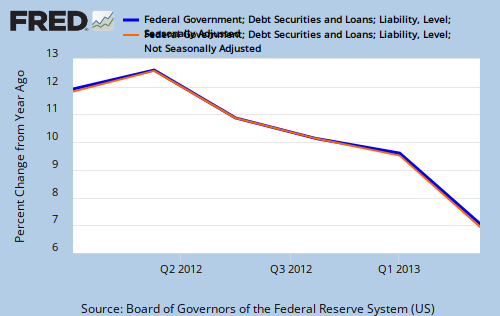
As the federal deficit growth lines drop, we approach recession, which will be cured only when the lines rise.

#MONETARY SOVEREIGNTY
–Why do the British enjoy committing economic suicide?

Twitter: @rodgermitchell; Search #monetarysovereignty
Facebook: Rodger Malcolm Mitchell

Mitchell’s laws:
●The more federal budgets are cut and taxes increased, the weaker an economy becomes.
●Austerity is the government’s method for widening the gap between rich and poor,
which ultimately leads to civil disorder.
●Until the 99% understand the need for federal deficits, the upper 1% will rule.
To survive long term, a monetarily non-sovereign government must have a positive balance of payments.
●Those, who do not understand the differences between Monetary Sovereignty and monetary non-sovereignty, do not understand economics.
●The penalty for ignorance is slavery.
●Everything in economics devolves to motive.
======================================================================================================================================================================================

Britain brilliantly did not give up its Monetary Sovereignty to join the euro nations. It kept its sovereign currency, the pound, and as a result, has the unlimited ability to create its money.

The British government never, and I mean NEVER, can run short of pounds to pay its bills.

Compare their situation with that of Greece, Spain, Italy, France, Ireland and the rest of the euro nations, none of which has a sovereign currency.

They all use the euro, the supply over which, they have no control. They are at the mercy of the EU, which is why they are in trouble. They cannot create the money to pay their debts.

So Britain is safe, right?

Yes, they are safe from the EU, but not safe from their own politicians:

December 4, 2013 9:31 pm
Osborne holds out prospect of surplus
By Chris Giles and George Parker

George Osborne will proclaim on Thursday that a budget surplus is in sight for the first time since the millennium, raising Tory hopes of significant tax cuts in the next parliament after nearly a decade of austerity.

The chancellor will deliver his Autumn Statement against a backdrop of sharply rising growth forecasts, which could pave the way for Britain to be back in the black by 2018-19 – almost two years earlier than seemed likely in March.

What does it mean for a Monetarily Sovereign nation to be “in the black”? For Britain, it means more pounds are sucked out of the private sector than flow in.

And who is the private sector? The citizens of Britain.

A government surplus = a private sector deficit. The British citizens are being impoverished.

Although Mr Osborne will say tax cuts should be introduced when the country can afford them, he will also urge Tory MPs not to get carried away by the recent recovery, with austerity far from over.

However the chancellor may struggle to contain the euphoria of Conservative MPs who believe that new growth forecasts from the Office for Budget Responsibility will confirm their view Mr Osborne’s fiscal Plan A has been fully vindicated.

Ah the euphoria of the conservatives, watching the populace starve in economic misery. How wonderful, that the gap between the rich and the rest, grows wider and wider and wider.

It’s what the rich pay the conservatives to do.

Once the government is running a surplus, David Cameron has made it clear he would seek to reduce taxes.

He will reduce taxes primarily on the rich, because after all, they pay the most taxes. And, the rest of Britain’s population will make so little money, they’ll pay little taxes, anyway.

And now for the funniest line of the entire article:

Speaking from China, he said the country needed “to put some money aside”, but added “it is possible to reduce people’s taxes as your economy recovers”.

“Put some money aside”? The British government already has the unlimited ability to create pounds. So where is “aside”?

This surely is one of the nuttiest statements any politician ever has made, perhaps exceeded only by, “Trust me.”

Ed Balls, shadow chancellor, will insist that the recovery is not feeding into household budgets and that working people are £1,600 a year worse off than when David Cameron entered Downing St.

What a surprise. Working people are suffering because of Britain’s austerity. Not to worry. The rich are doing just fine — better than ever.

To address Labour’s successful “cost of living” attack, Mr Osborne is expected to cancel a planned rise in fuel duty as well as confirming a transferable married couples tax allowance and free school meals for all infants.

To help fund those plans – costing about £2.3bn – the chancellor will announce a further cut of £1bn a year from central government spending, a foretaste of much bigger reductions planned for the next parliament in welfare and other spending.

The usual political magic show. “Focus on my hand putting a tiny bit of money in your hand, but pay no attention to my other hand stealing lots of money from your pockets.”

The rich grow richer; the poor grow poorer. And everyone who matters, is happy.

During the bombings of WWII, Britain learned to live down in the tube. They soon may learn to do it, again. So, stiff upper lip; keep calm and carry on.

Conservative George Osborne is the British government’s version of Jack Kevorkian.

Rodger Malcolm Mitchell
Monetary Sovereignty

====================================================================================================================================================
Nine Steps to Prosperity:
1. Eliminate FICA (Click here)
2. Medicare — parts A, B & D plus long term nursing care — for everyone (Click here)
3. Send every American citizen an annual check for $5,000 or give every state $5,000 per capita (Click here)
4. Free education (including post-grad) for everyone. Click here
5. Salary for attending school (Click here)
6. Eliminate corporate taxes (Click here)
7. Increase the standard income tax deduction annually
8. Increase federal spending on the myriad initiatives that benefit America’s 99% (Click here)
9. Federal ownership of all banks (Click here)

—–

10 Steps to Economic Misery: (Click here:)
1. Maintain or increase the FICA tax..
2. Spread the myth Social Security, Medicare and the U.S. government are insolvent.
3. Cut federal employment in the military, post office, other federal agencies.
4. Broaden the income tax base so more lower income people will pay.
5. Cut financial assistance to the states.
6. Spread the myth federal taxes pay for federal spending.
7. Allow banks to trade for their own accounts; save them when their investments go sour.
8. Never prosecute any banker for criminal activity.
9. Nominate arch conservatives to the Supreme Court.
10. Reduce the federal deficit and debt

No nation can tax itself into prosperity, nor grow without money growth. Monetary Sovereignty: Cutting federal deficits to grow the economy is like applying leeches to cure anemia.
Two key equations in economics:
1. Federal Deficits – Net Imports = Net Private Savings
2. Gross Domestic Product = Federal Spending + Private Investment and Consumption – Net Imports

THE RECESSION CLOCK
Monetary Sovereignty Monetary Sovereignty

As the federal deficit growth lines drop, we approach recession, which will be cured only when the lines rise.

#MONETARY SOVEREIGNTY