–You are watching the slow death of a people. Next?

Twitter: @rodgermitchell; Search #monetarysovereignty
Facebook: Rodger Malcolm Mitchell

Mitchell’s laws:
●The more federal budgets are cut and taxes increased, the weaker an economy becomes.
●Austerity is the government’s method for widening the gap between rich and poor,
which ultimately leads to civil disorder.
●Until the 99% understand the need for federal deficits, the upper 1% will rule.
To survive long term, a monetarily non-sovereign government must have a positive balance of payments.
●Those, who do not understand the differences between Monetary Sovereignty and monetary non-sovereignty, do not understand economics.
●The penalty for ignorance is slavery.
●Everything in economics devolves to motive.

======================================================================================================================================================================================

Back in June, 2005, in a talk at the University of Missouri, Kansas City, I said, “Because of the Euro, no euro nation can control its own money supply. The Euro is the worst economic idea since the recession-era, Smoot-Hawley Tariff. The economies of European nations are doomed by the euro.

Subsequently, I’ve written many posts along the same lines, one of the more definitive being: “There are two, and only two, long-term solutions for Greece and the other euro nations.” Thursday, Nov 3 2011, which included:

For Greece and the other euro nations, long term survival requires one of two, and only two, events:

1. Adopt some form of a sovereign currency, and become Monetarily Sovereign
or
2. The EU give (not lend) euros to its member nations as needed.

There are no other solutions. None. All the running in circles by the European financial geniuses will be to no avail. Each day they come up with some new lending plan, and the next day abandon it in favor of some other lending plan.

At the top of today’s, and most recent posts, is the comment:

●Austerity is the government’s method for widening the gap between rich and poor, which ultimately leads to civil disorder.

That comment contained a link to: One poll: What America believes about the likelihood of revolution, which included:

Three in 10 registered American voters believe an armed rebellion might be necessary in the next few years, according to the results of a poll released Wednesday by Fairleigh Dickinson University’s PublicMind.

Just this past Thursday, the Daily Kos ran the article, “The pitchforks are coming out in Europe,” which included these lines:

Events in Italy are turning serious. President Giorgio Napolitano has warned of “widespread social tension and unrest” in 2014 as the Long Slump drags on.

Those living on the margins are being drawn into “indiscriminate and violent protest, a sterile lurch towards total opposition”

The protest movement in Italy is literally called the Pitchfork Movement (Movimento dei forconi). Their demands are no less than the overthrow of the government.

The wind of revolt that is blowing in Italy today is the direct result of the euro and the wrong choices made by the EU and the ECB.” – Mario Borghezio, Northern League member

Greece is experiencing its worst deflation in 50 years. Credit in Spain and Italy is contracting at a rate of 6 to 12 percent a year. Soon there simply won’t be any money for people to live on.

It all was predictable. We predicted it:

The rich created the euro.
The euro requires austerity.
Austerity is another word for “deficit reduction.”
Deficit reduction widens the gap between the rich and the rest.
Always.

The people of Greece, France, Italy — they just now are learning about deficit reduction. They are learning deficit reduction is the primary sword of the rich, used to slash and impoverish the middle- and lower-income groups — to widen the gap.

You are watching the slow death of the European people — the death of a thousand cuts — because of deficit reduction, the sword wielded by the rich.

Look around. Everywhere you see your blood flowing from deficit cuts, cuts and more cuts, while the rich blame you for the misfortune they cause you.

How long before you realize what is being done to you?

●The penalty for ignorance is slavery.

Rodger Malcolm Mitchell
Monetary Sovereignty

====================================================================================================================================================
Nine Steps to Prosperity:
1. Eliminate FICA (Click here)
2. Federally funded Medicare — parts A, B & D plus long term nursing care — for everyone (Click here)
3. Send every American citizen an annual check for $5,000 or give every state $5,000 per capita (Click here)
4. Free education (including post-grad) for everyone. Click here
5. Salary for attending school (Click here)
6. Eliminate corporate taxes (Click here)
7. Increase the standard income tax deduction annually
8. Increase federal spending on the myriad initiatives that benefit America’s 99% (Click here)
9. Federal ownership of all banks (Click here)

—–

10 Steps to Economic Misery: (Click here:)
1. Maintain or increase the FICA tax..
2. Spread the myth Social Security, Medicare and the U.S. government are insolvent.
3. Cut federal employment in the military, post office, other federal agencies.
4. Broaden the income tax base so more lower income people will pay.
5. Cut financial assistance to the states.
6. Spread the myth federal taxes pay for federal spending.
7. Allow banks to trade for their own accounts; save them when their investments go sour.
8. Never prosecute any banker for criminal activity.
9. Nominate arch conservatives to the Supreme Court.
10. Reduce the federal deficit and debt

No nation can tax itself into prosperity, nor grow without money growth. Monetary Sovereignty: Cutting federal deficits to grow the economy is like applying leeches to cure anemia.
Two key equations in economics:
1. Federal Deficits – Net Imports = Net Private Savings
2. Gross Domestic Product = Federal Spending + Private Investment and Consumption – Net Imports

THE RECESSION CLOCK
Monetary Sovereignty Monetary Sovereignty

As the federal deficit growth lines drop, we approach recession, which will be cured only when the lines rise.

#MONETARY SOVEREIGNTY

Would you like money without government?

Twitter: @rodgermitchell; Search #monetarysovereignty
Facebook: Rodger Malcolm Mitchell

Mitchell’s laws:
●The more federal budgets are cut and taxes increased, the weaker an economy becomes.
●Austerity is the government’s method for widening the gap between rich and poor,
which ultimately leads to civil disorder.
●Until the 99% understand the need for federal deficits, the upper 1% will rule.
To survive long term, a monetarily non-sovereign government must have a positive balance of payments.
●Those, who do not understand the differences between Monetary Sovereignty and monetary non-sovereignty, do not understand economics.
●The penalty for ignorance is slavery.
●Everything in economics devolves to motive.

======================================================================================================================================================================================

Over the years, many people have written to this blog, stating their beliefs that the federal government, or the Federal Reserve Bank, or the private banks should not be allowed to create dollars. Instead dollars somehow should be created by “the people.”

There even have been proposals in Congress to eliminate the Fed and to create “debt-free” money, a functional impossibility (Some form of debt is what gives all money its value.)

Nevertheless, while I question most of their arguments, there is a program that should please them: Bitcoin.

Bitcoin are Internet money, neither created by, nor regulated by, any recognized government. They are created by smart computer geeks, the same sort of people who have given us smart phones, video games and the Internet itself (as well as the ACA website).

Bitcoin, being a form of money, need controls — controls over payment and availability. If you pay someone in bitcoin, that person needs to know that you actually own the bitcoin you’re spending, and you need to be able to prove you paid those bitcoin.

The concept is quite clever:

How does Bitcoin work?

Once you have installed a Bitcoin wallet on your computer or mobile phone, it will generate your first Bitcoin address and you can create more whenever you need one. You can disclose your addresses to your friends so that they can pay you or vice versa.

The block chain is a shared public ledger on which the entire Bitcoin network relies. All confirmed transactions are included in the block chain. This way, Bitcoin wallets can calculate their spendable balance and new transactions can be verified to be spending bitcoin that are actually owned by the spender.

Every transaction system requires verification. Typically, verification involves a central verifying agency. For instance, the New York Stock Exchange verifies (“clears”) the trades of member organization. The Federal Reserve Bank verifies (“clears”) payments of dollars through member banks.

Bitcoin transactions too, require verification, but this is not done by a central exchange. Rather, computer technology makes it possible for every “member” (i.e. everyone using bitcoin) together to handle verification.

Each bitcoin user is part of the blockchain. And it is the blockchain — all the users together — that verify every exchange of bitcoin.

Mining is a distributed consensus system that is used to confirm waiting transactions by including them in the block chain. It enforces a chronological order in the block chain, protects the neutrality of the network, and allows different computers to agree on the state of the system.

(As an aside, in the same way, stocks could be traded without stock exchanges and dollar payments could be processed without a central clearing agency like the Fed.)

So why use bitcoin? Here are some excerpts from coindesk.com’s “Why use bitcoin?”.

It’s fast
When you pay a cheque from another bank into your bank, the bank will often hold that money for several days, because it can’t trust that the funds are really available. Similarly, international wire transfers can take a relatively long time. Bitcoin transactions are generally far faster. Transactions can be instantaneous [under certain circumstances].

It’s cheap
Your credit card transactions are instantaneous too. But your merchant (and possibly you) pay for that privilege. Bitcoin transaction fees are minimal, or in some cases, free.

Central governments can’t take it away
The (Cyprus) Central Bank wanted to take back uninsured deposits larger than $100,000 to help recapitalize itself.

That can’t happen with bitcoin. Because the currency is decentralized, you own it. No central authority has control, and so a bank can’t take it away from you. For those who find their trust in the traditional banking system unravelling, that’s a big benefit.

I agree that bitcoin are fast and cheap, though not really faster nor cheaper than current dollar alternatives. But that third “advantage” — Central governments can’t take it away — is just plain wrong.

Central government can do anything they please within their borders. If, for whatever reason, the U.S. government unilaterally decided to make bitcoin transactions illegal or taxable, the value of the world’s bitcoin would plummet.

Further, there are guiding hands behind bitcoin, whether the hands of Satoshi Nakamoto, the pseudonymously named inventor(s) of bitcoin, or the hands of whatever group currently is in control. And those hands, by necessity, have the power to change the rules at any time they choose. They, in fact, constitute the “central government” of bitcoin.

There are no chargebacks
Once bitcoin have been sent, they’re gone. This makes it difficult to commit the kind of fraud that we often see with credit cards, in which people make a purchase and then contact the credit card company to make a chargeback, effectively reversing the transaction.

The ability to reverse a transaction is an important consumer protection. A credit card user, who receives a damaged or incorrect product, can stop payment by calling the credit card company. Bitcoin does not allow that protection.

People can’t steal your important information from merchants
Most online purchases today are made via credit cards. Credit cards are insecure. Online forms require you to enter all your secret information (the credit card number, expiry date, and CSV number) into a web form.

Bitcoin transactions don’t require you to give up any secret information. Instead, they use two keys: a public key, and a private one. Anyone can see the public key (which is actually your bitcoin address) but your private key is secret.

In that sense, bitcoin are more secure than credit cards, though credit card users are safe, if they merely look at their monthly statements. Any fraudulent charges can be challenged and deleted. No credit card user should lose money to fraud.

It isn’t inflationary
The problem with regular fiat currency is that governments can print as much of it as they like, and they frequently do. This causes the value of a currency to decrease.

This is called inflation, and it causes the price of goods and services to increase. Inflation can be difficult to control, and can decrease people’s buying power.

Bitcoin was designed to have a maximum number of coins. Only 21 million will ever be created under the original specification. This means that after that, the number of bitcoins won’t grow, so inflation won’t be a problem. In fact, deflation – where the price of goods and services falls – is more likely in the bitcoin world.

Complete nonsense:

First: The value of a dollar is based not only on supply, but also on DEMAND, a fact often forgotten by inflation hawks. That is why there has been no relationship between federal deficit spending and inflation for at least 40 years. (See: Federal deficit spending doesn’t cause inflation; oil does Tuesday, Apr 6 2010)

Second: In the real world, inflation exists. If additional bitcoins are not created, each bitcoin will increase in value, a process known as “deflation.” Most economists decry deflation, because it discourages purchasing today, for fear prices will be lower tomorrow — a recessionary phenomenon.

Third: The exchange value of bitcoin has changed massively in the past year, making bitcoin one of the highest risk investments in recent years.

Fourth: Notice the words “designed to” and “original specification.” If usage of bitcoin grows, is there anyone who believes the invisible hands guiding bitcoin won’t create more bitcoin?

It’s as private as you want it to be
Sometimes, we don’t want people knowing what we have purchased. Unlike conventional bank accounts, no one knows who holds a particular bitcoin address.

And that is why they have been so popular for illegal transactions. They are untraceable by outsiders and by the law. And bitcoin users think sovereign nations won’t step in and force changes to the rules? Really?

You own it
There is no other electronic cash system in which your account isn’t owned by someone else. Take PayPal, for example: if the company decides for some reason that your account has been misused, it has the power to freeze all of the assets held in the account, without consulting you. It is then up to you to jump through whatever hoops necessary to get it cleared so that you can access your funds.

And what exactly do you own? An invisible, secret system that can be changed at a moment’s notice, by the invisible, secret hands that control bitcoin. To whom do you complain when something goes wrong?

You can ‘mine’ bitcoins yourself
You can certainly buy bitcoins on the open market, but you can also mine your own if you have enough computing power. After covering your initial investment in equipment and electricity, mining bitcoins is simply a case of leaving the machine switched on, and the software running. And who wouldn’t like their computer to earn them money while they sleep?

Part of the verification process involves a procedure called “mining,” and “miners” receive bitcoin for their effort. The process, however, requires computer power, with presumably the biggest computers making the most money — a perfect “rich-get-richer” process. (Explain to me again how that is an improvement over today’s money allocation.)

Bottom line, complaints about the dollar usually are related to distrust of the government or of banks. But bitcoin is run by a form of “government,” that is even less accountable to its money users than is the U.S. government (if that’s possible).

Bitcoin may be a temporary solution to the privacy problem, but so far as I can see, that’s about it. And I feel confident governments, wanting taxes and legal control, soon will “correct” that solution.

Rodger Malcolm Mitchell
Monetary Sovereignty

====================================================================================================================================================
Nine Steps to Prosperity:
1. Eliminate FICA (Click here)
2. Federally funded Medicare — parts A, B & D plus long term nursing care — for everyone (Click here)
3. Send every American citizen an annual check for $5,000 or give every state $5,000 per capita (Click here)
4. Free education (including post-grad) for everyone. Click here
5. Salary for attending school (Click here)
6. Eliminate corporate taxes (Click here)
7. Increase the standard income tax deduction annually
8. Increase federal spending on the myriad initiatives that benefit America’s 99% (Click here)
9. Federal ownership of all banks (Click here)

—–

10 Steps to Economic Misery: (Click here:)
1. Maintain or increase the FICA tax..
2. Spread the myth Social Security, Medicare and the U.S. government are insolvent.
3. Cut federal employment in the military, post office, other federal agencies.
4. Broaden the income tax base so more lower income people will pay.
5. Cut financial assistance to the states.
6. Spread the myth federal taxes pay for federal spending.
7. Allow banks to trade for their own accounts; save them when their investments go sour.
8. Never prosecute any banker for criminal activity.
9. Nominate arch conservatives to the Supreme Court.
10. Reduce the federal deficit and debt

No nation can tax itself into prosperity, nor grow without money growth. Monetary Sovereignty: Cutting federal deficits to grow the economy is like applying leeches to cure anemia.
Two key equations in economics:
1. Federal Deficits – Net Imports = Net Private Savings
2. Gross Domestic Product = Federal Spending + Private Investment and Consumption – Net Imports

THE RECESSION CLOCK
Monetary Sovereignty Monetary Sovereignty

As the federal deficit growth lines drop, we approach recession, which will be cured only when the lines rise.

#MONETARY SOVEREIGNTY
–We keep tilting at windmills, and the windmills are winning.

Twitter: @rodgermitchell; Search #monetarysovereignty
Facebook: Rodger Malcolm Mitchell

Mitchell’s laws:
●The more federal budgets are cut and taxes increased, the weaker an economy becomes.
●Austerity is the government’s method for widening the gap between rich and poor,
which ultimately leads to civil disorder.
●Until the 99% understand the need for federal deficits, the upper 1% will rule.
To survive long term, a monetarily non-sovereign government must have a positive balance of payments.
●Those, who do not understand the differences between Monetary Sovereignty and monetary non-sovereignty, do not understand economics.
●The penalty for ignorance is slavery.
●Everything in economics devolves to motive.

======================================================================================================================================================================================

Some frightened folk fret that their guns will be taken from them, so they won’t be able to kill innocent animals or strangers or friends or family members.

Some deluded folk fret that the American government will run short of money, while the American people have too much money, so the people should send more money to the government and the government should send less money to the people (aka “deficit reduction”).

Some befuddled folk believe the federal government must “live within its means,” despite it having no means – or that the growing (misnamed) “debt” will cause a Weimar-like hyper-inflation, which never has happened in the history of America, not even during world wars or depressions, and despite the so-called “debt” not even being a debt, but rather a deposit.

Some generous folk believe the poor are selfish “takers” who happily and unfairly enjoy surviving on food stamps and living in crime-ridden, filthy squalor, rather than work.

Some vengeful folk fret that impoverished women will evade their rightful punishment for being poor and pregnant, by aborting future impoverished “takers.”

Some confused folk believe their federal taxes pay for unfair and excessive benefits to the poor, despite the fact that federal taxes pay for nothing.

Some conned folk believe Fed Chairman Bernanke, when he tells them Quantitative Easing (QE) stimulates the economy, despite the undeniable fact that it reduces the dollars the government pays into the economy via T-security interest, thus depressing the economy.

Some brainwashed folk believe the few rich are the “makers,” who provide jobs, when in fact, they are America’s worst takersthemselves overpaid employees of corporations that underpay millions of other employees.

Those same innocent folk believe the Supreme Court, when it tells them that money is speech, so the more money one has, the more speech to which that rich person is entitled. And corporations are American people, entitled to the same rights as the American people themselves.

Some illiterate folk believe Obama is a liberal who really wants to help the “little man,” and the Republicans really want to grow the economy, and the Tea Party really wants to keep the government solvent, despite the clear fact that the opposite is true in all three cases.

Some innocent folk believe that unless a politician is caught actually stealing money, that politician is unbribed, honest, and truth-telling, despite the fact that what the politicians are stealing is our power and our freedom.

And God help anyone who tries to tell those absolutely certain folk anything different because, they will respond in invective, attached to such lines as “I’m not an economist, but I know . . . [insert nonsense here, to be followed by more nonsense].” Uneducated in a science, they know all there is to know about that science.

And sadly, some of us Quixotic folk keep trying to educate the above-mentioned folk, when we could be engaged in far more productive enterprises – like watching TV game shows, drinking beer or snoozing on the couch.

But having learned nothing from failure, here we go, again:

TruthDig
Judge Blasts Feds for Failure to Go After Wall Street Fraudsters

U.S. District Court Judge Jed S. Rakoff has written a scathing indictment of the federal government’s approach to prosecuting Wall Street finance and banking executives, concluding that timidity, lack of resources, and a desire by individual prosecutors to pluck the low hanging fruit of fraud cases has left the country’s top financial wheeler-dealers unscathed by the likely crimes that seized up the world economy.

An accused corporation can negotiate a settlement, pay a fine, promise not to sin again, then pass along the costs to consumers and shareholders and maybe fire a subordinate executive or two for public relations value.

Meanwhile, the individuals responsible—or who most benefited from willful ignorance—pay no penalty for their crimes.

No, Judge Rakoff, it isn’t timidity. It isn’t lack of resources. And it isn’t a desire to pluck low-hanging fruit. If President Obama wanted prosecutions, there would be prosecutions.

So why doesn’t Obama want prosecutions?

Because he has been bribed by campaign contributions and promises of lucrative employment for him and his family, after he leaves office. (Call it the “Clinton” syndrome.)

The rich do not want prosecutions of the rich. They want prosecutions of the poor, for far lesser crimes, to keep the poor in line.

Finally, consider that hoped-for, big Obama Presidential Library for which billionaire Penny Pritzker undoubtedly will raise funds, and for which she has been pre-rewarded with the title, Secretary of Commerce.

Obama’s entire Chicago history has been to toady up to the mega-wealthy and allow them to lift him to glory.

That has been the source of success for a man who essentially has accomplished nothing — nothing in the private sector, nothing as a Senator and nothing as a President — nothing that is except to stump for reductions in Social Security, Medicare and other social programs — nothing but the ironically named “Obamacare,” for which he did little to create, even less to pass, and nothing to supervise.

Progressives on the Take
Robert Scheer

(Obama) he warns us that sharply rising income inequality “is the defining challenge of our time” and pledges to reverse “a dangerous and growing inequality and lack of upward mobility. …” But then he once again turns to the same hacks in the Democratic Party who helped create this problem to fix it.

His tough speech on income inequality earlier this month was delivered at the Center for American Progress, founded by John Podesta. As chief of staff to Bill Clinton, Podesta helped lead the charge to deregulate Wall Street.

(There was) the appointment of Lawrence Summers and Timothy Geithner, two former Clinton officials responsible for the banking meltdown, to repair it.

The pattern was set by Obama when, in his successful race for the presidency, he decided to shun public financing and instead shamefully courted the Wall Street fat cats who bankrolled him handsomely. It is not surprising then that in his major speech on income inequality, there was no mention of the role of the big banks in fostering this inequality.

(Obama said), ” . . . in the past, the average CEO made about 20 to 30 times the income of the average worker, today’s CEO now makes 273 times more. And meanwhile, a family in the top 1 percent has a net worth 288 times higher than the typical family, which is a record for this country.”

Big talk, but his “grand bargain” features the budget cuts that have made this deplorable situation possible.

The rich are not winning. It is the middle and the poor who are losing. They are the ones who buy into the Big Lie, and announce that though they are not economists, they are absolutely, positively sure they understand economics, and absolutely, positively will not listen to facts that disagree with their uninformed intuition.

Bottom line: The windmills are winning.

Rodger Malcolm Mitchell
Monetary Sovereignty

====================================================================================================================================================
Nine Steps to Prosperity:
1. Eliminate FICA (Click here)
2. Federally funded Medicare — parts A, B & D plus long term nursing care — for everyone (Click here)
3. Send every American citizen an annual check for $5,000 or give every state $5,000 per capita (Click here)
4. Free education (including post-grad) for everyone. Click here
5. Salary for attending school (Click here)
6. Eliminate corporate taxes (Click here)
7. Increase the standard income tax deduction annually
8. Increase federal spending on the myriad initiatives that benefit America’s 99% (Click here)
9. Federal ownership of all banks (Click here)

—–

10 Steps to Economic Misery: (Click here:)
1. Maintain or increase the FICA tax..
2. Spread the myth Social Security, Medicare and the U.S. government are insolvent.
3. Cut federal employment in the military, post office, other federal agencies.
4. Broaden the income tax base so more lower income people will pay.
5. Cut financial assistance to the states.
6. Spread the myth federal taxes pay for federal spending.
7. Allow banks to trade for their own accounts; save them when their investments go sour.
8. Never prosecute any banker for criminal activity.
9. Nominate arch conservatives to the Supreme Court.
10. Reduce the federal deficit and debt

No nation can tax itself into prosperity, nor grow without money growth. Monetary Sovereignty: Cutting federal deficits to grow the economy is like applying leeches to cure anemia.
Two key equations in economics:
1. Federal Deficits – Net Imports = Net Private Savings
2. Gross Domestic Product = Federal Spending + Private Investment and Consumption – Net Imports

THE RECESSION CLOCK
Monetary Sovereignty Monetary Sovereignty

As the federal deficit growth lines drop, we approach recession, which will be cured only when the lines rise.

#MONETARY SOVEREIGNTY

–At last: The great Washington compromise.

Twitter: @rodgermitchell; Search #monetarysovereignty
Facebook: Rodger Malcolm Mitchell

Mitchell’s laws:
●The more federal budgets are cut and taxes increased, the weaker an economy becomes.
●Austerity is the government’s method for widening the gap between rich and poor,
which ultimately leads to civil disorder.
●Until the 99% understand the need for federal deficits, the upper 1% will rule.
To survive long term, a monetarily non-sovereign government must have a positive balance of payments.
●Those, who do not understand the differences between Monetary Sovereignty and monetary non-sovereignty, do not understand economics.
●The penalty for ignorance is slavery.
●Everything in economics devolves to motive.

======================================================================================================================================================================================

We all should very happy. Washington has moved away from angry, Tea Party, take-no-prisoners, destroy-America-to-save-it rhetoric, and now is in compromise mode.

Ryan pleads with conservatives as budget deal heads to Senate
Republicans plan to use debt ceiling fight as a bargaining chip in 2014
By Jacqueline Klimas-The Washington Times Sunday, December 15, 2013

As the bipartisan budget deal moves to the Senate, where it faces opposition from some Republicans, Rep. Paul Ryan is telling those on the right that the compromise is good for core conservative values.

(“Bipartisan” is a much-loved word these days, as supposedly it stands for something good, though no one knows what.)

O.K., so it’s not exactly the friendliest of compromises, but at least it’s better than all that fighting. At least something will get done. Right?

“Look at the details, I say to those who are criticizing it. This is keeping our principle intact: no tax increases, net deficit reduction, permanent spending cuts in place of the across-the-board approach,” Mr. Ryan said on “Fox News Sunday.”

The Wisconsin Republican joined Sen. Patty Murray, Washington Democrat, last week to announce the two-year, $1.012 trillion plan, which would alleviate some of the sequester cuts and reduce the deficit by $23 billion over 10 years.

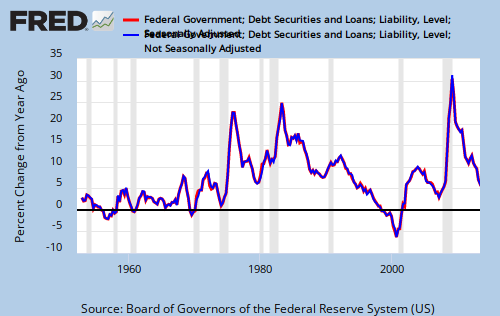
In August of this year, we published The Recession Clock. It showed two graphs and asked four questions:

Monetary Sovereignty

1. What does the federal government do in the years leading up to recessions? (Answer: Cut growth in deficit spending)

2. What does the government do that cures recessions? (Answer: Increase deficit spending growth)

3. What is the government doing now? (For a clearer picture, here is a closeup of the most recent past):

monetary sovereignty

4. Why is the government cutting deficit spending growth, despite overwhelming evidence this causes recessions? (Because of the false premises that the federal government can run short of dollars, or by creating dollars, could cause inflation.)

Now the Republicans and the Democrats, in the spirit of collegiality, plan to compromise. They will reduce the deficit. The Republicans want to kill us by shooting, and the Democrats want to kill us by poisoning. The compromise is all about how best to kill the lower and middle income groups.

So we head toward another recession, which will impact the poor far more than it impacts the rich (as recessions always do). It will be a wholly avoidable, entirely unnecessary recession. For our Monetarily Sovereign nation, the deficit is no burden. Your children will not pay the federal debt.

The federal deficit is the economy’s surplus. The deficit stimulates economic growth. (GDP = Federal Spending + Non-federal Spending + Net Exports)

On average, the U.S. negative balance of trade is $40 billion per month. We import $40 billion more each month than we export. Month after month, $40 billion flows out of America.

This means, that just to break even, i.e. for Net Exports to = $0, the federal government needs to run a $40 billion monthly deficit — a $360 billion annual deficit.

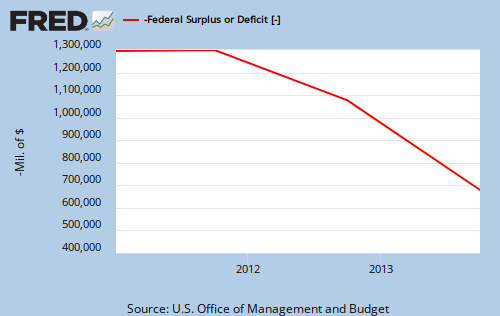
What is our current deficit?

monetary soverignty

Six hundred billion . . . and dropping fast.

So, the “compromise” is a cousin to President Obama’s rightfully scorned “grand bargain.” Like the “grand bargain,” the “compormise” will continue to reduce the deficit with massive cuts to spending.

What exactly will be cut? I don’t yet know. But this is absolutely, positively certain: The cutting will affect the lower and middle income groups far more than the top .1%

The rich will get richer. The poor will get poorer. The middle will fade away. The politicians will prance and preen and congratulate themselves on how they made a bipartisan deal to save America (i.e. save their rich donors).

And the public, will buy into the myth that helping the poor makes them lazy “takers”, unmotivated and deserving of their suffering, while the rich are hard working, beneficial “makers,” deserving of their wealth, and even deserving of thanks for allowing the little people enough to keep alive.

It’s a lie, a Big Lie. The poor are not lazy. They are not sloths looking for handouts. Their lives are hard and unrewarding. Their hopes are diminished. It’s a daily effort just to get by. It’s a Big Lie promulgated by the rich.

And as for those “makers,” the presidents and top executives of General Motors or A.T.&T. or General Electric or Exxon or Apple — they haven’t made anything or hired anyone. It’s the corporation that does the making and the hiring.

The executives themselves were hired by the corporations to do jobs, for which they are well rewarded. These executives, these well-paid employees, are the ultimate takers, receiving massive benefits from the toil and sweat of their subordinates, and from the government.

It’s not the rich executives who pull 100 boxcars filled with freight. It’s the engine. All the executives do is pull the levers and watch the scenery. Is their job so much harder than yours, that they should be paid 10, 100, 1000 times more than what you earn?

Unless you’re among the very rich, cutting the deficit hurts you. It widens the gap between you and the rich. That is what the rich want, and to effect it, they gave you the Big Lie.

If you’ve bought the Big Lie, you and your children will spend the rest of your lives paying for it.

Rodger Malcolm Mitchell
Monetary Sovereignty

====================================================================================================================================================
Nine Steps to Prosperity:
1. Eliminate FICA (Click here)
2. Federally funded Medicare — parts A, B & D plus long term nursing care — for everyone (Click here)
3. Send every American citizen an annual check for $5,000 or give every state $5,000 per capita (Click here)
4. Free education (including post-grad) for everyone. Click here
5. Salary for attending school (Click here)
6. Eliminate corporate taxes (Click here)
7. Increase the standard income tax deduction annually
8. Increase federal spending on the myriad initiatives that benefit America’s 99% (Click here)
9. Federal ownership of all banks (Click here)

—–

10 Steps to Economic Misery: (Click here:)
1. Maintain or increase the FICA tax..
2. Spread the myth Social Security, Medicare and the U.S. government are insolvent.
3. Cut federal employment in the military, post office, other federal agencies.
4. Broaden the income tax base so more lower income people will pay.
5. Cut financial assistance to the states.
6. Spread the myth federal taxes pay for federal spending.
7. Allow banks to trade for their own accounts; save them when their investments go sour.
8. Never prosecute any banker for criminal activity.
9. Nominate arch conservatives to the Supreme Court.
10. Reduce the federal deficit and debt

No nation can tax itself into prosperity, nor grow without money growth. Monetary Sovereignty: Cutting federal deficits to grow the economy is like applying leeches to cure anemia.
Two key equations in economics:
1. Federal Deficits – Net Imports = Net Private Savings
2. Gross Domestic Product = Federal Spending + Private Investment and Consumption – Net Imports

THE RECESSION CLOCK
Monetary Sovereignty Monetary Sovereignty

As the federal deficit growth lines drop, we approach recession, which will be cured only when the lines rise.

#MONETARY SOVEREIGNTY