–How much should the rich pay in taxes?

Mitchell’s laws:
●The more budgets are cut and taxes increased, the weaker an economy becomes.
●Austerity is the government’s method for widening the gap between rich and poor,
which leads to civil disorder.
●Until the 99% understand the need for federal deficits, the upper 1% will rule.
●To survive long term, a monetarily non-sovereign government must have a positive balance of payments.
●Those, who do not understand the differences between Monetary Sovereignty and monetary non-sovereignty, do not understand economics.

==========================================================================================================================================

Recently, CNNMoney.com published an article titled, “How much should the rich pay in taxes?”

The data in the article are interesting, but the fundamental premise of the article is nonsense. Here are some excerpts:

How much should the rich pay in taxes?
By Jeanne Sahadi | CNNMoney.com – Thu, Aug 30, 2012

It’s a heated question these days. President Obama and his Republican challenger, Mitt Romney, spar over it bitterly. And the taxes Romney pays on his own vast wealth have become the subject of massive press attention. But the question is not so easily answered and depends on a number of hard-to-nail-down factors — starting with how you define rich.

“Virtually no one thinks of themselves as wealthy,” said Joseph Henchman, a policy analyst at the Tax Foundation. “They’re thinking about what others should pay in taxes.”

One frequently used definition of rich is the top 1% of federal tax filers — those with adjusted gross incomes of at least $343,927 in 2009.

They earned nearly 17% of all AGI in the country and paid more than a third (37%) of all federal income taxes collected by the government. The group’s average effective tax rate — AGI divided by income taxes paid — was 24%, more than twice the national average.

The top 0.1% — had an AGI of at least $1.43 million. They paid 17% of income taxes collected. But, some wealthy individuals pay little or nothing in federal income taxes because their income is from sources not included in AGI such as tax-free municipal bonds.

Federal income taxes, meanwhile, don’t reflect a household’s total federal tax burden. That leaves out things like payroll taxes, estate taxes and corporate taxes. The Tax Policy Center incorporates these broader views of income and tax burdens in its calculations. And it found that in 2009, people making more than $1 million in total income paid roughly 16% of all federal taxes in 2009.

Ultimately, there is no right answer about how much the rich should pay. A majority of Americans simply say “more.”

My guess: Most people would describe “rich” as anyone earning significantly more than they themselves earn, and “soaking the rich” always has been a great populist agenda, fueled by envy. Everyone enjoys seeing the rich get their comeuppance.

Policymakers will have to decide not only on a definition of rich, but also consider broader questions about the federal budget and economy. Questions such as: What do Americans want from their government and how much will it cost?

Here is where the article veers off track, because what Americans want from government has absolutely nothing to do with its cost. Apparently the author, Jeanne Sahadi, wrongly believes federal taxes pay for federal spending.

Yes, state taxes pay for state spending, and county taxes pay for county spending, and city taxes pay for city spending. The states, counties and cities are monetarily non-sovereign. But, federal taxes do not pay for federal spending. Even if federal taxes fell to $0, our Monetarily Sovereign federal government easily could double or triple its spending.

So if federal taxes don’t pay for federal spending, what purposes do they have? I can think of four:

1. To force social change. Cigarette and liquor taxes help reduce the purchase of cigarettes and liquor — a bit. Maybe.

2. To help close the gap between rich and poor, though this form of gap-closing would not help the poor; it only would hurt the rich. So at best, it’s a questionable strategy.

3. To force demand for U.S. dollars, which are necessary for paying taxes. However, there are sufficient state and local taxes to produce that effect. Federal taxes would be unnecessary.

4. To prevent/cure inflation, though this would be a very last resort in case no other prevention/cure worked. (I discuss this in more detail at Preventing and Curing Inflation: Modern Monetary Theory vs. Monetary Sovereignty. Using taxes to fight inflation trades one disaster for another, i.e. recession for inflation.)

In summary, #1 and #2 have some slight merit; #3 is unnecessary and #4 is unmanageable and dangerous.

What is the fair level of taxes on the rich relative to everyone else? And should the more than 40% of households with no federal income tax liability — thanks largely to tax breaks — be asked to pay something in income taxes as well?

“Fairness” always is an issue for which there can be no resolution. We discuss this at: “Which Taxes Are Fairest? Which Taxes are Least Fair?” (Summary: No taxes are fair; all are unfair; some are more unfair than others.)

In the end, any decision Washington makes about taxing the rich could affect the economy.

That actually is the central issue, though it is the least discussed. Economic growth, and measured by Gross Domestic Product (GDP) is calculated this way: GDP = Federal Spending + Non-federal Spending – Net Imports.

If we increase taxes on the rich, we reduce Non-federal spending, but do not increase Federal Spending. So increasing taxes on the rich absolutely, positively will result in a reduction in GDP growth, which will impact the non-rich more than the rich.

Any tax increase of any kind always, always, ALWAYS must have a negative effect on the economy. Period.

To stimulate the economy, and to reduce the gap between the rich and the poor, the first tax step is to reduce taxes on the non-rich. And that begins with eliminating the worst, most harmful, most useless tax America ever has known: FICA (see “Ten Reasons to Eliminate FICA”)

Increasing taxes on the rich is the classic, “Cutting off your nose to spite your face.” The right wing claims that raising taxes on the rich taxes the “job makers,” and to some degree they are correct. But the real problem is not in raising taxes on the rich; it is in raising taxes anyone.

Rodger Malcolm Mitchell
Monetary Sovereignty

====================================================================================================================================================

Nine Steps to Prosperity:
1. Eliminate FICA (Click here)
2. Medicare — parts A, B & D — for everyone
3. Send every American citizen an annual check for $5,000 or give every state $5,000 per capita (Click here)
4. Long-term nursing care for everyone
5. Free education (including post-grad) for everyone
6. Salary for attending school (Click here)
7. Eliminate corporate taxes
8. Increase the standard income tax deduction annually
9. Increase federal spending on the myriad initiatives that benefit America’s 99%

No nation can tax itself into prosperity, nor grow without money growth. Monetary Sovereignty: Cutting federal deficits to grow the economy is like applying leeches to cure anemia. Two key equations in economics:
Federal Deficits – Net Imports = Net Private Savings
Gross Domestic Product = Federal Spending + Private Investment and Consumption – Net Imports

#MONETARY SOVEREIGNTY
–You never will know what you have lost. Part III

Mitchell’s laws:
●The more budgets are cut and taxes increased, the weaker an economy becomes.
●Austerity is the government’s method for widening the gap between rich and poor,
which leads to civil disorder.
●Until the 99% understand the need for federal deficits, the upper 1% will rule.
●To survive long term, a monetarily non-sovereign government must have a positive balance of payments.
●Those, who do not understand the differences between Monetary Sovereignty and monetary non-sovereignty, do not understand economics.

==========================================================================================================================================

Today’s Washington Post published an excellent article that bears on the idiocy of the “small government” beliefs, as expressed by the Tea Party and adopted by the Republicans (and to a lesser extent by the Democrats).

I urge you to read the full article, but here are a few excerpts,

It’s time to get serious about science
By Jim Cooper and and Alan I. Leshner, Published: September 9, 2012
Jim Cooper, a Democrat, represents Tennessee’s Fifth Congressional District in the U.S. House. Alan I. Leshner is chief executive of the American Association for the Advancement of Science and executive publisher of the journal Science.

Some policymakers, including certain senators and members of Congress, cannot resist ridiculing any research project with an unusual title. The United States may now risk falling behind in scientific discoveries as other countries increase their science funding. It’s time for researchers to fight back, to return a comeback for every punch line.

Toward that end, we are announcing this week the winners of the first Golden Goose Awards, which recognize the often-surprising benefits of science to society. Charles H. Townes, for example, is hailed as a primary architect of laser technology. Early in his career, though, he was reportedly warned not to waste resources on an obscure technique for amplifying radiation waves into an intense, continuous stream.

Similarly, research on jellyfish nervous systems by Osamu Shimomura, Martin Chalfie and Roger Y. Tsien unexpectedly led to advances in cancer diagnosis and treatment, increased understanding of brain diseases such as Alzheimer’s, and improved detection of poisons in drinking water. The late Jon Weber as well as Eugene White, Rodney White and Della Roy developed special ceramics based on coral’s microstructure that is now used in bone grafts and prosthetic eyes.

It is human nature to chuckle at a study titled “Acoustic Trauma in the Guinea Pig,” yet this research led to a treatment for hearing loss in infants. Similar examples abound. Transformative technologies such as the Internet, fiber optics, the Global Positioning System, magnetic resonance imaging (MRI), computer touch-screens and lithium-ion batteries were all products of federally funded research.

Yes, “the sex life of the screwworm” sounds funny. But a $250,000 study of this pest, which is lethal to livestock, has, over time, saved the U.S. cattle industry more than $20 billion. Remember: The United States itself is the product of serendipity: Columbus’s voyage was government-funded. Remember, too, that basic science, the seed corn of innovation, is primarily supported by the federal government — not industry, which is typically more interested in applied research and development.

Federal investments in R&D have fueled half of the nation’s economic growth since World War II. Federal support for basic science is at risk: We are already investing a smaller share of our economy in science as compared with seven other countries, including Japan, Taiwan and South Korea.

Since 1999, the United States has increased R&D funding, as a percentage of the economy, by 10 percent. Over the same period, the share of R&D in the economies of Finland, Germany and Israel have grown about twice as fast. In Taiwan, it has grown five times as fast; in South Korea, six times as fast; in China; 10 times.

In the United States, meanwhile, additional budget cuts have been proposed to R&D spending for non-defense areas. If budget-control negotiations fail, drastic across-the-board cuts will take effect in January that could decimate entire scientific fields.

Last year, I wrote two posts on this subject: “You never will know what you have lost.” and “You never will know what you have lost. Part II”

The earlier post ends with this comment:

The lame who might have walked. The blind who might have seen. The children who might have given to America. The tornados and hurricanes and earthquakes that might have been foreseen or stopped. The money that investors might have saved. The inventions never invented. The recessions and depressions that might have been avoided. The wars that might have been won or prevented. The life-saving drugs that might have been developed. The people who might not have died too soon. The beauty never created. The ideas lost. The better world that might have been. You never will know.

And we trade all this potential for the reality of a meaner, uglier, less elegant life, especially for the lower classes, who will be affected most by deficit reduction, though we all will be affected. What a waste, given the tools we’ve been given, that we intentionally should deprive ourselves and our children and our grandchildren of the benefits a society can offer, and instead retreat toward the days of hardscrabble anarchy.

What have we lost? What will we lose tomorrow? You never will know.

And that is the invisible cost of “smaller government and deficit reduction — all unnecessary in a Monetarily Sovereign nation.

Rodger Malcolm Mitchell
Monetary Sovereignty

====================================================================================================================================================

Nine Steps to Prosperity:
1. Eliminate FICA (Click here)
2. Medicare — parts A, B & D — for everyone
3. Send every American citizen an annual check for $5,000 or give every state $5,000 per capita (Click here)
4. Long-term nursing care for everyone
5. Free education (including post-grad) for everyone
6. Salary for attending school (Click here)
7. Eliminate corporate taxes
8. Increase the standard income tax deduction annually
9. Increase federal spending on the myriad initiatives that benefit America’s 99%

No nation can tax itself into prosperity, nor grow without money growth. Monetary Sovereignty: Cutting federal deficits to grow the economy is like applying leeches to cure anemia. Two key equations in economics:
Federal Deficits – Net Imports = Net Private Savings
Gross Domestic Product = Federal Spending + Private Investment and Consumption – Net Imports

#MONETARY SOVEREIGNTY
John Kass and the war myth

Mitchell’s laws:
●The more budgets are cut and taxes increased, the weaker an economy becomes.
●Austerity is the government’s method for widening the gap between rich and poor,
which leads to civil disorder.
●Until the 99% understand the need for federal deficits, the upper 1% will rule.
●To survive long term, a monetarily non-sovereign government must have a positive balance of payments.
●Those, who do not understand the differences between Monetary Sovereignty and monetary non-sovereignty, do not understand economics.

==========================================================================================================================================

John Kass used to be a pretty good investigative writer for the Chicago Tribune, at least he was when he stuck to what he knows best: Dirty Chicago and Illinois politics, ala Mike Royko. Kass was an equal opportunity rock kicker, who uncovered political snakes and slime, Republican and Democratic — and of course there was, and still are, plenty of snakes and slime for him to uncover, in our fair city and state.

Of late however, he must have received “The Word” from the wealthy owners and editors of the Chicago Tribune. So for the past few weeks, every one of his columns has been devoted to national politics and economics, two subjects of which he knows little to nothing. Per boss’s instructions, his sole focus has been on blasting Obama.

I can’t blame anyone for kissing up to the boss, although Kass always has smirked at political sycophants. So it’s ironic and a bit sad, to see this once-effective writer turn into “Kissup Kass,” writing just what his masters want, neither more nor less.

Anyway, the above is just a prelude to the central theme of this post: The war myth.

Kissup Kass mentioned the myth in todays (September 9, 2012):

Under Obama’s watch, the national debt has ballooned, passing into the trillions and trillions, numbers inconceivable only a decade ago. And China holds our paper.

Yet there he was, offering more government, not less, while parading that savage icon of massive federal spending and authority, Franklin Roosevelt.

“I won’t pretend the path I’m offering is quick or easy. I never have,” said the president. “You didn’t elect me to tell you what you wanted to hear. You elected me to tell you the truth. And the truth is, it will take more than a few years for us to solve challenges that have built up over decades. It will require common effort, shared responsibility, and the kind of bold, persistent experimentation that Franklin Roosevelt pursued during the only crisis worse than this one.”

Many historians have concluded that Roosevelt’s big-government moves only made the Depression worse, and that only a world war got the economy going.

I wish I had a dime for every time someone told me that federal deficit spending hurts the economy but wars stimulate the economy. And I never stop being amazed at the lack of logic those two opposing ideas convey.

Let’s get this straight. The only historians that agree with Kissup must be morons, for wars do not stimulate economies. Wars only kill people. It’s the federal deficit spending for wars that stimulates economies. The federal purchase of all those bullets, tanks and bombs, plus the massive salary total for all the soldiers, pumps huge numbers of dollars into the economy, and those additional dollars stimulate the economy.

There are many ways to measure economic growth, but Gross Domestic Product (GDP) may be the most popular, an here is how GDP is calculated.

Gross Domestic Product = Federal Spending + Non-federal Spending – Net Imports

Those of you having even a smidgeon of algebraic knowledge will recognize that increasing GDP without increasing Federal Spending would be quite difficult, and in a practical sense, well nigh impossible (because Federal Spending also boosts Non-federal Spending). This is why the “small government” preachers either are ignorant, intentionally trying to sabotage the economy or merely are kissing up to rich people. There are no other alternatives.

The wealthiest among us are only too happy to see the economy tank, because during recessions and depressions, the gap between the rich and the others, widens.

Obama did have an opportunity, after his party lost the House in 2010, to pivot and change political course like a Chicago version of Bill Clinton, but he remains, stubbornly, a man of the left, and government is the hammer in his hand.

Here, Kissup refers to the myth that Bill Clinton’s surpluses benefited the economy. But, federal surpluses reduce the domestic money supply, which always leads to recessions and depressions, exactly what Kissup’s masters want. Clinton’s deficit reductions beginning in 2002, and culminating in the surpluses of 1998-2001, led to the recession of 2001

Finally, if you think I’m being harsh and childish by referring to John Kass as “Kissup,” you’re right. However, readers of Kass’s column will recognize the irony. Kissup repeatedly refers to politicians by his own invented nicknames. His name for Mayor Emanuel is “Rahmfather” and Mayor Daley was “shortshanks.” (I know. I don’t get it, either.)

Bottom line, the media barons have “influnced” even good writers to toe the right-wing line, which includes the false notion that the federal debt and deficit are too large. The purpose: To increase the gap between the income groups. And wars stimulate only because they stimulate federal spending. Killing people doesn’t grow the economy.

Rodger Malcolm Mitchell
Monetary Sovereignty

====================================================================================================================================================

Nine Steps to Prosperity:
1. Eliminate FICA (Click here)
2. Medicare — parts A, B & D — for everyone
3. Send every American citizen an annual check for $5,000 or give every state $5,000 per capita (Click here)
4. Long-term nursing care for everyone
5. Free education (including post-grad) for everyone
6. Salary for attending school (Click here)
7. Eliminate corporate taxes
8. Increase the standard income tax deduction annually
9. Increase federal spending on the myriad initiatives that benefit America’s 99%

No nation can tax itself into prosperity, nor grow without money growth. Monetary Sovereignty: Cutting federal deficits to grow the economy is like applying leeches to cure anemia. Two key equations in economics:
Federal Deficits – Net Imports = Net Private Savings
Gross Domestic Product = Federal Spending + Private Investment and Consumption – Net Imports

#MONETARY SOVEREIGNTY

–Is America better off today than it was when Obama took office?

Mitchell’s laws:
●The more budgets are cut and taxes increased, the weaker an economy becomes.
●Austerity is the government’s method for widening the gap between rich and poor,
which leads to civil disorder.
●Until the 99% understand the need for federal deficits, the upper 1% will rule.
●To survive long term, a monetarily non-sovereign government must have a positive balance of payments.
●Those, who do not understand the differences between Monetary Sovereignty and monetary non-sovereignty, do not understand economics.

==========================================================================================================================================

The Republicans ask, “Are you better off than you were four years ago?” The implication is that we are not better off, and perhaps even worse off.

There are many criteria for “better off,” two of which are Gross Domestic Product and Unemployment. To my knowledge, the Republicans have not been specific about what measure they are using.

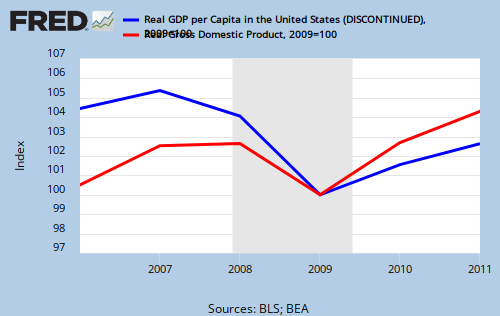
President Obama took office in January, 2009. The following graph shows the trends for real Gross Domestic product (red line) and real per-capita GDP figures (blue line).

Monetary Sovereignty

The economy seems to have hit its low point at the very beginning of Obama’s term, and has grown, since.

Monetary Sovereignty

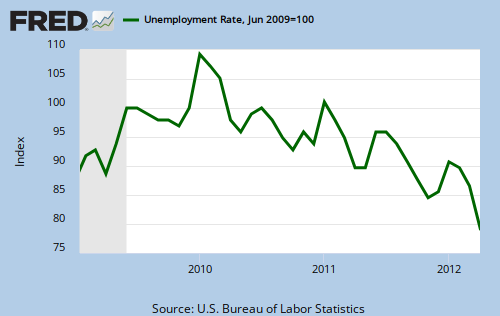
The civilian unemployment rate (green line) rose during Obama’s first year in office, reaching its peak in 2010, and has fallen since, to below where it was when he took office.

As I said, there are many measures of “better off,” but GDP and Unemployment seem to be the most referenced, and by those measures, the answer to the questions would be, “Yes, we are better off.”

That said, other data point in both directions. The poverty level is rising. Obamacare will reduce the number of people who have no health insurance. Real Disposable Personal Income is up.

Monetary Sovereignty

All signs point to the unpleasant fact that the gap between the 1% and the 99% is growing. The rich are better off; the poor are worse off and growing more numerous. And historically, this has led to revolution.

Note to the rich: Cut taxes on the 99%. Increase social benefits — Social Security, Medicare, Medicaid, aid to education, aid to the poor — help the states, help small business, reduce working hours. Follow the 9 steps, below.

If you want to keep what you have, close the gap, or the people will rise up and take what you have, away.

Rodger Malcolm Mitchell
Monetary Sovereignty

====================================================================================================================================================

Nine Steps to Prosperity:
1. Eliminate FICA (Click here)
2. Medicare — parts A, B & D — for everyone
3. Send every American citizen an annual check for $5,000 or give every state $5,000 per capita (Click here)
4. Long-term nursing care for everyone
5. Free education (including post-grad) for everyone
6. Salary for attending school (Click here)
7. Eliminate corporate taxes
8. Increase the standard income tax deduction annually
9. Increase federal spending on the myriad initiatives that benefit America’s 99%

No nation can tax itself into prosperity, nor grow without money growth. Monetary Sovereignty: Cutting federal deficits to grow the economy is like applying leeches to cure anemia. Two key equations in economics:
Federal Deficits – Net Imports = Net Private Savings
Gross Domestic Product = Federal Spending + Private Investment and Consumption – Net Imports

#MONETARY SOVEREIGNTY