-Do you believe President Obama is gay ??


An alternative to popular faith

       If a reporter were to come to his editor with a proposed article titled, “President Obama is gay,” the editor would demand supporting evidence, before that article ever saw daylight.
      However, if the same reporter submitted an article titled, “Federal deficit is too high,” history says the editor would ask for no supporting evidence, nor would the article contain any. The media merely assume, as a matter of faith, that revenue neutrality is more prudent than deficits.

      Economics is rare, perhaps unique, among sciences, most of which demand evidence for their hypotheses. Only in economics can intuition and popular faith obviate facts or even the desire for facts. Thus, I have had editors, columnists and reporters tell me it is “obvious” that large deficits are unsustainable, crowd out lending funds, lead to recessions, depressions, inflations and hyper-inflations. When I ask for evidence to support these views, I seldom hear from them again, probably because they feel scientific evidence is unnecessary in a science, but more importantly, they don’t have any.
      Even the Concord Coalition, an organization that for seventeen years, has collected vast amounts of money to preach for federal deficit reduction, unashamedly offers no evidence to support its views. Check its website, http://www.concordcoalition.org, or write to them and you will see they neither offer, nor have, evidence.
      Because our leaders parrot the economic beliefs promoted by the media, lack of evidence has contributed heavily to the government actions that yield repeated recessions. Until the media learn to ask, “What is your evidence?” we will continue to suffer periodic, economic traumas. These traumas may seem inevitable and unavoidable, but in reality they are caused by beliefs lacking evidence.
      If you don’t believe President Obama is gay, unless you see solid evidence, don’t believe the federal deficit is too high, unless you see solid evidence.

Rodger Malcolm Mitchell
For more information, see http://www.rodgermitchell.com
–When China will pass the U.S. as the world’s dominant economy


An alternative to popular faith

      When China passes the U.S. as the world’s dominant economy, you can blame the economists, who parrot the popular faith that federal debts are unsustainable and cause recessions, inflations, high taxes and harmful high interest rates. No evidence supports these intuitive beliefs.
Contrary to popular faith:

–Fact: We do not need other nations to buy our debt. We do not even need to create debt. Just as the U.S. government has the unlimited ability to create T-securities and sell them (aka “borrow”), the government has the unlimited ability to create money, thus the unlimited ability to “sustain” any size debt.
–Fact: There is no historical relationship between deficits and inflation (See the blog: “Do deficits really cause inflation,” below). Data indicates inflation is more closely related to energy costs, specifically to oil, than to any other factor.
–Fact: In only 15 years, from 1979 through 1994, taxes were cut and the federal debt grew an astounding 500%. This massive, unprecedented money printing did not cause inflation or high taxes. Instead, we entered a long period of economic growth, low taxes and moderate interest rates. Repeating that 500% debt growth would yield a $72 trillion debt in 2024 and an average deficit of $4 trillion — and if history is a judge, the same economic growth, the same low taxes and the same moderate interest rates.
–Fact: All six depressions in U.S. history immediately followed years of federal surpluses. Every recovery coincided with increases in debt growth.
–Fact: All nine recessions in the past 50 years immediately followed reductions in federal debt growth. Every recovery coincided with increases in debt growth, such as we are seeing, today.
–Fact: There is no historical relationship between high interest rates and slow economic growth. Similarly, low interest rates have not stimulated growth.
–Fact: There is no historical relationship between deficits and tax rates. There is no mechanism for our grandchildren to pay for deficits.

The factually unsupported fear of federal deficits in the U.S., when compared with the lack of such fear in China, is why we will fail and they will succeed.

Rodger Malcolm Mitchell
For more information, see http://www.rodgermitchell.com

–Deficits, inflation and hyperinflation

The debt hawks are to economics as the creationists are to biology. Those, who do not understand monetary sovereignty, do not understand economics. Cutting the federal deficit is the most ignorant and damaging step the federal government could take. It ranks ahead of the Hawley-Smoot Tariff.
==========================================================================================================================================

      It commonly is believed large federal deficits cause inflation. Examples often are given of Germany, China, Brazil, Italy and other nations that experienced hyperinflation.

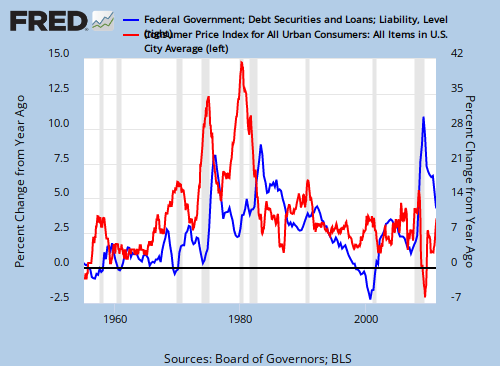
So it might be useful to see what the experience in America has been. Here’s a graph created by the St. Louis Federal Reserve. The blue line is deficit growth. The red line is inflation.

In the past 50 years at least, deficit growth has not been associated with inflation.

Inflation is more closely related to special factors than to deficits; such things as oil shortages, wars and weather are the main culprits.

Deficits vs inflation

I do not suggest the government should create an unlimited amount of money, though it has the power to do so. In 1979, gross federal debt was $800 billion. In 2009 it reached $12 trillion, a 1400% increase in 30 years.

During that period, GPD rose 440% (annual rate of 5.5%) with acceptable inflation throughout. The same 1400% increase would put the debt at $180 trillion in 2039, a mean deficit of $5+ trillion.

This calculates to a 9.5% annual debt increase for the past 30 years. Repeating that growth rate would put the 2010 deficit at about $1.14 trillion, and the 2011 deficit at about $1.25 trillion.

The deficit for year 2039 would be about $15.8 trillion. I know of no reason why the results would not be the same as they have been in the past 30 years.

However, increasing the debt growth rate above 9.5% might show even better results. In the 10 year period, 1980 – 1989, federal debt grew 210%, from $900 billion to $2.8 trillion (a 12% annual debt increase), while GDP grew .96% from $2.8 trillion to $5.5 trillion (a 7% annual increase).

During that same period, inflation fell from 14.5% in 1980 to 5.2% in 1989.
In summary, large deficits have led to GDP growth, while not causing unacceptable levels of inflation. Those are the bare bones.

For more information, see http://www.rodgermitchell.com