What is the purpose of the debt ceiling?

Once again, the so-called “debt ceiling” is in the news. The Republicans, who traditionally favor limiting federal spending, now support increasing it. The Democrats, who traditionally favor increased federal spending, now advocate for limiting it.

So, as of this writing, we are headed toward a stalemate, which threatens America’s economy.

The Basic Problem: Inflation

Money was created as a store of value and a medium of exchange. It is the basis of economics. 

The earliest form of “standard money” appeared between 3000 and 2000 BCE in Mesopotamia, among the Sumerians and Babylonians. They utilized silver, measured by weight in shekels, as a standard of value for trade and record-keeping, even before the invention of coins. In Egypt, grain, metals, and other commodities served as units of account.

By around 2500 BCE, a form of money as a unit of account and medium of exchange was already in use.

Since then, nations have faced recessions, depressions, and stagflation; however, the primary concern in economics is inflation—the decrease in the value of a nation’s currency. 

Money is an artificial construct of value. A dollar bill is simply printed paper, just like a check. Neither possesses intrinsic value, and both can be easily created. The concern is that creating too much money will lead to a reduction in its value.

To prevent inflation, governments try to limit their ability to create money.

Gold and silver are permanently available in physical form and somewhat scarce, so linking money to these elements (gold and silver standards) was a means of restricting the creation of money.

Gold Standard and the Debt Limit

The debt limit serves as a modern equivalent to the historical gold standard. While the two concepts have different impacts, both aim to limit the government’s ability to create money.

If not for the fear of inflation, neither a gold standard, a silver standard, nor a debt limit would have been invented.

Under a gold standard, each unit of currency (dollar, pound, franc, etc.) was pegged to a fixed weight of gold. The U.S. Gold Standard Act of 1900 set 1 troy ounce of gold to be equal to, $20.67. People could, in theory, redeem paper money for gold at that fixed rate.

The government couldn’t create new money freely; it had to maintain sufficient gold reserves to back it.

If a government runs large deficits and needs to spend heavily, it risks losing gold reserves because creditors or foreign nations might demand repayment in gold. Additionally, “breaking the peg” could trigger panic, bank runs, and a loss of confidence.

In practice, deficit spending was tightly constrained by gold holdings. Countries often had to raise interest rates, cut spending, or deflate their economies to protect reserves.

Gold standards and other physical currency pegs limit economic growth. This limitation is both their purpose and their shortcoming.

When the economy grows faster than the supply of gold, it leads to deflation, meaning there isn’t enough money relative to the amount of goods available. Moreover, if gold is depleted—such as when it’s sent overseas to cover trade deficits—countries are forced to reduce credit and spending, even during recessions.

This is why the gold standard worsened the Great Depression: the U.S. and Europe focused on defending gold reserves instead of stimulating their economies.

The U.S. suspended gold convertibility for domestic purposes in 1933.

Following World War II the Bretton Woods system was established, which pegged various currencies to the U.S. dollar. The dollar, in turn, was pegged to gold at a rate of $35 per ounce.

In 1971, President Nixon ended gold convertibility by “closing the gold window.” Since that time, the U.S. dollar has become fiat money, meaning it is not backed by any physical commodity but rather by U.S. law and the “full faith and credit” of the U.S. government.

The years spent dealing with the challenges of the gold and silver standards have ultimately been in vain. Today, inflation is no greater a problem since those standards have been abolished. Additionally, we have not experienced a depression since the end of the gold standard.

About the Debt Ceiling

The debt ceiling is a legal limit set by Congress on the total amount of money that the U.S. Treasury can borrow to fulfill existing obligations.

The stated purpose is to control borrowing. It was originally intended (in 1917, with expansion in 1939) to give Congress oversight of federal borrowing while allowing the Treasury to issue debt without constant, individual approval.

Supporters claim it forces Congress to confront federal deficits and spending levels. Also, it allows legislators to make a public statement about debt, deficits, or fiscal responsibility.

In reality, the debt ceiling does not control new spending. Rather, it restricts the payment of existing obligations. Spending levels and taxes are set by Congress through separate budget and appropriations laws. Once those laws are passed, the Treasury is obligated to pay the bills.

The debt ceiling creates a risk of default. Once the ceiling is reached, the Treasury cannot issue new debt, even though it must meet legally required obligations such as Social Security, interest on the debt, Medicare, military pay, and contracts. This situation forces the use of “extraordinary measures,” and if it continues for too long, it could lead to a U.S. default.

Additionally, the debt ceiling has become a political tool. In recent decades, political parties have used debt ceiling votes to advance unrelated policy goals.

Most economists view the debt ceiling as economically unnecessary and politically hazardous. It does not actually limit future debt, as spending and tax laws determine that. Instead, it introduces an unnecessary risk of default that can destabilize markets and increase U.S. borrowing costs.

The United States is unique in having a separate debt limit; few other advanced economies impose such a restriction, as they allow borrowing to flow automatically based on budget decisions.

In summary, while the stated purpose of the debt ceiling is to promote fiscal restraint, its actual effect is often a result of political posturing that can have serious economic consequences.

Major Debt Ceiling Crises

Congress raised the debt ceiling several times during President Eisenhower’s presidency.

Even then, this effort has been more about political strategy than actual debt control. While Republicans have aimed to project a fiscally more conservative image, the ceiling continued to rise under both parties.

1979 – “Technical Default”: A clerical error, plus temporary cash-flow issues, caused a brief delay in paying Treasury bills. Investors demanded higher yields afterward—showing even the hint of default costs taxpayers.

1995–96 – Clinton vs. Gingrich: The Republican House, led by Speaker Newt Gingrich, refused to raise the ceiling without big spending cuts. Result: Two government shutdowns. The ceiling was eventually raised with no major long-term cuts.

2011 – Obama vs. House Republicans: The Republicans refused to raise the ceiling unless Obama agreed to major deficit reduction. Outcome: The U.S. came within days of default. The “Budget Control Act” imposed automatic spending caps (sequestration).

S&P downgraded the U.S. credit rating for the first time in history due to political dysfunction. As a result, stock markets fell and borrowing costs rose.

2013 – Obama Again: Another showdown over Obamacare and spending. The Treasury used “extraordinary measures” for months. The ceiling finally was suspended—but markets were rattled, with short-term Treasury yields spiking.

2013 – Obama Again: Another confrontation over Obamacare and spending. The Treasury employed “extraordinary measures” for several months. The ceiling was ultimately suspended, but markets were unsettled, causing short-term Treasury yields to spike.2013 –

2019 – Trump: A bipartisan deal suspended the debt ceiling for two years. Republicans largely dropped opposition to debt increases when they controlled the White House.

2021–2023 – Biden Era: Republicans initially refused to raise the ceiling; Mitch McConnell allowed a temporary extension at the last minute.

2023: With Republicans controlling the House, Speaker Kevin McCarthy negotiated a deal with Biden. The deal capped some discretionary spending growth for 2 years. Treasury had been within days of running out of money.

Notice the pattern? The stated purpose always is to “control debt and deficits,” but the actual outcome is that the debt ceiling always is raised or suspended (78 times since 1960), the so-called “debt” continues to rise, and the economy continues to grow.

Meanwhile, the side effects are market turmoil, higher borrowing costs, political theater, and in 2011, a credit downgrade.

Other advanced countries do not have this issue. In those countries, borrowing authority is automatically granted through the budget process.

The U.S. debt ceiling is unique because it creates artificial crises without altering fiscal reality.

Even the fundamental beliefs are wrong.

I. The Federal Government Does Not Borrow Dollars.

Federal finances are not like personal finances.

The federal government uniquely is Monetarily Sovereign. It has the unlimited ability to create dollars simply by pressing computer keys. It never unintentionally can run short of dollars.

Even if the federal government collected $0 taxes, it could continue spending trillions upon trillions of dollars, forever. 

The notion that the government “borrows” comes from the semantic misunderstanding of the words “notes.” “bills,” and “bonds.” In the private sector, those words signify debt. But in the federal sector, they merely are forms of money, like “dollar bill” and “federal reserve note.”

II. Federal Deficit Spending Is Necessary for Economic Growth

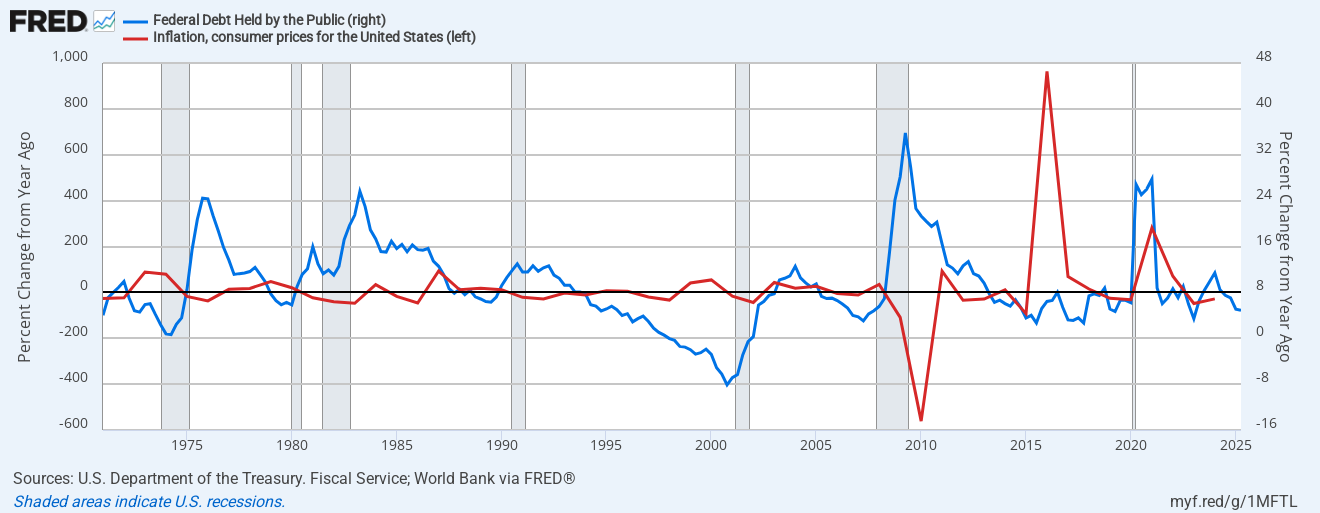
Reductions in federal deficits lead to recessions (vertical gray bars). Recessions are cured by increased federal deficits.

Federal deficits inject growth capital into the economy. While the federal government has unlimited currency, the economy needs a steady inflow of dollars for expansion.

Over the years, as federal deficits have increased, the Gross Domestic Product has also risen.

If federal deficits were economically harmful, one would not expect to see the graph above, which shows the economy’s growth paralleling the growth of deficits.

The reason is clear. GDP=Federal Spending + Nonfederal Spending + Net Exports.

III. Federal Deficit Spending Does Not Cause Inflation
 

–The failure of common sense in economics. How the President and Congress ignore economic facts and play Russian roulette with our lives.

Those, who do not understand the differences between Monetary Sovereignty and monetary non-sovereignty, do not understand economics.
=================================================================================================================================================================================================================

There is something of a rule in problem-solving that questions beginning with “How” are to be preceded by a thorough examination of questions beginning with “Should.” President Bush II failed to do that when he asked his advisors questions like, “How do we fight a war in Iraq and Afghanistan” and “How do we arrest Saddam Hussein.” The correct questions were “Should we fight a war in Iraq and Afghanistan” and “Should we arrest Saddam Hussein.”

A football coach does not begin with “How can we increase our passing yardage?” He begins with “Should we increase our passing yardage?” A company does not begin with, “How can we increase the number of our stores?” It begins with a thorough examination of “Should we increase the number of our stores?”

Sadly, President Obama, Congress, the media and the old-line economists work feverishly to answer the question, “How can we reduce the federal deficit?” They believe a thorough examination of “Should we reduce the federal deficit?” is unnecessary. They already “know” the answer, despite massive evidence to the contrary.

When you ask the wrong question, you find the wrong answer. Congress and the President can’t agree on an answer, because the question is wrong. It’s akin to asking, “How should we sail a ship without falling off the edge of the world?”

The correct question is, “Should we reduce the federal deficit?” Many people give perfunctory, knee-jerk answers, such as, “The deficit is not sustainable” or “Our children will pay for it.” But no answers have been based on the one, overriding, undeniable fact:

Federal deficits = net non-federal saving

Cut deficits and you cut saving. Cut saving and you cut economic growth. Cut economic growth and you enter recessions and depressions and the unemployment that accompanies them. The facts are that simple and undeniable. But, the President and members of Congress do not work from facts; they work from what each believes is common sense.

Common sense consists of beliefs most people consider obvious and sound, things “everyone knows.” Yet, your common sense may be different from my common sense, because it is affected by our different personal experiences, as well as by analogy, religion, social mores, history, logic, teaching, folklore, aphorisms, leaders and every form of information transfer, all of which vary from person to person.

The earth must be flat, not round, else the oceans would pour out. Nothing can be in two places at the same time – except in Quantum Mechanics. Running fast does not make your watch run slower – except in Relativity. If a roulette wheel lands on red five times in a row, it is more likely to land on black the next spin. Common sense.

Because common sense does not require research, it allows for fast decisions and is powerfully built into our genes. We have great difficulty departing from our common sense beliefs, because they are evolutionarily valuable. We experience and use common sense every day of our lives. We do not need research to tell us to avoid walking blindly into a street or reaching into a fire. Anyone who intentionally does these things is a “fool.”

So powerful is common sense, we angrily consider all those who depart from of our visions of common sense to be fools. Here are examples of common sense for most Americans:

1. Debt is a burden on the debtor; the more debt, the greater the burden. Debtors can be forced into bankruptcy by creditors.
2. A deficit is worse than a surplus. Outgo requires income. Taxes and borrowing pay for government spending.
3. Everything has a cost and a limit. Nothing can be created from nothing. Nothing goes on forever. There is no such thing as a free lunch. No pain; no gain. If it sounds too good, it is.
4. The greater the supply, the less the value. “Printing” money causes inflation. You can have too much of a good thing.
5. Dollars are real and scarce. They can be held, stored and moved.

Every one of these common sense beliefs either is always false or often false, when applied to the U.S. federal government, because:

1. Federal debt is not a burden. Unlike state and local governments, the federal government cannot be forced into bankruptcy (except by Congress). It can service any debt of any size, any time.
2. Federal deficits stimulate the economy while surpluses cause recessions and depressions. The federal government, being Monetarily Sovereign, neither needs nor uses taxes or borrowing to pay its bills.
3. The federal government creates money by marking up the bank accounts of creditors, in a cost-free, pain-free, limit-free process. To the federal government, money is a “free lunch.”
4. Increasing the supply does reduce value, unless demand increases more. Money demand is increased by interest rates. Since we went off the gold standard, there has been no relationship between federal deficit spending and inflation.
5. Dollars have no physical reality. They are nothing more than numbers in bank accounts. Even dollar bills are not dollars; they are receipts or titles for dollars. Dollars are not scarce to the federal government.

These truths are counter to intuition, counter to common sense and counter to the beliefs of most Americans, yet they are truths, nonetheless.

Very soon, Americans will face the cold reality of recession or depression, caused by Congress’s and the President’s following their “common sense,” rather than economic fact. Federal spending for Social Security, Medicare, Medicaid, and many other vital federal services will decline. We will suffer “invisible” pain from the loss of scientific and medical research, declining infrastructure, a weaker military, poorer schools, less food and drug inspection, and worse investment protections. Our standard of living will decline. Unemployment will worsen. Destitution will increase. Our children and our grandchildren will lead meaner lives. Their futures will be impoverished.

And most Americans will not realize what has been done to them.

Rodger Malcolm Mitchell
http://www.rodgermitchell.com


==========================================================================================================================================
No nation can tax itself into prosperity, nor grow without money growth. Monetary Sovereignty: Cutting federal deficits to grow the economy is like applying leeches to cure anemia.

MONETARY SOVEREIGNTY

–The single, most misunderstood fact in all of economics. It will blow your mind.

Those, who do not understand the differences between Monetary Sovereignty and monetary non-sovereignty, do not understand economics.
====================================================================================================================================================================================================
When you ask the wrong question, you get the wrong answer. Congress and the President are asking, “How should we reduce the federal deficit?” The correct question is, “Should we reduce the federal deficit?” And the answer is “No.”
=================================================================================================================================================================================================

Sometimes, something is so simple it can be hard to understand, as though “It just couldn’t be that easy.” This is one of those times.

The media don’t understand it. The columnists don’t understand it. The Tea Party, the Republicans, the Democrats and the debt hawks don’t understand it. For sure, President Obama doesn’t understand it. The old-line economics professors do understand it, but they’re afraid to admit it, because it makes them look like boobs for not telling you, all these years.

It is the single most important equation in economics. It’s so simple as to be laughable, yet it will amaze you (unless you are among the one-in-ten-thousand who already understands it). And once you understand it, you will look at the politicians in wonderment at their incredible ignorance.

Are you ready? Here it is:

Federal Deficits – Net Imports = Net Private Saving

This is not a hypothesis. It’s not a theory. It’s not my opinion or anyone else’s opinion. It is an accounting fact. In a closed economy (where money exports equal money imports), your annual savings, plus my annual savings, plus everyone else’s annual savings equals annual federal deficit spending, to the penny. In such an economy, Federal Deficits = Net Private Savings.

This means, if the federal deficit is reduced $1, our combined savings will be reduced by exactly $1 — not $.99; not $1.01 — exactly $1.00.

Today, the politicians in Washington are talking about a $4 trillion (!) deficit reduction. That means our savings will be reduced by $4 trillion. There are about 310 million people in America. A deficit reduction of $4 trillion will reduce the savings of each man, woman and child in America by an average of $12,900.

That’s $12,900 out of your pocket, another $12,900 out of the pockets of your spouse, each of your children and each of your grandchildren. A four-person family will lose $51,600 in savings. If both your parents are alive, they’ll lose another $25,800 in savings.

Why do the politicians want to reduce your savings? Sheer ignorance of Monetary Sovereignty. They think “deficit” is a bad word and want to eliminate it. But a federal deficit is money in your pocket. And a federal surplus? That’s money taken out of your pocket.

How can this be? Again, simple. When federal spending exceeds federal taxes, it’s called a “deficit.” When the federal government spends, its payments for goods and services enter the economy. When you pay taxes, the money leaves the economy. So federal deficits add money to the economy, and where does that money go? Into your pocket as savings. Similarly, federal taxes take money out of your pocket.

(If you want to see a longer, more erudite explanation, you might try Deficit = Savings, or Mosler letter to the President but I think you get the picture.)

Now tell me, how much would you like the federal deficit to be reduced? That is, how much of your savings would you like to lose? Tell your Congressperson.

Rodger Malcolm Mitchell
http://www.rodgermitchell.com


==========================================================================================================================================

Rodger Malcolm Mitchell
http://www.rodgermitchell.com


==========================================================================================================================================
No nation can tax itself into prosperity, nor grow without money growth. Monetary Sovereignty: Cutting federal deficits to grow the economy is like applying leeches to cure anemia.

MONETARY SOVEREIGNTY

–Is NPR in league with the Tea Party, or simply clueless?

Those, who do not understand the differences between Monetary Sovereignty and monetary non-sovereignty, do not understand economics.
====================================================================================================================================================================================================================

It was at 11:00 AM Central time, today, that I heard a discussion on National Public Radio, station WBEZ. The participants claimed the media are hamstrung by the need to present both sides of each issue.

They lamented the fact that “fairness” required them to give equal weight to opposing opinions, even when one opinion was far more persuasive than the other — and shouldn’t the media have more leeway in exercising their judgement on this?

Aside from the fact that columnists and editorials do exercise a form of censorship (aka “judgement”), there is one other aspect to the conversation that troubled me. The specific subject was the federal deficit. Both participants agreed the deficit must be reduced, so the “two sides” were: Raise taxes or don’t raise taxes.

As readers of this blog know, those are not both sides of the deficit issue. Those “two sides” are mere details in the real issue: Increase the deficit or don’t increase the deficit.

The media, including public radio, have been derelict in not presenting the “increase the deficit” side. And its not as though they don’t know or can’t find out. They easily can access such sources as this web site, Warren Mosler’s The Center of the Universe), Bill Mitchell’s Billyblog ), almost the entire faculty at the University of Missouri, Kansas City (far ahead of traditional Nobel winners like the University of Chicago and Harvard) and many,many others, to see powerful arguments, substantiated by facts, about why the federal deficit should be increased.

Why do they never broadcast these opinions and facts? It’s yet another puzzle surrounding the entire Monetary Sovereignty subject. Because “everyone” agrees the world is flat, the media don’t consider the possibility it may be round, so nothing is said.

There is only one solution. I’m following it and I urge you to follow it: Contact your local NPR station (www.mpr.org) and ask them to do as they claim to do: Broadcast both sides of the issue – the real both sides. If enough people request it, NPR finally may realize they are missing an important part of the economics debate.

Rodger Malcolm Mitchell
http://www.rodgermitchell.com


==========================================================================================================================================
No nation can tax itself into prosperity, nor grow without money growth. Monetary Sovereignty: Cutting federal deficits to grow the economy is like applying leeches to cure anemia.

MONETARY SOVEREIGNTY