–Federal deficit spending doesn’t cause inflation; oil does

An alternative to popular faith

Ask a debt hawk why he hates federal deficits and he will give you four main reasons:

1. Federal debt must be paid back by taxpayers. (But, because the federal government has the unlimited power to create the money to pay its bills, taxpayers do not fund federal spending.)

2. Federal debt adds to the government’s interest-paying burden. (Again, interest is no burden to a entity having the unlimited ability to create money.)

3. Federal debt uses up lending funds that otherwise would go to private needs. (But, federal spending adds money to the economy, making more, not less, funds available for private lending.)

4. By increasing the money supply, federal deficits reduce the value of money, thereby causing inflation. Readers of this blog have seen the graph (below) which shows no relationship between federal deficits — even large federal deficits — and inflation.

Note how the peaks and valleys of deficit growth do not match the peaks and valleys of inflation growth:

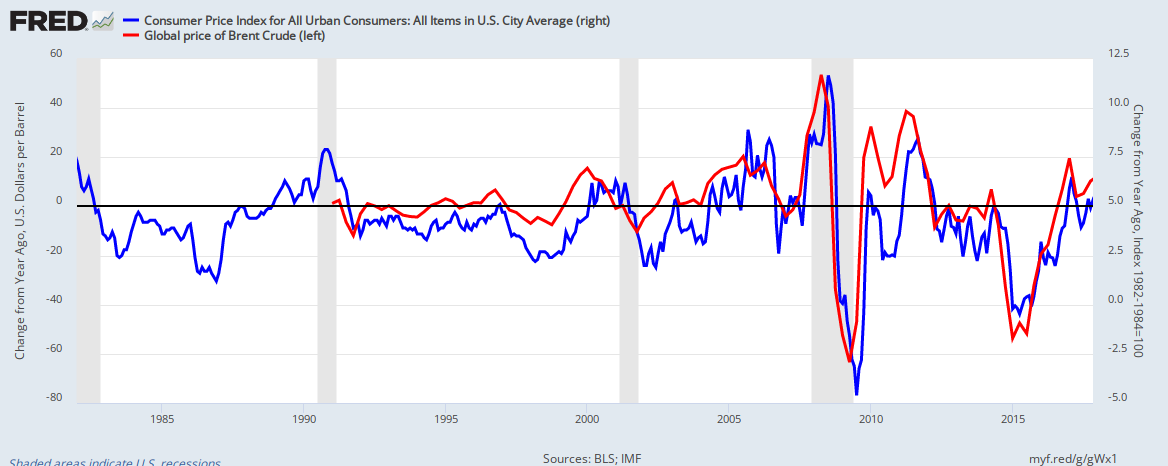
If deficits don’t cause inflation, what does? In a previous post “Is inflation too much money chasing too few goods”, we answered that question (“No.”), and we presented a graph indicating the real cause of inflation may be energy prices, more specifically, oil prices. See below:

The extreme movements of energy prices corresponding with the more modest movement of overall inflation, seem to indicate that energy costs “pull” inflation in either direction.

We can see this parallelism better by magnifing the CPI movement with a different vertical axis:
Monetary Sovereignty

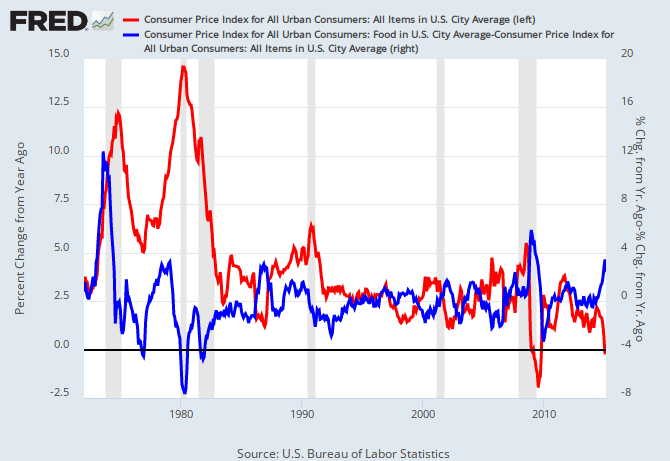
Now here is another graph that may substantiate the hypothesis that energy prices pull CPI:

monetary sovereignty

It compares inflation movements (red line) with the movement of energy prices less the movement of inflation (blue line). Notice how closely the two lines correspond.

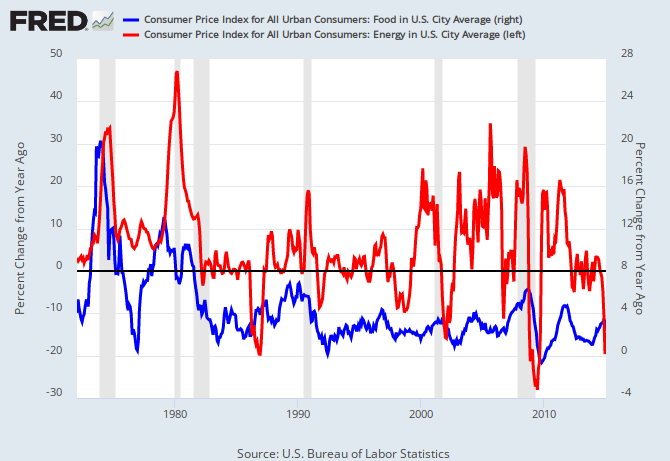
Compare that graph with the graph below. This graph is the same as the one above, except rather than comparing energy price changes with inflation, it compares food price changes. See how there is much less correlation.
monetary sovereignty

Food price changes do not seem to be the key inflation-causing factor. In fact, energy price changes seem to cause food price changes:
monetary sovereignty

Inflations are not caused by too much money. Inflations are caused by shortages.

Energy, and more specifically oil is, aside from food and water, the one universal need. It is the only commodity, the shortage of which, affects the prices of all other goods and services.

Rodger Malcolm Mitchell
http://www.rodgermitchell.com

No nation can tax itself into prosperity. Those who say the stimulus “didn’t work” remind me of the guy whose house is on fire. A neighbor runs with a garden hose and starts spraying, but the fire continues. The neighbor wants to call the fire department, which would bring the big hoses, but the guy says, “Don’t call. As you can see, water doesn’t put out fires.”

–Cuts to Medicare vs deficit spending

An alternative to popular faith

I just received a note from Mark Kirk, Republican Congressman, listing the cuts to be made in Medicare. I don’t know how factual they all are, because frankly the new program not only is complex, but evolving.

In any event, this is what the Republicans (and Democrats) should work on, rather than the “repeal and replace” political effort that has no chance to succeed. Forget the McCain, “There will be no cooperation for the rest of the year” attitude. Focus on correcting the negatives rather than throwing out the baby with the bathwater.

By the way, every one of these cuts could be eliminated if wrongheaded, deficit paranoia were eliminated. The federal government can and should pay, via deficit spending, to eliminate all these cuts. Consideration of real damages to real people should take precedence over imaginary, unproven damage from federal deficits

Here is what Rep. Kirk wrote:

2010: Medicare Cuts to Hospitals: The federal government will reduce Medicare reimbursements for hospitals who provide seniors with long-term and inpatient and rehabilitation care.

2011:Medicare Advantage Cuts Begin: Approximately 121,000 Illinois seniors will be dropped from their chosen Medicare Advantage coverage. Drug Discounts for those in Medicare Part D “donut hole” begin: The federal government will impose a new requirement on pharmaceutical companies to provide a 50% discount on “brand name” prescriptions. Increased Medicare Part D Premiums: Seniors with incomes above $85,000 for individuals and $170,000 for couples will be forced to pay higher Medicare Part D premiums. Medicare Imaging Cuts: The federal government will cut Medicare reimbursements for seniors who use MRI and CT scans. Medicare Cuts to Ambulance Services and Durable Medical Equipment: The federal government will begin cutting Medicare reimbursements for seniors who use ambulances or durable medical equipment.

2012: Medicare Cuts for Hospitals with Readmissions: The federal government will cut Medicare reimbursements to any hospital with a high readmission rate. Medicare Cuts for Hospice Care: The federal government will cut Medicare reimbursements for seniors on hospice care. Medicare Cuts for Dialysis Care: The federal government will cut Medicare reimbursements for Americans – both youth and seniors – on dialysis.

2014: Medicare Board Cuts: The federal government will establish an Independent Payment Advisory Board with powers to make further cuts to seniors on Medicare.

2015: Medicare Home Health Cuts: The federal government will cut Medicare reimbursements for seniors who depend on home health care.

I’d be interested in hearing from those of you who think reducing federal deficits is more important than eliminating these cuts, together with your evidence that deficits are harmful in any way.

Rodger Malcolm Mitchell
http://www.rodgermitchell.com

–We hate big government

An alternative to popular faith

Perhaps it began with President Reagan, who said, “[…] government is not the solution to our problem; government is the problem.” Or maybe it began long before that, when brave, heroic, self-sufficient individuals populated this land, doing everything for themselves, and asking help from no one.

I don’t know when it started, but somewhere along the line, it has become quite knowledgeable and oh so chic to express hatred for big government and big business.

These days, to demonstrate how clever we are, we parrot the popular faith that socialism, deficits and tax increases are bad. Yes, we like Medicare, Medicaid and Social Security, but we hate big government, taxes and deficits.

We like having a strong army, a national highway system, being first to go to the moon, flu vaccine, smallpox eradication and ecologically friendly cars, but we don’t want that big, bad government telling us what to do.

We want federal help when we are hit by floods, tornados, hurricanes, volcanic eruptions and blizzards, but please no big government, taxes or deficits.

We want someone to inspect our food, take a census, protect our savings, build our dams, supervise our courts and maintain our prisons. But, not big government.

Yes, we love Yellowstone, Grand Teton, Grand Canyon and the other 389 national parks. And sure, we also appreciate the many national monuments, seashores, recreation areas, historic sites, military parks and battlefields maintained by the government, but remember this: We hate big government.

Sure, protect our borders, our airports, trains, bus stations, subways, and cities from terrorists, but please do it without big government, tax increases or deficits.

Most recently, we’ve criticized all suggestions for improving health care, because they involve big government, or big insurance companies, or federal spending or tax increases, all of which we hate. And of course, doctors are overpaid; hospitals charge too much; pharmaceutical companies gouge us, and the poor don’t deserve our help, so we hate them all, too.

We join groups like the Tea Party, so we can be with other people who prove their understanding of the world, by hating socialism, big government and big business. You see, the federal government is wasteful, inefficient and stupid. And because small business can’t compete with large foreign businesses, they need to grow, but when they become large, they get greedy. And unsuccessful large companies go out of business, firing millions of people, so yes, we hate them. And we especially hate them when the government bails them out, so they don’t have to go out of business and fire millions of people.

We just wish someone would take care of things for us. But no more taxes, no more deficits, and by all means, no big government or big business.

Is magic available?

Rodger Malcolm Mitchell
http://www.rodgermitchell.com

–Debt “unsustainable” no longer.

An alternative to popular faith

        Just when I thought the Chicago Tribune was starting to get it, they ruined everything. For years, the Tribune has told its readers the federal deficits and debt are unsustainable, that China and the other nations would refuse to lend to us, that the government would be unable to service its debts and that federal taxes needed to be increased or spending reduced.
        And because the federal debt is unsustainable, the government is not able to support Medicare, Social Security, Medicaid and universal health care without significant tax increases or benefit cuts.
        Then I saw this in the March 30, 2010 editorial titled, “Debt Dangers”:“But the U.S. is not about to run out of money, even if it keeps overspending. Why not? First it can appropriate more of its citizens earnings through the tax system. Second and most important, it can print money to pay its bills.
        Wow, is the staid, old Tribune finally starting to understand? Do they realize the government can support Medicare, Social Security, Medicaid and universal health care, even if taxes are reduced? Do they understand we don’t need China and the other nations to lend to us, because we can create money without borrowing?
         Sadly we were not to be so fortunate, for a few sentences later, the editorial said, “The danger is that (the government) would create money to make those debts payable, a course that would lead to much higher inflation.”
        Never mind that today, following the most massive deficits in our history, the government’s chief worry is deflation, not inflation. Never mind that for the past forty years, there has been zero relationship between deficits and inflation, and in fact, the largest deficits have corresponded with inflation reductions. (See the graph, below).

Debt vs inflation

        And never mind that deficits repeatedly have proved stimulative, while reduced deficits are depressive. Intuition and popular faith trump facts every time.
        Then the Tribune editors compounded the crime by stating, “The economy would also suffer as businesses and households scrambled to cope with the disruptive effects of soaring prices. It would suffer again if and when the government decided to curb inflation by driving up interest rates — a step that virtually guarantees a sharp downturn.”
        Never mind that high interest rates have not slowed GDP, nor have low rates stimulated, which is why the Fed’s twenty rate cuts failed to prevent or cure the recession. (See the next graph. If high interest rates slowed GDP, the peaks of the blue line would have to correspond with the troughs of the red line.)

InterestratesvsGDP

         But at least, the Tribune has taken the first step, and perhaps we never again shall see that ridiculous sentence, “The federal debt is unsustainable.”

Rodger Malcolm Mitchell
http://www.rodgermitchell.com