–A tale of two businesses – a lesson for the future of the American economy

Those, who do not understand the differences between Monetary Sovereignty and monetary non-sovereignty, do not understand economics.
==========================================================================================================================================================================================================================

There is an old saying, “Long after the price is forgotten, the quality and service are remembered.” Though some American businesses complain about the Chinese (or is it the Indians, the Vietnamese, the Mexicans et al?) taking business away due to low prices, many American businesses thrive with quality and service.

Even the mighty Walmart, which grew on the basis of low prices and no service, recently learned there is a limit to what Americans will endure. The chain began to remove slow selling items, and suddenly, sales took a hit. Americans wanted that minuscule amount of service at least – the ability to find their favorite products.

While numerous exceptions to this generalization can be found, I suspect American businesses will do better long-term, by focusing on quality and service than on price. Here are brief accounts of my experiences at two businesses. You be the judge about which has the better future:

Rooms to Go: This chain of furniture stores, selling moderately priced pieces assembled into groupings, has a store in Boca Raton, from which I made a purchase. Their advertised deal was: Buy now and pay monthly over two years, at no interest. The amount I bought was small – about $2,000 – but what the heck. Two years of no interest is worth something.

The month after I made the purchase, my credit card was charged the full amount. I called the store manager, who said there is nothing she could do, because the salesperson had quit, and note had been sold to a bank. I (not she) would have to call the bank. I tried, but after 20 minutes on hold, I gave up. I mean, we’re not talking about big money. I twice wrote to a guy named Stephen Buckley, who not only is company president but CEO – a real big shot. No response from the big shot.

What they could have done:Rather than putting the onus on me to spend my time trying to solve their mistake, they at least could have given me the interest I would have earned, had I invested my money. What would that have been? Forty dollars? A mere pittance, to be sure, but a gesture of concern for a customer. After all, it was their advertised deal, and they screwed up.

Needless to say, I never will buy from that chain again, and I tell this story every chance I get. So they saved $40, and cost themselves lots of business, as I am just now furnishing a new apartment in Boca Raton, as are some of my friends.

Wildfire Restaurants This chain is part of the Lettuce Entertain You group, that became big and famous for good food and good service. Their staff is well trained. Within two minutes after you are seated, a waiter must come to your table. Your water glass never is empty. You don’t need to find a waiter; they know how to anticipate your needs.

They send out “secret shoppers” to test the service and quality. These people are trained and given a long list of criteria to measure. Reports are made daily to home office. I mean, Lettuce Entertain You is dedicated to quality and service. Their prices are not low; in fact, they lean toward the higher side. Virtually all the restaurants nearby charge more, but Lettuce grows.

Recently I made an reservation for eight people. When we arrived, our table wasn’t ready and we had to wait 15 minutes. That may be normal for some restaurants, but for Wildfire that was unacceptable.

What they did: Immediately after we were seated, a waiter apologized and told us they were “comping” all appetizers, which eventually totaled about $60.

Will I go back to Wildfire? Darn right I will, as will the others who were with me. What could have been a grumpy meal, suddenly became great, as we snarfed down those free appetizers.

So that is the tale of two businesses, one providing me crap service from top to bottom, and one providing great service. Would Rooms to Go do better if it provided better service? You decide.

I believe American business can compete with the sweatshop nations, if not on price, then on quality and service. We have little to fear from competition; we have much more to fear from incompetent management. Once dominant General Motors learned that harsh lesson, but I doubt Rooms to Go will be bailed out by the federal government as GM was.

Rodger Malcolm Mitchell
http://www.rodgermitchell.com


==========================================================================================================================================
No nation can tax itself into prosperity, nor grow without money growth. Monetary Sovereignty: Cutting federal deficits to grow the economy is like applying leeches to cure anemia.

MONETARY SOVEREIGNTY
–Why there will be a full-blown depression in 2012

Those, who do not understand the differences between Monetary Sovereignty and monetary non-sovereignty, do not understand economics.
==================================================================================================================================================================================================================================================================================================================
The Naked Capitalism blog quotes the N.Y. Times, in an article titled, “More Proof That Obama is Herbert Hoover”:

An extraordinary amount of personal income is coming directly from the government. Close to $2 of every $10 that went into Americans’ wallets last year were payments like jobless benefits, food stamps, Social Security and disability, according to an analysis by Moody’s Analytics. In states hit hard by the downturn, like Arizona, Florida, Michigan and Ohio, residents derived even more of their income from the government.

By the end of this year, however, many of those dollars are going to disappear, with the expiration of extended benefits intended to help people cope with the lingering effects of the recession. Moody’s Analytics estimates $37 billion will be drained from the nation’s pocketbooks this year.

And President Obama not only wants federal budget cuts, he is aiming for a $4 trillion cut – the biggest cut even he can imagine. He’s ready to cut spending for everything – Medicare, Social Security, Medicaid – and to compound the problem, he wants to increase income taxes (but “only” on the wealthy, so that won’t remove money from the economy . . . or will it?)

Consider the enormous money drain from the economy, when the government reduces spending and compounds it with increased taxes. The economy is starved for money, and the government wants to cut the supply. Talk about applying leeches to cure anemia!

Question for debt-hawks: Where is the money going to come from to grow our economy? Given any thought to that?

The article’s author makes one final comment:

Even knowing how dedicated to bad ends Obama is, I still feel like I’ve walked into a parallel universe. He’s now determined to make these horrific entitlement cuts a sign of his manhood. This is “Change” for sure, to a more brutal, grasping, dog eat dog society, all administered by self serving elites. They will in the end reap the whirlwind they are creating, but not before it mows a path of destruction through our social order.

Based on where Obama and the Tea/Republicans are headed, there will be a depression (not just a recession) next year. Only a miracle of realization, by both parties, can save us now.

Rodger Malcolm Mitchell
http://www.rodgermitchell.com


==========================================================================================================================================
No nation can tax itself into prosperity, nor grow without money growth. Monetary Sovereignty: Cutting federal deficits to grow the economy is like applying leeches to cure anemia.

MONETARY SOVEREIGNTY

–Learn the bare fundamentals of Monetary Sovereignty in just five minutes

Those, who do not understand the differences between Monetary Sovereignty and monetary non-sovereignty, do not understand economics.
======================================================================================================================================================================================================================================
In comment #4. in the post titled, “Obama joins the Tea Party,” Tyler F. asked, “If you had 3 minutes to speak at a town hall meeting, what would you say?”

Well, three minutes could be a problem, only because so many questions remain unanswered, and for something most people are not prepared to understand, much less believe, the racetrack approach doesn’t work.

Nevertheless, given perhaps five minutes, I might say something like this:

In just five minutes, I can show you how to cure America’s economic problems.

The U.S. became Monetarily Sovereign in 1971, when we went off the gold standard. That change was so counter-intuitive, few economists, politicians or media writers understand it.

Unlike you and me, unlike the states, counties and cities, unlike Greece and Ireland, a Monetarily Sovereign nation has the unlimited ability to pay its bills. I must live within my means. The federal government has no means to live within. You must have a source of money before you spend. The government creates money by spending. The financial rules that apply to you and me, do not apply to the government.

Something else counter-intuitive: The dollar does not exist. Just as the number seven does not exist, the dollar merely is a balance sheet number. If you own a home, you have a title; it is evidence you own the home. But the title is not the home. Similarly, that dollar bill in your wallet is not a dollar. It is a title; it is evidence you own a dollar.

Because a dollar is just a balance sheet number, the federal government has the power to create and destroy dollars, merely by changing numbers. When you receive a government check, that check is not money. It is a set of instructions telling your bank to change the number in your bank account.

Your bank account number goes up, and a government balance sheet number goes down. No dollars move from the government to you. Dollars can’t move because dollars don’t exist. Your bank could be on Mars, and the government could pay you by changing the number in your bank account. That is the meaning of Monetarily Sovereign – infinite control over sovereign currency.

So, how is it possible for a Monetarily Sovereign nation to run short of its sovereign currency? Why would a nation, that can pay all its bills by changing bank account numbers, ever need to borrow its own currency? Why would a nation with infinite control over its sovereign currency, need tax money to pay its bills?

The answers are: The U.S. government never can run short of dollars. The U.S. government no longer needs to borrow money or to levy taxes. Borrowing and taxing are relics of the gold standard. To pay its bills, the U.S. government simply changes numbers in bank accounts.

So, what is the purpose of the debt ceiling? Answer: It has no purpose. It too is a relic of the gold standard.

By definition, a large economy contains more dollars than does a small economy. So, to grow from smaller to larger, an economy must have a growing supply of dollars. The government adds dollars to the economy by deficit spending, that is by changing numbers in bank accounts.

Why then does Congress wish to reduce deficit spending? Because Congress does not understand Monetary Sovereignty.

So, what about inflation? The value of money is based on supply and demand. Demand is based primarily on the reward for owning money, which is interest. So, preventing inflation requires reducing the money supply or increasing interest rates. However, reducing money supply growth historically has led to recessions and depressions. That is why the Fed controls inflation by raising interest rates.

To summarize, There is a simple and direct solution for our economic problems: Grow the economy with federal deficit spending, and use interest rate control to prevent excessive inflation.

Yes, this could be cut to three minutes, but people need more time to absorb a counter-intuitive concept. Even five minutes doesn’t really do it.

That’s why town hall meetings are not informative but rather are stage shows for the amusement of the audience.

Rodger Malcolm Mitchell
http://www.rodgermitchell.com


==========================================================================================================================================
No nation can tax itself into prosperity, nor grow without money growth. Monetary Sovereignty: Cutting federal deficits to grow the economy is like applying leeches to cure anemia.

MONETARY SOVEREIGNTY

–Why bank lending leads to recessions. A counter-intuitive finding.

Those, who do not understand the differences between Monetary Sovereignty and monetary non-sovereignty, do not understand economics.
================================================================================================================================================================================================================
Thirteen months ago, I published a post titled, “Is federal money better than other money.” I believed it was one of the more interesting posts in this long series, because it showed that while reduced federal debt growth led to recessions, increased non-federal debt growth also led to recessions.

At the time, the data stopped at February, 2002. I now have brought the data forward, and am republishing. These new data support the previous findings.

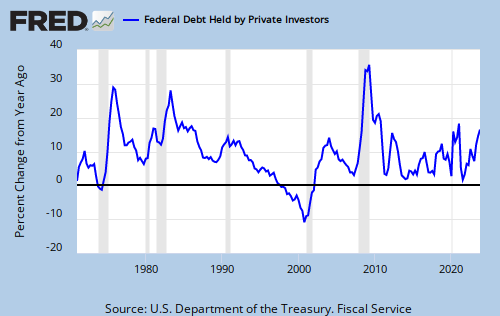
In other posts on this blog, we have discussed how reductions in federal debt growth, as shown by the following graph, “Federal Debt Held By Private Investors,” immediately precede recessions. This comes as no surprise, since a growing economy requires a growing supply of money, and deficit spending is the federal government’s method for adding money to the economy.

Federal debt

Clearly, federal debt/money growth is essential to keep us out of recessions. Yet, when we look at “Debt Outstanding Domestic Nonfinancial Sectors” which includes not only Federal debt, but also outstanding credit market debt of state and local governments, and private nonfinancial sectors (tan line), we do not see the same pattern.

In fact, when we subtract federal debt from total debt, leaving only state, local and private debt, we see the opposite pattern. Recessions follow increases in state, local and private debt!

4
STATE, LOCAL AND PRIVATE DEBT, PERCENT CHANGE FROM YEAR AGO

Now in one sense, money is money. Your buying on your credit card creates debt/money, just as federal deficit spending creates debt/money. Presumably, both should have the same stimulative effect on the economy. They do, but not long term. Why?

Because, unlike the federal government, you, your business and local governments cannot create new money endlessly to service your debts. Your debts can pile up to the point where you must liquidate them by paying them off or by going bankrupt. When non-federal debts become too large, a growing number of people, states, cities and businesses must pull back and stop further borrowing, i.e. stop creating money, or even destroy money by paying off loans. When that happens, we have a recession.

(As an aside, this is one reason the early stimulus efforts had so little effect. People used the stimulus money to pay off loans, so while the federal deficit spending created money, the loan pay-downs destroyed it. Debt reduction destroys debt/money.)

During the recession, and for a short time after, we tend to cut back on our personal borrowing and liquidate debt/money. Then we begin to resume borrowing, more and more, until again, we hit our personal limits and cut back, causing yet another recession. The sole prevention of this cycle, which averages about 5 years in length, is to make sure that federal deficit spending grows sufficiently to offset periodic money destruction by the private sector.

In summary, federal deficit spending is good for the economy, always good, endlessly good (up to the point of inflation). Private and local government spending/borrowing also is good, but not endlessly. Unlike the federal government, the private and local-government sectors eventually reach a point where debt is unaffordable and unsustainable.

To prevent recessions, the government continuously must provide stimulus spending, then provide added stimulus spending to offset the periodic reduction of money creation by the private sector.
__________________________________________________________________________________________________________________________
These data call into question the popular belief that encouraging bank lending stimulates the economy. While short-term effects may be positive, long-term bank lending seems to lead to recessions, as servicing loans becomes ever more onerous for the monetarily non-sovereign sectors. In contrast, Federal deficit spending easily is serviced by the government, and therefore is preferable to private borrowing as a stimulus.
__________________________________________________________________________________________________________________________
Rodger Malcolm Mitchell
http://www.rodgermitchell.com


==========================================================================================================================================
No nation can tax itself into prosperity, nor grow without money growth. Monetary Sovereignty says: Cutting federal deficits to grow the economy is like applying leeches to cure anemia.

MONETARY SOVEREIGNTY