–What are the best recession/depression investments?

Those, who do not understand the differences between Monetary Sovereignty and monetary non-sovereignty, do not understand economics.
======================================================================================================================================================================================================================================================================

It looks like Congress and the President, with the approval of the media, old-line economists and the voting public, are determined to reduce the deficit. Historically, deficit reduction has resulted in recessions and depressions. Federal deficits are the government’s method for adding money to the economy, and economic growth requires money growth.

So, we will cause ourselves a recession or a depression. I’m resigned to the fact that the vast majority doesn’t believe this, so I suppose I should enjoy the pleasant irony of seeing all the fact doubters lose their money, their jobs and their homes in the years to come.

But I don’t, partly because my own children and grandchildren will be hurt by the mess Congress is creating. I’ll be hurt, too – unless I can think of some recession-proof investments. While it seems nothing can prevent the out-of-control freight train known as “Congress” from destroying America, I’d like to protect my own family as best I can.

Many of you are investors. Some may know far more about stocks, bonds etc than I do. So I ask you this:

Given that we will have deficit reduction, which absolutely, positively will cause a recession or a depression (depending on how big the deficit reduction will be), what are the best investments to make today? Cash may be safest, but there’s no income. Treasuries are safe too, but again, there is scant income. Its a dilemma. What do you suggest?

Thank you for your help.

Rodger Malcolm Mitchell
http://www.rodgermitchell.com


==========================================================================================================================================
No nation can tax itself into prosperity, nor grow without money growth. Monetary Sovereignty: Cutting federal deficits to grow the economy is like applying leeches to cure anemia.

MONETARY SOVEREIGNTY

–Be careful what you wish for, Mr. President.

Those, who do not understand the differences between Monetary Sovereignty and monetary non-sovereignty, do not understand economics.
================================================================================================================================================================================================================================================================

President Obama is operating under the confusing myth that while deficit spending is stimulative, deficit spending should be reduced or even eliminated. So he has advocated a “grand bargain” to cut deficits, a plan which will lead us first to recession, then to depression. Guaranteed.

Washington Post, By Alec MacGillis and Lori Montgomery, July 16, 2011.

Even as President Obama and congressional leaders focus on a fallback plan to lift the nation’s debt ceiling, top Democrats and Republicans have begun to map a new way to craft the same sort of ambitious deficit-cutting plan they abandoned last week.

As part of the deal being discussed to raise the debt ceiling, leaders on Capitol Hill are forming an especially powerful congressional committee that would be charged with drawing up a new “grand bargain,” possibly by the end of the year.

Key elements for a big deal remain in place. Obama has been clear that he wants one and has started making the case to skeptical factions of his own party that getting the nation’s fiscal house in order is in their best interest. House Speaker John A. Boehner (R-Ohio) also remains committed to an ambitious plan, having told his troops that he didn’t become speaker to do small things. And, perhaps most critically, the markets are demanding it. The credit rating agency Standard & Poor’s says Washington must agree to reduce the debt by $4 trillion over 10 years to avert a downgrade.

The Democrats want it. The Republicans demand it. The Tea Party insists on it. The credit agencies advocate it. What possibly could go wrong?

“We cannot as a country fail to deal with the debt threat,” said Senate Budget Committee Chairman Kent Conrad (D-N.D.), one of the bipartisan “Gang of Six” senators who tried to reach an agreement in recent months. “Every serious economic analysis tells us we’ve reached the danger zone. And just kicking the can down the road? That can’t be. We’re better than that. We’ve got to be better than that.”

Er . . . ah . . . exactly what is the “debt threat”? Is it that the government will be unable to pay its bills? No, the government has the unlimited ability to pay its bills. That was the reason we went off the gold standard.

Is it that taxes will need to be raised? No, the government does not use tax money to pay its bills. In fact if taxes were reduced to $0 or increased to $100 trillion, neither event would affect the government’s ability to pay its bills.

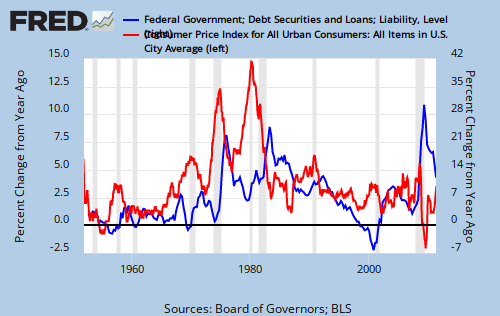
Is it that federal deficit spending will cause inflation? No, contrary to what the Tea Party tells you, there has been no relationship between federal deficits and inflation. See: Cause of Inflation

Is it that foreign countries will stop lending to us? No, since we went off the gold standard in 1971, the federal government has had no need to borrow the dollars it can create without limit. If the Treasury stopped issuing T-securities, this would have no effect on the government’s ability to pay its bills. We could “pay off”China tomorrow at the press of a computer key.

Is it that “future generations” will pay for the debt? No, the debt merely is the total of outstanding T-securities, which the government services by crediting the bank accounts of T-security holders. It can do this endlessly. Nobody pays, not today’s generation, nor tomorrow’s. But future generations will pay by receiving less Social Security, less Medicare, less Medicaid — in short, our children and grandchildren will lead worse lives because of deficit cutting today.

So what is the “debt threat.” No one knows, and no one specifically says, but by heaven, we simply must deal with it somehow, even if we destroy the economy.

But hopes for a grand resolution in coming months face the same question that hangs over the current crisis: whether tea-party-aligned conservatives in Congress who forced the debt-ceiling showdown will provide the necessary votes for an eventual major deal, even if it includes new taxes.

Well, if it has Tea Party support, it must be good. We all know what brilliant economists those folks are.

The Gang of Six — which tried to come up with its own plan — disbanded last week after failing to reach agreement on how to cut spending and raise taxes. Meanwhile, the big deal pursued by Obama and Boehner faltered amid criticism from congressional Republicans opposed to additional revenue.

House Majority Leader Eric Cantor (R-Va.), who has emerged as the leader of this contingent, has argued against such a deal. But his views may be shifting along with those of some rank-and-file House Republicans whose imaginations have been captivated by the idea of slicing as much as $5 trillion out of the federal budget over the next decade.

In a caucus meeting last week, some freshmen wanted to know whether they could slice that much out of the budget in the next two years, GOP aides said. (Answer: no. The entire federal government is expected to spend about $3.6 trillion this year.)

Ah, those freshmen. They have proved they have no idea what they are talking about, but they sure are loud. So I guess we should respect their opinions.

In public at least, conservatives are maintaining that the answer is to “cut, cap and balance” — passing a balanced-budget amendment that would cap federal spending at 18 percent of the nation’s gross domestic product, down from its current 24 percent.

I can’t think of a better way to assure an ongoing recession or even a depression than to limit the amount of money the federal government can add to the economy.

The House is expected to vote Tuesday on such an amendment, but it has scant odds of getting the needed supermajority in the Senate. Democrats say an 18 percent cap in a country with an aging population and rising health-care costs would lead to ruinous cuts.

But conservatives said Saturday that they are holding out for the amendment and are not ready to accept a stopgap measure being put together by Senate leaders Mitch McConnell (R-Ky.) and Harry M. Reid (D-Nev.) that would raise the debt ceiling before the nation hits its borrowing limit Aug. 2.

“I didn’t get elected to punt this problem down the road another six months,” said Rep. Jason Chaffetz (R-Utah). “We are the body, we are the commission to make these tough decisions. . . . Guys like me are not coming along. We’re not going along just to get along.”

Translation: “We don’t care about ruinous cuts. We don’t care about the economy. We just want to do what the Tea Party tells us to do, so we can get elected, again. We have our priorities.

Under the stopgap plan, Congress would allow Obama to raise the debt ceiling in three increments totalling $2.5 trillion over the next year. Each time, Congress would vote on a resolution of disapproval, allowing Republicans to blame the increases on Obama.

Can anyone take these guys seriously. They propose a complex, convoluted plan that allows them to avoid all responsibility for the disastrous results. Our brave Congress at work.

The commission recommended saving $3.8 trillion by raising the retirement age for Social Security, slashing spending across government and wiping out more than $100 billion a year in popular tax breaks, including the tax deduction for mortgage interest and the tax-free treatment of employer-provided health insurance. It recommended larger Pentagon cuts and revenue increases than the White House sought this month.

Obama countered last week that Democrats should want a major fiscal deal, because it would make it easier to win approval for spending on their priorities in the next few years.

“If you care about making investments in our kids and making investments in our infrastructure and making investments in basic research,” he said, “then you should want our fiscal house in order so that every time we propose a new initiative somebody doesn’t just throw up their hands and say, ‘Ah, more big spending, more government.’ ”

Let’s see. You want to cut Medicare and health coverage, but you also want to increase investments in research, infrastructure and “our kids.” So you want the elderly and the sick to pay for roads and research. Great plan, Mr. President.

Here is the bottom line. Money is the lifeblood of an economy. A growing economy requires a growing supply of money. Federal deficit spending is the method by which the federal government adds this “lifeblood” to the economy. Today’s economy is starved for money. Cutting federal deficit spending is like applying leeches to cure anemia.

Whichever deficit-cutting plan is being debated in Congress, I absolutely, positively guarantee it will cause a recession that will make the last recession look like a walk in the park. The public has been sold a bill of goods about the so-called dangers of deficits, and we all will pay the price of ignorance.

Be careful what you wish for, Mr. President. If you get what you want, it will come back to bite you in the butt. You will take your place in history, right beside Herbert Hoover, as the guy who through ignorance caused the next Great Depression. That will be your legacy.

Rodger Malcolm Mitchell
http://www.rodgermitchell.com


==========================================================================================================================================
No nation can tax itself into prosperity, nor grow without money growth. Monetary Sovereignty: Cutting federal deficits to grow the economy is like applying leeches to cure anemia.

MONETARY SOVEREIGNTY
–What is our priority: The recession and joblessness — or inflation?

Those, who do not understand the differences between Monetary Sovereignty and monetary non-sovereignty, do not understand economics.
==========================================================================================================================================================================================================================

If you drove your car onto a railroad track, while a train was bearing down on you, would you worry about the price of gas, or would you step on the accelerator to get out of the way?

Clearly, the more immediate problem is the train. But according to debt-hawk thinking, you should ignore the immediate problem and wait until gas prices come down. Today, the Tea/Republican party is worried that federal servicing of deficits causes inflation . They wrongly claim that for the federal government to service larger deficits, it must “print” so much money eventually there will be inflation, even hyperinflation..

As always, the Tea/Republicans are wrong: Federal government borrowing does not increase the money supply. Borrowing is a simple asset exchange, in which T-securities are created and traded for dollars, which are destroyed. The servicing of federal debt is the exact opposite. Dollars are traded for T-securities and the T-securities are destroyed. During the entire process, no inflationary money is created.

Which is one reason federal deficit spending has not been associated with inflation since 1971, when we went off the gold standard and became Monetarily Sovereign. (See the following graph)

Inflation vs. Deficits

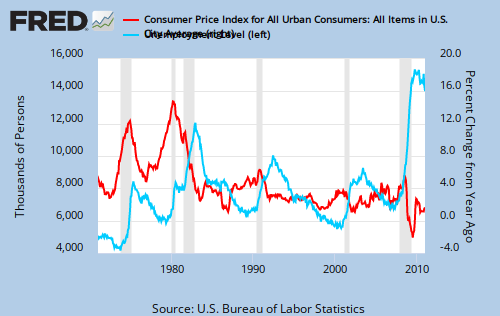
Yes, let’s forget that the Tea/Republicans simply do not know what they are talking about from a factual standpoint, and instead let’s focus on priorities. Look at the graph below, and tell me whether today’s priority is inflation or recession/joblessness.

Inflation vs Unemployment

Clearly, today’s priority is the weakness of the economy and unemployment. The economy is starved for money. To treat a starving patient, you must feed him. How do you feed a starving economy? By giving it money. How do you give an economy money? Via federal deficit spending.

But, debt-hawk Tea/Republicans will tell you that adding ”infinite” money to the economy (a straw man nobody is recommending) will cause inflation and even hyperinflation. Oh really?

Here is an excerpt from an article in Time Magazine:

Inflation Falls: Is the Economy Saved or Doomed?
Posted by STEPHEN GANDEL Friday, July 15, 2011

Gas prices fell last month, prompting the first drop in overall prices in a year. (Lucy Nicholson / Reuters)

Inflation in June fell for the first time in a more than a year. The Consumer Price Index (CPI), which is the government’s most widely watched gauge of what the things average Americans buy cost, fell 0.2% last month. The drop was mostly driven by a fall in gas prices, which were down nearly 7% alone in June.

Lest you think that gas prices were the sole cause of low inflation, take another look at the first chart. The red line is total Consumer Price Index. The black line is CPI less food and energy. Both are headed down.

And, even when inflation eventually crops up, the Fed can increase the value of the dollar (fight inflation), by raising interest rates to increase the demand for money. That is the way the Fed has controlled inflation for many years.

So tell me, which is the more immediate problem, the recession/joblessness or inflation? Are you the type who would not drive off the tracks until gas prices come down? If you are, then welcome to the Tea/Republican Party.

Historians will look back at 2011 and shake their heads at the suicidal bent of the Tea/Republicans and even the Democrats. The notion that federal deficit spending, which adds money to the economy, should be reduced at a time of economic starvation, is so unbelievably wrong-headed, future economists will say, ‘What were these fools thinking? At just the time they should have been adding money to the economy, they were searching for ways to bleed money out of the economy.

Of course, The debt debate has nothing to do with the economy. It’s just economic blackmail for political power. Neither the Democrats nor the Tea/Republicans give a damn about the people of this nation. The sole concern is who wins the next election. So when you see these phonies, giving their speeches (inevitably standing in front of American flags, the bigger the better), realize they don’t care about America. Not even a little bit. It’s all about them and their lust for power.

What would you call a person, who deliberately endangers America, who actually is willing to sacrifice America, just to advance his own career? I’d call him a traitor.

That will be the legacy of today’s politicians, and the media and old-line economists who went along with this travesty, and that is the pain our generation will cause our children and our grandchildren.

Rodger Malcolm Mitchell
http://www.rodgermitchell.com


==========================================================================================================================================
No nation can tax itself into prosperity, nor grow without money growth. Monetary Sovereignty: Cutting federal deficits to grow the economy is like applying leeches to cure anemia.

MONETARY SOVEREIGNTY
–Ignorance on every side. Et tu Shadow Government Statistics?

Those, who do not understand the differences between Monetary Sovereignty and monetary non-sovereignty, do not understand economics.
====================================================================================================================================================================================================================

Shadow Government Statistics (SGS) is a popular site for those who correctly recognize that many government data are politically spun. It’s a good data resource, but when it comes to economics . . . well you be the judge. Here is a quote from the site:

The U.S. government effectively is bankrupt and remains extremely likely to resolve this ultimate sovereign insolvency by printing money to meet its obligations. As global pressures force the Fed into further Treasury debt monetization, as global confidence in the world’s reserve currency evaporates, risks remain particularly high of a U.S. hyperinflation beginning to unfold in the first-half of 2011, along with severe economic, social and political consequences that will follow. The outside timing for this manmade financial catastrophe remains 2014.

Let’s analyze this:

“The U.S.governemtn effectively is bankrupt . . . “ What does that mean? A bankrupt entity cannot pay its bills; the U.S. can. . . endlessly.

“. . . and remains extremely likely to resolve this ultimate sovereign insolvency by printing money to meet its obligations.” If by “printing money” SGS means crediting the bank accounts of its creditors, yes, that’s the way a Monetarily Sovereign government pays its bills. Always has; always will. If the government didn’t “print” dollars, there would be no dollars.

Then we get into hyperinflation, scheduled by SGS to begin the first half of this year and no later than 2014. Let’s call this the Harold Camping syndrome – the foolish attempt to date a catastrophy prediction without giving yourself a “out.” At least when I recently predicted a “full blown depression for 2012, I included the caveat, “Based on where Obama and the Tea/Republicans are headed. . . “ which at the time was toward a $4 trillion deficit reduction, which unquestionably would cause a depression. Clever me. I gave myself an “out.”

But John Williams, the author of SGS offers no caveat. He just flat-out predicts hyperinflation, which the U.S. never has had, through wars, depressions, recessions, stagflations and every other economic crisis. Hyperinflations always are caused by specific and unique circumstances, and are not merely inflations on steroids. Today, we are worried about deflation, while having the absolute power to prevent even inflation, via interest rate control.

No, hyperinflation is the least of our worries — somewhere at the danger level of being destroyed by a huge meteor. The “most” of our worries: Recession and depression, which either are existent or imminent, depending on how you define them. Oddly, debt hawks continue to fret about the least of our worries, while ignoring the “most” of our worries. Just can’t figure those strange people.

So add Shadow Government Statistics and John Williams to the long list of people and institutions that display zero understanding of Monetary Sovereignty.

Rodger Malcolm Mitchell
http://www.rodgermitchell.com


==========================================================================================================================================
No nation can tax itself into prosperity, nor grow without money growth. Monetary Sovereignty: Cutting federal deficits to grow the economy is like applying leeches to cure anemia.

MONETARY SOVEREIGNTY