–Professor Black and the secret plot to defeat Obama

The debt hawks are to economics as the creationists are to biology. Those, who do not understand monetary sovereignty, do not understand economics. Cutting the federal deficit is the most ignorant and damaging step the federal government could take. It ranks ahead of the Hawley-Smoot Tariff.
==============================================================================================================================================

On Monday, December 13, 2010, William Black, associate professor of economics and law at the University of Missouri-Kansas City, wrote a post on his blog, New Economic Perspectives, titled, “Obama haters praise his tax policies because they believe those policies will make him fail” (I once spoke at the UMKC, and have great respect for the professors of economics whom I met there. I still correspond with Professor Randall Wray, one of the more brilliant minds in economics.)

The thrust of Professor Black’s post was summarized in his first paragraph:

Like the Sirens reputed to lure sailors onto rocks, a series of columnists who want President Obama to fail are praising Obama’s capitulation on extending the Bush tax cuts for the wealthy. The motif of these comments has three common characteristics – all designed to destroy the Obama presidency. First, and the chutzpah of this aspect is wondrous, those that hate Obama’s policies are telling Obama he is demonstrating his strength by surrendering on the Bush tax cuts to the wealthy. Second, they claim that Obama “moved to the center” by agreeing to support tax cuts for the wealthy. Third, they claim that Obama’s attacks on his strongest supporters are brilliant politics essential to saving his Presidency.

Professor Black’s fundamental complaint was:

Obama’s promise to end the Bush tax cuts for the wealthy was supported by a strong majority of Americans. . . The people who want Obama to fail consistently push him to abandon policies that are desirable and broadly supported by the public. . .

I commented on Professor Black’s post, and the essence of my comments was:

“A couple of problems. First, because the public does not understand monetary sovereignty, and so does not understand economics, the beliefs held by the public do not necessarily constitute ‘policies that are desirable.’

“Second, increasing taxes on any group, rich or poor, removes money from the economy, and so is anti-growth. There is zero economic benefit from increasing taxes on the rich, despite the emotional satisfaction it may give the poor.

“Obama was dragged kicking and screaming into exactly the right action, i.e. he didn’t increase any taxes other than the ‘death tax,’ and that went up less than feared.

“In total, his ‘capitulation’ is predicted to give us a continuation of the Bush tax rates, a reduction in FICA and a lesser increase in the death tax. Assuming this bill passes, we will have a much better chance of exiting the recession. If that’s ‘losing|,’ I’ll take losing over winning every time.”

I was quite surprised to read Professor Black’s post. Because he teaches at UMKC, I innocently had expected he would have a better understanding of federal finance and monetary sovereignty. Perhaps, the word has not yet had time to float around the hallowed halls.

Rodger Malcolm Mitchell
http://www.rodgermitchell.com

No nation can tax itself into prosperity. Those who say the stimulus “didn’t work” remind me of the guy whose house is on fire. A neighbor runs with a garden hose and starts spraying, but the fire continues. The neighbor wants to call the fire department, which would bring the big hoses, but the guy says, “Don’t call. As you can see, water doesn’t put out fires.”

–How to fight inflation and how not to.

The debt hawks are to economics as the creationists are to biology. Those, who do not understand monetary sovereignty, do not understand economics. Cutting the federal deficit is the most ignorant and damaging step the federal government could take. It ranks ahead of the Hawley-Smoot Tariff.
==================================================================================================================================
I know this is a strange time to talk about fighting inflation. Recently we struggled up from a minus inflation (aka “deflation”) and now are at a puny 1% level. But too often, when I say that federal deficit spending should increase, a debt-hysteric concern expressed to me, is not just inflation, but the typical debt-hawk exaggeration: hyperinflation!

The debt-hawks seem to be the kind of folks who, upon seeing a starving child, would not feed that child for fear the food would cause obesity. Today, our economy is starved for money, but the debt hawks fear monetary obesity (aka “inflation”) and they warn us of wheelbarrows full of money. They give silly speeches about what they term “fiscal prudence” and what I term, “starving the baby.”

So as long as we must face debt hysteria, and the hysteria has to do with a non-existent though dreaded inflation, we might as well talk about preventing and curing inflation. Inflation is the loss in value of money compared to the value of goods and services.

So, there are two fundamental methods for curing inflation: Reduce the supply of money or increase the demand for money. Both methods increase the value of money vs the value of goods and services. (In theory, increasing the supply of goods and services or decreasing the demand for goods and services also would work, but there is no known method for accomplishing this without changing the money supply.)

Ideally, any anti-inflationary activity should be effective, quick to activate, quick to take effect, incremental, easy to rescind and not damaging to the economy. But while tax increases remove money from the economy, and so can be effective, they fail all the other tests. They are highly political; They are slow to pass through Congress. They take effect slowly, because taxes are collected slowly. They cannot be passed and implemented incrementally. They are difficult to undo. And they damage the economy. The require answers to difficult questions: Exactly which taxes should be increased? By how much? Should we have a tax increase during a stagflation? How do we calibrate an incremental tax increase?

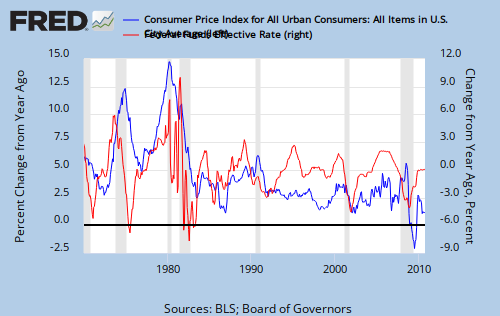
Compare this approach with another approach: Interest rate increases. Interestingly, interest rate increases have both pro-inflation and anti-inflation effects. Pro inflation: Increase in business costs and increase in the money supply due to increased federal interest payments. Anti-inflation: Increase in the demand for money vs the demand for non-money.

On balance, the anti-inflation effects are stronger. One hint is this graph: graph 1that seems to indicate interest rate increases are followed about one year later by inflation decreases.

The other hint is the Fed’s ongoing success in controlling inflation despite massive increases in the money supply. Interest rate increases actually work.

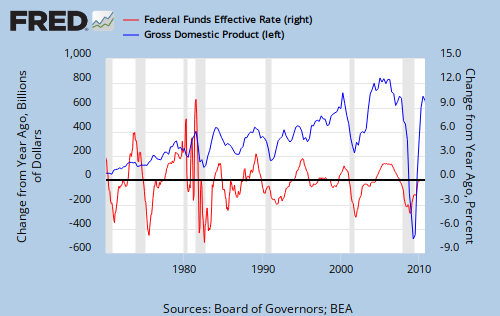
Interest rate increases can be done quickly and in small or large increments — just what is needed for inflation control. And contrary to popular faith, high interest rates do not negatively affect GDP growth. See: Interest

In summary:
–We are nowhere near inflation
–We can control inflation by raising interest rates
–High interest rates do not negatively affect GDP growth

We can and should feed the starving economy without letting unfounded worries about our ability to prevent or cure the economy’s obesity, prevent us from saving the child.

Rodger Malcolm Mitchell
http://www.rodgermitchell.com

No nation can tax itself into prosperity. Those who say the stimulus “didn’t work” remind me of the guy whose house is on fire. A neighbor runs with a garden hose and starts spraying, but the fire continues. The neighbor wants to call the fire department, which would bring the big hoses, but the guy says, “Don’t call. As you can see, water doesn’t put out fires.”

–Senator Durbin wanders in Fantasyland

The debt hawks are to economics as the creationists are to biology. Those, who do not understand monetary sovereignty, do not understand economics. Cutting the federal deficit is the most ignorant and damaging step the federal government could take. It ranks ahead of the Hawley-Smoot Tariff.

Read about Senator Durbin’s wanderings in Fantasyland. Today, 12/3/10, the Chicago Tribune published an article by Dick Durbin, the senior Senator (D) from Illinois. The title: “Why I’m voting ‘yes.” Here are some quotes from the article, and my comments.

“On Friday, when President Brach Obama’s National Commission on Fiscal Responsibility and Reform gathers to consider a plan to bring our national debt under control, I will be voting yes. . . . America needs to grow our economy and reduce our $13.trillion debt. “

Never mind that almost 30% of that debt is merely one government department owing another government department. (Think of your checking account owing your savings account.) We can forgive that “minor” arithmetic error, because the good Senator makes a much larger one.

It mathematically is impossible to cut the debt and grow the economy at the same time. Money not only is the engine, but also the measure, of economic growth. GDP is a money measure. Cutting the debt requires taking money out of the economy, either by raising taxes or with reduced spending, or both. When you take money out of the economy, there is no mechanism by which you can grow the economy. There are no caveats about efficiency or savings or reducing waste or any other supposedly mitigating concepts. It simply is 100% impossible to grow an economy while reducing the money supply.

It’s like telling someone to take a lower paying job so he can buy a bigger house. The arithmetic doesn’t work.

Apparently Senator Durbin realizes this, because later he says:

“I worked (to) make certain that the (recommended) spending cuts do not start until 2013. We cannot run the risk of hitting the brakes in the midst of this recession, driving more people into unemployment and shredding the safety net to protect our families.”

So let’s see if we understand his thinking. Spending cuts “hit the brakes and drive people into unemployment.” We don’t want to do that now, but we do want to do it in 2013. Huh?

Then he said:

“I also insisted on two things to spark the economy: a payroll tax holiday that can create up to 900,000 jobs and a longer-term investment of $100 billion in infrastructure, education and reserach and development – key investments for long-term economic growth.”

Hmmm. So he wants to cut the deficit, but realizing that deficits stimulate the economy, he wants to increase the deficit with a payroll tax holiday and $100 billion investment.

So tell us again, Senator Durbin why do you want to cut the deficit? Oh sorry, you never told us the first time. Could it be because you have no reason? None at all?

“Borrowing 40 cents out of every dollar we spend for missiles or food stamps is unsustainable.”

Ah yes, the old “unsustainable” line. Back in February 7, 1982, almost 30 years ago, when the Federal Debt Held by Private Investors was $733 billion, President Ronald Reagan referred to the, “rapid, unsustainable expansion of Federal spending and money growth.” (See: Unsustainable) Today, the FDHBPIN is $7.9 trillion, having increased an astounding 1,000% in only 29 years, and politicians continue to refer to it as “unsustainable” – while we keep sustaining it with no difficulty whatsoever. When you say that something we have done, actually since the 1930s, is impossible, at some point you must question yourself. If it’s unsustainable, how have we sustained it?

Senator Durbin is yet another politician who does not understand monetary sovereignty. He does not understand that the U.S. can “sustain” any spending of any amount. Its spending is not constrained by deficits, debt or taxes, but rather by inflation – the inflation the Fed easily controls, the inflation from which we are a long, long way.

And he does not understand the federal government does not need to borrow the dollars it previously created, and does not need to borrow what it can create in unlimited quantities.

How frightening it is that Senator Durbin expresses the false beliefs held by the majority, not only of Congress but of the American people. One only can imagine how Galileo felt.

Rodger Malcolm Mitchell
http://www.rodgermitchell.com

No nation can tax itself into prosperity. Those who say the stimulus “didn’t work” remind me of the guy whose house is on fire. A neighbor runs with a garden hose and starts spraying, but the fire continues. The neighbor wants to call the fire department, which would bring the big hoses, but the guy says, “Don’t call. As you can see, water doesn’t put out fires.”

–Read how debt-hysteria destroys American medicine

The debt hawks are to economics as the creationists are to biology. Those, who do not understand monetary sovereignty, do not understand economics. Cutting the federal deficit is the most ignorant and damaging step the federal government could take. It ranks ahead of the Hawley-Smoot Tariff.
==========================================================================================================================================

Last Wednesday, 11/24/10, I posted America’s future if the debt hawks have their way. It told about the misery Ireland, not being monetarily sovereign now will suffer. The other EU nations, that also surrendered their monetary sovereignty, i.e Portugal, Greece, Italy, France et al, eventually will meet the same fate.

Sadly, though the U.S. is monetarily sovereign, and so can create unlimited dollars to service any size debt, our leaders do not understand the concept. In the name of “fiscal prudence,” we suffer at the hands of ignorance. Here are excerpts from an article (Doctors say Medicare cuts force painful decision) about elderly patients, demonstrating the harm debt-hawks do to our families and to us.

By N.C. Aizenman, Washington Post Staff Writer, Friday, November 26, 2010; 12:02 AM

“Want an appointment with kidney specialist Adam Weinstein of Easton, Md.? If you’re a senior covered by Medicare, the wait is eight weeks.

“How about a checkup from geriatric specialist Michael Trahos? Expect to see him every six months: The Alexandria-based doctor has been limiting most of his Medicare patients to twice yearly rather than the quarterly checkups he considers ideal for the elderly. Still, at least he’ll see you. Top-ranked primary care doctor Linda Yau is one of three physicians with the District’s Foxhall Internists group who recently announced they will no longer be accepting Medicare patients.

“’It’s not easy. But you realize you either do this or you don’t stay in business,’ she said.

“Doctors across the country describe similar decisions, complaining that they’ve been forced to shift away from Medicare toward higher-paying, privately insured or self-paying patients in response to years of penny-pinching by Congress.

“And that’s not even taking into account a long-postponed rate-setting method that is on track to slash Medicare’s payment rates to doctors by 23 percent Dec. 1. Known as the Sustainable Growth Rate and adopted by Congress in 1997, it was intended to keep Medicare spending on doctors in line with the economy’s overall growth rate. But after the SGR formula led to a 4.8 percent cut in doctors’ pay rates in 2002, Congress has chosen to put off the ever steeper cuts called for by the formula ever since.

“This month, the Senate passed its fourth stopgap fix this year – a one-month postponement that expires Jan. 1. The House is likely to follow suit when it reconvenes next week, and physicians have already been running print ads, passing out fliers to patients and flooding Capitol Hill with phone calls to convince Congress to suspend the 25 percent rate cut that the SGR method will require next year.”

Debt-hawks tell us that by reducing the federal deficit, they protect our children and grandchildren. But in fact, they condemn our children, grandchildren and us to more costly medical services, fewer doctors, nurses and hospitals, as well as to lower paying Social Security, poorer roads and bridges, a less-equipped military, worse schools and indeed less of every benefit our monetarily sovereign government easily is able to pay for.

Yes, the EU nations were foolish to surrender their ability to control their money supply. That control is one of the prime duties of any government. But we are even more foolish not to understand that we have that control, yet we neglect to use it.

Our leaders fear deficits, not realizing that “federal deficit” merely is a synonym for “money created this year.” Rather than being a negative, it’s a positive; it’s an absolute necessity.

Our leaders fear “federal debt” (which contrary to popular belief is not the total of deficits, but rather the total of outstanding T-securities). Federal debt could be eliminated by the simple act of no longer creating and selling T-securities. They became obsolete in 1971, the end of the gold standard. It is difficult to understand why Congress believes we must borrow the dollars we previously created and have the unlimited ability to create.

Our leaders fear ” uncontrollable inflation.” They do not understand we are so far from uncontrollable inflation that since we went of the gold standard, there has been no relationship between federal spending and inflation, . Further, our leaders don’t realize inflation easily can be controlled by raising interest rates, which is exactly how the Fed has controlled inflation all these years.

By what logic could these fears and the resultant actions, be considered “prudent” or “protecting our grandchildren”?

“Among the top points of contention is the complaint by doctors that Medicare’s payment rate has not kept pace with the growing cost of running a medical practice. As measured by the government’s Medicare Economic Index, those expenses rose 18 percent from 2000 to 2008. During the same period, Medicare’s physician fees rose 5 percent.

“’Physicians are having to make really gut-wrenching decisions about whether they can afford to see as many Medicare patients, said Cecil Wilson, president of the American Medical Association.’”

Of course, not all doctors are suffering. To continue quoting the article:

“On average, primary-care doctors make about $190,000 a year, kidney specialists $300,000, and radiologists close to $500,000, figures that reflect the income doctors receive from both Medicare and non-Medicare patients. The disparity has prompted concern that Medicare is contributing to a growing shortage of primary doctors.”

Whether an average income of $190,000 per year is enough to entice the thousands more doctors we need annually, to endure and pay for many years of post-graduate and internship is debatable. The article quoted one doctor:

”’I graduated medical school $100,000 in debt. I worked 110 hours a week during my residency for $30,000 a year and sacrificed all through my 20s. And even now, you’re still seeing people all day, with meetings and paperwork at night, on top of the emotional side of worrying when the patients you care for aren’t doing well. This is life-and-death stuff. And I feel like that should be compensated.’”

Many doctors have begun to restrict the number of Medicare patients, either by refusing to accept Medicare or by demanding annual fees (boutique doctors).

And the misery rolls down hill. I, who am on Medicare, received this note from Blue Cross, the supplementary insurance I pay for, because Medicare doesn’t pay enough: ‘Effective January 1, 2011, the deductibles and coinsurance amounts for Medicare Parts A and B will increase, which will result in Medicare paying less toward hospital and medical services next year. To compensate for Medicare’s changes, Blue Cross and Blue Shield of Illinois will automatically update its coverage. ‘Update’ is a euphemism for ‘charge more’.”

So this is the way the debt hawks protect our children and our grandchildren. As medical costs increase, Medicare payments decrease. Our families will have fewer doctors from which to choose, receive less service and pay more. And all because of the false belief our monetarily sovereign government can’t afford to pay for America’s health care.

Watch the EU nations slide into poverty and know that is the future awaiting us. And know whom to blame.

Rodger Malcolm Mitchell
http://www.rodgermitchell.com

No nation can tax itself into prosperity. Those who say the stimulus “didn’t work” remind me of the guy whose house is on fire. A neighbor runs with a garden hose and starts spraying, but the fire continues. The neighbor wants to call the fire department, which would bring the big hoses, but the guy says, “Don’t call. As you can see, water doesn’t put out fires.”