–Should we take the government out of energy?

The debt hawks are to economics as the creationists are to biology. Those, who do not understand monetary sovereignty, do not understand economics. Cutting the federal deficit is the most ignorant and damaging step the federal government could take. It ranks ahead of the Hawley-Smoot Tariff.
==========================================================================================================================================================================================

In today’s Washington Post, I saw an article that could get some traction within three debates: deficit, energy and climate/ecology:

To save the planet and the budget, cut energy off the dole
By Jeffrey Leonard, (chief executive of a private equity investment firm), Friday, January 14, 2011

President Obama promised in the fall that a top priority of his legislative program for 2011 would be an energy policy “that helps us grow at the same time as it deals with climate change in a serious way.” With global warming deniers now in charge of the House of Representatives, there would seem to be little hope for major legislation on clean energy or climate in this Congress. Even a member of his own party, West Virginia’s new senator, Joe Manchin, has boasted of extracting “a deep commitment and personal commitment” from Senate Majority Leader Harry Reid “that cap-and-trade is dead.”

But all is not lost. If Obama wants to set us on a path to a sustainable-energy future – and a green one, too – he should propose a very simple solution to the current mess: eliminate all energy subsidies. . . And with anti-pork Tea Partyers loose in Washington and deficit-cutting in the air, it’s not as politically inconceivable as one might think.

As long as current energy subsidies stay in place, and K Street lobbyists have sway over what interests deserve congressional favoritism, American tax dollars will continue to retard the market forces that are pushing the United States toward energy independence and a greener future.

RMM: Deficit cutting is the last thing the U.S. should do, and since tax dollars do not pay for federal spending, this part of his thesis is suspect.

Major changes in the picture of domestic energy supply make it possible to sweep away decades of accumulated subsidies without seriously threatening the affordability of energy . . . The real game-changer among several major trends is the discovery in recent years that America is sitting on many decades’ worth of exploitable natural gas. Natural gas emits half the carbon dioxide of coal. Other long-term market trends complement the availability of cheaper, abundant natural gas: the growing likelihood in 2011 of more expensive oil; the extended life of existing nuclear facilities, adding thousands of megawatts of unexpected power to American generating capacity; the increasing competitiveness of solar and wind power coupled with state mandates for utilities to adhere to renewable portfolio standards; and the slow but steady electrification of transportation. The U.S. energy market, if left to its own devices, without distortions or subsidies, will provide plentiful and affordable energy while gradually evolving away from oil and coal as the primary fuel sources.

RMM:The reality is that natural gas is not a suitable substitute for oil, under current or even projected technology, and we are decades away from the time when nuclear, solar and wind can take over from coal and oil. I see no way that reduced federal subsidies would not increase the price of energy.

The federal government . . . should invest heavily in long-term research and development to hasten the progress of new commercially viable energy technologies.

RMM: Agreed.

It should stiffen regulations on coal use so that the fuel’s environmental and health costs are borne by industry and reflected in its price.

RMM: The rise in energy prices is the prime motivator for inflation. See: Inflation. Rather than raising the price of coal, the government should help the industry be “cleaner.” Subsidies, not penalties, may be more productive.

Eventually, when the political climate is right, it should impose some form of tariff on carbon and other greenhouse-gas emissions to ensure that the market internalizes the global “costs” of threats to the planet’s life-giving atmosphere.

RMM: All taxes are anti-stimulus. The market cannot “internalize” anything. All costs are passed on to the consumers (aka the taxpayers).

Is eliminating all energy subsidies politically possible? There have always been libertarian elements in the Republican Party that have railed against “corporate welfare,” including the massive tax expenditures that favor oil production. Now they are joined by many Tea Party sympathizers who, appalled by the bailouts of the big banks and automakers, instinctively share the same hostility toward subsidies of big business. Though progressives are inclined to forget, Sarah Palin imposed a steep tax on oil companies’ windfall profits while serving as Alaska’s governor.

RMM: Again, they aren’t “tax expenditures.” Mr. Leonard has no understanding of monetary sovereignty, And, if the Tea Party and Sarah Palin are proposed as experts in this debate, one has to wonder.

Nevertheless, the energy debate is one of our most important. What do you think of the fundamental idea that the federal government should get out of the energy business and allow the market to dictate where we should go and what we should do?

Rodger Malcolm Mitchell
http://www.rodgermitchell.com

No nation can tax itself into prosperity. Those who say the stimulus “didn’t work” remind me of the guy whose house is on fire. A neighbor runs with a garden hose and starts spraying, but the fire continues. The neighbor wants to call the fire department, which would bring the big hoses, but the guy says, “Don’t call. As you can see, water doesn’t put out fires.”
–Fed profits. You lose.

The debt hawks are to economics as the creationists are to biology. Those, who do not understand monetary sovereignty, do not understand economics. Cutting the federal deficit is the most ignorant and damaging step the federal government could take. It ranks ahead of the Hawley-Smoot Tariff.
======================================================================================================================================================

When the Fed profits, you lose.

1/10/11: WASHINGTON (Reuters) – The Federal Reserve is turning over a record $78.4 billion to the U.S. Treasury Department after its swollen securities portfolios generated big profits in 2010, the central bank said on Monday.
The remittance to the Treasury for 2010 is $31 billion more than a year earlier.
“The increase was due primarily to increased interest income earned on securities holdings during 2010,” the Fed said in a reference to portfolios that have been fattened by buying aimed at stimulating a slow-paced recovery.

That’s $78.4 billion taken from the economy and lost forever. Last year $47 billion was lost. True, much of this money was interest on T-securities, which was paid by the government, so the money merely recirculated. But had that money been paid to private holders, rather than to the Fed, it would have stimulated the economy.

The Fed turns over profits to the Treasury annually and has never posted a loss.

In short, every year the Fed removes money from the economy, an annual anti-stimulus action. While many people will cheer the Fed’s “profits,” this money is identical with a tax on the private sector.

No, these so-called profits do not reduce your taxes. No, these so-called profits do not increase the federal government’s ability to pay its bills. No, these so called profits do not have a positive effect on our economy. They are a dead loss to the money supply — exactly the opposite of the stimulus spending. They are the worst financial news of the day.

When it comes to federal financing, “profit” is bad and “deficit” is good. That has been true since 1971, when we became Monetarily Sovereign. One day, the government and the mainstream economists will get it.

Rodger Malcolm Mitchell
http://www.rodgermitchell.com

No nation can tax itself into prosperity. Those who say the stimulus “didn’t work” remind me of the guy whose house is on fire. A neighbor runs with a garden hose and starts spraying, but the fire continues. The neighbor wants to call the fire department, which would bring the big hoses, but the guy says, “Don’t call. As you can see, water doesn’t put out fires.”
–More “Constitutional” phony baloney from the Tea Party

The debt hawks are to economics as the creationists are to biology. Those, who do not understand monetary sovereignty, do not understand economics. Cutting the federal deficit is the most ignorant and damaging step the federal government could take. It ranks ahead of the Hawley-Smoot Tariff.
================================================================================================================================================

Each day I become more convinced that being a member of the Tea Party is a litmus test for childishness. Back in April, I wrote the post “What does the Tea Party want?” in which I explored some of the truly inane pronouncements by this group. It is an amazing attribute of the human species that anything sober and logical (Monetary Sovereignty) will be rejected by a large group, but anything outrageously juvenile (Lady Gaga) will be revered by an even larger group.

In the earlier post, I commented not only on the Tea Party’s adoration of such sages as Sarah Palin and Christine O’Donnell, but it’s hopelessly confounding message:

Unfortunately for Tea Party “logic,” they not only want lower taxes, but lower deficits and less government. At the same time, they want a stronger army, better schools, federal supervision of banks and other financial firms, better roads, defense of our borders, less crime, more guns, defense against terrorism, safer food, better retirement, better unemployment insurance, police, health care, rescue from hurricanes and other disasters, more jobs and a better environment.

I reminded readers that what the Tea Party wants costs money, the money they don’t want the government to spend. But now that bit of TP logic has been superceded by the next puerile demand, to which the eagerly submissive GOP has agreed. Not only must the House of Representatives waste an hour or a day listening to someone read the U.S. Constitution aloud (“Now follow along, children. See Spot jump.”), but every new bill must contain a statement by the lawmaker who wrote it citing his constitutional authority to enact the legislation.

Puleeze. The most contentious bill passed by Congress – hated by the TP – already contains such a statement, and that hasn’t prevented two judges from ruling one way and a third judge from ruling the other. What is called the “Individual Mandate” of the Patient Protection and Affordable Care Act already includes these sentences:

The individual responsibility requirement provided for in this section (in this subsection referred to as the requirement) is commercial and economic in nature, and substantially affects interstate commerce . . . In United States v. South-Eastern Underwriters Association (322 U.S. 533 (1944)), the Supreme Court of the United States ruled that insurance is interstate commerce subject to Federal regulation.

Well, I guess that should satisfy the TP.

The problem is that the Constitution was written 200+ years ago to address problems of the time, and must be interpreted to address today’s problems. And while “originalist” Justices Antonin Scalia and Clarence Thomas claim to have special insight into the original intent of the Constitution framers, they don’t, they don’t even try, and anyway, why should anyone want that?

The Supreme Court has nine members rather than just one, because the Constitution, like the Bible, is either vague, outdated or repeatedly misconstrued concerning almost all we wish to know. Every Justice has pledged to obey the Constitution, yet seldom do we see a 9 – 0 decision. Does this mean some Justices intentionally disobey the Constitution every business day?

Reality check: The true issue is not whether a law obeys or disobeys the Constitution, but rather, whether the sponsors are Democrats or Republicans (aka TP sycophants). But that bit of truth does not perturb the TP members, who live in a magical world of dreams, where all wishes come true, even (especially?) those that are self-conflicting.

It seems our Representatives prefer time-wasting, populist, pandering nonsense, to actually learning about, and coming to grips with, real problems, which is why the recovery has been so slow, and why millions of Americans have no jobs, no homes, no health insurance and no retirement.

What next from the Guns ‘n’ God Group? A rule that the House must stand and recite the Pledge of Allegiance every day?

Rodger Malcolm Mitchell
http://www.rodgermitchell.com

No nation can tax itself into prosperity. Those who say the stimulus “didn’t work” remind me of the guy whose house is on fire. A neighbor runs with a garden hose and starts spraying, but the fire continues. The neighbor wants to call the fire department, which would bring the big hoses, but the guy says, “Don’t call. As you can see, water doesn’t put out fires.”

–When will the economy recover?

The debt hawks are to economics as the creationists are to biology. Those, who do not understand monetary sovereignty, do not understand economics. Cutting the federal deficit is the most ignorant and damaging step the federal government could take. It ranks ahead of the Hawley-Smoot Tariff.
======================================================================================================================================================================

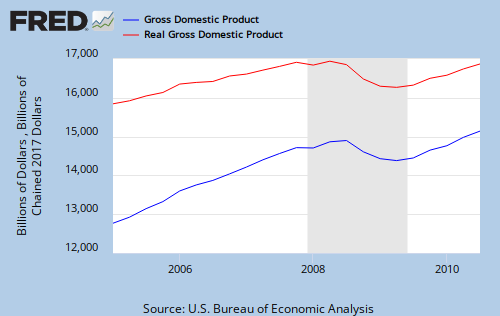
At long last, when will the economy recover? Wait a minute. Look at this graph:

graph 1

Considering that the data only goes through September, 2010, one easily can infer that the economy already has recovered. Yes, the stock market has not recovered, but that could be good news. It could mean it still has plenty of recovery left in it.

And yes, unemployment still is a big problem:

But that could be a good thing, too (although not for those who are unemployed.) A high level of unemployment mitigates against inflation. The government could continue to use its infinite spending ability and not be concerned it was causing inflation. For instance, FICA could be eliminated, as it should be, rather than the tentative, temporary step now taken. And the standard deduction could be raised, also as it should be. And Social Security benefits could be increased, and Medicare could be expanded, again as they should be.

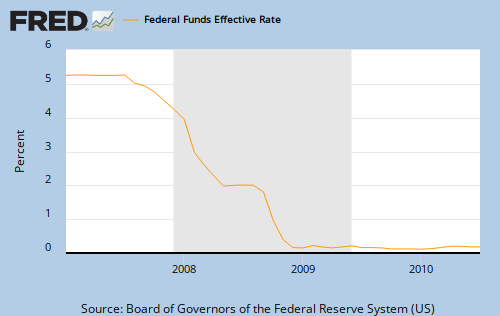
And interest rates have stayed way down:

graph 3

And that’s another good thing, because it means the Fed has plenty of room (not that “room” really is needed) to raise rates if inflation should rear its ugly head.

There are plenty of leading indicators one might explore, but these graphs give me cause for optimism, if only the federal government will seize the moment.

Rodger Malcolm Mitchell
http://www.rodgermitchell.com

No nation can tax itself into prosperity. Those who say the stimulus “didn’t work” remind me of the guy whose house is on fire. A neighbor runs with a garden hose and starts spraying, but the fire continues. The neighbor wants to call the fire department, which would bring the big hoses, but the guy says, “Don’t call. As you can see, water doesn’t put out fires.”