— Let’s blame China

An alternative to popular faith

Here we go, again. The typical beggar-thy-neighbor approach to international trade.

————————————————————————————-
6/10/10: By David Lawder; WASHINGTON (Reuters) – Treasury Secretary Timothy Geithner said on Thursday that reform of China’s exchange rate is “critically important” to the U.S. and global economies and a more flexible yuan was in China’s interest.
[…]
In his testimony, Geithner said the Obama administration wanted China to change policies that disadvantage American companies and to provide a more level playing field for U.S. products and investments. He vowed the administration would “apply forcefully” all remedies available under U.S. law to curb China’s unfair trade practices, including anti-dumping and countervailing duty complaints.
[…]
“A stronger yuan would benefit China because it would boost the purchasing power of households and encourage firms to shift production for domestic demand, rather than for export,” he said. “[…]which is particularly important now, with China’s economy facing a risk of inflation in goods and in asset prices.”

————————————————————————————-

Think of it this way. When two nations each have the unlimited ability to create money, which nation benefits from a positive balance of trade? That is, which nation benefits when one sends more of its goods and services to the other?

In CHINA TRADE we saw that the nation exporting fewer resources (i.e. exporting more, easily created money), has the advantage. The Obama administration seems to believe international trade is a zero-sum game, where for every “winner” (net goods and services exporter) there is a “loser” (net goods and services importer). So in their minds, for the U.S. to be a winner, we must make sure there are enough nations that are losers – as I said, the beggar thy neighbor approach to international trade.

The technical truth is, the U.S. could we wealthy without exporting a single dollar’s worth of goods and services. Visualize that our exports were zero and the U.S. government were the sole “export” customer. Rather than exporting steel, sausage and services, the government would buy all this output. No, don’t get excited. I don’t suggest we stop exporting. I’m just trying to demonstrate a point.

Could the government afford it? Yes, the government has the unlimited ability to create the money to afford anything. Would our industries suffer? No, they would receive the same money as if they actually had exported. Would this increase the money supply to inflationary levels? No, the total money within the economy would be the same as if it had come in from other nations.

Yes, we’d have to solve the problem of what we do with all the goods and services we produce (Create new industries for this purpose??), but the U.S. literally could survive and prosper with no exports at all – as though it were the only nation on earth.

The Obama administration merely has set up China as a straw man, to take the blame for our economy’s failure to grow as fast as it should. But, the real blame should go to the debt hawk belief that federal deficit spending should be minimized. For years, our stimulus efforts have been too-little, too-late, and even today, while growth is painfully slow, and millions are out of work, there is more concern about so-called debt (i.e. money created) than about economic success.

Rodger Malcolm Mitchell
http://www.rodgermitchell.com

No nation can tax itself into prosperity
–Anthropomorphic economics disease

An alternative to popular faith

Fundamental to debt hawk beliefs is the idea that monetarily sovereign nations are like you and me. Thus, debt hawks practice “anthropomorphic economics.”

A monetarily sovereign nation is the monopoly supplier of its currency, which currency is not tied to any asset (like gold) or to a foreign currency. A monetarily sovereign nation has the unlimited ability, and the monopoly power, to create its currency.

The U.S., Canada, Australia, China and India are monetarily sovereign. The EU nations are not. That is why so many of the comparisons between Greece and the U.S. are false.

Specifically, here are a few of the assumptions debt hawks have about the U.S. — assumptions that might be correct for individuals, but not for the U.S.

1. The U.S. government must borrow or tax in order to spend.
You and I must obtain money, either by borrowing or by income, before we spend. The reverse is true for the U.S. government. U.S. spending creates money. So-called federal “borrowing” is not like personal borrowing. The U.S. creates T-securities from thin air, then exchanges them for dollars it previously created from thin air. Then it destroys the dollars. When the government repays its ‘debt,” the situation is reversed. It creates dollars, which are exchanged for T-securities, and the T-securities are destroyed. The whole process became obsolete in 1971.

2. Servicing the federal debt is a burden on the U.S.
Because the U.S. pays all its bills by creating money ad hoc, paying its debts never is a burden. Unlike you and me, the government simply credits the bank accounts of its creditors and debits its own balance sheet, which it can do endlessly. The “debt” carried on the government balance sheet is an accounting of the T-securities created by the government. Rather than “debt,” this balance sheet entry should be called “T-securities open.”

3. Federal debt is a burden on future taxpayers
Unlike you and me, the government does neither needs nor uses income in order to spend. There is no relationship between federal taxes and spending. Even were taxes dropped to zero or raised to $100 trillion, neither event would affect the federal government’s ability to spend by one penny. In fact, tax money is destroyed upon receipt, as a credit in a government balance sheet. The government does not spend tax money.

4. Federal surpluses are more prudent than deficits
For you and me, net income is more prudent than net outgo. Not so for the U.S. government. Federal taxes destroy money; federal spending creates money. To grow, an economy must have a growing supply of money. Federal spending is the most reliable, controllable source of money. Federal surpluses are imprudent, because by destroying money, they create recessions and depressions.

5. If U.S. debt is “too big,” nations will refuse to lend to us.
A credit rating is based on the past and future ability and willingness to service debt. You and I need a good credit rating in order to borrow. But, the federal debt has grown 1500% in only 30 years, and no nation has refused to buy our T-securities (not that it would matter, because we no longer need to sell T-securities).

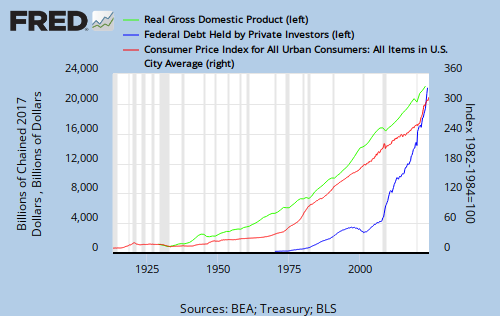
Debt hawks have made the intuitive argument that federal debt is like personal debt – anthropomorphic economics – but are unable to supply data to substantiate their intuition. One person told me the proof is that costs have risen (inflation) and the federal debt also has risen, therefore federal debt must cause inflation. The problem with this cause-effect conclusion is that through time, many things in addition to debt have risen: population, real GDP, the miles of paved roads, satellites in orbit, M3, the number of schools in the Big Ten, the number of cell phones and the years since the Cubs won the World Series. For example:

rising thingsGRAPH

If federal debt caused inflation, we would expect to see greater inflation when deficits are greater and less inflation when deficits are smaller. But, as we have seen at INFLATION there is no historical relationship between deficits and inflation.

In short, debt hawks suffer from anthropomorphic economic disease, the unsubstantiated intuition that the federal government’s finances are like personal finances, where debt must be minimized and spending must follow the acquisition of money.

As I have so often in the past, I again suggest you write to one of the debt hawk web sites – Concord Coalition, the Committee For A Responsible Federal Budget et al – and ask for data to substantiate their claim that federal debt has an adverse effect on our economy. In the unlikely event they answer you, they will supply data showing the debt is large and growing, but no data showing it hurts then economy. The reason: No such data exists. Growing federal debt is economically necessary.

Rodger Malcolm Mitchell
http://www.rodgermitchell.com

No nation can tax itself into prosperity

–How the debt hawks will destroy the U.K.

An alternative to popular faith

Cameron Warns Britons of ‘Decades’ of Austerity
By SARAH LYALL, Published: June 7, 2010

LONDON — Prime Minister David Cameron said Monday that Britain’s financial situation was “even worse than we thought” and that the country would have to make savage spending cuts to bring its swelling deficit under control.

Stern and grim-faced in a speech in Milton Keynes, just north of London, Mr. Cameron said, “How we deal with these things will affect our economy, our society — indeed our whole way of life. The decisions we make will affect every single person in our country,” he said. “And the effects of those decisions will stay with us for years, perhaps decades, to come.
[…]
Dave Prentis, the general secretary of Unison, a union that represents many public service workers, nonetheless told the Press Association news agency that Mr. Cameron’s speech was “a chilling attack on the public sector, public sector workers, the poor, the sick and the vulnerable, and a warning that their way of life will change.”
[…]
“Nothing illustrates better the total irresponsibility of the last government’s approach than the fact that they kept ratcheting up unaffordable government spending even when the economy was shrinking,” Cameron said.
[…]
As a cautionary tale, he mentioned Greece, where profligate spending led to a huge budget deficit and eventually a downgrading on financial markets.

While Britain’s economic position is stronger than that of Greece, he said, “Greece stands as a warning of what happens to countries that lose their credibility, or whose governments pretend that difficult decisions can be avoided.”

—————————————————————————————————————————————————————————

The U.K. was smart not to lose control over their money. They remain monetarily sovereign. Unlike the euro-using nations, the U.K. can create their money at will. But suddenly, they have forgotten why they didn’t switch to the euro.

Now, the debt hawks have the U.K. preparing for “decades of austerity” (aka, decades of poverty), as they falsely compare themselves to Greece. Wake up, U.K. You aren’t like Greece and you don’t need to choose poverty.

Mr. Cameron said, “. . . if you start with a large structural deficit, ramping up spending even further is likely to undermine confidence and investment, not encourage it.” This is as false a statement as it’s possible to make. I challenge Mr. Cameron to explain how government spending, which is the way government adds money to the economy, can reduce investment or economic growth. It simply is total nonsense.

It’s difficult to imagine why an otherwise intelligent people intentionally will subject themselves to decades of misery based on a foolish belief that not only is unproven, but factually has been proven wrong on many levels. While some of the same ignorance exists in the U.S., we only can pray it does not reach the extreme levels of utter stupidity it apparently has reached in the U.K.

Rodger Malcolm Mitchell
http://www.rodgermitchell.com

No nation can tax itself into prosperity

–What is the real Mideast war? A hypothesis.

An alternative to popular faith

We begin with a few relevant facts:
1. Most Jews support Israel
2. The Democratic Party generally is liberal. The Republican party generally is conservative.
3. Most American Jews vote Democratic and tend to support liberal causes.
4. The conservative Republican Party displays the stronger support of Israel

What’s going on? Why do Jews, who support Israel, tend to vote Democratic, and why do the liberal-leaning Democrats seem less supportive of Israel than do the conservative Republicans?

Here is a hypothesis for your comment. Warning: I make many generalizations, which may not apply to specific individuals:

Historically, Jews have been the underclass, the put-upon, the unfortunate objects of bigotry. Jews empathize with those who are treated unfairly. While some Jews have achieved fame and financial success, the notion of “mitzvah” (literally “commandment,” but generally thought of as the obligation to do a “good deed”) remains deeply embedded in the Jewish psyche.

Jewish charities lean more toward helping people and less toward supporting the synagogue. Jewish houses of worship on average are less expensive and ornate than those of other faiths. Even Christ, the Jew, preached compassion and love for the unfortunate. Thus, the Jewish natural instinct aligns with liberal causes and with the Democratic Party.

Conservatives tend to lean more toward Christian piety and the literal law, than do liberals. Love of God may exceed love of the unfortunate. Strict interpretations of the law may more likely to be found among Christian conservatives than among liberals.

Given all of the above, why do the conservative Wall Street Journal and Chicago Tribune write editorials supporting Israel following the “flotilla,” while the liberal New York Times supports the Palestinians? Why was “born-again” George Bush a much more vocal supporter of Israel than is Barack Obama. The reasons may have nothing to do with love or empathy.

The reasons may have to do with the war. No, not that war. Not Israel’s ongoing war with Hamas, Hezbollah, Fatah et al. Not the war we read about daily. I am talking about an older and much larger war: The war between Christianity and Islam.

This conflict, exemplified by the Crusades, has continued without abatement. Cyprus, Macedonia, Bosnia Herzegovina, East Timor, the Sudan, Kosovo, the Philippines all are sites of recent or ongoing violence between Christians and Muslims.

The vast majority of Muslim-dominated nations are dictatorships. While Turkey, which is Muslim, has struggled to remain secular, this secularism may be at risk as the current government leans ever closer to Islam. France which has seen its Muslim population rise markedly, now has begun to show signs of Christian resistance, with the UK not far behind. The world over, Islam is growing faster than Christianity.

The American Republican party sees as its base, the Christian right, the group most sensitive to the growth in population and power of worldwide Islam. Perhaps they see Israel as a bulwark against Muslim monopoly domination of the Mideast. Perhaps Israel is admired merely for its resistance to the overwhelming population odds, or for occupying the growth energy of Islam. In some cases, mere realpolitik (“The enemy of my enemy is my friend”) may account for right wing Christian attitudes.

Whatever the reason, I suspect Israel is a tiny bit player in the ongoing war between the two giant religions. Even economics itself may be a less important, long-term determinant of the world’s future, than the war between the two giant, Abrahamic religions. It will not be won in our lifetimes or in our grandchildren’s lifetimes. It never may be won, but the battle will continue to affect us all.

So, while Israel’s concern is its survival against the sea of Islam, the religious right’s focus may be on the survival and growth of Christianity. What do you think?

Rodger Malcolm Mitchell
http://www.rodgermitchell.com

No nation can tax itself into prosperity