–Are you for immigration reform? What does that mean?

The debt hawks are to economics as the creationists are to biology. Those, who do not understand monetary sovereignty, do not understand economics. Cutting the federal deficit is the most ignorant and damaging step the federal government could take. It ranks ahead of the Hawley-Smoot Tariff.
==========================================================================================================================================================

Congress has been debating immigration reform, and like all political “reforms,” the word means different things to different people. Health insurance “reform” means federally provided, affordable insurance to everyone, or to no one, or somewhere in between. Budget “reform” means cut spending, increase taxes, both or neither. Tax reform means make taxes simpler or fairer or lower or higher.

But what does immigration reform mean? Does it mean fewer or more immigrants? Does it mean an easier or more difficult procedure? And more importantly, what is the goal? Is it to:
–Protect our nation from terrorists and other enemies?
–Protect American workers from competition?
–Protect America from crime?
–Save our limited resources?
–Keep American white? Or Christian? Or English speaking?
–To relieve an overcrowded America?
–Just keep Mexicans out?

For example, consider Rep. Steve King, an Iowa Republican who wants to end automatic or “birthright” citizenship for all children born in the United States. What is the benefit to America? He says it’s to prevent non-citizens from coming here on a visa, and intentionally having a child, thereby circumventing immigration laws. Aside from the probability the number of such people is small, what is the problem? What if some women do that? Who has been harmed? How has that diminished America?

Or consider those Republican lawmakers from southern states and lawmakers who wish to copy Arizona’s harsh law. They would give police the massive job of screening all suspects for immigration status. Why? They claim the undocumented immigrants are too costly, using medical and educational facilities without paying taxes. But how true is this really? What percentage of undocumented immigrants do not pay taxes? And what would be the police costs and the court costs and attorney costs and the logistic costs of pursuing all these people, trying them and deporting them, only to have them return again and again? And what would be the cost in human suffering, or do we now consider undocumented immigrants to be something less than human?

These lawmakers claim their goal also is to protect their states from crime, but do undocumented immigrants cause more or less crime than citizens?

Rather than allowing the xenophobes, who wish to create a “fortress America,” to coopt the word “reform,” perhaps those, who still belief the words on the Statue of Liberty, might wish to define reform in our own terms. How about if “immigration reform” means make immigration much faster and easier? How about recognizing that going through danger, cost and effort is prima facie evidence of people who truly want to be Americans, and such desire might make them more loyal and more devoted to our nation than those lucky enough to be born here?

Surely, we can protect America without building a North Koreanesque barrier. Is Mexico our enemy? Are the great open plains so crowded? Is the American worker too weak to compete? Are resources truly limited to a Monetarily Sovereign nation that at the snap of an finger, can spend trillions on the world’s greatest war machine? And don’t immigrants actually contribute to our resources? My immigrant parents did.

Yes, let’s have immigration reform. Let’s open the welcoming arms of a great, confident, powerful America, rather than hiding behind the barbed wire curtain of a crouching, fearful, mean spirited bunch of petty losers.

Rodger Malcolm Mitchell
http://www.rodgermitchell.com

No nation can tax itself into prosperity. Those who say the stimulus “didn’t work” remind me of the guy whose house is on fire. A neighbor runs with a garden hose and starts spraying, but the fire continues. The neighbor wants to call the fire department, which would bring the big hoses, but the guy says, “Don’t call. As you can see, water doesn’t put out fires.”
–When will the economy recover?

The debt hawks are to economics as the creationists are to biology. Those, who do not understand monetary sovereignty, do not understand economics. Cutting the federal deficit is the most ignorant and damaging step the federal government could take. It ranks ahead of the Hawley-Smoot Tariff.
======================================================================================================================================================================

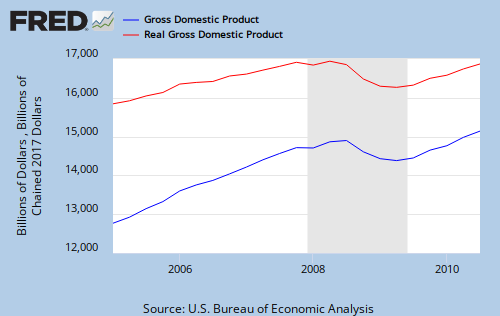
At long last, when will the economy recover? Wait a minute. Look at this graph:

graph 1

Considering that the data only goes through September, 2010, one easily can infer that the economy already has recovered. Yes, the stock market has not recovered, but that could be good news. It could mean it still has plenty of recovery left in it.

And yes, unemployment still is a big problem:

But that could be a good thing, too (although not for those who are unemployed.) A high level of unemployment mitigates against inflation. The government could continue to use its infinite spending ability and not be concerned it was causing inflation. For instance, FICA could be eliminated, as it should be, rather than the tentative, temporary step now taken. And the standard deduction could be raised, also as it should be. And Social Security benefits could be increased, and Medicare could be expanded, again as they should be.

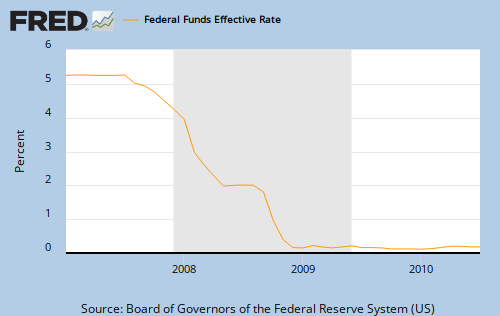
And interest rates have stayed way down:

graph 3

And that’s another good thing, because it means the Fed has plenty of room (not that “room” really is needed) to raise rates if inflation should rear its ugly head.

There are plenty of leading indicators one might explore, but these graphs give me cause for optimism, if only the federal government will seize the moment.

Rodger Malcolm Mitchell
http://www.rodgermitchell.com

No nation can tax itself into prosperity. Those who say the stimulus “didn’t work” remind me of the guy whose house is on fire. A neighbor runs with a garden hose and starts spraying, but the fire continues. The neighbor wants to call the fire department, which would bring the big hoses, but the guy says, “Don’t call. As you can see, water doesn’t put out fires.”
–News: China must control inflation, exports and GDP growth. But how?

The debt hawks are to economics as the creationists are to biology. Those, who do not understand monetary sovereignty, do not understand economics. Cutting the federal deficit is the most ignorant and damaging step the federal government could take. It ranks ahead of the Hawley-Smoot Tariff.
======================================================================================================================================================================

On December 17, 2010 Columnist Michael Schuman published an online article saying:

Chinese inflation hit 5.1% in November, the fastest clip since the pre-crisis boom months of 2008. Though much of the increase is in food (up 11.7% from a year earlier), the inflationary pressures are spreading to more aspects of the economy.

By hiking interest rates, the central bank would be increasing the interest burden on borrowers. That, in turn, could intensify a bad loan problem at China’s banks that many economists believe is an inevitable result of the lending boom.

So the Chinese have instead turned to an old favorite, price controls on certain staple foods.

Inflation is the loss in value of money compared to the value of goods and services. The cure for inflation is to increase the value of money and/or to decrease the value of goods and services.

The later is difficult for any government to accomplish, other than with price controls. Sadly, price controls have serious defects. They lead to reduced supply, while allowing demand to increase, which invariably causes pent up demand and black markets.

A second approach is for the government to buy, store then mete out supplies of oil, when prices rise. Because oil is the prime mover of inflation, this can be an effective anti-inflation plan, if the government has the discipline to do it. The plan falls apart when the government becomes reluctant to part with any of its suddenly-more-precious oil.

In all, increasing the value of money seem to be the best prevention/cure for inflation. That can be accomplished by decreasing the supply of money or by increasing the demand for money. Reduced government spending or increased taxation can reduce the supply. However, reducing the money supply not only leads to recessions and depressions, but involves very slow, uncertain and cumbersome processes.

In addition to the difficulty of knowing how much to increase taxes or to reduce spending, the even more difficult question is which taxes to increase and/or which spending to decrease. By the time politicians finish debating and voting on these highly political questions, the situation either may have passed or more likely, worsened appreciably.

Preventing/curing inflation requires agility and incremental response, for which interest rate modification is ideal. Raising interest rates can be done instantly and in tiny increments. It increases the demand for money, which increases the value of money – perfectly anti-inflationary.

China’s reluctance to strengthen its currency probably is tied to its false belief it must continue to build its export business, which relies in part on the weakness of the yuan. The function of exports is to bring money into an economy, but China, being Monetarily Sovereign does not need additional money coming in from outside its borders. It has the unlimited ability to create money.

China also may subscribe to the popular belief that low interest rates stimulate its economy. American history shows this belief to be false. See: Low interest rates do not help the economy. China also may believe high rates increase business costs, and so actually could foster inflation. However, in America at least, high rates have not corresponded with inflation. (See Item 12,) probably because interest is a minuscule part of most companies’ costs..

The Chinese government has the ability to be its nation’s own best customer. It does not need to rely on exports. This is a fact for all Monetarily Sovereign nations. China has the means to prevent/cure its inflation by raising interest rates. It needs only to understand its own powers.

Rodger Malcolm Mitchell
http://www.rodgermitchell.com

No nation can tax itself into prosperity. Those who say the stimulus “didn’t work” remind me of the guy whose house is on fire. A neighbor runs with a garden hose and starts spraying, but the fire continues. The neighbor wants to call the fire department, which would bring the big hoses, but the guy says, “Don’t call. As you can see, water doesn’t put out fires.”

–Which Taxes Are Fairest? Which Taxes are Least Fair?

The debt hawks are to economics as the creationists are to biology.

Lately, there has been more talk about revising our taxes to be more “fair.” There even is an organization that calls itself FairTax.org, which promotes a national sales tax, a first cousin to the European style value-added tax.

All federal taxes remove money from our economy, and for that reason, all federal taxes hurt our economy. Unfortunately, the belief that federal taxes are necessary (They are not) is so powerfully ingrained, it is impossible to have a rational discussion on the subject.

So we are left with repeated attempts to fix the unfixable.

Tax fairness often is confused with tax simplification.

The U.S. Tax Code contains 50 Chapters. Each chapter is divided into Sub Chapters, each of which is divided into Parts, and then into Paragraphs, all of which are subject to interpretation by Congress, the Internal Revenue Service and the courts.

Because all elements of our economy are intertwined, the interpretation of one paragraph impacts the interpretations of other paragraphs, which then require further interpretations, which impact other paragraphs and ad infinitum. Thus, our Tax Code has acquired infinite complexity, which one could argue is unfair.

Supposedly there was a king who nailed laws too high to be read, then punished those who broke the laws. Would that have been fair?

Tax complexity is inevitable. Imagine the simplest possible tax idea: Tax every man, woman and child $1,000 per year. Period. Simple enough? Fair?

How long would it be before “modifications” would be made? Reduce this tax on the poor. Increase it on the rich. Multiple definitions of “poor” and “rich.” Various payment requirements (monthly? quarterly? annually?).

Charitable deductions allowed? Do businesses pay? Definitions of “business” vs. “person.” Even the simplest possible tax idea soon will turn ever more complex and so, unfair.

The American ethic is based on “getting ahead” and on “fairness.” However, being ahead seems unfair to those who are behind.

Taxes can be levied in a variety of ways, all justifiable as “fair” and all condemned as “unfair.” For instance:

A unit tax on individuals: Each person pays the same tax (similar to an airport departure tax). This tax is fair, because it treats every individual equally. This tax is unfair, because it takes as much from the poor as from the rich.

“Sin” or luxury taxes on cigarettes, liquor, entertainment, gambling, restaurants, travel, etc. are fair, because they tax things we do not need. These taxes are unfair, because they arbitrarily designate certain items as not being needed. (Is an apple “needed?”)

FICA is fair, because the people who pay are the people who receive Social Security and Medicare. This tax is unfair, because it is a regressive tax.

Sales taxes are fair, because each person pays according to his consumption. Sales taxes are unfair, because they place a burden on low income people, who spend a greater percentage of their income and save/invest less.

Flat-rate income tax is fair, because each person pays the same rate. These taxes are unfair, because the poor cannot afford to pay as high a rate as the wealthy. They also are unfair, because some people will pay more than others.

Progressive rate income tax is fair, because high earners can afford to pay a higher rate. This tax is unfair, because even at a flat rate, higher earners would pay more. A progressive rate compounds the unfairness.

Tax on Social Security benefits is fair, because social security is just another form of income. These taxes are unfair, because income tax already was paid on Social Security deposits. It is a double tax.

Tax on Medicare benefits. See above.

Inheritance tax is fair, because wealthy families can afford to pay more. This tax is unfair, because taxes already have been paid on the assets being inherited. It is a double tax.

Personal property tax is fair, because the wealthy can afford to pay more. This tax is unfair, because taxes already have been paid on the earnings needed to acquire the assets. It is another double tax.

Tax on stock dividends is fair, because dividends are no different from any other income. This tax is unfair, because companies cannot deduct the cost and already have paid taxes on the earnings. It is one more double tax.

Taxes on corporations are fair because business should pay its share. These taxes are unfair, because they penalize workers by reducing corporations’ ability to hire and to pay salaries and benefits.

All taxes are fair and unfair, depending on whose toes are pinched. Discussions of tax fairness are sophistry, demagoguery or both. If you hear someone arguing that one federal tax is fairer while another is unfair, mark that person as a liar or a fool.

The question of federal tax fairness is not an appropriate subject for economics’ discussions. No tax is fair, and the federal government doesn’t need tax money. Perhaps the discussion is more appropriate for a psychology seminar.

If taxes are wrongly to be collected for anti-inflation purposes, the real question should be: How harmful is it to the overall economy?

In nearly all cases, the tax will be harmful. (Exceptions may be taxes collected to curtail harmful items that politically cannot be eliminated by law. These include taxes on guns, drugs, cigarettes, etc.)

I submit that the most harmful taxes tend to be those most likely to widen the Gap between the rich and the rest, i.e. the most regressive taxes.

Rodger Malcolm Mitchell
http://www.rodgermitchell.com

No nation can tax itself into prosperity. Those who say the stimulus “didn’t work” remind me of the guy whose house is on fire. A neighbor runs with a garden hose and starts spraying, but the fire continues. The neighbor wants to call the fire department, which would bring the big hoses, but the guy says, “Don’t call. As you can see, water doesn’t put out fires.”