–Deficits and interest rates: Another myth

An alternative to popular faith

11/15/09 (AFP): “The US government announced last month that it had closed its 2009 fiscal year with a record budget deficit of 1.417 trillion dollars, up 962 billion dollars from the prior year. The huge gap stemmed from declining revenues and a massive boost to spending in a 787-billion-dollar stimulus plan designed to jolt the world’s largest economy from its prolonged recession. Concerns over the deficit underscore a fundamental tension undercutting Obama’s presidency in its first year — the extent to which he is attempting sweeping political change at a moment of historic financial peril.

“Many economists say high deficits during economic crises are acceptable to fuel government spending to stimulate growth. But long-term deficits can result in high interest rates, making it much harder for consumers to finance outlays such as new homes and cars.”

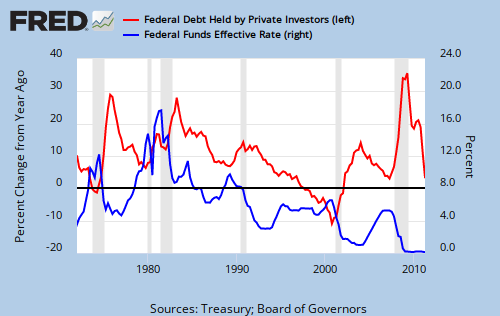
Yet another myth in the pantheon of economic myths circulating the globe. Look at the following chart and tell me whether you can see a relationship between deficits — even large deficits — and interest rates.

Debt vs Interest Rates

Contrary to popular faith, deficits are not the cause of inflation or high interest rates. Browse through the posts on this site, and you will see why.

-How to eliminate federal debt and save the economy

An alternative to popular faith

Here is the solution to the federal debt problem — a solution that involves neither increased taxes nor reduced spending.

The federal debt is caused by deficit spending. Taxpayers do not pay for deficit spending, which by definition is spending above tax receipts. Yet taxpayers find the debt worrisome for two reasons: They incorrectly believe someday, they or their grandchildren will have to pay it, and they incorrectly believe large federal deficits cause inflation.

Those concerns affect efforts to improve our health care system, crumbling infrastructure, bad schools, excessive taxes, bankrupt states, Social Security funding, poverty, joblessness and homelessness, Internet service, NASA funding, military funding, disease research and repeated recessions. The solutions require deficit spending, which debt fear prevents.

Currently the government obtains money for deficit spending by borrowing. It borrows by creating T-securities (T-bills, notes and bonds), then selling them. These T-securities are created in unlimited quantities out of thin air. This method, though still used, actually became obsolete in 1971, when President Nixon took us off the last vestiges of the gold standard. Before then, T-securities were collateralized in part by gold, which limited their issuance. Today, they are collateralized solely by the “full faith and credit” of the federal government, a resource the government has in unlimited supply.

Just as the government now creates T-securities out of thin air, it as easily and prudently could create money directly – also out of thin air and also backed only by full faith and credit.

Ending the creation and sale of T-securities would end the creation of debt. No longer would we suffer over deficits, fears that nations might refuse to lend to us and fears our path is “unsustainable.” Rather than “deficit spending” the process would be called “money-creation,” and what now is called “debt,” would more properly be called “Net Money Created.”

By eliminating debt, we would eliminate taxpayers’ concerns they or their grandchildren would pay it. Further, because the federal government now controls not only the supply, but the demand for U.S. money (via interest rates), large federal deficits have not caused inflation. See chart, below:

Deficits vs. inflation
Since we went off the gold standard, there has been no relationship between deficits and inflation.

The elimination of T-securities would allow us to create the money to solve our many economic problems and to prevent the negative economic consequences of tax increases or spending decreases.

Rodger Malcolm Mitchell
http://www.rodgermitchell.com/

–Federal Debt/GDP– A Useless Ratio

An alternative to popular faith

Lately, we’ve heard a great deal about the federal debt/GDP ratio.

The Investopedia says, “The debt-to-GDP ratio indicates the country’s ability to pay back its debt.” This ratio often is quoted in stories predicting the demise of America if federal debt continues to rise and especially if the debt ever were to exceed 100% of GDP. (Since we are about to hit that level, and we still exist, the debt hawks now have moved the time of Armageddon too 200%. But Japan is there already, so maybe move it to 300%?)

This nonsense ratio is so important, the European Union once required, as a condition of membership, the ratio of gross government debt to GDP not to exceed 60% at the end of the preceding fiscal year.

What would you say if I told you the total number of hits the Chicago Cubs made in 2008 is 47% of the total number of runs the Cubs have scored in all of their 100+ year history?

You might well say, “Huh? What does one thing have to do with the other? One is hits; the other is runs. One is 100+ years; the other is one year. It’s classic apples vs oranges.” And you would be right.

Yet, that is exactly what the debt/GDP ratio represents. Federal “debt” is the net amount of outstanding T-securities created in the history of America. The GDP is the total dollar value of goods and services creating this year. The two are unrelated. The federal government does not use GDP to service its debt.

Actually, federal “debt” is not even related to federal “deficits” by function, though the two are related by law. During the gold standard days, the Treasury was required by law to issue T-securities in the amount of the federal deficit.

It was necessary then, because the Treasury could only produce money in the amount of gold reserves. In 1971, we went off the gold standard, which gave the Treasury the unlimited ability to create money.

The creation of T-securities no longer is necessary; it is a relic of the gold standard days. A government with the unlimited ability to create dollars does not need to borrow those dollars.

The government “borrows” by creating T-securities out of thin air, backed only by full faith and credit. Purchasers of T-securities instruct their banks to debit their checking accounts and credit their T-security accounts at the Federal Reserve Bank.

No dollars are created or destroyed.

Then, to “pay off” its debt, the process is reversed: The government merely transfers dollars from T-security accounts (essentially bank savings accounts) back to checking accounts.

Again, no dollars are created or destroyed.

Today, Japan’s ratio is above 200%. The U.S. ratio is near 100%.

monetary sovereignty

By contrast, Russia’s, Chile’s, Libya’s, Qatar’s and others are below 10% – which tells you nothing about their economies, but says a great deal about the meaningless Debt/GDP ratio.

As for GDP indicating “the country’s ability to pay back its debt,” again we have apples/oranges. The value of goods and services created by the private sector, has no relationship to the federal government’s ability to transfer dollars from T-security accounts at the FRB to checking accounts at private banks.

Finally, Debt/GDP (shown as “FYGFDPUN/GDP”) has no relationship to inflation:

Debt/GDP vs inflation

And that is why the debt/GDP ratio is meaningless.

Rodger Malcolm Mitchell
http:www.rodgermitchell.com
-Richard Koo–If you don’t believe me, believe him

An alternative to popular faith
Listen to Richard Koo’s tape at http://www.ritholtz.com/blog/2009/11/richard-koo-great-recessions-lessons-learned-from-japan/comment-page-1/#comment-233008. He says some of what I have been saying for the past 15 years. Federal deficit spending is absolutely, positively necessary for economic growth.

I hope our government leaders listen to him, though I doubt they will. They sure haven’t listened to me. The reason: The debt hawks have the nation worried, because they equate federal debt with personal debt. So you hear that your grandchildren will have to pay the debt, and large deficits cause inflation, and surpluses are more prudent than deficits — none of which are true.

So, we struggle with trying to provide universal health care, which the government can and should provide, while debt fear negatively impacts the physical and financial health of millions.

Deficit spending grows the economy and can provide health care, too — and it never needs to be paid back. Never. But Congress, the President and most of the economists simply don’t get it. They don’t even look at our economic history, which repeatedly shows long-term deficit spending is necessary for long-term economic growth.

Rodger Malcolm Mitchell
http://www.rodgermitchell.com