–John Mauldin defines “too much debt”

The debt hawks are to economics as the creationists are to biology.

John Mauldin responded to my comment on his post, “Pushing on a String”

“I don’t know why you think I would not respond. Just happened to see this on Google alerts.

I have been quite clear on what is too much debt. I have done whole e-letters on it. It is debt growth above nominal GDP on a consistent basis, which ends up in a Greece like state. In fact, I will have a book out in January called The Endgame which goes into hundreds of pages of detail about the problems with debt and debt crises.

Now, I do not want private businesses or people borrowing beyond their own means or banks lending if they do not think there is reason to believe they will be repaid. And there is a limit to how much countires can borrow. To assert that the US can borrow without limit is rather absurd. You write:
‘And here is the government, which can service a debt of any size, and functionally is incapable of bankruptcy, and the debt hawks want to restrict debt.’

Go read Rogoff and Reinhart. 266 crises in 60 countries over the last few hundred years, from countries that can print their own money to gold standard currencies. Everything was fine until the last moment. There are more than one ways to default on debt, and one way is to print the money and debase the money supply. Inflation ruins pensioners and savers. If that is your ideal future, then by all means, run up that debt!

John”

First John, you have my apology. You responded, and did so without name-calling, which not only is commendable, but a rarity in the debt hawk world. Unfortunately, you didn’t offer any facts, so I will supply one.

Again, you said,“I have been quite clear on what is too much debt . . . It is debt growth above nominal GDP on a consistent basis, which ends up in a Greece like state.”

Here is a graph you might find interesting:
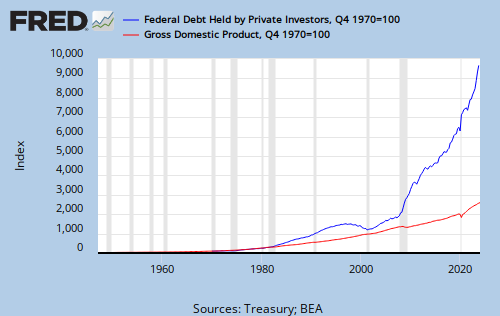
Graph

It shows that in the past 40 years GDP has risen less than 1,400% while federal debt has risen 3,500% — well more than double the rate. I would call that “debt growth above nominal GDP on a consistent basis,” wouldn’t you? Yet, where is the inflation?

The last big inflation was in 1979, at a time when debt growth did not exceed GDP growth.

Also, ” . . . ends up in a Greece like state . . .” makes no sense, whatsoever. The U.S. is monetarily sovereign. Greece is not. It functionally is impossible for a monetarily sovereign nation magically to transform itself into a “Greece like state.”

The debt hawk inflation bogeyman emerges every time deficit spending is mentioned. I’m surprised you didn’t offer pre-war Germany or Zimbabwe as examples. But that bogeyman has hurt the lives of real people. It has prevented universal health care. It has restricted Social Security and Medicare benefits. It has given us a monster, wasteful, unnecessary federal tax system. And all because the debt hawks tell us that eventually — eventually — we will have inflation.

Yet, money debasement is not related only to money supply, but more importantly to money demand (interest rates), which is why in the past 40 years, there has been no relationship between federal deficits and inflation.

Again, I do appreciate your comments and your courage, but because you do not understand monetary sovereignty, you simply are wrong.

Rodger Malcolm Mitchell
http://www.rodgermitchell.com

No nation can tax itself into prosperity.

–John Mauldin, debt hawk pushing on a string

The debt hawks are to economics as the creationists are to biology.

John Mauldin makes a living writing about economics. He posts a blog called “The Big Picture” One of his more recent posts (9/28/10), titled, “Pushing on a string,” contained this observation: “What is needed is fiscal austerity (slowly) before debt spirals out of control. . . “

I entered the following comment to his post:

It’s nice to see that John remains a typical debt-hawk. He never says what “out of control” means, because debt hawks never offer specifics. So let’s speculate:

Does it mean the federal government will be unable to service its debt (the normal meaning for “out of control”)? Nope. Couldn’t be that. As a monetarily sovereign nation since 1971, the U.S. federal government has the unlimited ability to service its debt.

So, does it mean we’ll have inflation? Nope. Since that fateful August 1971 date, there has been no relationship between federal deficits and inflation. Since that time, the cause of inflation has been energy prices.

So, does it mean taxes will be higher or our grandchildren will owe the debt? No, there is no modern (post-1971) relationship between tax rates and inflation or deficits. Our grandchildren actually benefit from federal spending. So what does “out of control” mean. No one knows. I suspect it means something like, “It’s big and I don’t like the word ‘debt.’”

Oh, then there is the “problem” of banks not lending, which is another way of saying, adding to private debt. Does it strike anyone as curious that the pundits want the private sector to borrow more, while these same pundits want the federal government to borrow less? Here is the private sector, where bankruptcies are rampant, and the pundits want more borrowing. And here is the government, which can service a debt of any size, and functionally is incapable of bankruptcy, and the debt hawks want to restrict debt.

And then there is the debt hawk call for less federal spending and more taxes (the only way to get the federal debt down), while being vaguely aware that federal spending is stimulative and taxes hurt the economy.

Oh, you don’t like stimuli because they “don’t work.” Then you will enjoy the story of the man whose roof was on fire. His neighbor showed up with a garden hose and actually was able to reduce the flames, but only somewhat. The neighbor wanted to call the fire department, who would bring out the big hoses, but the man told him to stop, because “The fire still is burning, so obviously, water doesn’t put out fires.” And just as “obviously,” adding money doesn’t cure a recession.

The reason debt hawks continually call for conflicting actions is they begin with a false assumption. The assumption: Federal debt has an adverse effect on the economy. The truth: Federal debt is absolutely necessary for economic growth. Without it, we would have no economy at all.

But try telling facts to a debt hawk.

John has not and will not respond, which is a debt hawk custom. They don’t respond because they have no facts with which to respond. But I’ll give them this: Even with no facts they have managed to convince the world. I’m envious.

Rodger Malcolm Mitchell
http://www.rodgermitchell.com

No nation can tax itself into prosperity.

–Bank closings from 2008 through 2010

The debt hawks are to economics as the creationists are to biology.

I saw these two graphs on a good blog by noted debt-hawk Barry Ritholtz, called The Big Picture. You can see the post at http://www.ritholtz.com/blog/2010/09/fdic-bank-failures-7/comment-page-1/#comment-412084

Bank Failures since June 2008

These graphs brought to mind a few of the questions I’d like to ask those who keep demonstrating for “less government”:

1. How many bank depositors have been saved by FDIC?
2. How much depositor money has been protected by FDIC?
3. Do you feel there is too much regulation of banks?
4. Would you like to deposit your money in a bank that is not insured by FDIC?

Every time you hear someone say there is too much government, ask specific questions about what he/she would like to give up. Less Social Security? Less Medicare? Less military? Fewer roads and bridges, or less maintenance thereof? Eliminate the Supreme Court? Fewer national parks? Less inspection of our food and drugs? Less research? Where exactly should the cuts be made? (And don’t let them get away with “Eliminate waste.” That’s a cop out).

Rodger Malcolm Mitchell
http://www.rodgermitchell.com

No nation can tax itself into prosperity

–The “Pledge to America” Sham

The debt hawks are to economics as the creationists are to biology.

The House Republicans have published a “Pledge to America.” It is a blatant, political sham. It includes:
–Make the Bush tax cuts permanent
–Give small businesses an additional tax deduction
–Fully fund missile defense
–Strengthen our Mexican border
–Reduce government spending to the 2008 levels
–Reduce the federal deficit

See anything wrong with these nice, safe political “pledges”? If you make the tax cuts permanent, give extra tax deductions to small business, fully fund missile defense and strengthen our border, there is no way to reduce spending to the 2008 levels and reduce the deficit — nor should we. Reduced spending (aka “money creation”) would doom us to an immediate return to recession. All six depressions and nearly every recession immediately have followed reductions in deficit growth. The reason: Federal deficits provide the money for economic growth.

Further, what spending would be cut? See: Federal Debt cuts for a list of right-wing recommended spending cuts and tax increases. Ask yourself which ones you like.

And, of course, nothing is said about Social Security and Medicare, which politicians will tell you (wrongly) require either tax increases or benefit cuts.

The Pledge also includes:
–Repeal the health-care law
–Ensure access for patients with pre-existing conditions

But, of course, ensuring access for patients with pre-existing conditions is one of the benefits of the health care law the House Republicans want to scuttle. The health care plan also contains such benefits as:
*Young people can remain on parents’ insurance until age 26
*No discrimination against children with pre-existing conditions
*No dropping people from coverage when they get sick
*No lifetime limits on coverage
*Free preventive care
*Increased ability to appeal decisions made by your health plan
And other benefits that slowly come on line between now and 2014. How many of these would you like to forgo if the health care plan is repealed?

And the Pledge includes:
–Tough sanctions against Iran (but no mention is made of Iraq, Pakistan and Afghanistan, where our troops actually are fighting and additionally, spending massive amounts of money.)

In short, the House Republican “Pledge” includes a potpourri of popular-sounding, though contradictory ideas. They want to spend more and spend less. They want to increase benefits and reduce them. They want to cut taxes and cut the deficit. Meanwhile, the public has been sold on the idea of “reduced federal deficits,” while not understanding what that really means. It means higher taxes and/or reduced federal benefits.

And it means recessions and depressions. But the politicians don’t tell you that.

Yes, the Pledge is a sham, but it will fool some of the people, and that might be enough.

Rodger Malcolm Mitchell
http://www.rodgermitchell.com

No nation can tax itself into prosperity