–An “investigative” newspaper comments on the new tax agreement

The debt hawks are to economics as the creationists are to biology. Those, who do not understand monetary sovereignty, do not understand economics. Cutting the federal deficit is the most ignorant and damaging step the federal government could take. It ranks ahead of the Hawley-Smoot Tariff.
====================================================================================================================================================================================
For reasons I cannot even begin to imagine, the Chicago Tribune, which prides itself on being an investigative newspaper, refuses to investigate facts before or even after, writing about the economy. I have contacted them often, and they never have displayed even a modicum of interest in learning anything about how the economy works. Instead, they rely solely on popular myth.

Here is a verbatum copy of an Email I sent to editors and others at the Tribune:

“Today’s (12/7/10) Chicago Tribune editorial titled, “Tax Dealing” contains a mixture of truth and myths.

1. Truth: “ . . .raising marginal (tax) rates, especially with the tax year ending an a matter of weeks, would hurt an economic recover still on life support. Obama knows he needs all the growth he can get.” Translation: Yes, taxes hurt the economy because they remove money from the economy. A growing economy requires a growing supply of money.

2. Myth: ” . . . nobody is reducing the cost of government to make up the lost revenue.” Fact: Federal spending is not constrained by taxes, nor do taxes pay for federal spending. Tax money is destroyed (i.e. “lost”) upon receipt and is not stored anywhere.

3. Truth: “The (commission on debt reduction) work can be a catalyst for historic change.” Yes, if we follow the commission’s debt reduction advice, we will have a depression of historic proportions. See item #1, above.

4. Truth: “The panel’s plan involves cutting everything from defense to Social Security . . . Everyone from senior citizens to post-office customers have complained about the pain involved if the plan were enacted.” Yes, it’s a plan that hurts everyone and benefits no one. It’s all pain and no gain.

5. Myth: “That’s unavoidable. Everyone is going to feel some pain when the nation makes its government live within its means.” Fact: Causing economic pain neither is unavoidable nor praiseworthy. As for the government “living within its means,” the Tribune demonstrates it does not know the difference between monetarily sovereign finances (U.S. Government) and monetarily non-sovereign finances (everyone else). You and I have “means.” We must have a source of money before we spend. We are limited in how much we can spend. The federal government is not limited. It creates money by spending. It alone has the unlimited ability to pay any bills of any size. It has no “means.”

6. Myth: You repeated Sen. Durbin’s comment, “Borrowing 40 cents out of every dollar we spend for missiles or food stamps is unsustainable.” Fact: The federal government does not need to borrow even one cent. Borrowing the money the federal government originally created, and can continue to create endlessly, makes no economic sense. It is a relic of the gold standard days, when federal borrowing was necessary. The government does not spend borrowed money. As for federal spending being “unsustainable,” this myth has been bandied about since 1980 (See: Unsustainable) It is no more true today than it was 30 years ago.

7. Myth: “It’s irresponsible for our nation to go on accumulating unaffordable debts that will force even more painful cuts down the line.” What makes the debt “unaffordable”? The Tribune has no idea. In fact, “federal debt” merely is a synonym for “federal money created.” Without federal debt there would be no money and no economy. The Tribune makes the nonsensical complaint that money is unaffordable.

8. Myth: “The coming agreement on tax cuts will avoid an unwelcome shock to the U.S. economy. It will buy time. But it has to lead to an agreement on long-term deficit reduction.” The Tribune editors do not realize that the first part of this paragraph contradicts the second part. If increasing deficits will help the economy, why do the Tribune editors want to decrease deficits? Ever?

In summary, the Tribune editors continue to parrot the myths of the day. Not once do they even make an attempt to provide evidence supporting their beliefs. So I’ll leave you with a couple of questions, you may or may not wish to answer:

–Exactly what do you mean by “make up for lost revenue.” Do you mean that without this “lost revenue” the federal government will be unable to pay its bills?
–Why do you feel economic pain is beneficial. Has the economic pain we already have felt proved beneficial?
–Why do you feel cutting defense will benefit the economy and American security?
–Why do you feel cutting Social Security benefits will benefit the economy?
–Why do you feel reducing postal service will benefit the economy?
–What is the definition of “means,” when you say the government must live within its means. What has happened because the government has not lived within its “means.”
–What do you mean by ‘unaffordable debts.” Do you think a government with the unlimited power to create money, cannot afford to pay for the T-securities it creates out of thin air? Similarly, what do you mean by “unsustainable”?
–Does the Tribune feel any concern about spreading false information that could damage your readers and the entire American economy?
–Is the Tribune interested in learning the facts?

If any of you are readers of the Chicago Tribune, you may wish to write to them. Perhaps mutiple voices would help. I write to:
Zoll, Yerak, Dold, Japsen, Page, Greising, Letters, Ponpei, Delama, Kern, , Oliphant, Hirt, Business, Knowles, Kass, Lythcott, McHolt, O’Brien, Epodmolik, Lev, Doneal
Hughlett, Nicholas, Widder, Jones, Hunter, Wong

Rodger Malcolm Mitchell
http://www.rodgermitchell.com

No nation can tax itself into prosperity. Those who say the stimulus “didn’t work” remind me of the guy whose house is on fire. A neighbor runs with a garden hose and starts spraying, but the fire continues. The neighbor wants to call the fire department, which would bring the big hoses, but the guy says, “Don’t call. As you can see, water doesn’t put out fires.”
–How to fight inflation and how not to.

The debt hawks are to economics as the creationists are to biology. Those, who do not understand monetary sovereignty, do not understand economics. Cutting the federal deficit is the most ignorant and damaging step the federal government could take. It ranks ahead of the Hawley-Smoot Tariff.
==================================================================================================================================
I know this is a strange time to talk about fighting inflation. Recently we struggled up from a minus inflation (aka “deflation”) and now are at a puny 1% level. But too often, when I say that federal deficit spending should increase, a debt-hysteric concern expressed to me, is not just inflation, but the typical debt-hawk exaggeration: hyperinflation!

The debt-hawks seem to be the kind of folks who, upon seeing a starving child, would not feed that child for fear the food would cause obesity. Today, our economy is starved for money, but the debt hawks fear monetary obesity (aka “inflation”) and they warn us of wheelbarrows full of money. They give silly speeches about what they term “fiscal prudence” and what I term, “starving the baby.”

So as long as we must face debt hysteria, and the hysteria has to do with a non-existent though dreaded inflation, we might as well talk about preventing and curing inflation. Inflation is the loss in value of money compared to the value of goods and services.

So, there are two fundamental methods for curing inflation: Reduce the supply of money or increase the demand for money. Both methods increase the value of money vs the value of goods and services. (In theory, increasing the supply of goods and services or decreasing the demand for goods and services also would work, but there is no known method for accomplishing this without changing the money supply.)

Ideally, any anti-inflationary activity should be effective, quick to activate, quick to take effect, incremental, easy to rescind and not damaging to the economy. But while tax increases remove money from the economy, and so can be effective, they fail all the other tests. They are highly political; They are slow to pass through Congress. They take effect slowly, because taxes are collected slowly. They cannot be passed and implemented incrementally. They are difficult to undo. And they damage the economy. The require answers to difficult questions: Exactly which taxes should be increased? By how much? Should we have a tax increase during a stagflation? How do we calibrate an incremental tax increase?

Compare this approach with another approach: Interest rate increases. Interestingly, interest rate increases have both pro-inflation and anti-inflation effects. Pro inflation: Increase in business costs and increase in the money supply due to increased federal interest payments. Anti-inflation: Increase in the demand for money vs the demand for non-money.

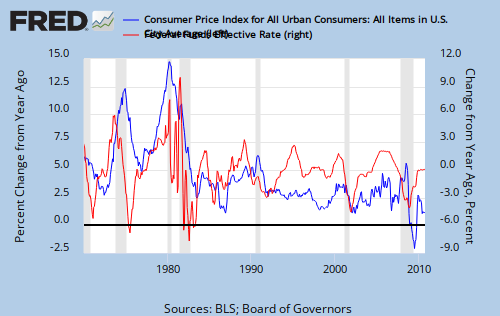
On balance, the anti-inflation effects are stronger. One hint is this graph: graph 1that seems to indicate interest rate increases are followed about one year later by inflation decreases.
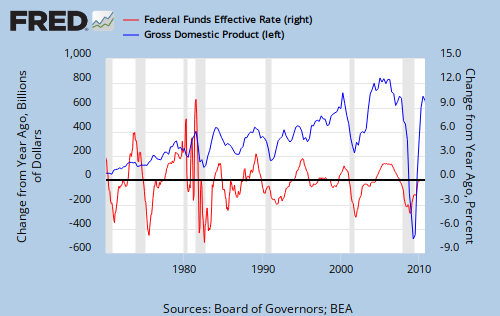
The other hint is the Fed’s ongoing success in controlling inflation despite massive increases in the money supply. Interest rate increases actually work.

Interest rate increases can be done quickly and in small or large increments — just what is needed for inflation control. And contrary to popular faith, high interest rates do not negatively affect GDP growth. See: Interest

In summary:
–We are nowhere near inflation
–We can control inflation by raising interest rates
–High interest rates do not negatively affect GDP growth

We can and should feed the starving economy without letting unfounded worries about our ability to prevent or cure the economy’s obesity, prevent us from saving the child.

Rodger Malcolm Mitchell
http://www.rodgermitchell.com

No nation can tax itself into prosperity. Those who say the stimulus “didn’t work” remind me of the guy whose house is on fire. A neighbor runs with a garden hose and starts spraying, but the fire continues. The neighbor wants to call the fire department, which would bring the big hoses, but the guy says, “Don’t call. As you can see, water doesn’t put out fires.”

–Senator Durbin wanders in Fantasyland

The debt hawks are to economics as the creationists are to biology. Those, who do not understand monetary sovereignty, do not understand economics. Cutting the federal deficit is the most ignorant and damaging step the federal government could take. It ranks ahead of the Hawley-Smoot Tariff.

Read about Senator Durbin’s wanderings in Fantasyland. Today, 12/3/10, the Chicago Tribune published an article by Dick Durbin, the senior Senator (D) from Illinois. The title: “Why I’m voting ‘yes.” Here are some quotes from the article, and my comments.

“On Friday, when President Brach Obama’s National Commission on Fiscal Responsibility and Reform gathers to consider a plan to bring our national debt under control, I will be voting yes. . . . America needs to grow our economy and reduce our $13.trillion debt. “

Never mind that almost 30% of that debt is merely one government department owing another government department. (Think of your checking account owing your savings account.) We can forgive that “minor” arithmetic error, because the good Senator makes a much larger one.

It mathematically is impossible to cut the debt and grow the economy at the same time. Money not only is the engine, but also the measure, of economic growth. GDP is a money measure. Cutting the debt requires taking money out of the economy, either by raising taxes or with reduced spending, or both. When you take money out of the economy, there is no mechanism by which you can grow the economy. There are no caveats about efficiency or savings or reducing waste or any other supposedly mitigating concepts. It simply is 100% impossible to grow an economy while reducing the money supply.

It’s like telling someone to take a lower paying job so he can buy a bigger house. The arithmetic doesn’t work.

Apparently Senator Durbin realizes this, because later he says:

“I worked (to) make certain that the (recommended) spending cuts do not start until 2013. We cannot run the risk of hitting the brakes in the midst of this recession, driving more people into unemployment and shredding the safety net to protect our families.”

So let’s see if we understand his thinking. Spending cuts “hit the brakes and drive people into unemployment.” We don’t want to do that now, but we do want to do it in 2013. Huh?

Then he said:

“I also insisted on two things to spark the economy: a payroll tax holiday that can create up to 900,000 jobs and a longer-term investment of $100 billion in infrastructure, education and reserach and development – key investments for long-term economic growth.”

Hmmm. So he wants to cut the deficit, but realizing that deficits stimulate the economy, he wants to increase the deficit with a payroll tax holiday and $100 billion investment.

So tell us again, Senator Durbin why do you want to cut the deficit? Oh sorry, you never told us the first time. Could it be because you have no reason? None at all?

“Borrowing 40 cents out of every dollar we spend for missiles or food stamps is unsustainable.”

Ah yes, the old “unsustainable” line. Back in February 7, 1982, almost 30 years ago, when the Federal Debt Held by Private Investors was $733 billion, President Ronald Reagan referred to the, “rapid, unsustainable expansion of Federal spending and money growth.” (See: Unsustainable) Today, the FDHBPIN is $7.9 trillion, having increased an astounding 1,000% in only 29 years, and politicians continue to refer to it as “unsustainable” – while we keep sustaining it with no difficulty whatsoever. When you say that something we have done, actually since the 1930s, is impossible, at some point you must question yourself. If it’s unsustainable, how have we sustained it?

Senator Durbin is yet another politician who does not understand monetary sovereignty. He does not understand that the U.S. can “sustain” any spending of any amount. Its spending is not constrained by deficits, debt or taxes, but rather by inflation – the inflation the Fed easily controls, the inflation from which we are a long, long way.

And he does not understand the federal government does not need to borrow the dollars it previously created, and does not need to borrow what it can create in unlimited quantities.

How frightening it is that Senator Durbin expresses the false beliefs held by the majority, not only of Congress but of the American people. One only can imagine how Galileo felt.

Rodger Malcolm Mitchell
http://www.rodgermitchell.com

No nation can tax itself into prosperity. Those who say the stimulus “didn’t work” remind me of the guy whose house is on fire. A neighbor runs with a garden hose and starts spraying, but the fire continues. The neighbor wants to call the fire department, which would bring the big hoses, but the guy says, “Don’t call. As you can see, water doesn’t put out fires.”

–Reducing the federal deficit and other forms of national suicide

The debt hawks are to economics as the creationists are to biology. Those, who do not understand monetary sovereignty, do not understand economics. Cutting the federal deficit is the most ignorant and damaging step the federal government could take. It ranks ahead of the Hawley-Smoot Tariff.
======================================================================================================================================================

Here is what my local newspaper, the Chicago Tribune, says about the federal debt and deficit:

“First pay attention to Ireland, the latest nation to discover that when no one will take your IOUs, terrible things happen. In exchange for a bailout, Ireland has committed to huge spending cuts and brutal tax hikes that will inflict sever economic pain across the Emerald Isle for years.”

Right you are, Tribune. Tax hikes and spending cuts always cause severe damage to a nation and its people..

“Second, pay attention to Erskine Bowles and Alan Simpson. The dogged co-chairmen of the president’s deficit commission are telling you how difficult it already will be to save the U.S. from reaching the day when no onee will take our IOUs.”

If that’s what Messrs. Bowles and Simpson are saying they are more dog-brained than dogged. The U.S., as a monetarily sovereign nation, does not need anyone to accept our IOUs, for this simple reason: A monetarily sovereign nation never needs to borrow the sovereign money it already has the unlimited ability to create. In fact, when the U.S. “borrows,” it simply exchanges T-securities it creates out of thin air for dollars it already has created, also out of thin air. Monetarily non-sovereign nations do need to borrow, because they do not have the unlimited ability to create money.

“The lesson from Ireland, the lesson from Bowles and Simpson, the lesson that official Washington still doesn’t want to hear: If we don’t make painful choices on spending and taxes right now, we’re going to invite chaos.”

Ireland is monetarily non-sovereign; the U.S. is monetarily sovereign. The Tribune doesn’t understand the difference. And because the Tribune and Messrs. Bowles and Simpson, and indeed the entire political establishment thinks U.S. finances are similar to monetary non-sovereign finances, we most certainly will have chaos. What these people imagine as a problem (deficits) actually is a benefit (money), and they try to cure this supposed problem with solutions that will damage us for decades. It’s like trying to “cure” good height by cutting off a person’s legs.

“(Bowles’ and Simpson’s) plan would raise the retirement age for Social Security [Keep paying FICA, but work ’til you drop], put federal health care programs on a strict budget [i.e. cut Medicare and Medicaid to improve health care], slash defense spending [for a stronger America] . . . It targets everything from federal payments to states reclaiming abandoned coal mines [Goodby environment] to restrictions that stop the Postal Service from shifting to five-day-a-week delivery [What next? Once-a-week delivery?]. Everybody gets gored one way or another.”

Yes, we all will get gored. But aside from worse health care, poorer retirement, more poverty, less national defense, worse education, worse environment and a thousand other reductions in the American life style, not only for us but for our children and our grandchildren, why worry? There is only one small detail. I almost hate to mention it, but: Where is the economic evidence that our federal deficit is too large? Nowhere.

Where do we see that the federal government can’t pay its bills? Nowhere. Where do we find that inflation threatens us? Nowhere. Where do we find that deficits cause recessions, depressions, stagflations, unemployment, poverty or any other form of economic miserey? Nowhere. According to the Tribune et al, the debt is big, ergo bad. Don’t ask for evidence. There is none. Just take your bitter pill on our say so.

Bowles and Simpson will make Osama bin Laden happy. Between them, they propose more damage to America than the Taliban and al-Qaeda together would be able to effect in a century. And all because of brutal ignorance.

“All together, the 16-nation eurozone has less debt and a much lower deficit in relation to its size than the United States has.”

The ignorance just grows and grows. The 16-nation eurozone is composed of both monetarily sovereign nations (which can service any size debt), and monetarily non-sovereign nations, which have limited debt-serving ability. The Tribune treats them as one. This respected paper sees no differences among the U.S., our states, counties, cities, businesses you and me. To the Tribune, whatever applies to one, applies to all.

“We’re not heading into trouble. We’re there.”

With thinkers like Bowles, Simpson, our political leaders and the Tribune editors, we are in desperate trouble, indeed.

But dammit, if they expect us to endure all this misery, and if they expect us to agree to harm our children and our grandchildren, and if they, in their own words, want to “inflict sever economic pain for years,” shouldn’t they at least be required to provide evidence all this is necessary?

Rodger Malcolm Mitchell
http://www.rodgermitchell.com

No nation can tax itself into prosperity. Those who say the stimulus “didn’t work” remind me of the guy whose house is on fire. A neighbor runs with a garden hose and starts spraying, but the fire continues. The neighbor wants to call the fire department, which would bring the big hoses, but the guy says, “Don’t call. As you can see, water doesn’t put out fires.”