–Here is an example of an “Obama compromise”

Mitchell’s laws: To survive, a monetarily non-sovereign government must have a positive balance of payments. Economic austerity causes civil disorder. Reduced money growth cannot increase economic growth. Those, who do not understand the differences between Monetary Sovereignty and monetary non-sovereignty, do not understand economics.
==========================================================================================================================================================================

An “Obama compromise” is when you give the other person everything he demands, but pretend it either is meaningless or is something you always wanted. Here’s a classic example:

Washington Post:
—————————————-
News Alert: Obama to address joint session of Congress on Sept. 8
August 31, 2011 9:36:20 PM
—————————————-

President Obama will address a joint session of Congress on Sept. 8 to lay out his plan for jobs and the economy, the White House announced Wednesday night. The date is one day later than the president requested earlier Wednesday, but that date conflicted with a scheduled debate of Republican presidential candidates, drawing objections from GOP lawmakers. House Speaker John A. Boehner responded by suggesting that Obama come to Capitol Hill on Thursday night, a date that now puts the president up against the first game of the NFL season.

Good luck, Mr. President, getting a huge, national audience vs. the NFL opener. But at least the Tea/Republicans have what they demanded. So that’s nice.

Rodger Malcolm Mitchell
http://www.rodgermitchell.com


==========================================================================================================================================
No nation can tax itself into prosperity, nor grow without money growth. Monetary Sovereignty: Cutting federal deficits to grow the economy is like applying leeches to cure anemia. The key equation in economics: Federal Deficits – Net Imports = Net Private Savings

MONETARY SOVEREIGNTY

–Uh oh. The Debt/GDP police soon will be on the prowl.

Mitchell’s laws: To survive, a monetarily non-sovereign government must have a positive balance of payments. Economic austerity causes civil disorder. Reduced money growth cannot increase economic growth. Those, who do not understand the differences between Monetary Sovereignty and monetary non-sovereignty, do not understand economics.
==========================================================================================================================================================================

Lately federal debt as a percentage of GDP has been rising. So very soon, the Debt/GDP police will tell you that if the ratio goes above 100% or 150% or whatever number is chic these days, some terrible things will happen. What are these terrible things? No one knows, but we can assume they have to do with economic growth and/or with inflation.

Previously, I have showed how Debt/GDP is a meaningless fraction. The numerator is a life-of-nation measure, and the denominator is a one-year measure. Further, federal debt is nothing more than Treasury securities outstanding, which the federal government could eliminate tomorrow, merely by instructing banks to credit holders’ T-security accounts and debit their checking accounts.

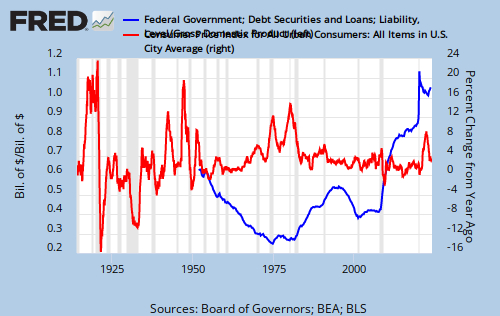
Nevertheless, it might be instructive to see whether there is any historical relationship between Debt/GDP and inflation or economic growth. Here is what GDP/Debt (blue line) looks like when compared with inflation:

Debt/GDP vs inflation

Do you see any relationship between GDP/Debt and inflation? I don’t. Not surprisingly, this meaningless fraction has had no effect on inflation.

What about Debt/GDP as compared with economic growth. Here’s what that graph looks like:

Debt/GDP vs GDP

It would be difficult to conclude that a high Debt/GDP ratio affects economic growth, negatively. In fact, one could make the case that for the past 25 years, increases in Debt/GDP have had positives effect on economic growth. Notice also, that Debt/GDP does not seem to be related to the beginning of recessions (gray bars). If fact, as befits a meaningless ratio, Debt/GDP does not seem related to any economic function.

So the next time you read a sky-is-falling article saying the Debt/GDP ratio is too high, unsustainable, will cause inflation or will reduce economic growth, send him/her this article.

Rodger Malcolm Mitchell
http://www.rodgermitchell.com


==========================================================================================================================================
No nation can tax itself into prosperity, nor grow without money growth. Monetary Sovereignty: Cutting federal deficits to grow the economy is like applying leeches to cure anemia. The key equation in economics: Federal Deficits – Net Imports = Net Private Savings

MONETARY SOVEREIGNTY

–Fitch joins the idiot patrol

Those, who do not understand the differences between Monetary Sovereignty and monetary non-sovereignty, do not understand economics.
===================================================================================================================================================================================================================================================================================

Despite living in ignomy, the rating agencies never seem embarrassed and never seem to quit. You know who they are: Standard & Poor’s, Moody’s and Fitch, the infamous trio that gave AAA ratings to total junk, costing American families billions, because these guys were paid by those they rated. (No conflict of interest, right?)

Have you seen any of these big-time crooks prosecuted? No? What about a single mother whose children are starving, and who shoplifts a few dollars worth of food? Yes, the prosecutors will see she is punished “as a lesson to others.” Thus is American justice. But that’s a separate story.

Before the fake “debt crisis” was solved (whew!), these three bandits threatened to downgrade the U.S. AAA bond rating. (What’s wrong boys? The federal government not paying you for a high rating?) The fact that this would leave some monetarily non-sovereign, private companies with a higher credit rating than the Monetarily Sovereign U.S. government — an impossible situation for several reasons — did not seem to trouble any of the three.

Until recently though, Fitch had been less noisy about the fake “debt crisis.” It had allowed Standard & Poor’s and Moody’s to hog the spotlight, demonstrating their ignorance loudly, and while Fitch did issue quiet little threats, it seemed to remain, appropriately, in the shadows.

But no. Why let the other guys get all the publicity? So Fitch decided to issue its own stern warning:

“On current trends Fitch projects that US government debt, including debt incurred by state and local governments as well as the federal government, will reach 100% of GDP by the end of 2012, and will continue to rise over the medium term, a profile that is not consistent with the US retaining its AAA sovereign rating.”

There’s an old saying: “You can keep your mouth closed and let people think you are stupid, or you can open your mouth and prove to people you are stupid.” Fitch opened its mouth. By lumping US government sovereign debt with state and local debt, and then comparing all this debt hash with GDP, Fitch indicated it has zero concept of economic risk. Pretty bad for an economic risk rating company, huh?

The U.S. is Monetarily Sovereign. It never, ever, ever can run out of money. It creates money by paying bills. If the federal debt (i.e. T-securities outstanding) were 10 times its current size, the U.S. would have no difficulty, not only servicing it, but paying it off — in one day. The U.S. does not need to borrow; T-securities are a relic of the gold standard days; they could and should be eliminated, immediately. They have zero effect on the federal government’s ability to spend or need to tax. Fitch doesn’t understand that.

By contrast, the states and local governments are monetarily non-sovereign, just like you and me. They can and do run out of money. They do not create money by paying bills; they transfer money. They do need to borrow, and increased debt does affect their ability to spend and need to tax. Fitch doesn’t understand that.

So when discussing debt risk, it makes absolutely no sense to lump a Monetarily Sovereign government’s debts with monetarily non-sovereign governments’ debts. Fitch doesn’t understand that.

Then there is the comparison with GDP. What does it mean? What is the significance of a high debt/GDP ratio? No one knows what this oft-quoted, never explained ratio means. The federal government does not service its debts with GDP. Does a high ratio indicate difficulty servicing debt? No. The federal government services its debts simply by crediting the bank accounts of its creditors. GDP is not remotely involved.

Even the states and local governments do not service their debts with GDP. They levy taxes to service their individual debts. So, does GDP affect taxes? Well, sort of. If the taxes are based on business profits, personal income and property value, then in a relatively distant way, GDP can affect state and local taxes, except for one, small detail: State and local taxes are adjusted according to state and local need. So if business earnings, your personal income and the value of your house go down, and the governments need more money, they raise the tax rates. Fitch doesn’t understand that.

If GDP has zero relevance to servicing debt, what does total government debt/GDP mean? Well, er, uh, it means the debt owed by all the various government entities in the U.S. is less-than, equal-to or more-than the total domestic production in the U.S. And what does that mean? Not a damn thing.

The next time you see this ratio — debt/GDP — or hear it discussed in any meaningful context, know this: The speaker or the writer has no idea what the heck he/she is talking about. Debt/GPD is a meaningless ratio, much sound and fury signifying nothing. Fitch doesn’t understand that.

In short, this rating agency, whose reason for existence is predicated on their ability to analyze economic factors to determine economic credit risk, does not understand the most basic, elemental foundation of all modern economics: Monetary Sovereignty. If these guys were architects, we all would have to live in tents, because the buildings would come crashing down.

Welcome to the clueless patrol, Fitch. Next time I buy a bond, remind me to check the ratings you publish.

Not.

Rodger Malcolm Mitchell
http://www.rodgermitchell.com


==========================================================================================================================================
No nation can tax itself into prosperity, nor grow without money growth. Monetary Sovereignty: Cutting federal deficits to grow the economy is like applying leeches to cure anemia. The key equation in economics: Federal Deficits – Net Imports = Net Private Savings

MONETARY SOVEREIGNTY

–Why a dollar bill is not a dollar, and other economic craziness

Those, who do not understand the differences between Monetary Sovereignty and monetary non-sovereignty, do not understand economics.
==================================================================================================================================================================================

You may have seen your bank; you may have seen your safe deposit box. But have you ever seen your checking account?

No, you haven’t. Your checking account is not a physical reality. It is an accounting notation. You could travel to your bank, and walk into the lobby, and you would not be one inch closer to your checking account than if you had stayed home.

When you receive a printed checking account statement, you receive evidence you own the dollars in your checking account. But, you never will see those dollars. They too, are not physical realities, but rather, accounting notations. In fact, you never will see a dollar, anywhere. No one on earth ever has seen a dollar.

A dollar bill is not a dollar.

A dollar bill is a piece of paper telling the world the bearer owns a dollar. It can be compared to a title. When you own a car or a house, you have a document telling the world you own that car or house. The document is called a “title.” The title is not the car or house. You can’t drive a title; you can’t live in a title. It’s just evidence of ownership. Your dollar bill is evidence you own that invisible dollar.

A dollar has no physical existence. You can’t hold a dollar. A dollar has no more substance than does a number. You can’t hold the number “one.” You can’t carry the number “ten.” When you write a check, from your invisible checking account, that check is a set of instructions telling your bank to debit your checking account and to credit the payee’s checking account.

One account is debited and another account is credited. No dollars move. They can’t. They aren’t physical. The peso, the euro, the mark, the pound, the yuan, – none of the world’s currencies are physical. They all are accounting notations.

The U.S. federal government has been Monetarily Sovereign since we went off the gold standard in 1971. Money creation no longer is limited by the availability of gold. Our Monetarily Sovereign government can pay any bill of any size at any time, merely by sending instructions to banks to credit bank accounts.

The world’s financial structure is based on instructions to banks. When the federal government owes you $1,000, it sends you a check for $1,000, and you send the check to your bank. The check is not money. It is a written instruction to your bank to credit your account. The bank does as instructed, and your account balance is increased by $1,000. The federal government can send such checks – such instructions – endlessly. It doesn’t need to borrow or collect taxes. It merely sends instructions.

The federal government never “prints” dollars. Printing implies a physical creation. But dollars are not physical. Warren Mosler, uses the analogy of a football scoreboard. The government creates dollars by crediting bank accounts; the scoreboard creates points by posting them. The government never can run short of dollars just as the scoreboard never can run short of points.

Is paying a debt a burden to the federal government? Is posting a score a burden to the scoreboard? Does the federal government need to tax or borrow dollars? Does the scoreboard need to tax or borrow points?

Can the government run short of dollars? Can the scoreboard run short of points?

Would the posting of points be “unsustainable” as some claim the federal debt is?

The federal government pays all its bills by typing numbers into a computer – just like a scoreboard.

The dollar bill is an IOU. On its face is printed, “Federal Reserve Note.” The words “bill” and “note” describe debt instruments (as in “T-bill”and “T-note”). These instruments are held by creditors to demonstrate debt.

When you hold a dollar, who owes you what? The federal government owes you full faith and credit, which may not sound like much, but actually is powerful. It means:

1. The government will accept U.S. currency in payment of debts to the government
2. It unfailingly will pay all it’s dollar debts with U.S. dollars and will not default
3. It will force all your domestic creditors to accept U.S. dollars, if you offer it, to satisfy your debt.
4. It will not require domestic creditors to accept any other money
5. It will take action to protect the value of the dollar.
6. It will maintain a market for U.S. currency
7. It will continue to use U.S. currency and will not change to another currency.
8. All forms of U.S. currency will be reciprocal, that is five $1 bills always will equal one $5 bill and vice versa.

Every form of U.S. money is a form of debt. For many people, the word “debt” is threatening. That may be true for you and me and the states, counties and cities, and Greece and Ireland, all of which are monetarily non-sovereign, but not for our Monetarily Sovereign government, which can credit bank accounts endlessly.

Try to think of any U.S. money that is not owed by something to someone. You can’t.

Federal debt is not functionally the total of federal deficits. By law, the Treasury must issue T-securities (aka “debt”) in an amount equal to federal deficits. But that law is obsolete and could be eliminated immediately. Were it eliminated, there still could be deficits, but all federal debt would disappear.

Similarly, the Treasury could issue T-securities (debt), while the government did not run a deficit, or even ran a surplus.

Brief summary: A dollar has no physical reality. Neither does a checking account or any other bank account, debt, deficit, inflation, recession, depression, stagflation or money. All these terms are descriptive of accounting notations. The federal government can change any of these simply by typing into a computer.

Dollars do not physically move, because they don’t physically exist. When the government pays a debt, you may imagine dollars moving out of some government storage place into a creditor’s bank. But, there is no storage place; there is no movement. The government sends instructions to the creditor’s bank. That’s it. A Monetarily Sovereign government never can run out of instructions.

Given all of the above, how is there a debt crisis? How can the federal debt be a “burden” or “unsustainable” or a “ticking time bomb.” as the media love to claim?

One final thought: Debt-hawks typically confuse two questions:
1. How many dollars can the federal government create?
2. How many dollars should the federal government create?

When a debt-hawk is presented with the unassailable proof that the federal government cannot run short of dollars, and easily can pay any bill of any size, the rejoinder often is, “But that would cause inflation,” or “Why don’t we just give everyone a trillion dollars?” These responses indicate a quick switch in subjects, from question #1 to question #2.

This post describes only question #1. Question #2, which involves economic stimulus and inflation, is described in other posts. The answer to #1 is “infinite,” and that is why the federal debt is an obsolete, useless, meaningless, indeed harmful, concept.

Isn’t economics crazy?

Rodger Malcolm Mitchell
http://www.rodgermitchell.com


==========================================================================================================================================
No nation can tax itself into prosperity, nor grow without money growth. It’s been 40 years since the U.S. became Monetary Sovereign, , and neither Congress, nor the President, nor the Fed, nor the vast majority of economists and economics bloggers, nor the preponderance of the media, nor the most famous educational institutions, nor the Nobel committee, nor the International Monetary Fund have yet acquired even the slightest notion of what that means.

Remember that the next time you’re tempted to ask a teenager, “What were you thinking?” He’s liable to respond, “Pretty much what your generation was thinking when it ruined my future.”

MONETARY SOVEREIGNTY