–How the federal budget really works

An alternative to popular faith

A parable about the Fed budget:

We shall call him “Mr. Fed.” He has an unruly daughter named “Taxpay,” whom he wishes to encourage toward goodness, while teaching her basic budgeting. So Mr. Fed tapes two sheets of paper to the refrigerator.

One sheet is titled “Taxpay Savings.” The other sheet is titled “Deficit Scoresheet.” Each day when Taxpay is good, Mr. Fed will draw a checkmark on her Savings sheet, and because he is teaching her double-entry accounting, he also will draw a checkmark on his Deficit Scoresheet.

Taxpay wants these checkmarks, because Mr. Fed will allow her to use them to buy things like staying up late or having friends for a sleepover. She trusts Mr. Fed to exchange these goods and services for checkmarks (In some quarters this trust is known as “full faith and credit.”) Also, if she is bad, Mr. Fed will tax her, so she needs checkmarks to pay any “bad girl” taxes she might incur.

All of the first week, little Taxpay is good, so by the end of the week she has accumulated 7 checkmarks on her Savings sheet. Similarly, Mr. Fed has drawn 7 checkmarks on his Deficit Scoresheet.

The system works so well, Mr. Fed tells Taxpay that from now on, he will give her 2 checkmarks for every day she is good, which of course requires that he also draw 2 checkmarks on his Deficit Scoresheet.

This is no problem for Mr. Fed who has plenty of pencils to draw checkmarks. But it outrages a visiting busybody named “Debthawk,” who asks Taxpay the nonsensical question, “Who is going to give Mr. Fed checkmarks to reduce the number of checkmarks on his Scoresheet?

Puzzled, little Taxpay asks, “Huh? Why does Mr. Fed’s Deficit Scoresheet need to be reduced? It’s just a scoresheet for accounting purposes. The checkmarks don’t cost Mr. Fed anything. They are free, backed by nothing. They merely are arbitrary symbols that Mr. Fed can draw in unlimited quantities. They are exactly like the dollars the federal government produces, now that we are off the gold standard – arbitrary symbols, free and backed by nothing other than full faith and credit.”

Taxpay is pretty smart for a little girl, obviously smarter than Debthawk, who keeps insisting that one day Taxpay’s children and grandchildren will have to give Mr. Fed checkmarks to offset those on the Deficit sheet. Debthawk calls this “inter-generational transfer.”

In short, Debthawk wants a “balanced budget,” aka “deficit neutral” which means every time Mr. Fed gives Taxpay a checkmark, she should give it back. Think about the sense of that.

The first day of the next week, Taxpay is bad, so Mr. Fed taxes her. He erases a checkmark on her Savings sheet, and also erases a checkmark on his Deficit Scoresheet, reducing the Deficit Score to 6 checkmarks. Debthawk is thrilled, failing to notice the reduction on Taxpay’s Savings sheet.

Taxpay then decides to spend all her remaining checkmarks for permission to have a dozen friends at a sleepover. Mr. Fed erases all her Savings checkmarks and simultaneously erases all the checks on his Deficit Scoresheet. At first elated to see the Deficit Scoresheet having no checkmarks, Debthawk belatedly realizes that Taxpay now has no checkmarks left to pay for future goods and services. This puts everyone into a Great Depression, at which time Debthawk says, “I always knew that in emergencies like this one, Mr. Fed would have to add to his Deficit Scoresheet so Taxpay would have checkmarks.” (Of course he did.)

But, the minute Mr. Fed started to give Taxpay more checkmarks, Debthawk again complained about there being too many checkmarks in the Deficit Scoresheet. Poor little Taxpay. Debthawk wants to take away her precious checkmarks, and because his mind is closed, she can’t seem to convince him that is unnecessary.

And that is the way the federal budget really works.

Rodger Malcolm Mitchell
http://www.rodgermitchell.com

Faith is belief without evidence. Science is belief from evidence.
–Does your money belong to the government?

An alternative to popular faith

The November 23, 2009 New Yorker contained an article by James Surowiecki, titled “The Debt Economy.” He claims what he calls “tax breaks,” adversely skew the economy and cause people not to “make decisions based on economic fundamentals (but) on tax considerations.”

He gives the example of corporate interest payments vs. dividends. The former are tax deductible “tax breaks”; the later are not, which provides a “debt bias” (his words) to the economy.

Mr. Surowiecki disparages “tax breaks” as being “unnecessary” and having “nonexistent social benefits.” His solution: Eliminate tax breaks.

Consider health insurance. The government encourages companies to provide it by allowing payments to be tax deductible for the companies, and not taxable to the employees – i.e., using before-tax dollars. In contrast, people who purchase their own health insurance must use after-tax dollars. In Mr. Surowiecki’s world, the economy would benefit from eliminating the “tax break” by taxing employees’ health benefits.

This solution suggests taxes are the norm, and tax breaks are departures from that norm. That is, all the money you earn belongs to the government, and only an aberration or “break,” allows you to keep some of it.

I disagree. It is taxes, not “tax breaks,” that skew our economy, forcing decisions away from economic fundamentals. Eliminate taxes and the economy would be steered by the economic fundamentals Mr. Surowiecki craves. All taxes depart from these economic fundamentals. There are no innocuous taxes. They all make a difference. So the very act of imposing a tax, any tax, will skew the economy.

Further, there are no “fair” taxes. You can read a one-page article on this subject at: http://rodgermitchell.com/FairTaxes.html

Tax breaks are less harmful than taxes, not only because taxes skew the economy, but because all taxes remove money from the economy, thereby reducing economic growth.

Taxes are not the norm. Your money does not belong to the government. When deciding whether to tax debt or to “untax” non-debt, the economy would benefit from the later.

*Faith is belief without evidence. Science is belief from evidence.

–Deficit fears do more damage than deficits

An alternative to popular faith

Those concerned about large federal deficits cite fears of inflation, high interest rates and obligations of our children and grandchildren as major factors. See:

https://rodgermmitchell.wordpress.com/2009/11/15/deficits-and-interest-rates-another-myth/, https://rodgermmitchell.wordpress.com/2009/10/30/deficits-the-possible-vs-the-certain/ and several other posts on this site. Ever since we went off the gold standard in 1971, deficits have not been related to inflation or high interest rates. And no one pays for deficits, which is what makes them deficits. We, the children and grandchildren of Reagan-era parents, never paid for the huge Reagan deficits. (By definition, deficits are paid for only when we run surpluses.)

While deficit fears are misplaced, the damage these fears do is significant. Read these recent headlines.

08/14/09: Deficit Plays Into Health Reform: Democrats say it will be hard to push an ambitious health reform bill through Congress unless it reduces projected federal spending on medical care and begins to bring the national debt under control.

11/14/09: High Costs Weigh on Troop Debate for Afghan War: The budget implications of President Obama’s decision about sending more troops to Afghanistan are adding pressure to limit the commitment, senior administration officials say.

11/14/09: China’s Role as U.S. Lender Alters Dynamics for Obama:
China’s position as the country’s largest foreign lender means that President Obama is likely to spend more time reassuring Beijing than pushing reforms.

11/14/09: Obama vows ‘serious’ bid to cut US deficit: Obama’s Republican critics, and some conservative Democrats, have called on the president to rein in spending on huge programs such as health care and climate change to avoid inflating the sky-high deficit.

Thus, deficit fears will impact medical care, the fight against terrorism, financial reforms and efforts to prevent climate change, improve the infrastructure, improve education, etc. More specifically, read what the Wall Street Journal editors said on 11/16/09 about a new Medicare Commission:

“So far, the commission has banned knee arthroscopy for osteoarthritis, discography for chronic back pain and implantable infusion pumps for pain not related to cancer. This year, it is targeting such frivolous luxuries as knee replacements, spinal cord stimulation, a specialized autism therapy and MRIs of the abdomen, pelvis or breasts for cancer. Currently, the commission is pushing through the most restrictive payment policy in the nation for drug-eluting cardiac stents – simply because bare metal stents are cheaper, even as they result in worse outcomes.”

The belief deficits are harmful is debatable, at best. What is not debatable is that deficit cutting absolutely, positively will injure our grandchildren and us. Peculiarly, those wanting to cut federal spending consider themselves “prudent,” while the nation suffers under the blows of their meat axe.

Rodger Malcolm Mitchell
http://www.rodgermitchell.com

–Deficits and interest rates: Another myth

An alternative to popular faith

11/15/09 (AFP): “The US government announced last month that it had closed its 2009 fiscal year with a record budget deficit of 1.417 trillion dollars, up 962 billion dollars from the prior year. The huge gap stemmed from declining revenues and a massive boost to spending in a 787-billion-dollar stimulus plan designed to jolt the world’s largest economy from its prolonged recession. Concerns over the deficit underscore a fundamental tension undercutting Obama’s presidency in its first year — the extent to which he is attempting sweeping political change at a moment of historic financial peril.

“Many economists say high deficits during economic crises are acceptable to fuel government spending to stimulate growth. But long-term deficits can result in high interest rates, making it much harder for consumers to finance outlays such as new homes and cars.”

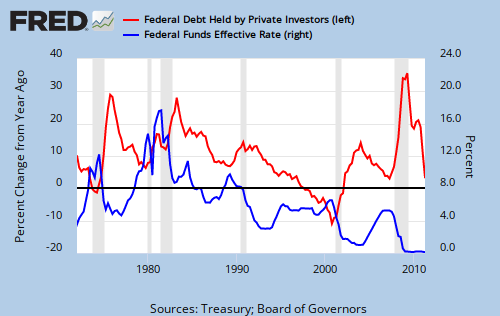
Yet another myth in the pantheon of economic myths circulating the globe. Look at the following chart and tell me whether you can see a relationship between deficits — even large deficits — and interest rates.

Debt vs Interest Rates

Contrary to popular faith, deficits are not the cause of inflation or high interest rates. Browse through the posts on this site, and you will see why.