Is it ignorance, or is it an agenda?

The author of the following article, Veronique de Rugy, may need help understanding federal government finance, for she has written several articles in the same misleading vein.

The question: Is it ignorance or is it an agenda? Perhaps she needs to be more knowledgeable about federal finance. No problem. Most laypeople, and even many economists, suffer from that form of ignorance.

I suspect, however, that Ms. de Rugy is feigning ignorance and has an agenda, a pro-rich, pro-right, anti-poor agenda. You decide. Here are excerpts from her article:

The U.S. Credit Rating Just Dropped. It’s Time for Radical Budget Reform. The lack of oversight and the general absence of a long-term vision is creating inefficiency, waste, and red ink as far as the eye can seeBy, Veronique de Rugy | 8.10.2023 

Fitch Ratings just downgraded the U.S. government’s credit rating due in part to Congress’ erosion in governance.

Indeed, year after year, we see the same political theater unfold: last-minute deals, deficits, and, all too often, the passage of gigantic omnibus spending bills without proper scrutiny, repeated debt ceiling fights and threats of shutdown.


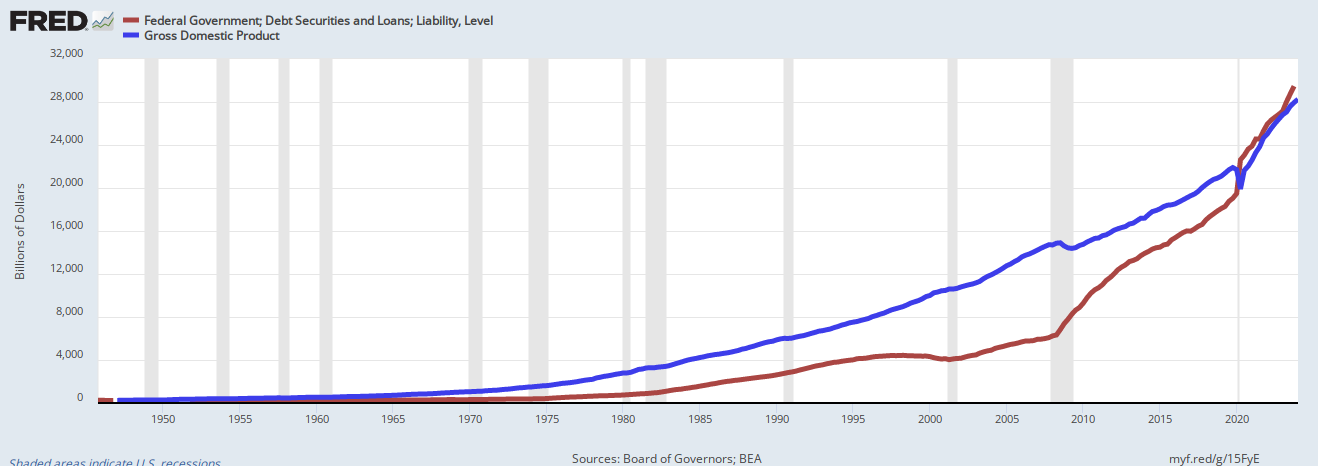
The blue line represents a standard measure of the economy, Gross Domestic Product (GDP). The red line represents what too often (and misleadingly) is termed “federal debt,” the “red ink” to which Ms. de Rugy refers.

We say “mistakenly termed debt” because it is unlike private debt. Federal “debt” is the total of deposits into privately owned, T-security accounts.

When you invest in a T-bill, T-note, or T-bond, you deposit your dollars into your T-security account at the U.S. Treasury.

This account is similar to your safe deposit box, where you deposit valuables. The bank does not touch the box’s contents, and they are not considered bank “debt,” though the bank owes you those contents in one minor sense.

Similarly, the federal government never touches the dollars held in your T-security account. Although some mistakenly refer to the dollars as borrowing, the federal government never borrows dollars.

Why would it? Given the federal government’s infinite power to create dollars at the touch of a computer key, borrowing dollars would be a ridiculous exercise:

Alan Greenspan: “A government cannot become insolvent with respect to obligations in its own currency.”

Alan Greenspan: “There is nothing to prevent the federal government from creating as much money as it wants and paying it to somebody.”

Alan Greenspan: “The United States can pay any debt it has because we can always print the money to do that.”

Ben Bernanke: “The U.S. government has a technology, called a printing press (or, today, its electronic equivalent), that allows it to produce as many U.S. dollars as it wishes at essentially no cost.”

Quote from former Fed Chairman Ben Bernanke when he was on 60 Minutes:
Scott Pelley: Is that tax money that the Fed is spending?
Ben Bernanke: It’s not tax money… We simply use the computer to mark up the size of the account.

Statement from the St. Louis Fed:
“As the sole manufacturer of dollars, whose debt is denominated in dollars, the U.S. government can never become insolvent, i.e., unable to pay its bills. In this sense, the government is not dependent on credit markets to remain operational.”

“Not dependent on credit markets” is Fed-speak meaning, “We don’t borrow.”

So what is the purpose of T-securities, the total of which erroneously is called “debt”? T-security accounts”

  1. They allow holders of unused dollars to store them in a safe, interest-paying account, which stabilizes the dollar
  2. They help the Fed control interest rates.

That’s it. The purpose is not to provide the federal government with spending dollars. The government creates all it needs. All federal spending is done with newly created dollars. No spending uses the dollars in T-security accounts.

For this reason, the size of the misnamed “debt” is irrelevant. Whether total deposits equal $100 or $100 TRILLION, the government has the same real ability to return them to depositors.

That is why the debt ceiling is so outrageously foolish. Why limit the amount of deposits that will be accepted if the dollars neither are used nor scarce to the government?

The confusion comes with the word “debt.” Federal “debt” differs from personal debt as an ink pen is a pig pen. Different meanings for the identically spelled and pronounced word “pen.”

If someone thought they could write with a pig pen, that would be equivalent to someone thinking the federal government was burdened by its federal debt.

Since 1940, there never has been a time when the government has not had Ms. de Rugy’s “red ink.” The lines essentially parallel, which should be no surprise to anyone because the formula for GDP is:

GDP = Federal Spending + Nonfederal Spending + Net Exports.

Federal Spending adds dollars to the economy, as do Net Exports, and those added dollars stimulate Nonfederal Spending. The three terms work in concert to create economic growth. 

Sadly, “debt” confuses some economists, who wrongly equate it with private sector or state/local government debt.

But while the private sector and state/local governments are monetarily non-sovereign (i.e. they do not have the infinite ability to create U.S. dollars), the federal government is Monetarily Sovereign (it does have that limitless ability).

The difference is that the private sector and state/local governments unintentionally can run short of dollars, the federal government cannot unintentionally run short. That is a huge difference.

Imagine you had the federal government’s ability to create dollars at will. Why would you ever worry about debt? You wouldn’t.

A billion dollars in debt. No problem. A trillion? Still fine. A trillion trillion. Again, no problem.

So why is Ms. de Rugy worried about the “debt” if it’s no problem for the federal government? Does she understand that the federal government pays all its debts by creating dollars? Here is what she wrote:

Fitch Ratings just downgraded the U.S. government’s credit rating due in part to Congress’ erosion in governance.

Indeed, year after year, we see the same political theater unfold: last-minute deals, deficits, and, all too often, the passage of gigantic omnibus spending bills without proper scrutiny, repeated debt ceiling fights and threats of shutdown.

In the above two paragraphs, Ms. de Rugy properly explains the reason for the rating downgrade: Political theater, debt ceiling fights and threats of shutdown.

It isn’t that the federal “debt” is too high. The reason for the downgrade is the political theater, the debt ceiling fights, and the shutdown threats. The federal government politically has become an unreliable payer.

It always can pay, but it might not choose to pay.

But, having expressed the truth, Ms. de Rugy goes off the rails.

But these are just symptoms of a budget-making process that desperately needs reform. In a world where politicians are rarely told no when it comes to creating or expanding programs, most simply refuse to have their hands tied or behave as responsible stewards of your dollars.

The lack of oversight and the general absence of a long-term vision is creating inefficiency, waste, and red ink as far as the eye can see. Without fundamental reform, no one can stop it. So, let’s have some real reform.

Inefficiency, waste, and red ink have nothing to do with the federal government’s ability to pay. I suspect Ms. de Rugy knows this because here comes what I believe to be her agenda.

We need a comprehensive budget process under which programs like Social Security, Medicare, and Medicaid can no longer grow without meaningful oversight.

Combined with other mandatory, more-or-less automatic spending items, they comprise over 70 percent of the budget.

Thus, they must be included in the regular budget process and subjected to periodic review.

Only then will our elected representatives be forced to stop ignoring the side of the budget that requires their attention the most.

Her solution to the federal credit rating cut is to cut Social Security, Medicare, and other spending items (like Medicaid and anti-poverty initiatives).

In this, she has become a shill for the Republican Party, which is a shill for the rich people of America.

The GOP has tried to eliminate the popular ACA (aka Obamacare) for many years, but it’s a program that helps the less affluent, a significant voting bloc.

This is the party that gave massive tax cuts to the rich, falsely complains about the Social Security and Medicare “trust funds” supposedly running short of dollars, and consistently votes against anything that would help the poor (whom they deem “lazy takers.”)

Federal “trust funds” differ from private trust funds as federal debt differs from personal debt. 

WHAT ARE FEDERAL TRUST FUNDS?
Sep 20, 2016, Peter G. Peterson Foundation

A federal trust fund is an accounting mechanism the federal government uses to track earmarked receipts (money designated for a specific purpose or program) and corresponding expenditures.

The largest and best-known funds finance Social Security, Medicare, highways and mass transit, and pensions for government employees.

Federal trust funds bear little resemblance to their private-sector counterparts.

In private-sector trust funds, receipts are deposited and assets are held and invested by trustees on behalf of the stated beneficiaries.

In federal trust funds, the federal government does not set aside the receipts or invest them in private assets.

Again, the public and many economists are confused about the words “trust fund.” A federal trust fund is not a real trust fund and cannot run short of dollars unless Congress and the President want it to. 

So all the bleating about the Social Security and Medicare trust funds running short of money is nonsense. Congress and the President could add $100 trillion to those trust funds or eliminate them completely at the touch of a computer key.

Medicare and Social Security could be funded directly like the military, Congress, SCOTUS, and the White House, none of which are burdened with fake trust funds.

This would also help deal with the fact that entitlement spending is, as every serious observer knows, unsustainable. Unless reformed, these programs will drain wealth from the government and the economy.

Ensuring their sustainability must be part of any serious budget process reform.

The above statements to too wrong to be accidental. They are outright lies. The government has proved it has the infinite ability to pay for things. It has been sustaining federal deficit spending since 1940, and the economy has continues to grow.

And federal spending, which adds dollars to the economy, certainly does not “drain wealth” from the economy, nor does it drain wealth from a government with infinite dollars.

See the article: Remember that “ticking time bomb”? After 83 years it’s still ticking and still a scam 

Since 1940, people like Ms. de Rugy have complained that the federal “debt” is an unsustainable, ticking time bomb. Year after year, the same complaint and the lies are proven wrong year after year.

But the de Rugys of the world never stop.

Enter a “Base Closure and Realignment Commission (BRAC)”-style fiscal commission, an idea promoted by the Cato Institute’s Romina Boccia.

This commission would be “tasked with a clear and attainable objective, such as stabilizing the growth in the debt at no more than the GDP of the country, and empowered with fast-track authority, such that its recommendations become self-executing upon presidential approval, without Congress having to affirmatively vote on their enactment,” Boccia explains.

Go to the Cato Institute’s website and you’ll be greeted with more misinformation like the above.

Besides the fact that the economy has grown faster than the “debt” (see the graph above), what is the purpose of this objective?

The federal government cannot run short of dollars. And think of the reality: CATO and de Rugy want a group of unelected political bureaucrats to determine how much Social Security and Medicare should be cut.

It’s unimaginably ignorant.

And think of the result. By formula, cutting federal spending cuts GDP, so we would enter an endless spiral of spending cuts, GDP cuts, spending cuts, GDP cuts ad infinitum.

The euro nations, Greece, Italy, and France tried this. It’s called “austerity,” a process that dooms a nation to recessions, to borrow Ms. de Rugy’s phrase, as far as the eye can see.

Cutting federal spending cuts GDP, and cuts to GDP are, by definition, a recession. Why do the rich-loving Republicans want recessions?

Because recessions actually make the rich richer. Here is how that works.

  1. “Rich” is a comparative. A person with $100 is rich if everyone else has $1, but that person is poor if everyone else has $1,000—the Gap between the richer and the poorer measures how wealthy a person is.
  2. Recessions widen the Gap between the rich and the rest. During recessions, desperate people will accept menial, low-paying, demanding jobs, while wealthy business owners continue to profit by paying low salaries.

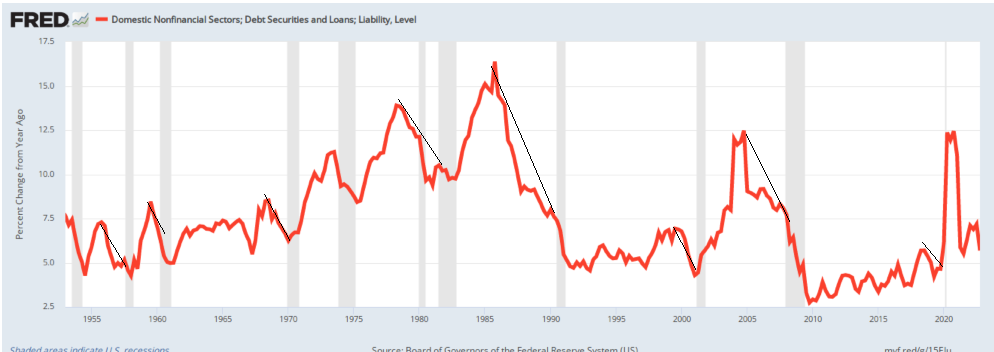
Here is what happens to an economy when the federal “debt” doesn’t increase substantially:
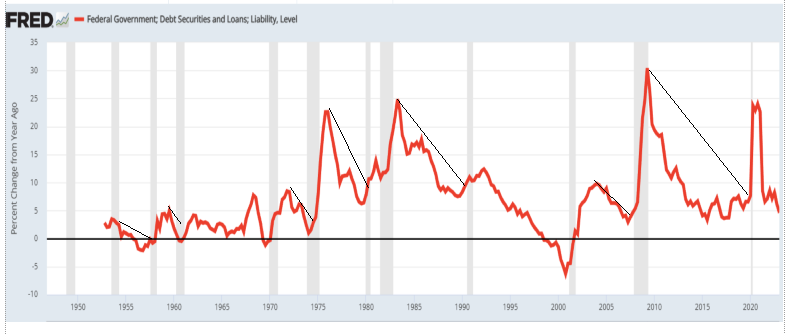
“Debt” doesn’t need to fall for us to have a recession; even when debt GROWTH falls, we have recessions (vertical gray bars).

Not just reduced debt but reduced deficits cause recessions. Imagine what would happen to the economy if de Rugy’s bureaucrats started making cuts. The idea is so screwball that even de Rugy is unsure about it:

I’m uneasy about delegating the president’s power to appoint “experts.” But, Congress would retain some veto power.

If they disapprove of the proposal, the House and Senate can reject it through a joint resolution within a specified period. Whether it’s the best solution to address our fiscal problems remains to be seen, but it’s worth considering.

No, Ms. de Rugy, it’s not “worth considering” any more than economic suicide is worth considering.

There are many more budget reform ideas out there. I’ll leave you with one more. For years, Congress has failed to pass a budget, bringing the country to the brink of a government shutdown by fighting over the need for a continuing resolution.

This temporary measure extends previous funding levels for a few months.

Making continuing appropriations automatic in case of a lapse could remove the threat of shutdowns.

As explained in one senator’s proposal, if appropriations work isn’t done, “implement an automatic continuing resolution (CR), on rolling 14-day periods, based on the most current spending levels enacted in the previous fiscal year.”

Further, to avoid over-relying on CRs, “all Members of Congress must stay in Washington, D.C., and work until the spending bills are completed.”

The problem is the nutty debt limit law. Just eliminate that law and Congress could not easily bring the economy to its knees.

It’s time to completely rethink how we approach the federal budget, grounding our efforts in transparency, accountability, and fiscal responsibility.

Yes, it is time to rethink how we approach the federal budget. First, learn Monetary Sovereignty. By learning how federal financing works, we could help our poor, retired, sick, homeless, and hungry.

But, of course, that is not what the rich want.


Rodger Malcolm Mitchell
Monetary Sovereignty

Twitter: @rodgermitchell Search #monetarysovereignty
Facebook: Rodger Malcolm Mitchell

……………………………………………………………………..

The Sole Purpose of Government Is to Improve and Protect the People’s Lives.

MONETARY SOVEREIGNTY
Why did Fitch downgrade U.S. “Debt”? It’s not what you may think.

The purpose of credit ratings is to assess the likelihood that an issuer of a debt document will adhere to the terms of the document. The U.S. debt documents consist of Treasury bills, bonds, and notes, including the Federal Reserve Notes you carry in your wallet, aka “money.” The value of U.S. debt/money is determined by the U.S. government’s full faith and credit, which includes:

A. –The government will accept only U.S. currency in payment of debts to the government B. –It unfailingly will pay all its dollar debts with U.S. dollars and will not default C. –It will force all your domestic creditors to accept U.S. dollars if you offer them to satisfy your debt. D. –It will not require domestic creditors to accept any other money E. –It will take action to protect the value of the dollar. F. –It will maintain a market for U.S. currency G. –It will continue to use U.S. currency and will not change to another currency. H. –All forms of U.S. currency will be reciprocal; that is, five $1 bills always will equal one $5 bill and vice versa.

The key to the downgrade is item “B,” the “not default” claim. The following article from Investor News attempts to explain why federal Treasuries were downgraded from AAA to AA+.

Credit Rating Alert: Why Did Fitch Downgrade U.S. Debt? Story by Josh Enomoto 

Primarily, the negative reassessment focuses on “the expected fiscal deterioration over the next three years,” a matter worsened by increasingly bitter political infighting.

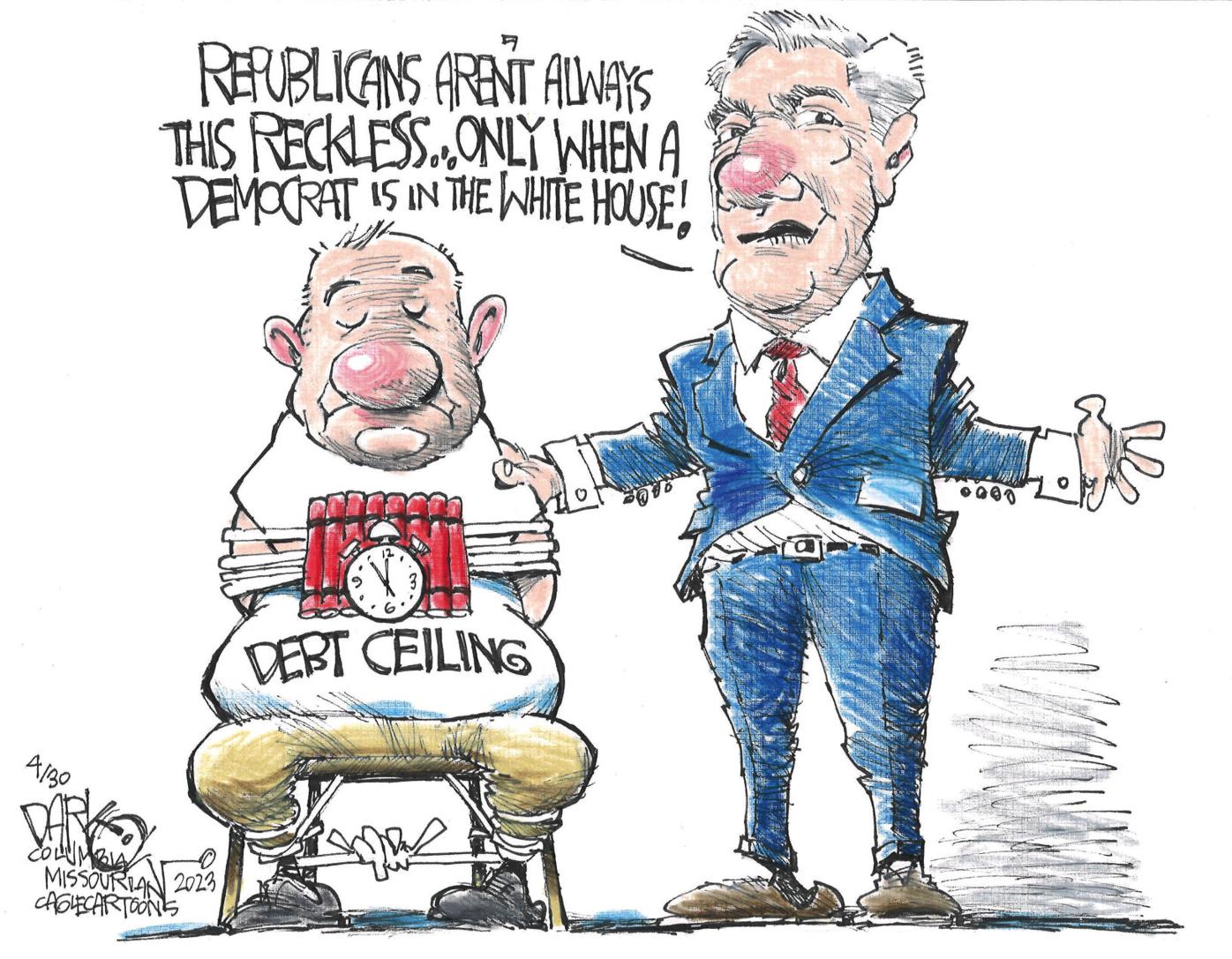
The matter was not “worsened” by political infighting. The matter was entirely political infighting. As you will see, that was the sole reason for the downgrade.Editorial Cartoon: John Darkow (May 3, 2023) | Opinion | yakimaherald.com

Per the agency’s official statement, a “steady deterioration” in standards of governance during the past two decades imposes a dark cloud as policymakers struggle to navigate the extraordinarily difficult post-pandemic environment.

Specifically, “[t]he repeated debt-limit political standoffs and last-minute resolutions have eroded confidence in fiscal management.”

“Standards of governance” is the polite way to say that the GOP has become Trump-nuts, with such stellar brains as Matt Gaetz, Marjorie Taylor Greene, Lauren Boebert, Marsha Blackburn, et al leading the way. Really, would you lend to those people? The debt limit is 100% political. It is how the party not holding the Presidency exerts political power over the competing party. It has no other purpose.

As well, the combination of economic shocks and initiatives involving tax cuts and spending programs spiked the overall debt load.

Tax cuts and spending programs are irrelevant to the federal government’s ability to pay all its dollar debts. Even if the total “debt,” which stands at about $30 trillion, were instead only $1, that would have no effect on the federal government’s ability to pay. As the creator and issuer of the U.S. dollar (aka Monetarily Sovereign), the government has the infinite ability to create enough dollars to pay all its dollar-denominated debts. If, for instance, you sent a $50 trillion, or $100 trillion, invoice to the U.S. government today, it could pay that invoice today simply by passing laws and pressing computer keys.

Alan Greenspan: “A government cannot become insolvent with respect to obligations in its own currency.

Alan Greenspan: “There is nothing to prevent the federal government from creating as much money as it wants and paying it to somebody.”

Alan Greenspan: “The United States can pay any debt it has because we can always print the money to do that.”

Ben Bernanke: “The U.S. government has a technology, called a printing press (or, today, its electronic equivalent), that allows it to produce as many U.S. dollars as it wishes at essentially no cost.”

Quote from former Fed Chairman Ben Bernanke when he was on 60 Minutes: Scott Pelley: Is that tax money that the Fed is spending? Ben Bernanke: It’s not tax money… We simply use the computer to mark up the size of the account.

Statement from the St. Louis Fed: “As the sole manufacturer of dollars, whose debt is denominated in dollars, the U.S. government can never become insolvent, i.e., unable to pay its bills. In this sense, the government is not dependent on credit markets to remain operational.”

This infinite power is true not only of the U.S. federal government but also other Monetarily Sovereign entities. Consider the European Union, which is monetarily sovereign over the euro:

Question: I am wondering: can the ECB ever run out of money? Mario Draghi: Technically, no. We cannot run out of money.

No Monetarily Sovereign entity can run short of its sovereign currency unless it wishes to. Some elements of today’s Republican Party would like to see the U.S. economy fail, so they can claim, before elections, that the economic failure is the Democrat’s fault.

In addition, Fitch took into account the Federal Reserve’s efforts in combating historically high inflation into account regarding its latest credit rating decision.

“While headline inflation fell to 3% in June, core PCE inflation, the Fed’s key price index, remained stubbornly high at 4.1% yoy,” wrote the agency. As a result, this framework will likely preclude benchmark interest rate cuts until March of next year.

All inflations are caused by shortages of crucial goods and services, most often oil and food. So-called “core inflation” refers to this:

“Inflation is based on the consumer price index (CPI), covering the inflation of all the goods and services except the volatile food & fuel prices, excise duties, income tax, and other financial investments.

It guides the government in forecasting long-term inflation trends for a country.

Using “core inflation” as a forecasting tool is nonsensical because the primary causes of inflation are those “food & fuel prices, excise duties, income tax, and other financial investments.” It’s like predicting a baseball team’s wins while omitting runs-scored-and-allowed to get “core victories.”

In a possible reality check, the Fitch downgrade also incorporated recession risks. Based on the aforementioned tighter credit condition and a projected consumer spending slowdown, the U.S. economy may slip into a mild recession in the fourth quarter of 2023 and Q1 of 2024.

The predicted “mild recession and consumer spending slowdown have absolutely nothing to do with the federal government’s ability to service its Treasury paper. Zero. The only thing that affects debt service is the federal government’s willingness to service its debt.

As The Wall Street Journal pointed out, the Fitch downgrade represents the first by a major credit rating agency in more than a decade. In theory, the unfavorable reassessment clouds the outlook for the global market for Treasurys, which stands at $25 trillion.

Indeed, the WSJ states that “America’s reputation for reliably making good on its IOUs has cast Treasury bonds in an indispensable role in global markets: a safe-haven security offering nearly risk-free returns.”

The U.S. dollar is a safe-haven security only if the government wants it to be a safe-haven security. All those other factors — total debt, spending, inflation, taxes, etc. — are meaningless to that safe haven. There is but one question: Will the Republican party refuse, for political reasons, en masse, to authorize future payment. Period.

Treasury Secretary Janet Yellen blasted the Fitch downgrade as “arbitrary.” Yellen noted that the agency demonstrated deteriorating U.S. governance since 2018 but didn’t say anything until now. “The American economy is fundamentally strong,” she emphasized.

The downgrade was not arbitrary. The crazies have taken over the GOP, and Fitch merely is allowing for that craziness by, in effect, saying, “You have a political party that cares nothing about America’s credit rating, and instead, will do everything it can to destroy it. If I were Fitch, I too would have downgraded the U.S. credit rating, not because of any economic problems but solely because of the political situation, notably the craziness of the Trump-led GOP.

The New York Times op-ed writer and Nobel laureate Paul Krugman chimed in, calling the credit rating decision “bizarre.” Also, former Secretary of the Treasury Larry Summers, in an interview with Bloomberg, stated, “I can’t imagine any serious credit analyst is going to give this weight.”

Sorry, guys, it’s not bizarre. It’s legitimate and will continue to be legitimate so long as the Republicans are enslaved to their MAGA wing.

On paper, the credit rating falling appears rather ominous. However, Axios — while not dismissing the relevant concerns leading to the decision — stated that the Fitch downgrade is “largely symbolic.”

It’s symbolic but also a warning. If you invest in a T-bill, T-note, or T-bond, buy U.S. dollars, or sell something to the U.S., and will be paid in dollars — and if the crazies decide not to raise the so-called “debt ceiling” — you will lose money.

Also, it’s important to remember that credit rating agencies don’t always issue accurate prognostications. For instance, in October of last year, Fitch stated that it expected a mild recession to materialize in Q2 2023.

However, CNN recently reported that the economy picked up steam in Q2 “despite punishing rate hikes and still-high inflation.”

The wrong prediction of a mild recession may have been based on “core inflation,” which is irrelevant. If it was based on predicted shortages of oil and food, and those didn’t materialize, Fitch should have stated that. Bottom line: People are discouraged from buying the obligations of a crazy debtor. Wouldn’t you be? That unpredictable craziness, and not the size of the so-called “debt,” “core inflation,” or any other factor, are solely responsible for the value loss of the federal government’s full faith and credit. Eliminate the useless — no, harmful — debt limit, and/or get rid of the crazies, and the U.S. credit rating instantly will be AAA again. Rodger Malcolm Mitchell Monetary Sovereignty Twitter: @rodgermitchell Search #monetarysovereignty Facebook: Rodger Malcolm Mitchell

……………………………………………………………………..

The Sole Purpose of Government Is to Improve and Protect the Lives of the People.

MONETARY SOVEREIGNTY

GDP=FEDERAL SPENDING + NON-FEDERAL SPENDING – NET IMPORTS

People, this is not rocket science. It is so simple, even Donald Trump understands it.

GDP = FEDERAL SPENDING + NONFEDERAL SPENDING – NET IMPORTS

I. GDP = Gross Domestic Product. It is the most common measure of the U.S. economy. When people say the economy has grown, they mean GDP has grown.

A recession is usually characterized by a fall in GDP for two successive quarters.   A depression may be defined as an extreme recession that lasts three or more years or which leads to a decline in real gross domestic product (GDP) of at least 10% in a given year.

II. Federal Spending is all the spending the federal government does. It includes every dollar the government spends.

III. Nonfederal spending includes all the dollars spent in the economy by every individual, every business, and every state/local government.

IV. Net Imports is the difference between dollars spent on imports vs. dollars received for exports. Usually, we spend more on imports than we receive for exports, so just to break even, either Federal Spending or Non-federal spending must take up the slack.

However, if we break even, the economy will shrink because of inflation. So — and this is very important– for the economy to grow, government spending must grow. There is no way for the economy to grow when government spending does not grow. That is basic algebra. Now someone might say, what if federal spending doesn’t grow but nonfederal spending grows enough to overcome both Net Imports and Inflation. The problem with that hypothetical scenario is that when Federal Spending doesn’t grow, there is no way for the Non-federal sector to obtain the spending dollars that would grow the economy. In fact, not only do we have recessions and depressions when Federal Spending doesn’t grow, we even have recessions and depressions when Federal Spending grows, but too little to overcome inflation and Net Imports.

U.S. depressions come on the heels of federal surpluses.

1804-1812: U. S. Federal Debt reduced 48%. Depression began 1807. 1817-1821: U. S. Federal Debt reduced 29%. Depression began 1819. 1823-1836: U. S. Federal Debt reduced 99%. Depression began 1837. 1852-1857: U. S. Federal Debt reduced 59%. Depression began 1857. 1867-1873: U. S. Federal Debt reduced 27%. Depression began 1873. 1880-1893: U. S. Federal Debt reduced 57%. Depression began 1893. 1920-1930: U. S. Federal Debt reduced 36%. Depression began 1929. 1997-2001: U. S. Federal Debt reduced 15%. Recession began 2001.

When the money supply decreases, or even increases, but not enough, we have recessions.
Federal Spending increases the money supply. When the money supply increases, GDP increases. When the money supply decreases, we have recessions and depressions. The above graph shows the parallel paths taken by the money supply and GDP.
Again, GDP is the measure of two things. It is the measure of the economy, and it is the measure of spending. This is just simple algebra. You don’t need a degree in economics to understand it. And yet, Congress, the President, the Republican, Democratic, and especially the Libertarian Parties pretend it’s all a mystery to them because they say they don’t want Federal Spending to grow. In essence, they don’t want the economy to grow; more accurately, they want us to have recessions and depressions that affect the rich much less than they affect the rest of us. Congress, the media, and the economists all parrot the same line. They claim federal spending is “unsustainable” and should be reduced. But what makes federal spending “unsustainable”? The federal government is Monetarily Sovereign, meaning it cannot run short of U.S. dollars. The Federal government can pay any bill of any size if it’s denominated in dollars. Send the government an invoice for a trillion dollars; it could pay it tomorrow by pressing computer keys. This is not just my opinion. It is a well-known fact:

Former Federal Reserve Chairman, Alan Greenspan: “A government cannot become insolvent with respect to obligations in its own currency.”

Alan Greenspan: “There is nothing to prevent the federal government from creating as much money as it wants and paying it to somebody.”

Alan Greenspan: “The United States can pay any debt it has because we can always print the money to do that.”

Former Fed Chairman, Ben Bernanke: “The U.S. government has a technology, called a printing press (or, today, its electronic equivalent), that allows it to produce as many U.S. dollars as it wishes at essentially no cost.”

Quote from Ben Bernanke when he was on 60 Minutes: Scott Pelley: Is that tax money that the Fed is spending? Ben Bernanke: It’s not tax money… We simply use the computer to mark up the size of the account.

Despite what you’ve read and heard, not only can the government create all the dollars it needs by pressing computer keys, but it never needs to borrow dollars.

Statement from the St. Louis Fed: “As the sole manufacturer of dollars, whose debt is denominated in dollars, the U.S. government can never become insolvent, i.e., unable to pay its bills. In this sense, the government is not dependent on credit markets to remain operational.”

The words “not dependent on credit markets” means the federal government does not borrow. Those T-bills, T-notes, and T-bonds that wrongly are called “borrowing” are nothing of the sort. A borrower borrows because it needs money. The federal government doesn’t. The government merely accepts deposits into T-security accounts. It never touches those dollars. Why would it, given its infinite ability to create dollars? The purposes of T-securities are not to provide the government with spending dollars, but rather to:
  1. To provide a safe storage place for unused dollars. This helps stabilize the dollar
  2. To help the Fed control interest rates.
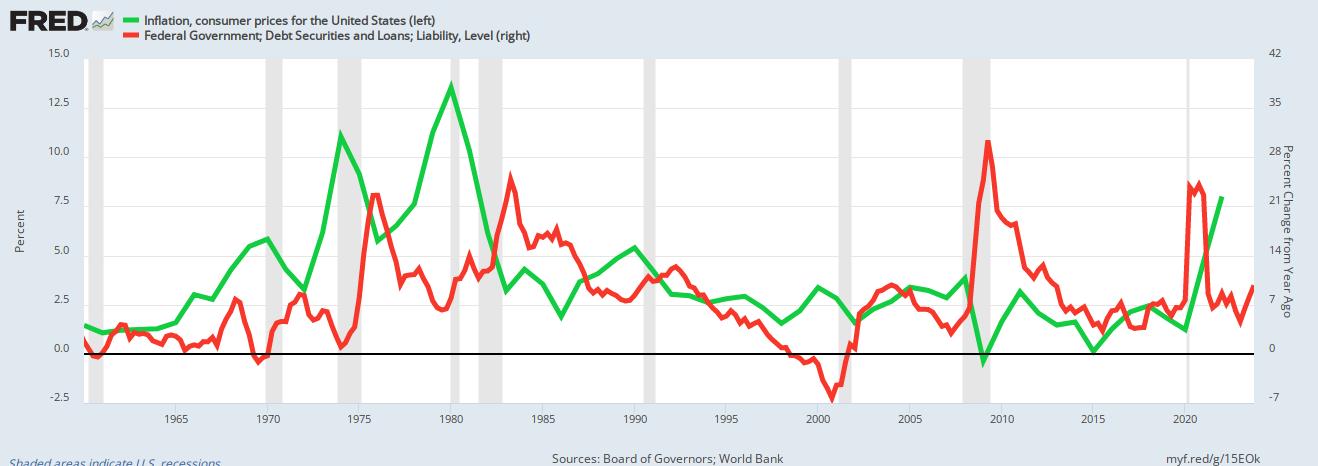
And then there is the false “inflation” claim. The mantra is that we will have inflation if the federal government prints money. Historically, that simply is not true:
If federal spending caused inflation the red spending line and the green inflation line would essentially be parallel. They are not. They move randomly with respect to one another.
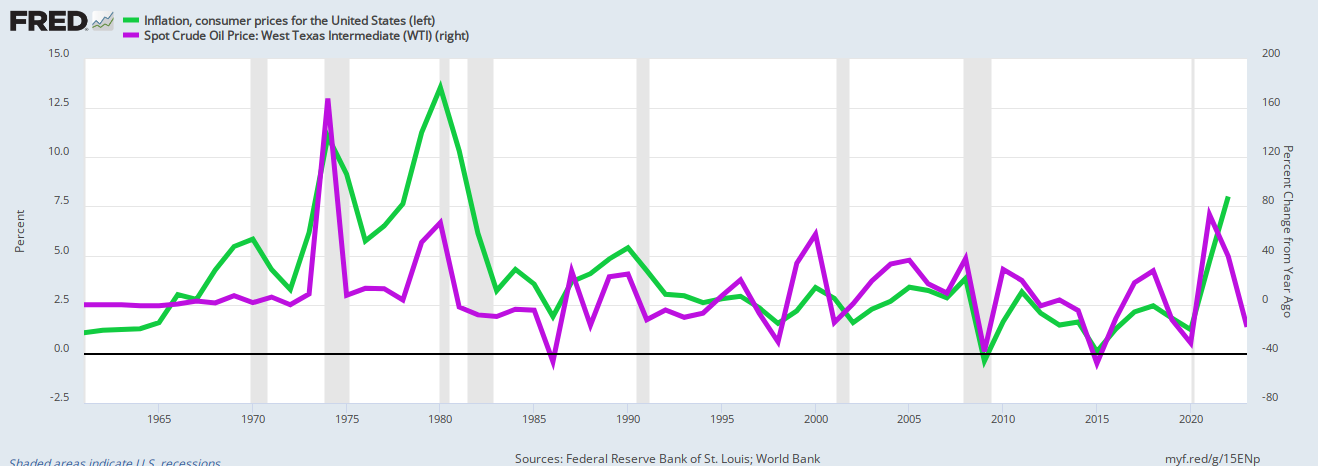
The thing that always causes prices to rise is scarcity. You know this from experience. When weather causes a shortage of oranges or apples, the price of oranges and apples goes up. When COVID creates shortages of oil, steel, lumber, computer chips, labor, etc., the price of everything goes up. We have inflation. The single most common scarcity that has caused inflation for the past few decades is the scarcity of oil:
Oil scarcity causes oil prices to rise, and because the price of oil affects the prices of almost every other product, oil scarcity causes inflation.
While federal spending does not parallel inflation, the scarcity of oil does parallel inflation. Again, none of this is rocket science, and none of it is secret. Politicians, the media, and economists all have these data. So why do they conduct these mock battles about a useless, meaningless, misleading debt ceiling? Why all the lies? Because the politicians, media, and economists have been bribed by the rich, who run America. The politicians are bribed by campaign contributions and promises of lucrative employment at think tanks. The media are bribed by advertising dollars and by straight-out ownership of the media. The economists are bribed by contributions to their universities and promises of employment in think tanks and controlled corporations. And why do the rich want the politicians, media, and economists to pretend that federal spending should be reduced? It’s because of something called “Gap Psychology.” The word “rich” is comparative, not absolute. Someone with a million dollars is poor if everyone else has ten million. Someone who has a hundred dollars is rich if everyone has one dollar. Getting richer requires acquiring more compared to everyone else. You can do this in either or both of two ways:
  1. Acquiring more for yourself and/or
  2. Making sure everyone else has less.
Gap Psychology is the human desire to distance oneself from those below you and/or to come closer to those above you on any scale of income, wealth, or power. Most people wish to become richer. This is especially true of the rich, who are driven by their insatiable desire to become even richer, i.e., distancing themselves from those below and coming closer to those above. They hate your receiving government-funded healthcare insurance. They hate food stamps, unemployment benefits, government-funded college — anything that even slightly narrows the Gap between them and those below. To distance themselves from the middle and lower quadrants, the rich do all they can to make you believe the federal government cannot afford to give you benefits. They draw false comparisons between your personal financing and federal government financing. They talk about federal “borrowing” though the government, unlike you, does not borrow dollars. They talk about the federal “credit card,” though the government uses nothing that resembles a credit card. They talk about “out-of-control” spending, though unlike you, the federal government has the infinite ability to spend. They claim federal deficit spending is “unsustainable” though the government has “sustained” deficit spending for more than 80 years — deficit spending that grew the economy from several billion dollars to thirty trillion. Here is another graph that shows the essentially parallel paths of federal spending and GDP.
Naturally, the lines essentially are parallel. Federal Spending is an integral part of GDP. It would be like a graph comparing total touchdowns with total points. The lines essentially would be parallel.
To say that federal spending is too high, unsustainable, or out-of-control — i.e., to say that federal spending should be reduced — is to say that economic growth is too high, unsustainable, out of control, and should be cut. No one believes that, not even the rich. They just want to cut the benefits you receive, not the benefits they receive. They bribe Congress to give them tax loopholes so that they, like Donald Trump, pay at a far lower rate than the average salaried person. And they spread the myth that giving the Internal Revenue Service more money will send investigators after you when the money was meant to investigate the rich. Everywhere you turn, the rich have bribed your sources of information to indoctrinate you with the belief that federal spending should be cut and taxes increased, especially the spending and taxes related to benefits for you who are not rich. The purpose of federal taxes is different from the purpose of state/local government taxes. Federal taxes do not provide spending money to the federal government, which already has infinite spending money. Federal taxes have two financial purposes plus a third purpose that should anger you:
  1. To control the economy by taxing what the government wishes to discourage and by giving tax breaks to what the government wishes to encourage
  2. To assure demand for the U.S. dollar by requiring taxes to be paid in dollars. And here is the one you’ll really hate:
  3. To help widen the income/wealth/power Gap by giving tax loopholes to the rich.
And now we have the phony “debt-limit” struggle. The Republicans (the party of the rich) demand cuts to Medicare, Medicaid, food stamps, etc., and the Democrats (pretending to be the party of the poor) fight weakly against too many cuts (just a few). And neither of them tells you the truth. The entire charade is a professional wrestling exhibition held in the halls of Congress. The bottom line is: You have been brainwashed into ignorance. Federal deficit spending is not unsustainable, nor does it cause inflation. The federal government easily could fund no-deductible, comprehensive, generous Medicare and Social Security benefits for every man, woman, and child in America, a college education for everyone who wanted it, food so that no child in America ever would need to go hungry, and decent housing for even the poorest among us. The federal government could do all that while funding the military, medical research and development, the physical sciences, renewable energy, and all the other things that would improve your life and the lives of those you love. It can be done, and it will be done, but first, you must understand the lies you are being fed and then demand, en masse, that the government does what it was formed to do. Rodger Malcolm Mitchell Monetary Sovereignty Twitter: @rodgermitchell Search #monetarysovereignty Facebook: Rodger Malcolm Mitchell

……………………………………………………………………..

The Sole Purpose of Government Is to Improve and Protect the Lives of the People.

MONETARY SOVEREIGNTY

Will Congress and the President force America to commit financial suicide?

Here is what true experts say about Monetarily Sovereign entities like the United States government and the European Union:

Alan Greenspan: “A government cannot become insolvent with respect to obligations in its own currency.”

Alan Greenspan: “There is nothing to prevent the federal government from creating as much money as it wants and paying it to somebody.”

Alan Greenspan: “The United States can pay any debt it has because we can always print the money to do that.”

Ben Bernanke: “The U.S. government has a technology, called a printing press (or, today, its electronic equivalent), that allows it to produce as many U.S. dollars as it wishes at essentially no cost.”

Quote from former Fed Chairman Ben Bernanke when he was on 60 Minutes:
Scott Pelley: Is that tax money that the Fed is spending?
Ben Bernanke: It’s not tax money… We simply use the computer to mark up the size of the account.

Statement from the St. Louis Fed:
“As the sole manufacturer of dollars, whose debt is denominated in dollars, the U.S. government can never become insolvent, i.e., unable to pay its bills. In this sense, the government is not dependent on credit markets to remain operational.”

Press Conference: Mario Draghi, President of the ECB, 9 January 2014
Question: I am wondering: can the ECB ever run out of money?
Mario Draghi: Technically, no. We cannot run out of money.

Here is what people who are ignorant of Monetary Sovereignty say:

The US treasury’s cash balance has dipped below $100bn, further ramping up the pressure on lawmakers to solve the impending national debt crisis.

Although it’s volatile (like personal bank balances often are), the treasury’s cash pile of $57.3bn, recorded last Thursday, is by far the lowest figure for more than a year — and it’s well below the $150bn minimum that the treasury reportedly likes to keep as a buffer.

The X-date Treasury Secretary Janet Yellen has said to lawmakers that the “X-date” — the date when the US can no longer guarantee its ability to pay bills— is June 1st.

If the US government does run out of money, the biggest problem is a default on its debt.

Most analysts agree that a default would lead to complete financial chaos but the reality is that it’s anyone’s guess, because it’s never happened before.

“Will someone please get me a longer rope, so I don’t have to kill myself.”

The current debt ceiling stands at a whopping $31.4 trillion, legally limiting how much the treasury can borrow.

Because the government has the infinite ability to create dollars, it never borrows dollars. Sadly, the public doesn’t comprehend that simple fact.

Talks between President Biden and Speaker Kevin McCarthy are set to resume today, as each side negotiates the latest fiscal package that would raise the limit, though both parties remain ideologically opposed on whether the new debt ceiling should come with deep cuts to, or caps on, federal spending.

The U.S. federal government has the infinite ability to pay its bills simply by pressing a computer key. It also has the infinite ability to raise the phony debt ceiling, which it already has done 94 times.

The spending that resulted in the current debt had been authorized by previous Congresses and previous Presidents. The current Republican House essentially is saying, “Even though the money already is spent, by both Democratic and Republican Congresses and Presidents — and even though we have infinite money to pay our bills —  we aren’t going to pay what we owe.”

Sounds like something six-times-bankrupt Donald Trump would do. Despite being a billionaire, he has cheated many creditors, and now his party threatens to do what he has called “smart business.”

This is exactly what the 14th Amendment was written to stop.

(“The validity of the public debt of the United States, authorized by law, including debts incurred for payment of pensions and bounties for services in suppressing insurrection or rebellion, shall not be questioned.”)

Now, the party of the biggest crook in Presidential history threatens to cheat our creditors unless the current President yields to their demands to raise your taxes (though not the taxes of the very rich) or to cut your benenfits (though not the benefits of the very rich).

Ironically, if President Biden invokes the 14th Amendment, the party that wants to cheat our creditors will claim that this is cheating the Constitution.

The question is, will the Democrats follow the Constitution and end the ridiculous “debt ceiling,” once and for all.

Then, we can leave it up to the right-wing SCOTUS, beholden to the “party-of-law-and-order,” to wriggle a way to claim that the Constitution really doesn’t say what it says.

Hey, they did it for the 2nd Amendment with regard to well-regulated militias; why not the 14th? 

Rodger Malcolm Mitchell
Monetary Sovereignty

Twitter: @rodgermitchell Search #monetarysovereignty
Facebook: Rodger Malcolm Mitchell

……………………………………………………………………..

The Sole Purpose of Government Is to Improve and Protect the Lives of the People.

MONETARY SOVEREIGNTY