–Nonsense from the Committee for a Responsible Federal Budget

An alternative to popular faith

Demonstrating the bankruptcy of the typical debt-hawk position, here are excerpts from a long Email I just received from the Committee for a Responsible Federal Budget, a leading anti-debt advocate.

The current fiscal path of the United States government is unsustainable. For the past forty years, our debt-to-GDP ratio has averaged around 40 percent. This year, it is projected to exceed 60 percent, the highest point since the early 1950s. […] By the end of the decade, debt is projected to be 90 percent of GDP, approaching our record high of around 110 percent after World War II. Things will deteriorate further as the Baby Boom retirement accelerates. Ten years later, the debt is expected to be well over 150 percent of GDP. By 2050, it is projected to be over 300 percent and still heading upward.Though they claim the “fiscal path is unsustainable,” they project all the way to 2050. The lowest (since WWII) Debt/GDP ratio of about 35% came 70 years earlier, at 1979-1980, the end of the Carter administration, which also was the time of the highest inflation


Deficits vs inflation thru 09

[…]It is not at all clear how exactly such a crisis would unfold – what would prompt it or how it would play out. A crisis could occur as soon as this year, or decades from now. It could begin inside or outside the country. The crisis could be dramatic or gradual. It could come from an economic or another financial shock, or even a political surprise.In short, “We don’t know when; we don’t know how; and we don’t know what. Otherwise, we’re sure.”

Experts agree that we will be in a crisis when we can no longer service our debt obligations. However, we will probably never face this scenario.This is the first time I ever have heard a debt hawk make this admission, which the author repeatedly forgets, later in the Email.

There are a number of different crisis scenarios: Scenario 1: The Gradual Crisis – We stay the current course and try to muddle through. Our massive borrowing leads to less capital available for productive private investment, which lowers economic growth.Federal deficit spending adds money to the economy. There is no mechanism by which added money can reduce the supply of capital.

Increasing debt service payments – particularly when interest rates return to normal – squeeze out other areas of the budget. The steady crowding out of government spending on programs that boost the economy, such as spending for education, infrastructure and innovation, will hurt our competitiveness.This crowding out only can happen in a debt-hawk world, where deficits are restricted, either by tax increases or by reduced spending – a self-fulfilling prophecy.

Scenario 2: The Political Risk Crisis – Political calculations trump risk threats. […] As a result, more budget resources are shifted from children to seniors, and from investment in programs boosting future growth. […] creditors lose confidence in U.S. fiscal management. Our creditors increasingly demand large risk premiums on purchases of their debt, sharply lower their purchases of our debt, or, in the worst case, stop buying our debt if the shift occurs suddenly. Credit ratings agencies lower our sovereign credit rating.This neglects the simple fact that since the end of the gold standard, in 1971, the federal government no longer has needed to borrow its own money. Rather than borrowing by creating T-securities out of thin air, then selling them, the government can and should create money directly, and omit the borrowing step.

Scenario 3: Catastrophic Budget Failure – An abrupt crisis occurs. […] at some point financial markets or foreign lenders decide we are no longer a good credit risk, possibly due to debt affordability concerns.Debt affordability? Didn’t you just say,” Experts agree that we will be in a crisis when we can no longer service our debt obligations. However, we will probably never face this scenario.”

“[Creditors] stop buying our debt securities or demand dramatically higher interest rates due to increased perceived risk. […] In the extreme case, the U.S. may not be able to borrow at any interest rate.” Creditors concerned with hyperinflation or even default will not buy U.S. debt.” As we said, the U.S. no longer needs to sell debt. Issuance of Treasury securities could end today, and this would not change by even on penny, the government’s ability to spend.

“Scenario 4: Inflation Crisis – Higher debt is managed through inflation. […] Under strong political pressure, the Fed […] does not raise interest rates despite signs of increasing inflationary pressures. […] Fiscal consolidation will require spending cuts that will hurt safety net programs. Business investment incentives will disappear and tax rates will rise, as policymakers search for revenue. Household taxes rise and government services are reduced.Wait. Isn’t that exactly what you are preaching – spending cuts and tax increases?

Scenario 5: External Crisis -A dollar or trade crisis leads to a fiscal crisis. When the economy recovers in a few years, our current account deficit (which had narrowed during the recession) resumes widening to record levels. […] Capital inflows slow abruptly as investors see better risk-return opportunities elsewhere, decide the risks of the U.S. market are too high […] A sudden stop in lending lowers the dollar, increases inflation and interest rates[…]A widening of the current account deficit means dollars leave the U.S., which if anything, would be anti inflationary.

Scenario 6: Default Crisis – A series of events lead to a default.Once again, you already have said the U.S. will not default.

“[…] Our need to pay higher interest rates increases debt service and crowds out public and private spending. […]Higher interest rates increase the amount of money in the economy which facilitates private spending.

[…}A new administration defaults or attempts to renegotiate our debts. Burned creditors stop buying U.S. debt or demand onerous interest premiums.[…]Again, defaults? You’ve already discussed this impossibility.

Countries that have sufficient domestic savings to finance their debt are less vulnerable than those that must attract considerable foreign capital – such as the United States.Totally false. The U.S. does not service its debt with savings. It creates money, ad hoc, to pay its debts.

“[…] Our large trade deficit outlook is considered unsustainable and a likely crisis flash point.”You already have admitted U.S. has the unlimited ability to service its debts. So what do you mean by “unsustainable”?.

Some top economists argue that the U.S. can “afford” even more debt awhile longer because its debt service will still remain quite manageable. They also expect that the United States can avoid adjustment longer than fiscal policy norms might suggest because the dollar is the world’s reserve currency.The debt service is manageable, not because the dollar is the world’s reserve currency, but rather because the government has the unlimited ability to pay its bills, and does not need to borrow.

“While certain countries are often cited to show that high sovereign debt ratios can be sustained without crisis (Italy, Belgium, Japan now), these countries – unlike the United States – can finance their debt through their substantial domestic savings.Government debt is not financed through private savings. You and I do not pay federal debt with our savings.

Many governments facing similar circumstances to the United States over the next generation have tried to avoid fiscal adjustment by running higher inflation to reduce their debt burden. Though appealing, this strategy hurts the economy and its citizens (particularly those on a fixed income).There ever is a reason for a sovereign nation, in control of its money, to reduce its debt through inflation.

The entire premise of the Committee for a Responsible Federal Budget is that buyers of T-securities control the fate of the U.S., when in fact, the U.S., as the creator of dollars, no longer needs anyone to buy T-securities. This lack of understanding would be amusing were it not for the fact that the government acts on these beliefs.

One of the reasons we have been so slow to exit recession, is the government’s timid stimulus responses. The too little / too late, initial $150 per person mailing two years ago was restricted by debt fear. A $1,000-$2,000 per person mailing at that time, would have ended the recession.

Rodger Malcolm Mitchell
http://www.rodgermitchell.com

–Fiscal Sustainability Teach-In and Conference

Mainstream economics has led us to an average of one recession every five years. People have been fed obsolete hypotheses for so long and so often, we now have knee-jerk agreement among the media, the politicians and some economists.

But deficits neither are normal nor inevitable. Many prominent economists have discovered a better way to foster economic growth. They will host a conference to discuss their ideas, and you are invited.
==================================================================

April 28th: Fiscal Sustainability Teach-In and Conference
________________
“The Fiscal Sustainability Teach-In Conference will be the important event in Washington on April 28. This will feature important work by honest scholars. It deserves (your)attention, and […] respect.”
— James K. Galbraith, The University of Texas at Austin. [April 19, 2010 via email with permission]
________________
The deficit hawks are at it again: attacking Social Security and Medicare with obsolete economic notions. We offer a counter-narrative to the false but conventional notion that Federal deficit spending is harmful, that it is a burden to the next generation, that deficit spending risks insolvency — basically that the Federal Government Budget is some how analogous to a household budget when, in fact, it is quite different.

The Teach-In Conference on Fiscal Sustainability on April 28th, 2010 in Washington, DC aims to do just that with some real world, honest economics.

We can move beyond the false economic orthodoxy that got us into the current economic mess and that is now being promoted to attack Social Security and Medicare — and harming our nation and it’s people. You can participate.

The tentative program schedule: Interesting topics and excellent presenters as of 04/16/10:

8:30–8:45 AM Welcoming Remarks
8:45–10:15 AM What Is Fiscal Sustainability? Bill Mitchell, Research Professor in Economics and Director of the Centre of Full Employment and Equity (CofFEE), at the University of Newcastle, NSW Australia, and blogger at billy blog

10:15–10:30 AM BREAK
10:30 AM–12:00 PM Are There Spending Constraints on Governments Sovereign in their Currency? Stephanie Kelton, Associate Professor of Macroeconomics, Finance, and Money and Banking, Research Scholar at The Center for Full Employment and Price Stability (CFEPS), University of Missouri – Kansas City, Research Associate at The Levy Economics Institute of Bard College, and blogger at New Economics Perspectives

12:00–12:15 PM BREAK
12:15–1:45 PM The Deficit, the Debt, the Debt-To-GDP ratio, the Grandchildren and Government Economic Policy Warren Mosler, International Consulting Economist, Independent Candidate for the US Senate in Connecticut, and blogger atmoslereconomics.com

1:45–2:00 PM BREAK
2:00–3:15 PM Inflation and Hyper-inflation Marshall Auerback, International Consulting Economist, blogger at New Deal 2.0 and New Economic Perspectives, and Mat Forstater, Professor of Economics, Director of CFEPS, Department of Economics, University of Missouri — Kansas City, Research Associate at The Levy Economics Institute of Bard College, and blogger at New Economic Perspectives

3:15–3:30 PM BREAK
3:30–5:00 PM Policy Proposals for Fiscal Sustainability L. Randall Wray, Professor of Economics, Director of CFEPS at the University of Missouri – Kansas City, and Senior Scholar at The Levy Economics Institute of Bard College; and Pavlina Tcherneva, Assistant Professor of Economics at Franklin and Marshall College, Senior Research Associate at CFEPS and Research Associate at The Levy Economics Institute of Bard College and bloggers at New Economic Perspectives

How you can participate:
1. Contribute to the cost of the Conference — Please click below and make a donation of $50 (or more if you want) to show support. It’s about strength in numbers (the entire budget is under $10,000).
Make Donation
2. Attend the Teach-In — watch these pages for location and other logistical information
3. Spread the word — write a blog post, talk with your friends.
4. Educate yourself — some great introductory resources are:
o Teaching the Fallacy of Composition: The Federal Budget Deficit, by L. Randall Wray
o Fiscal sustainability 101, by William Mitchell
o 7 Deadly Innocent Frauds, by Warren Mosler
o In Defense of Deficits, by James K. Galbraith
o A Quick Summary, by Rodger Malcolm Mitchell

Please do what you can to help bring the truth to light. Deficits are not normal. Social Security and Medicare can survive without benefit cuts.

Every little bit helps. Thank you.
________________
Rodger Malcolm Mitchell
http://www.rodgermitchell.com


.
.

–Federal deficit spending doesn’t cause inflation; oil does

An alternative to popular faith

Ask a debt hawk why he hates federal deficits and he will give you four main reasons:

1. Federal debt must be paid back by taxpayers. (But, because the federal government has the unlimited power to create the money to pay its bills, taxpayers do not fund federal spending.)

2. Federal debt adds to the government’s interest-paying burden. (Again, interest is no burden to a entity having the unlimited ability to create money.)

3. Federal debt uses up lending funds that otherwise would go to private needs. (But, federal spending adds money to the economy, making more, not less, funds available for private lending.)

4. By increasing the money supply, federal deficits reduce the value of money, thereby causing inflation. Readers of this blog have seen the graph (below) which shows no relationship between federal deficits — even large federal deficits — and inflation.

Note how the peaks and valleys of deficit growth do not match the peaks and valleys of inflation growth:

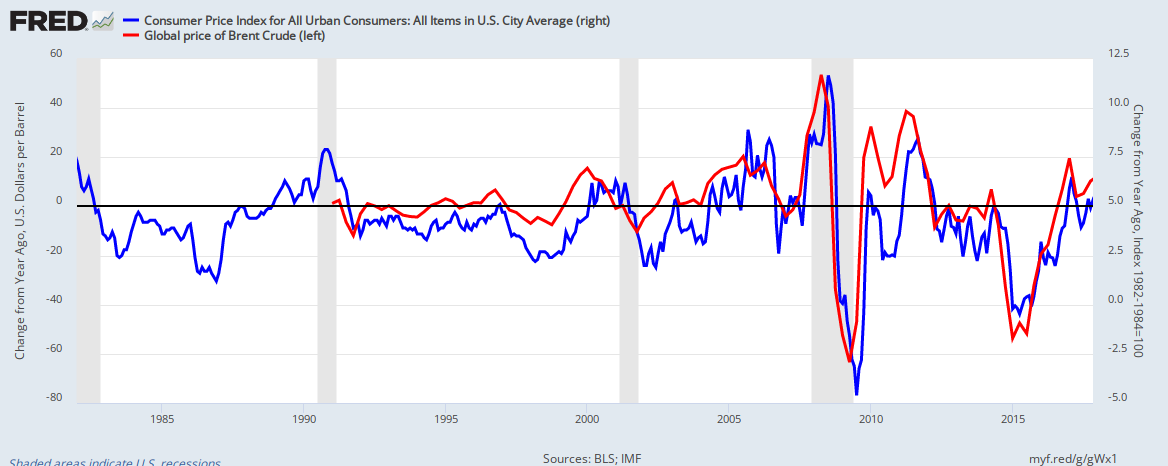
If deficits don’t cause inflation, what does? In a previous post “Is inflation too much money chasing too few goods”, we answered that question (“No.”), and we presented a graph indicating the real cause of inflation may be energy prices, more specifically, oil prices. See below:

The extreme movements of energy prices corresponding with the more modest movement of overall inflation, seem to indicate that energy costs “pull” inflation in either direction.

We can see this parallelism better by magnifing the CPI movement with a different vertical axis:

Monetary Sovereignty

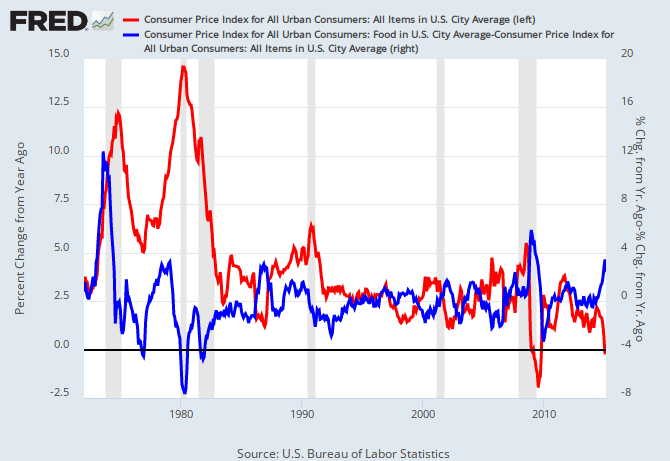
Now here is another graph that may substantiate the hypothesis that energy prices pull CPI:

monetary sovereignty

It compares inflation movements (red line) with the movement of energy prices less the movement of inflation (blue line). Notice how closely the two lines correspond.

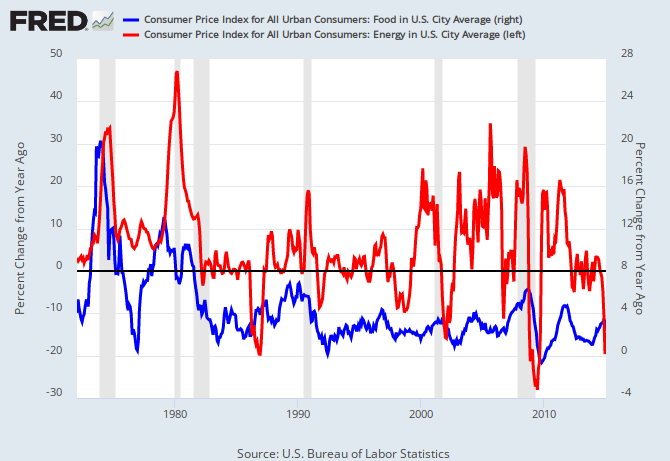
Compare that graph with the graph below. This graph is the same as the one above, except rather than comparing energy price changes with inflation, it compares food price changes. See how there is much less correlation.

monetary sovereignty

Food price changes do not seem to be the key inflation-causing factor. In fact, energy price changes seem to cause food price changes:

monetary sovereignty

Inflations are not caused by too much money. Inflations are caused by shortages.

Energy, and more specifically oil is, aside from food and water, the one universal need. It is the only commodity, the shortage of which, affects the prices of all other goods and services.

Rodger Malcolm Mitchell
http://www.rodgermitchell.com

No nation can tax itself into prosperity. Those who say the stimulus “didn’t work” remind me of the guy whose house is on fire. A neighbor runs with a garden hose and starts spraying, but the fire continues. The neighbor wants to call the fire department, which would bring the big hoses, but the guy says, “Don’t call. As you can see, water doesn’t put out fires.”

–Et tu, Wall Street Journal?

An alternative to popular faith

The average person doesn’t understand the difference between federal government finances, state government finances and personal finances. The same could be said of most politicians and most editorial writers.

But one expects more of the Wall Street Journal, whose editors are, after all, immersed in finance all day long. So it was saddening to read WSJ’s March 1, 2010 editorial titled “Back to the ObamaCare Future.”

The editorial begins, “Natural experiments are rare in politics, but few are as instructive for ObamaCare that Massachusetts set in motion in 2006.” Do you detect the problem? The WSJ thinks a state-run, health-care program provides a learning template for a federally run program, despite the crucial differences in ability to fund programs. (States’ access to money is limited; the federal government’s access is unlimited.)

The WSJ properly criticizes Governor Deval Patrick for wanting to set hospital and doctor rates. Why does the governor want to do that? So he can cut the rates. You see, the Massachusetts program is running a deficit (of course), so rather than committing political suicide by raising taxes, the governor wants to assure worse health care by discouraging doctors and hospitals from operating profitably in his fair state.

The editorial continues, “The administered prices of Medicare and Medicaid already shift costs to private patients, while below-cost reimbursement creates balance-sheet havoc among providers.” Yes, that’s right. Medicare pays too little, which forces our most talented doctors into boutique programs, where annual fees run anywhere from $50 to $5,000 (or more?) Eventually all the best doctors will be unaffordable to the very people Medicare is supposed to help. And smaller hospitals will disappear. This because of federal price controls.

The editorial continues, “It doesn’t even count as irony that former Governor Mitt Romney (like President Obama) sold this plan as a way to control spending.” Sure, states need to control costs, but why doesn’t President Obama understand the difference between state spending and federal spending?

Let’s see if we can clarify the difference: Taxpayers pay for state spending. Taxpayers do not pay for federal spending. Can I make it any simpler?

Because states do not have the power to create unlimited amounts of money, they must rely on taxes and borrowing. Eventually, the ability to borrow runs out, and everything falls on the taxpayer. Ultimately, there is a direct relationship between state taxes and state spending.

The federal government does have the power to create unlimited amounts of money, and so does not need to rely on taxes. It does not even need to borrow (See: https://rodgermmitchell.wordpress.com/2009/09/10/it-isnt-taxpayers-money/)

The biggest problem with Medicare (and Social Security, for that matter) is that it’s limited by FICA collections. Medicare is a version of federal price controls, which WSJ properly criticizes. Government price controls always are damaging. As WSJ said, “. . . hospital rate setting in the 1970s and 1980s . . . didn’t control costs . . . and it killed people.”

If government medical rate setting doesn’t work, and in fact kills people, please tell me again how the universal health care plan is designed to save money.

And if the federal government has the unlimited ability to create money, without ever charging the taxpayer, please tell me again why the universal health care plan is designed to save money.

Oh, the unnecessary damage the debt hawks have caused — not just financial damage, but human damage — and all for refusing to acknowledge that federal deficits not only are beneficial, but necessary for a growing economy.

Rodger Malcolm Mitchell
http://www.rodgermitchell.com