–Anthropomorphic economics disease

An alternative to popular faith

Fundamental to debt hawk beliefs is the idea that monetarily sovereign nations are like you and me. Thus, debt hawks practice “anthropomorphic economics.”

A monetarily sovereign nation is the monopoly supplier of its currency, which currency is not tied to any asset (like gold) or to a foreign currency. A monetarily sovereign nation has the unlimited ability, and the monopoly power, to create its currency.

The U.S., Canada, Australia, China and India are monetarily sovereign. The EU nations are not. That is why so many of the comparisons between Greece and the U.S. are false.

Specifically, here are a few of the assumptions debt hawks have about the U.S. — assumptions that might be correct for individuals, but not for the U.S.

1. The U.S. government must borrow or tax in order to spend.
You and I must obtain money, either by borrowing or by income, before we spend. The reverse is true for the U.S. government. U.S. spending creates money. So-called federal “borrowing” is not like personal borrowing. The U.S. creates T-securities from thin air, then exchanges them for dollars it previously created from thin air. Then it destroys the dollars. When the government repays its ‘debt,” the situation is reversed. It creates dollars, which are exchanged for T-securities, and the T-securities are destroyed. The whole process became obsolete in 1971.

2. Servicing the federal debt is a burden on the U.S.
Because the U.S. pays all its bills by creating money ad hoc, paying its debts never is a burden. Unlike you and me, the government simply credits the bank accounts of its creditors and debits its own balance sheet, which it can do endlessly. The “debt” carried on the government balance sheet is an accounting of the T-securities created by the government. Rather than “debt,” this balance sheet entry should be called “T-securities open.”

3. Federal debt is a burden on future taxpayers
Unlike you and me, the government does neither needs nor uses income in order to spend. There is no relationship between federal taxes and spending. Even were taxes dropped to zero or raised to $100 trillion, neither event would affect the federal government’s ability to spend by one penny. In fact, tax money is destroyed upon receipt, as a credit in a government balance sheet. The government does not spend tax money.

4. Federal surpluses are more prudent than deficits
For you and me, net income is more prudent than net outgo. Not so for the U.S. government. Federal taxes destroy money; federal spending creates money. To grow, an economy must have a growing supply of money. Federal spending is the most reliable, controllable source of money. Federal surpluses are imprudent, because by destroying money, they create recessions and depressions.

5. If U.S. debt is “too big,” nations will refuse to lend to us.
A credit rating is based on the past and future ability and willingness to service debt. You and I need a good credit rating in order to borrow. But, the federal debt has grown 1500% in only 30 years, and no nation has refused to buy our T-securities (not that it would matter, because we no longer need to sell T-securities).

Debt hawks have made the intuitive argument that federal debt is like personal debt – anthropomorphic economics – but are unable to supply data to substantiate their intuition. One person told me the proof is that costs have risen (inflation) and the federal debt also has risen, therefore federal debt must cause inflation. The problem with this cause-effect conclusion is that through time, many things in addition to debt have risen: population, real GDP, the miles of paved roads, satellites in orbit, M3, the number of schools in the Big Ten, the number of cell phones and the years since the Cubs won the World Series. For example:
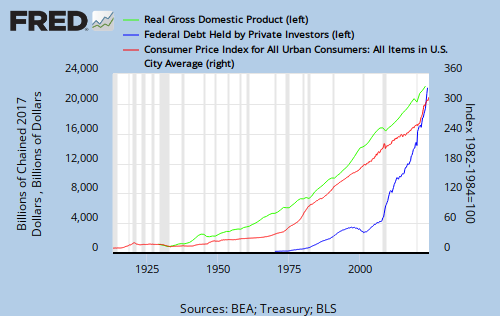
rising thingsGRAPH

If federal debt caused inflation, we would expect to see greater inflation when deficits are greater and less inflation when deficits are smaller. But, as we have seen at INFLATION there is no historical relationship between deficits and inflation.

In short, debt hawks suffer from anthropomorphic economic disease, the unsubstantiated intuition that the federal government’s finances are like personal finances, where debt must be minimized and spending must follow the acquisition of money.

As I have so often in the past, I again suggest you write to one of the debt hawk web sites – Concord Coalition, the Committee For A Responsible Federal Budget et al – and ask for data to substantiate their claim that federal debt has an adverse effect on our economy. In the unlikely event they answer you, they will supply data showing the debt is large and growing, but no data showing it hurts then economy. The reason: No such data exists. Growing federal debt is economically necessary.

Rodger Malcolm Mitchell
http://www.rodgermitchell.com

No nation can tax itself into prosperity

–How the debt hawks will destroy the U.K.

An alternative to popular faith

Cameron Warns Britons of ‘Decades’ of Austerity
By SARAH LYALL, Published: June 7, 2010

LONDON — Prime Minister David Cameron said Monday that Britain’s financial situation was “even worse than we thought” and that the country would have to make savage spending cuts to bring its swelling deficit under control.

Stern and grim-faced in a speech in Milton Keynes, just north of London, Mr. Cameron said, “How we deal with these things will affect our economy, our society — indeed our whole way of life. The decisions we make will affect every single person in our country,” he said. “And the effects of those decisions will stay with us for years, perhaps decades, to come.
[…]
Dave Prentis, the general secretary of Unison, a union that represents many public service workers, nonetheless told the Press Association news agency that Mr. Cameron’s speech was “a chilling attack on the public sector, public sector workers, the poor, the sick and the vulnerable, and a warning that their way of life will change.”
[…]
“Nothing illustrates better the total irresponsibility of the last government’s approach than the fact that they kept ratcheting up unaffordable government spending even when the economy was shrinking,” Cameron said.
[…]
As a cautionary tale, he mentioned Greece, where profligate spending led to a huge budget deficit and eventually a downgrading on financial markets.

While Britain’s economic position is stronger than that of Greece, he said, “Greece stands as a warning of what happens to countries that lose their credibility, or whose governments pretend that difficult decisions can be avoided.”

—————————————————————————————————————————————————————————

The U.K. was smart not to lose control over their money. They remain monetarily sovereign. Unlike the euro-using nations, the U.K. can create their money at will. But suddenly, they have forgotten why they didn’t switch to the euro.

Now, the debt hawks have the U.K. preparing for “decades of austerity” (aka, decades of poverty), as they falsely compare themselves to Greece. Wake up, U.K. You aren’t like Greece and you don’t need to choose poverty.

Mr. Cameron said, “. . . if you start with a large structural deficit, ramping up spending even further is likely to undermine confidence and investment, not encourage it.” This is as false a statement as it’s possible to make. I challenge Mr. Cameron to explain how government spending, which is the way government adds money to the economy, can reduce investment or economic growth. It simply is total nonsense.

It’s difficult to imagine why an otherwise intelligent people intentionally will subject themselves to decades of misery based on a foolish belief that not only is unproven, but factually has been proven wrong on many levels. While some of the same ignorance exists in the U.S., we only can pray it does not reach the extreme levels of utter stupidity it apparently has reached in the U.K.

Rodger Malcolm Mitchell
http://www.rodgermitchell.com

No nation can tax itself into prosperity

–Committee For A Responsible Federal Budget

An alternative to popular faith

On May 19th, I received the following Email from the Committee For A Responsible Federal Budget:

Dear friend, I am excited to share with you the latest CRFB initiative that I believe will quickly become a critical tool in educating the public regarding the fiscal outlook and motivating policymakers to take responsible action to put the country on a sustainable course. Today, we are publicly launching our “Stabilize the Debt” budget simulator (http://crfb.org/stabilizethedebt/).

“The ‘Stabilize the Debt’ challenge continues CRFB’s distinguished tradition of engaging policymakers, opinion leaders, the media, and the public in deliberating and discussing what it takes to be fiscally responsible. This new online endeavor is part of our long tradition of developing timely “Exercise in Hard Choices” exercises, and we are excited about our newest version.
[…]
“‘Stabilize the Debt’ challenges the user to think about reducing the debt in the longer term and maintaining it at a sustainable level, as opposed to simply balancing the budget for a single year. It promotes thinking about the need for both medium- and long-term term fiscal goals and how to attain them. It uses the goals from the Peterson-Pew Commission on Budget Reform from the Red Ink Rising report of stabilizing the debt at 60 percent of GDP by 2018 and keeping it low.

“I encourage you to take the challenge and share with all your friends. Since Congress appears unlikely to produce a budget this year and have the needed debate over fiscal priorities, this simulator can fill that void by enabling Americans to discover and discuss the difficult choices that must be made and engage in a nationwide dialogue on how best to put the country on a sound fiscal course. Sincerely, Maya MacGuineas, CRFB President

“For press inquiries, please contact Kate Brown at (202) 596-3365 or brown@newamerica.net.”
———————————————————————————————————————————————
Not having had Ms. MacGuineas’s Email address at the time, I wrote the following letter to Ms. Brown on May 19th. And again on May 20th. And May 24th. And May 27th. To date, no answer, which is normal for all debt hawk organizations. Knowing they have no data to support their claims, they simply ignore requests for data, even when, as you’ll see, I offered to promulgate their beliefs:

———————————————————————————————————————————————-

“Ms. Brown,

If you can supply historical, statistical evidence that the U.S. federal debt and deficit need to be reduced or are not sustainable, or that the federal debt needs to be stabilized at “60 percent of GDP by 2018,” I would be glad to post this data on my web site, https://rodgermmitchell.wordpress.com. I also will mail this information to my list of 100+ economics professors, 50 newspaper and magazine columnists, and 30 newspaper and magazine editors around the country.

Rodger Malcolm Mitchell”
————————————————————————————————————————————————-

Try it yourself. Write to any debt hawk organization or any debt hawk politician or economist, and ask for data to support the idea that the debt is too large. In the unlikely event you receive anything that constitutes evidence, please forward it to me.

Subsequently, I did find Maya MacGuineas’s Email address and wrote to her and Ms. Brown. For your interest, here is a calendar of my requests to supply evidence and my offer to send this evidence to economists and the media all over America:
May 19: Wrote to Ms. Brown
May 20: Wrote to Ms. Brown
May 24: Wrote to Ms. Brown
May 27: Wrote to Ms. Brown
May 28: Wrote to Ms. Brown & Ms. MacGuineas
June 1: Wrote to Ms. MacGuineas

Rodger Malcolm Mitchell
http://www.rodgermitchell.com

No nation can tax itself into prosperity

–What can save California?

An alternative to popular faith

California is broke and billions in debt. It’s unlikely California can pay its debts with tax increases and/or spending cuts, either of which could destroy the state’s economy. Tax increases and spending cuts always cause national recessions; the same would likely happen to California.

The best solution for California, and for all the other states in financial trouble, is to have the federal government step in with the necessary billions, which it easily could do. The government merely would credit California’s checking account at the Federal Reserve Bank, and debit its own balance sheet — a step it can take as easily, as repeatedly and as endlessly as the Rose Bowl scoreboard changing a score.

However, that won’t happen under current circumstances. The debt hawk belief that federal deficits are a problem, makes such support politically toxic. There are, however, two events which could force the federal government’s hand: Bankruptcy or disaster.

If California were to announce it planned to declare bankruptcy, businesses world wide would be threatened with ruin. Remember, California is one of the largest “nations” in the world — reputedly the 8th largest ( CALIFORNIA ) ahead of Russia and Spain. The federal government could not ignore such a threat, and would have to pay some or all of the bills, by a direct infusion of money.

Or, it could delay the inevitable, by lending California money ala Greece. (Loans to GM and Chrysler et al do not provide a model, because California cannot lop off large sections of its business and turn away from its citizens as companies can. So such loans, or even loan guarantees, just would put California deeper in debt.)

The other “solution” for California, though having terrible human consequences, would be to undergo a sufficiently large disaster, the most likely being a huge Los Angeles, earthquake, perhaps in the 8.0+ range. The government would declare LA County, perhaps even Southern California, a disaster area, and step in with the billions necessary to rebuild. Many of those billions would spread around the state, allowing the economy to recover.

Yes, FEMA didn’t rebuild New Orleans as it should have, but Louisiana doesn’t have California’s political clout, with only 9 electoral college votes compared to California’s 55.

I don’t know whether Governor Schwarzenegger has begged hard enough for federal support. Perhaps he is waiting for “the Big One.”

Rodger Malcolm Mitchell
http://www.rodgermitchell.com

No nation can tax itself into prosperity