What is the purpose of the debt ceiling?

Once again, the so-called “debt ceiling” is in the news. The Republicans, who traditionally favor limiting federal spending, now support increasing it. The Democrats, who traditionally favor increased federal spending, now advocate for limiting it.

So, as of this writing, we are headed toward a stalemate, which threatens America’s economy.

The Basic Problem: Inflation

Money was created as a store of value and a medium of exchange. It is the basis of economics. 

The earliest form of “standard money” appeared between 3000 and 2000 BCE in Mesopotamia, among the Sumerians and Babylonians. They utilized silver, measured by weight in shekels, as a standard of value for trade and record-keeping, even before the invention of coins. In Egypt, grain, metals, and other commodities served as units of account.

By around 2500 BCE, a form of money as a unit of account and medium of exchange was already in use.

Since then, nations have faced recessions, depressions, and stagflation; however, the primary concern in economics is inflation—the decrease in the value of a nation’s currency. 

Money is an artificial construct of value. A dollar bill is simply printed paper, just like a check. Neither possesses intrinsic value, and both can be easily created. The concern is that creating too much money will lead to a reduction in its value.

To prevent inflation, governments try to limit their ability to create money.

Gold and silver are permanently available in physical form and somewhat scarce, so linking money to these elements (gold and silver standards) was a means of restricting the creation of money.

Gold Standard and the Debt Limit

The debt limit serves as a modern equivalent to the historical gold standard. While the two concepts have different impacts, both aim to limit the government’s ability to create money.

If not for the fear of inflation, neither a gold standard, a silver standard, nor a debt limit would have been invented.

Under a gold standard, each unit of currency (dollar, pound, franc, etc.) was pegged to a fixed weight of gold. The U.S. Gold Standard Act of 1900 set 1 troy ounce of gold to be equal to, $20.67. People could, in theory, redeem paper money for gold at that fixed rate.

The government couldn’t create new money freely; it had to maintain sufficient gold reserves to back it.

If a government runs large deficits and needs to spend heavily, it risks losing gold reserves because creditors or foreign nations might demand repayment in gold. Additionally, “breaking the peg” could trigger panic, bank runs, and a loss of confidence.

In practice, deficit spending was tightly constrained by gold holdings. Countries often had to raise interest rates, cut spending, or deflate their economies to protect reserves.

Gold standards and other physical currency pegs limit economic growth. This limitation is both their purpose and their shortcoming.

When the economy grows faster than the supply of gold, it leads to deflation, meaning there isn’t enough money relative to the amount of goods available. Moreover, if gold is depleted—such as when it’s sent overseas to cover trade deficits—countries are forced to reduce credit and spending, even during recessions.

This is why the gold standard worsened the Great Depression: the U.S. and Europe focused on defending gold reserves instead of stimulating their economies.

The U.S. suspended gold convertibility for domestic purposes in 1933.

Following World War II the Bretton Woods system was established, which pegged various currencies to the U.S. dollar. The dollar, in turn, was pegged to gold at a rate of $35 per ounce.

In 1971, President Nixon ended gold convertibility by “closing the gold window.” Since that time, the U.S. dollar has become fiat money, meaning it is not backed by any physical commodity but rather by U.S. law and the “full faith and credit” of the U.S. government.

The years spent dealing with the challenges of the gold and silver standards have ultimately been in vain. Today, inflation is no greater a problem since those standards have been abolished. Additionally, we have not experienced a depression since the end of the gold standard.

About the Debt Ceiling

The debt ceiling is a legal limit set by Congress on the total amount of money that the U.S. Treasury can borrow to fulfill existing obligations.

The stated purpose is to control borrowing. It was originally intended (in 1917, with expansion in 1939) to give Congress oversight of federal borrowing while allowing the Treasury to issue debt without constant, individual approval.

Supporters claim it forces Congress to confront federal deficits and spending levels. Also, it allows legislators to make a public statement about debt, deficits, or fiscal responsibility.

In reality, the debt ceiling does not control new spending. Rather, it restricts the payment of existing obligations. Spending levels and taxes are set by Congress through separate budget and appropriations laws. Once those laws are passed, the Treasury is obligated to pay the bills.

The debt ceiling creates a risk of default. Once the ceiling is reached, the Treasury cannot issue new debt, even though it must meet legally required obligations such as Social Security, interest on the debt, Medicare, military pay, and contracts. This situation forces the use of “extraordinary measures,” and if it continues for too long, it could lead to a U.S. default.

Additionally, the debt ceiling has become a political tool. In recent decades, political parties have used debt ceiling votes to advance unrelated policy goals.

Most economists view the debt ceiling as economically unnecessary and politically hazardous. It does not actually limit future debt, as spending and tax laws determine that. Instead, it introduces an unnecessary risk of default that can destabilize markets and increase U.S. borrowing costs.

The United States is unique in having a separate debt limit; few other advanced economies impose such a restriction, as they allow borrowing to flow automatically based on budget decisions.

In summary, while the stated purpose of the debt ceiling is to promote fiscal restraint, its actual effect is often a result of political posturing that can have serious economic consequences.

Major Debt Ceiling Crises

Congress raised the debt ceiling several times during President Eisenhower’s presidency.

Even then, this effort has been more about political strategy than actual debt control. While Republicans have aimed to project a fiscally more conservative image, the ceiling continued to rise under both parties.

1979 – “Technical Default”: A clerical error, plus temporary cash-flow issues, caused a brief delay in paying Treasury bills. Investors demanded higher yields afterward—showing even the hint of default costs taxpayers.

1995–96 – Clinton vs. Gingrich: The Republican House, led by Speaker Newt Gingrich, refused to raise the ceiling without big spending cuts. Result: Two government shutdowns. The ceiling was eventually raised with no major long-term cuts.

2011 – Obama vs. House Republicans: The Republicans refused to raise the ceiling unless Obama agreed to major deficit reduction. Outcome: The U.S. came within days of default. The “Budget Control Act” imposed automatic spending caps (sequestration).

S&P downgraded the U.S. credit rating for the first time in history due to political dysfunction. As a result, stock markets fell and borrowing costs rose.

2013 – Obama Again: Another showdown over Obamacare and spending. The Treasury used “extraordinary measures” for months. The ceiling finally was suspended—but markets were rattled, with short-term Treasury yields spiking.

2013 – Obama Again: Another confrontation over Obamacare and spending. The Treasury employed “extraordinary measures” for several months. The ceiling was ultimately suspended, but markets were unsettled, causing short-term Treasury yields to spike.2013 –

2019 – Trump: A bipartisan deal suspended the debt ceiling for two years. Republicans largely dropped opposition to debt increases when they controlled the White House.

2021–2023 – Biden Era: Republicans initially refused to raise the ceiling; Mitch McConnell allowed a temporary extension at the last minute.

2023: With Republicans controlling the House, Speaker Kevin McCarthy negotiated a deal with Biden. The deal capped some discretionary spending growth for 2 years. Treasury had been within days of running out of money.

Notice the pattern? The stated purpose always is to “control debt and deficits,” but the actual outcome is that the debt ceiling always is raised or suspended (78 times since 1960), the so-called “debt” continues to rise, and the economy continues to grow.

Meanwhile, the side effects are market turmoil, higher borrowing costs, political theater, and in 2011, a credit downgrade.

Other advanced countries do not have this issue. In those countries, borrowing authority is automatically granted through the budget process.

The U.S. debt ceiling is unique because it creates artificial crises without altering fiscal reality.

Even the fundamental beliefs are wrong.

I. The Federal Government Does Not Borrow Dollars.

Federal finances are not like personal finances.

The federal government uniquely is Monetarily Sovereign. It has the unlimited ability to create dollars simply by pressing computer keys. It never unintentionally can run short of dollars.

Even if the federal government collected $0 taxes, it could continue spending trillions upon trillions of dollars, forever. 

The notion that the government “borrows” comes from the semantic misunderstanding of the words “notes.” “bills,” and “bonds.” In the private sector, those words signify debt. But in the federal sector, they merely are forms of money, like “dollar bill” and “federal reserve note.”

II. Federal Deficit Spending Is Necessary for Economic Growth

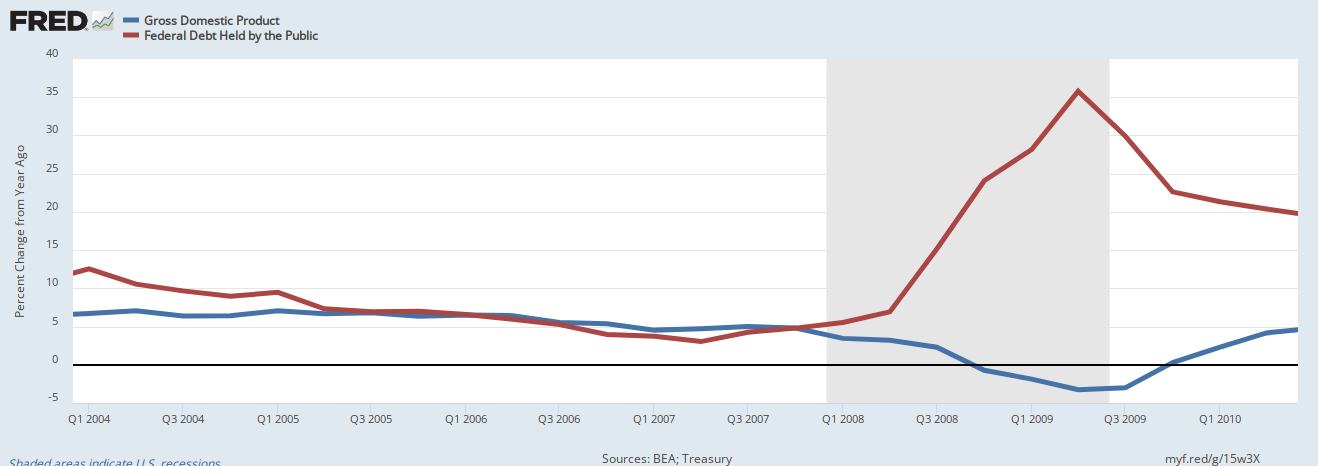
Reductions in federal deficits lead to recessions (vertical gray bars). Recessions are cured by increased federal deficits.

Federal deficits inject growth capital into the economy. While the federal government has unlimited currency, the economy needs a steady inflow of dollars for expansion.

Over the years, as federal deficits have increased, the Gross Domestic Product has also risen.

If federal deficits were economically harmful, one would not expect to see the graph above, which shows the economy’s growth paralleling the growth of deficits.

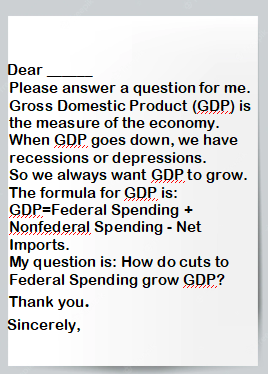
The reason is clear. GDP=Federal Spending + Nonfederal Spending + Net Exports.

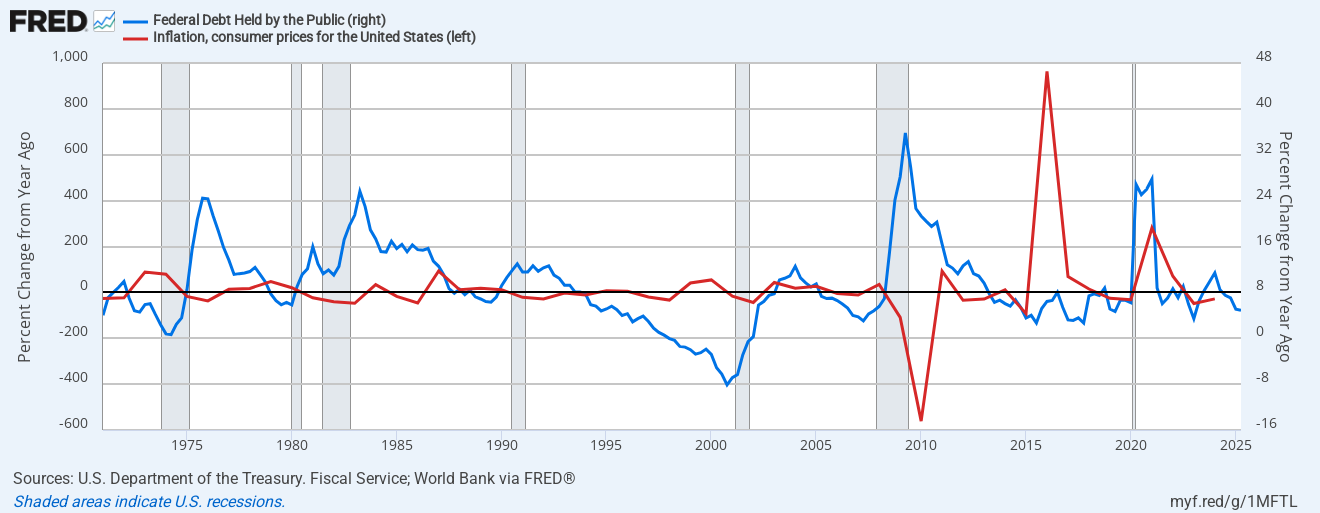
III. Federal Deficit Spending Does Not Cause Inflation
 

Translation of what you were told last year

Here is an article from last year, expressing the common sentiment. I’ve translated it for you so you can evaluate that common sentiment.

The US is paying a record amount of interest on its debt. It’s only going to get worse By Tami Luhby, CNN, Tue February 14, 2023

Translation: The US is pumping a record amount of growth dollars into the economy. It’s only going to get better.

Powell urges Congress to solve growing US debt ‘sooner, rather than later’

Translation: Powell urges Congress to blame federal “debt” for the inflation, so he doesn’t get blamed. We’ve had massive “debt” (See: The “National Debt” isn’t national, and it isn’t a debt) in the past without inflation. Powell doesn’t tell you that because he is a member of the “Federal Debt is a Ticking Time Bomb” culture.

Like many Americans, the federal government is shelling out a lot more money to cover interest payments on its debt after a series of Federal Reserve rate hikes over the past year.

Translation: The federal government is nothing “like many Americans.” The federal government is Monetarily Sovereign, while the American people are monetarily non-sovereign. But we want you to believe the government is just like you.

The Treasury Department paid a record $213 billion in interest payments on the national debt in the last quarter of 2022, up $63 billion from the same period a year earlier.

Translation: The Treasury Department pumped a record $213 billion growth dollars worth of interest payments in the last quarter of 2022. That is $64 billion added to Gross Domestic Product (GDP)from the same period a year earlier.

The fourth-quarter tab was also nearly $30 billion more than in the prior quarter, which is the largest quarterly increase on record, said Jerry Dwyer, an economics professor emeritus at Clemson University.

Translation: The fourth-quarter addition to GDP was nearly $30 billion more than in the prior quarter, the largest stimulus to the economy on record.

Borrowing costs are expected to become an increasingly heavy burden in coming years. The Congressional Budget Office is set to provide its latest estimate on Wednesday.

The surge is due mainly to the Federal Reserve raising interest rates by 4.25% between March and December. The central bank increased the rate another quarter point in February.

Translation: The Federal Reserve is raising interest rates by 4.25%, which will increase the price of everything, in its effort to combat increased prices. Think about that.

Until recently, it cost the federal government very little to issue debt to finance its operations.

Translation: Until recently, it cost the federal government very little to create the dollars to finance its operations. Just the press of a few computer keys.

“It was almost free money,” Dwyer said. “You could borrow a trillion dollars, and if you financed it with Treasury bills, you paid almost no interest.”

Translation (courtesy of former Fed Chairman Ben Bernanke): “The U.S. government has a technology, called a printing press (or, today, its electronic equivalent), that allows it to produce as many U.S. dollars as it wishes at essentially no cost.” Translation (courtesy of former Fed Chairman Alan Greenspan): “There is nothing to prevent the federal government from creating as much money as it wants and paying it to somebody.” So, why would the government borrow dollars? It doesn’t.

“But interest rates weren’t going to stay there forever.”

Translation: The Fed raises rates, which increases all prices, i.e., causes inflation, to fight inflation. It’s like a doctor bleeding a patient to cure anemia.

The national debt is once again in the spotlight now that the US has hit its $31.4 trillion debt ceiling, forcing Congress to take action or risk a catastrophic default. 

Translation: The US has hit its $31.4 debt ceiling, which actually isn’t a “debt” ceiling. Everything has already been paid for, and nothing is owed. There is no debt. The dollars exist in T-security accounts. To  pay off those accounts, the government merely returns the existing dollars. Congress created the fake “debt” ceiling to make itself look prudent to an ill-informed electorate.
Decreases in federal deficits (red) cause recessions (vertical gray bars), which are cured by increases in federal deficits.
Those who call for a decrease in deficit spending ignore the fact that economic growth relies on the federal government continuing to pump money into the economy.

The Treasury Department is taking extraordinary measures to allow the government to continue paying its bills in full and on time, which it expects to last at least until early June.

Translation (Courtesy of Alan Greenspan): “The United States can pay any debt it has because we can always print the money to do that.” so the “extraordinary measures” are a bunch of hokum. And so is the fake “debt ceiling.”

The spike in interest payments also contributed to the federal government hitting the debt ceiling that much faster.

And it adds to the pressure on Congress to raise taxes, cut spending or allow the government to borrow more to meet all its obligations.

Translation: The spike in interest payments added growth dollars to GDP much faster. This adds unnecessary pressure on Congress to take dollars out of the economy, thereby causing a recession.

Even if the Federal Reserve slows or stops raising rates this year, as many economists expect, the nation’s borrowing costs will continue to increase.

That’s because as the existing debt matures, the government issues new debt with the higher prevailing interest rates.

Translation: As existing Treasury Securities mature, the government will increase the amount of growth dollars it pumps into the economy.

The higher rates could increase the net interest cost on the national debt to about $9 trillion over the next decade, according to estimates by the Peter G. Peterson Foundation, a nonpartisan organization that seeks to raise awareness of America’s long-term fiscal challenges.

Translation: The higher rates could increase the amount of growth dollars pumped into GDP to about $9 trillion, according to the Peter B. Peterson Foundation, a right-wing organization that, on behalf of the rich, seeks to spread disinformation about America’s finances.

That’s up from the record $8.1 trillion that the CBO projected in May 2022 and the $5.4 trillion it projected in July 2021.

Translation: That’s up from a record $8.1 trillion growth dollars the CBO projected in May 2022, and the $5.4 growth dollars it tried to scare you about in July 2021.

By 2032, interest costs will triple to more than $3 billion per day and to at least $9,400 per household, on average, according to the foundation.

Translation: (Courtesy of Ben Bernanke) “It’s not tax money… We simply use the computer to mark up the size of the account.” By 2032, growth dollars will triple to more than $3 billion per day, and not costing any household a single penny. The federal government creates ad hoc every dollar it spends by pressing computer keys. No tax dollars are used.

They are on track to become the largest federal budget item, surpassing Social Security and Medicare by the middle of the century.

Translation: The government justifies paying too little to Social Security and Medicare by pretending it is short of money when, in fact, it has infinite money.

“Having rapidly growing interest makes it much more difficult for government to fund all the things that are important to our society,” said Michael Peterson, the foundation’s CEO.

Translation: To keep you from asking for benefits, we pretend that “Having rapidly growing interest makes it much more difficult for the government to fund all the things that are important to our society.” Why do we do that? Because the rich tell us to widen the income/wealth/power Gap between them and you. The wider the Gap, the richer they are. So, they bribe the main information sources to tell you the government can afford tax loopholes for the rich, but not Social Security and Medicare increases for the rest of you. Economists are bribed with university grants and promises of lucrative employment later. The media are bribed with advertising dollars and ownership. Politicians are bribed with political contributions and lucrative jobs in “think tanks.” All are bribed to tell you that increasing your benefits is unaffordable. SUMMARY The rich get richer when the income/wealth/Gap widens. So they promulgate the lie that your taxes pay for benefits, and your federal deficits are unsustainable. Rodger Malcolm Mitchell Monetary Sovereignty Twitter: @rodgermitchell Search #monetarysovereignty Facebook: Rodger Malcolm Mitchell; MUCK RACK: https://muckrack.com/rodger-malcolm-mitchell

……………………………………………………………………..

The Sole Purpose of Government Is to Improve and Protect the Lives of the People.

MONETARY SOVEREIGNTY

Contact your Senators, Representative and the media

We just finished the latest in over 100 episodes of “Debt Limit BS or How Government Lies Convince You to Accept Fewer Benefits While the Rich Get More.”

Being bribed by the rich, Congress does all it can get away with to widen the income/wealth/power gap between you and the rich.

One method is to tell you that federal government spending is “unsustainable,” or “out of control,” or is not “prudent,” or that the so-called federal debt is a “ticking time bomb.

Never mind that they have been telling you the same lie for more than 80 years. While Federal Spending has increased the debt that isn’t a debt from $50 billion to $30 trillion, the nation still stands.

They lie because they are bribed and because they assume you know no better, so they can get away with it.

We all should contact our Congress people and the media and challenge them to answer a very simple question.  Perhaps that will be a step toward narrowing the gap between you and the rich and give you the benefits you deserve and the government easily can afford.

If you’re tired of the BS, give this a try.

Oh, by the way, do you remember the Gephart Rule? 

In 1979, noting the potential problems of hitting a default, Dick Gephardt imposed the “Gephardt Rule,” a parliamentary rule that deemed the debt ceiling raised when a budget was passed.

This resolved the contradiction in voting for appropriations but not voting to fund them. The rule stood until it was repealed by Congress in 1995.

Get it? When Congress voted for an appropriation, it also voted to fund them.

So, if Congress said, “We authorize spending a billion dollars on a dam,” that meant a billion dollars immediately became available to build a dam.

Makes sense to any normal person. Apparently, though, it was too logical for Congress.

In 1995, Congress said, “When we authorize spending a billion dollars to build a dam, we really don’t authorize paying a billion dollars to build the dam.”

And if that makes sense to you, you should run for Congress. Since that convulsion of childish illogic, Congress has plagued the nation with repeated debt limit crises.

Contact your Congress people and the media. If you don’t, then don’t complain about cuts to Medicare, Social Security, Medicaid, food stamps, and other benefits.

As long as you don’t complain, they will keep cutting.

Rodger Malcolm Mitchell
Monetary Sovereignty

Twitter: @rodgermitchell Search #monetarysovereignty
Facebook: Rodger Malcolm Mitchell

……………………………………………………………………..

The Sole Purpose of Government Is to Improve and Protect the Lives of the People.

MONETARY SOVEREIGNTY

We did it for COVID. We did it for the Great Recession.” Why can’t we do it all the time?

We did it with the “Economic Stimulus Act 2008. The federal government simply sent people money.

Generally, low and middle-income taxpayers received up to $300 per person or $600 per couple.

The purpose was to stimulate economic growth and to cure the recession.

It worked:

As federal deficits (blue) declined, we fell into a deep recession, cured only by a robust increase in federal deficit spending (red).

Gross Domestic Product (GDP) is a common measure of the economy. The above graph should come as no surprise. The formula for economic growth is:

GDP = Federal Spending+ Nonfederal Spending + Net Exports

Mathematically, as federal deficit spending decreases, economic growth falls, and as federal deficit spending increases, economic growth increases.

If you want economic growth, you want federal deficit spending to increase.

I’ve written about this many times. It’s simple algebra. I’m not sure why this is a mystery to the politicians who think a debt limit is prudent finance. It’s exceedingly ignorant finance.

I mention this again because of an article I just read on MEDPAGETODAY:

Uninsured Rate Hits Record Low of 8.3%
— But that number will slowly rise as pandemic health insurance protections unwind, experts say
by Joyce Frieden, Washington Editor, MedPage Today May 24, 2023

WASHINGTON — The uninsured rate in the U.S. has fallen to a record-low 8.3%, but that percentage is expected to gradually increase as insurance protections from the COVID-19 pandemic wind down, according to officials from the Congressional Budget Office (CBO).

Why will insurance protections “wind down.” For the same reason we currently have a debt=limit battle in Congress. Sheer ignorance.

The federal government has repeatedly proved that it has the infinite ability to pay for anything. Why is it “winding down” payments for healthcare insurance?

The temporary policies enacted in the wake of the COVID-19 pandemic “have contributed to a record low uninsurance rate in 2023 of 8.3% and record-high enrollment in both Medicaid and ACA [Affordable Care Act] marketplace coverage,”said Caroline Hanson, Ph.D., principal analyst at the CBO, during a briefing sponsored by Health Affairs.

“As those temporary policies expire under current law, the distribution of coverage will change and the share of people who lack insurance is expected to increase by 2033.”

CBO is projecting an uninsured rate of 10.1% by 2033, and “while that’s obviously higher than the 8.3% that we’re estimating for 2023, it is nevertheless lower than the uninsured rate in the last year prior to the COVID-19 pandemic,” which was about 12%, she said.

Think about it. America has about 330 million people. A ten percent uninsured rate means 33 MILLION (!) people in America will have to do without health care insurance. I hope you’re not among them.

Whether or not you have insurance, here are some data that should concern you:

“A widely cited study published in the American Journal of Public Health in 2009 analyzed data from the National Health Interview Survey and found that uninsured individuals had a 40% higher risk of death compared to their insured counterparts. This study estimated that lack of health insurance contributed to approximately 45,000 deaths annually in the United States.

“Another study published in the Annals of Internal Medicine in 2017 conducted a systematic review and meta-analysis of previous research. The analysis concluded that uninsured individuals faced a 25% higher risk of mortality compared to those with insurance.”

When you don’t have healthcare insurance, you die younger. 

“Throughout the 2023-33 period, employment-based coverage will remain the largest source of health insurance, with average monthly enrollment between 155 million and 159 million,” Hanson and co-authors wrote in an article published in Health Affairs.

Employer-based health care insurance has two features seldom discussed.

  1. It ties employees to their employer, making job negotiation and movement much more difficult
  2. It is paid for by the employee because the employer figures the cost as part of the employment. Salaries could be higher without this “perk.”

If the federal government funded a comprehensive Medicare for All plan, employees would earn more without costing employers more.

However, they added, “in addition to policy changes over the course of the next decade, demographic and macroeconomic changes affect trends in coverage in the CBO’s projections.”

The Families First Coronavirus Response Act of 2020 gave states a 6.2-percentage-point boost in their Medicaid matching rates as long as the states didn’t disenroll anyone in Medicaid or CHIP for the duration of the COVID public health emergency.

Hanson noted that this law “allowed people to remain enrolled regardless of their changes in eligibility. So, for example, even if they had an income increase that would have made them ineligible but for the policy,” they were still able to stay on Medicaid.

The COVID public health emergency has been canceled now. Disenrollments can begin.

As a result of the law, Medicaid enrollment has grown substantially since 2019 — by 16.1 million enrollees, she said. But that has been superseded by another act of Congress, which allowed states to begin “unwinding” the continuous eligibility rules and start disenrolling people from Medicaid and CHIP beginning on April 1.

In total, “15.5 million people will be transitioning out of Medicaid after eligibility redetermination,” said Hanson. “Among that 15.5 million people, CBO is estimating that 6.2 million of them will go uninsured and the remainder will be enrolled in another source of coverage,” such as individual coverage or employment-based coverage.

Of those who are leaving Medicaid, how many are leaving voluntarily and how many are “falling through the cracks” because they didn’t receive their disenrollment notification or failed to fill out the required paperwork to reapply?

“We recognize that before these continuous eligibility requirements were put into place, people were losing Medicaid coverage, both because they were becoming no longer eligible for Medicaid, and … because they did not complete the application process despite remaining eligible,” said CBO analyst Claire Hou, PhD. However, she added, “we’re currently not aware of any data that would allow us to quantify the size of those two different groups.”

All of the above would be unnecessary if our Monetarily Sovereign federal government (which has unlimited funds) simply would fund a comprehensive, no-deductibles Medicare for All program.

Hanson delivered some bad news for those footing the bill for private health insurance. “We are projecting relatively high short-term premium growth rates in private health insurance, and this is for a few reasons,” she said.

“One is the economy-wide inflation that we’re experiencing in 2023 and that we have been experiencing, and that has not fully reflected itself in premiums yet.

And another contributor is the continued bouncing back of medical spending after the suppressed utilization that we saw earlier in the pandemic.”

The study authors project average premium increases of 6.5% in 2023, 5.9% during 2024-2025, and 5.7% in 2026-2027.

The current and projected-to-increase hardship on the American people is totally unnecessary. The federal government efficiently could ameliorate this hardship by: 

  1. Funding comprehensive, no-deductible Medicare for every man, woman, and child in America
  2. Funding Social Security benefits for every man, woman, and child in America.

Both would add dollars to Gross Domestic Product, thus growing the economy.

Instead, Congress battles over the unbelievably stupid debt ceiling. How do those people manage to dress themselves in the morning, much less be elected to America’s Congress? It boggles the mind.

Rodger Malcolm Mitchell
Monetary Sovereignty

Twitter: @rodgermitchell Search #monetarysovereignty
Facebook: Rodger Malcolm Mitchell

……………………………………………………………………..

The Sole Purpose of Government Is to Improve and Protect the Lives of the People.

MONETARY SOVEREIGNTY