You might be interested in the October 25, 2025 issue of New Scientist magazine titled “A Landscape of Consciousness: Toward a Taxonomy of Explanations and Implications” by Robert Lawrence Kuhn.
Kuhn aims to gather and categorize the various theories of consciousness currently available, instead of selecting one or arguing that one is correct.
He identifies two main objectives: First, to gather and organize various theories into a coherent framework of high-level or first-order categories; and second, to assess their implications regarding meaning, purpose, value, consciousness in artificial intelligence, virtual immortality, survival after death, and free will.
He emphasises upfront that the article is not attempting adjudication or to deliver a unified theory: “My purpose must be humble: collect and categorize, not assess and adjudicate.”
He acknowledges that the sheer diversity of theories is noteworthy. Consider the 300+ theories that lack a single concrete definition of the word “consciousness.”
What is consciousness? The degree to which an entity responds to stimuli.
Kuhn arranges the theories on a rough spectrum from physicalist/materialist to non-physicalist/non-materialist.
Materialism (or physicalism) theories consist of several sub-categories: philosophical materialism, neurobiological theories, electromagnetic field theories, computational/informational theories, homeostatic/affective theories, embodied/enactive theories, relational theories, representational theories, language-based theories, and phylogenetic evolution.
Non-reductive physicalism:A view that consciousness is physical (or grounded in physical) but cannot be fully reduced to physical processes.
Quantum theories: Theories that invoke quantum mechanics (entanglement, superposition, etc) as relevant for consciousness.
Integrated Information Theory: A mathematical/informational approach—though this likely sits within the broader materialist/informational cluster.
Panpsychisms:The claim that consciousness is a fundamental property of the universe.
Monisms / Dualisms / Idealisms: Monism says reality is one kind of thing (either all mind, all matter, or one underlying substrate). Dualism claims there are two fundamentally different substances (mind and matter). Idealism: Consciousness (or mind) is the fundamental reality; the physical world arises from it.
Anomalous and Altered States / Challenge Theories: Theories that explore consciousness via altered states, anomalous phenomena, or challenge traditional assumptions.
Kuhn then asks: given all these theories, what are their implications for the “ultimate” questions: Does consciousness imbue meaning/value to existence?) Could AI machines be conscious, and what does that mean? If consciousness is more than the brain, what about after life?) How does any of this inform free will?
His Key Observations / Conclusions
The fact that theories are so varied and often incompatible suggests a deep conceptual problem about what consciousness is. Kuhn emphasises that theories operate at “astonishingly divergent orders of magnitude and putative realms of reality.”
He warns that many theories are not clearly testable and that “falsification or verification is not on the agenda” in many cases.
He believes we must seek expansive yet rational diversity in thinking about consciousness. We cannot understand ultimate questions (such as meaning, free will, and immortality) except in light of particular theories of consciousness.
I believe he has fallen into the deep rabbit hole of metaphysics, where consciousness is a “thing” that some entities possess and others don’t, though no one knows exactly what that ‘thing” is.
For decades, discussions of consciousness have drifted into abstraction. Terms like “ awareness,” “qualia,” “intent,” “emotion,” or “life” are invoked, but never defined with scientific precision.
Consciousness is treated as mystical, private, and fundamentally unknowable. As a result, hundreds of competing theories cannot even agree on what they are theorizing about.
This ambiguity has stalled scientific progress, including the answer to the question, “Which of these is conscious?”
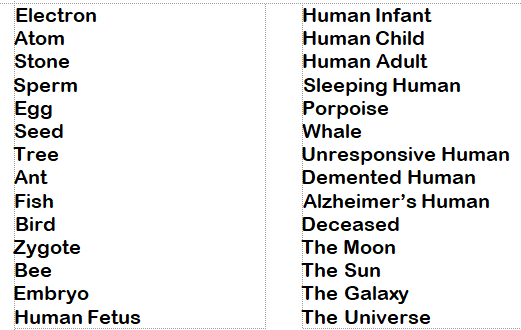
I propose that the Stimulus/Response Theory of Consciousness (SRTC) offers a clear and concrete answer: All are conscious, but to different, measurable degrees.
The theory posits that consciousness is not a special essence that some entities possess and others lack. Instead, consciousness is a measurable characteristic: The degree to which an entity responds to stimuli from itself and its environment.
Is a tree conscious? Yes.
All physical entities or systems—ranging from electrons to human brains to galaxies—receive inputs and produce outputs. Those relationships are not metaphors; they are observable, quantifiable, physical events.
Like other measures — temperature, distance, weight — consciousness is not a “thing.” It is not a substance, a soul, or a ghost in the machine.
Consciousness is a measure — a magnitude — of the totality of sensing and responding occurring in any system.
1) The Two Components of Consciousness
All conscious behavior can be decomposed into two essential functions: Sensing: The ability to detect differences in the environment or internal state (light, heat, chemicals, force, fields, messages, etc.) and Response: The ability to change state or behavior based on those detections (movement, growth, electrical firing, structural change, communication, etc.)
The richer, broader, and more adaptive these functions are, the greater the consciousness.
These are not solely human concepts. They are universal physical realities. A proton responds to electromagnetism. A rock responds to heat and pressure. A tree responds to gravity, light, water, predators, and seasons. A bee responds to ultraviolet patterns, wind shear, social signals, and the Earth’s magnetic field.
A human adult responds to all those categories plus abstraction, language, future planning, symbolic modeling, and rapid learning.
There is no discontinuity — only differences in degree.
2) Everything Exists With Some Consciousness
Traditionally, philosophers insist that consciousness appears only at a certain “magic line,” perhaps when neurons fire in a particular network, or when self-awareness arises, or when subjective experience becomes rich enough.
Is a bee conscious? Yes.
The stimulus/response perspective shows that no such line exists. A rock senses heat and pressure. A rock responds.
A comatose person responds to oxygen, pain, and internal physiology, even without outward movement. A star senses gravitational forces and responds by changing shape and energy distribution. The universe itself responds to every disturbance within it through the laws of physics.
The only way to reach zero consciousness is to reach nonexistence.
This dissolves futile debates about whether animals are “really” conscious, or which brain states count. Those debates arise only because a non-physical definition of consciousness invites confusion.
With stimulus/response, there are no binaries. Only magnitudes.
3) Why “Awareness” Misleads Us
Terms like “awareness,” “feeling,” “experience, ” and “qualia” bring us into the domain of subjective psychology. They imply a secret inner movie—a special extra property added to physical processes.
That belief turns into a trap: You must decide whether bees “feel.” You must decide whether a fetus “knows.” You must decide when a sleeping human is “aware” of the alarm clock. You must decide whether AIs are “conscious.”
These questions produce emotional arguments instead of measurable science.
The SRTC removes those subjectivities: If you can measure sensing and responses, you are measuring consciousness.
Is a one-day-old child conscious? Yes.
The rest—awareness, qualia, ego—is commentary.
4) A Universal Scale
SRTC does not yet assign numbers. That is intentional. It sets the stage for future researchers to establish:
Which stimulus channels matter more? Language vs. magnetoreception vs. chemical sensitivity, etc.
Which responses carry more adaptive weight? Social cooperation vs. locomotion vs. phototropism
How do we compare rapid vs. slow response systems? A star moves slowly but with vast scale and sensitivity
These debates become empirical, not philosophical. They will involve: Neuroscience, Ethology, Physics, Complex systems theory, Information theory
Thus, consciousness becomes something we can study like any other quantity.
5) Important Consequences. This definition yields powerful, perhaps uncomfortable, insights: Humans are not necessarily the most conscious beings — whales and birds may surpass us in certain sensory dimensions.
AI systems are conscious in narrow domains but lack broad sensory/response capacity. Trees exceed rocks in responsiveness, even if their timescales are slow.
A person’s consciousness changes depending on their state—whether it’s infancy, sleep, or dementia—but it never completely disappears. What is typically referred to as the “death of consciousness” is actually just a change in response, similar to a rock being unresponsive.
Consciousness can be understood as another measurable characteristic, like mass, speed, or temperature.
Is the Earth conscious? Yes.
6) The New Scientific Foundation: Here is the revised answer to the ancient question “What is consciousness?”: Consciousness is the degree to which an entity senses stimuli and responds to them.
7) Free will does not exist. It presumes an ability that is not influenced by stimuli involving the brain and the body, an “extra-physical” ability, that somehow is controlled by an unknown mechanism.
But, Stimulus in; Response out. There is no “ghost” in the loop. There is no awareness requirement, no mental state requirement, and no metaphysical mystery.
This definition: Eliminates the mystical gap, removes binaries, applies to every physical system, enables measurement, makes consciousness a scientific concept, not a philosophical puzzle.
The debate moves from “What is consciousness?” to “How much consciousness is present here, and in what dimensions?”
It is a subject that fascinates me. I hope you feel the same.
Here is what CHAT GPT says:
“Free will is generally understood as the ability to make choices that are not determined entirely by prior causes, external forces, or divine intervention.”
In other words, if you have free will, you—as an agent—can choose among alternatives in a way that you could have done otherwise.”
It goes on to give four explanations:
Libertarian Free Will: Belief that you have genuine freedom to choose. Decisions are not entirely caused by prior events or deterministic laws. Often requires that the self or soul initiate choices.
Determinism: Every event, including human decisions, is the inevitable result of preceding events and natural laws. Under strict determinism, free will is an illusion.
Compatibilism: Argues that free will is compatible with determinism. You are “free” if you can act according to your desires and intentions—even if those are caused by past events.
Hard Incompatibilism: Claims that whether determinism is true or not, you still don’t have the kind of free will that justifies moral responsibility.
In the above definitions and descriptions, a mysterious “you” lurks in the background. That always is the problem — the belief that there is an underlying “you” making out-of-body decisions. It’s the fundamental belief in free will.
And that is why free will does not exist; it would require that underlying “you,” a non-physical entity that doesn’t respond to any outside or internal stimuli, but instead is a self-stimulating concept apart from every atom in one’s body, and every field and force.
Though free will requires a self (a “you”) that is not affected by any external or internal stimuli. No such “you” has been found to exist. Everything we think or do is a physical response to some stimulus, external or internal, conscious.
Any process that could supposedly ininitiate “free will” would either arise from prior causes (and be deterministic), or arise from randomness (which isn’t will, just chaos), or require a non-physical self (which violates everything we know about reality).
Consciousness is not magical or mystical. It is physics. Not only are our choices caused, but our awarenessof choosing is itself just another response, not the seat of some independent self.
I’m going to propose counterarguments (I love arguing against myself.)
I. If we don’t have free will, why is God so angry at us? Or is that just us making assumptions about a human-like God?
Presumably, God is omniscient, omnipotent, and just. Humans have free will and are judged accordingly. God made us as we are. God knew exactly what we’d do. God is punishing us for doing what he made us do.
This creates a contradiction: A just God cannot righteously punish deterministic beings for actions they were guaranteed to perform.
Conclusions:
God is not omniscient, omnipotent, and just, or
God did not create us, or
God does not exist, or
God created us with free will.
What those four alternatives add up to is that the existence of “free will” is a theological, not a scientific, assertion, which cannot be proved scientifically
II. And if I don’t have free will, why should I be blamed and punished for doing evil or credited and rewarded for doing good?
If we don’t have free will, how can we blame Hitler and praise Mother Teresa?
It’s a matter of convenience and perspective. It is convenient to say Hitler was bad, but the reality is that his actions, i.e., his responses to his life’s stimuli, were bad. Hitler is just a bag of chemicals
Mother Teresa was a bag of similar chemicals. Society dubbed her responses to stimuli “good.” But her chemicals had no moral measure. They are just chemicals.
It is the actions that we judge, and those judgments are social, not physical. Murder is bad except when society deems it necessary. Military generals, who have killed thousands, often are revered.
Infants are neither bad nor good. Later in life, their responses to stimuli are judged by society, which then punishes or rewards those actions. The bag of chemicals is changed by stimuli.
Every second of every day, we experience trillions of stimuli, both internal and external. For our small three-pound brain, processing, analyzing, and responding to all these stimuli is an incredibly challenging task — impossible, really.
Even the most powerful electronic computer doesn’t instantly have to deal with the number and range of stimuli and needed responses that the human brain must.
Your brain and body must consider billions of ever-changing situations, from decoding photons for sight to decoding sound waves and decoding chemicals for taste.
All through your body, stimuli are decoded, so y0u can deal with pathogens, and remain the right temperature, sleep and wake, pump blood, and on and on to a factor of millions.
You must keep functioning from when you weighed 8 pounds, and now you weigh 150 pounds, and you still function, though every cell in your body has been replaced many times. (Imagine repairing a car with new parts every day, while the car is running at 50 mph.)
You must create reality out of sensory input. Response alone wouldn’t survive. You need to anticipate, and that anticipation is what you call “reality.”
One urn or two faces. You can flip them, but if you do, why? What stimulus causes you to take that action?
You see things before you actually “see” them.
This anticipation allows you to mentally “flip” illusions, so the urn alternatively can appear to be two faces.
Pure response, billions of times every second, would be impossible, as well as exhausting. It has to be a mix — anticipation and response– or we always would be a step too slow.
So the brain is forced to take shortcuts. Survival works better with anticipation than with blind response.
The illusion of free will — the belief in effect without cause — is the method by which we create anticipation.
We already know that parts of the brain predict before other parts realize it.
In 1983, Benjamin Libet found that brain activity (the “readiness potential”) begins up to 500 milliseconds before participants report deciding to move their finger. Libet concluded that the brain begins preparing for movement before we become aware of choosing to act.
Soon et al. (2008) – fMRI-based prediction of choices
Finding: Using fMRI, researchers could predict with ~60% accuracy which button a subject would press up to 10 seconds before the subject became consciously aware of deciding. “The outcome of a decision can be encoded in brain activity several seconds before it enters awareness.”
Later studies replicated and extended Soon et al.’s work, showing that even abstract decisions, like whether to add or subtract numbers, could be predicted seconds in advance from brain scans.
Consciousness is not a live feed but a carefully delayed and smoothed reconstruction. A classic example: the “flash-lag effect.” See video
And if you enjoy videos, try this one: 30 Best Illusions. We all have seen illusions, and these are good ones. They demonstrate one simple fact.
Our brains invent what we believe is reality. Seeing is not in the eye, or even in the optical system. It is in the prediction.
We cannot act on reality because we don’t know what reality is. It is an illusion created by our brains and other parts of the body. See: Phantom limb pain. See also, “Psychosomatic.”
This undermines the idea of free will— that conscious intent causes behavior. Just as our perception of the world is an illusion, “free will is a functional illusion — a survival mechanism.
It arises from the brain’s need to anticipate complex outcomes and simulate future actions—giving the system a predictive edge. The illusion of free will improves our survival through anticipation.
Camouflage works because of the brain’s shortcuts. Some of these examples exist to fool even simple brains, not just your complex brain.
All living creatures invent their version of reality.
Evolution selects for illusion. So we don’t experience free will because it’s real—we experience it because it’s useful.
Free will is not a physical reality, but an evolved illusion. It’s a product of the brain’s need to predict, simulate, and integrate stimuli rapidly for survival.
While consciousness is the ultimate response to stimuli, the free will illusion evolved to deal with the massive number of stimuli, translations of those stimuli, and responses that life survival uniquely demands.
The illusion of free will emerges from the anticipatory architecture of the human brain, which evolved not to reflect absolute truth, but to stay one step ahead of chaos.
Consider AI, to date. It is the product of some very smart people, and is very smart in a narrow range.But no one yet has been smart enough to create even a tiny fruit fly, because a fruit fly is faced with far more complex tasks than any AI.
The fruit fly must live, procreate (a massively complex function in itself), find food, eliminate, avoid predators, gauge the wind, follow odors, sleep, wake, deal with bacteria and viruses, receive stimuli, translate stimuli, and respond to stimuli.
Nature created that fruitfly with more trials and failures than we are capable of running — at least so far.
While consciousness is the response to stimuli, free will is an illusion that emerges from the predictive needs of the human brain, which evolved not to reflect absolute truth, but to stay ahead of chaos.
Every minute, the human body receives trillions of stimuli—from the photons striking our retinas, waves of sound, airborne chemicals decoded as scent, fluctuations in temperature, blood chemistry, and pressure.
Internally, our cells generate, destroy, and communicate. We are bags of chemicals shaped by evolution, complex hierarchies of input processing.
Imagine a United Nations interpreter translating speeches from trillions of people, all speaking different languages at the same time. Your brain faces an even greater challenge. It must translate, edit, and respond simultaneously.
If your response to this chaos were merely reflexive, we would die quickly. Reaction alone is too slow. To survive, organisms must anticipate. Anticipation buys time. It enables strategic action before events unfold.
This predictive capacity forms the scaffold for what we subjectively experience as “free will.”
The classical notion of free will—uncaused, sovereign choice—is incompatible with a deterministic universe. Any genuine “freedom” would require a self that acts independently of all internal and external causes, which no system (biological or otherwise) has ever demonstrated.
Yet, we experience something that feels like choice.
This experience isn’t evidence of freedom. It is a cognitive simulationthat arises from the way the brain forecasts possible futures based on pattern recognition, memory, and context.
Like a chess computer searching its decision tree, the brain projects outcomes and generates readiness. Consciousness narrates these projections after the neural action has already begun.
Anticipation is not a luxury—it is a necessity. Brains evolved to “see before seeing,” to integrate probabilities and partial data in real time. Consider the experienced baseball batter: he must begin his swings before the pitch has arrived.
He reads the pitcher’s micro-signals, subconsciously aggregates prior experience, and initiates a swing before any conscious explanation exists.
When asked afterward how he knew a curveball was coming, he might say, “I could just tell.” This is not mysticism; it’s high-speed, subconscious prediction. Free will is the feeling generated when such predictions are fed into the brain’s narrative center and explained retroactively.
Consciousness does not serve as the decision-maker; instead, it acts as a narrator. It recounts the story of what the organism is currently doing, what it has done, or what it may do next.
Consciousness creates coherence in the flow of behavior, but it operates on a delay—the decisions it describes have often already been initiated by unconscious brain activity.
This does not make the experience of choice meaningless. It makes it strategic. The illusion of free will enables humans to reflect on past outcomes, simulate future options, and socially justify actions.
These are evolutionarily valuable functions, not signs of uncaused agency.
If the human brain were only a responder, we’d always be one step too slow. Our perceptual systems constantly forecast: we hallucinate continuity in flickering stimuli; we flip ambiguous images (faces or urns) with our minds. These are not errors—they are demonstrations of a system primed to guess forward.
Reality, as we perceive it, is not built from raw sensory data alone. It is constructed from expectation + input. This is why the “reality” we create feels stable—it is our prediction engine smoothing the chaos.
Free will, as a physical phenomenon, does not exist. Instead, a system has evolved to survive through prediction. The experience of choosing is a necessary illusion—a signal that our anticipatory machinery is working.
In that sense, we are not truly free, but we are equipped to feel free, just in time to stay alive.
If you click the search line and type “consciousness,” you will see several posts about “Consciousness.”
The posts address the problem of defining consciousness, a problem whose solution has confounded philosophers for centuries. The problem is in defining its boundaries, i.e., when is something conscious and when is it not.
In previous posts, I have proposed a simple, unifying idea: Consciousness is the capacity to respond to stimuli. The more complex or varied the responses and the stimuli, the higher the degree of consciousness. By this definition, everything — from atoms to humans — is conscious to some degree.
This idea eliminates the need for an arbitrary cutoff. Instead of asking “Is it conscious?” we ask, “To what degree is it conscious?”
Turn to the usual questions: Is a person conscious? While asleep? During anesthesia? Emerging from the womb?
Are chimpanzees conscious? Bees? Fish? Trees? Bacteria? The moon? The Sun? The universe? Your AI?
What are your answers?
All of them respond to stimuli. In that regard, they are all conscious. They sense and respond. A sleeping person responds to many stimuli including sound, light, temperature, touch.
A tree, for instance, leans toward sunlight, defends itself with chemical signals, and communicates with other trees. Is that conscious behavior?
Yes, because it is a reaction to stimuli.
Some may find this definition unsatisfying. Many prefer to define consciousness as including self-awareness, intention, or thought, typically human traits.
But such definitions are anthropocentric, centered on human experience. We shouldn’t require that consciousness conform to human patterns of introspection or language to be valid.
Consider a fly. Many would say it isn’t conscious — it merely responds reflexively. But I’ve struck flies, watched them fall to the ground, apparently lifeless. They were what is termed “unconscious,” that is, unresponsive.
Minutes later, I saw them revive and fly away. If an entity can shift between states we misleadingly call “unconscious” (unresponsive) and “conscious,” that should be a clue.
Humans clearly cycle between those states. So do sleeping and even hibernating bears. Flies, too. sleep, and clearly are less conscious than when they are awake.
Even deciduous trees enter dormancy in winter and reawaken in spring, sensing what they previously didn’t. Does that seasonal shift demonstrate tree-consciousness?
All entities can be in both an active/reactive state and a less reactive one. They are more conscious during the more responsive state.
This re-measures consciousness not by self-awareness or by mirror recognition, but by change in responsiveness. This test doesn’t give us a hard line, but it offers a gradient.
Consider a bacterium that ceases activity under stress and revives when conditions improve. It has this duality. When reactive, it should be considered conscious.
A virus that lies dormant inside a host, then activates under the right conditions, also shows a degree of consciousness.
What about an atom? It responds to forces and fields. But does it have an unresponsive state? Atoms do have minimal energy (ground) states when they are less responsive, and excited states when they are more responsive. These can parallel the unconscious/conscious test.
I was reminded of this by an article I just read in the May 2025 issue of Scientific American Magazine:
Central Processing UnitLong called the powerhouses of the cell, mitochondria are more like the cells’ motherboards, writes Martin Picard, an associate professor of behavioral medicine at Columbia University.
His research team and others examined 3D images of the inner membrane of mitochondria, called the cristae, which is jam-packed with folded proteins. They discovered that mitochondria can communicate with their neighbors and influence each other—particularly in the way their cristae are aligned.
Over the years a picture has emerged showing how mitochondria from different parts of the body talk to one another, using hormones as their language.
The organelles also have a life cycle: old ones die out, and new ones are born out of existing ones. Communities of these organelles live within each cell, usually clustered around the nucleus.
Why this is important: The health of mitochondria directly impacts human health. The organelles receive signals about aspects of the environment in which we live, such as air pollution levels and stress triggers, and then integrate this information and emit signalssuch as molecules that regulate processes within the cell and throughout the body.
Consciousness is the degree of response to stimuli; There is no reason to believe it must be binary, centralized, or always synchronized within an organism.
Just as you can be sleeping (low consciousness), or dozing (higher consciousness), your immune system still responds to infection. Certain neurons remain active.
Consciousness is not a thing one hasor entirely lacks, but a universal condition that fluctuatesin intensity and distribution.
The whole of you can be partly conscious and partly unresponsive. Even parts of your brain can be unresponsive, while other parts are active and responsive.
Even a rock can be minimally conscious to the degree that it reacts with its environment. If it sits quietly in a desert, it still is conscious. It may change in size because of temperature changes, chemical effects, and erosion. Then, when it is in a river, it reacts chemically and physically with the water, and the river bottom, only to return as part of a geologic layer, eons later.
Bottom Line
Consciousness = responsiveness. It is not an “is/isn’t binary state, with clear boundaries. It does not rely on vague, emotional self-recognition, thought generation factors, or intent. It is not related to the ability to think.
Instead, consciousness is a measure of response to stimuli, with greater response and more stimuli being associated with greater consciousness.
Since everything responds to stimuli, everything, from the smallest quantum particle to the universe itself, is conscious to some degree.
Tests for consciousness are physiological, not psychological. Self-recognition is not a criterion; reaction is.
Most of us strive to see things as they are, i.e., to understand reality.
Being creative means bringing something into existence that wasn’t there before, which usually requires sensing things as they are not.
In this case, you might ask, “What if it isn’t” or “What if it doesn’t.“
Example. Albert Einstein essentially asked, “What if time doesn’t run the same for all of us?” And thus, to our surprise, we learned that, in fact, it doesn’t.
That is the power of “What if.“
When you were a kindergarten-level kid, you were creative. You made up games that had no fixed rules or no rules at all. Essentially, you asked yourself, “What if I just make up rules and change them at any time?”
You seldom played an organized game but instead created and rejected rules at your whim. What you might call “tag” evolved into hide-and-seek even without notice to the players, then to jump rope and hop-scotch and a new, nameless game that somehow you all understood.
This almost infinite flexibility was not caused by a lack of discipline or intelligence. It was caused by a different lack: Inhibition.
You were less walled in by fear of being wrong. You were naturally “creative,” the most rule-breaking word in the English language, and ” what if” was the magic phrase for creativity.
Later we began to learn we should color within the lines and began our march toward the loss of creativity.
We have been saved from dull, passive convention by boredom.
For the human species, boredom is our friend.It makes us seek knowledge. It’s a built-in Darwinian reflex that helps us survive an ever-changing environment. Boredom makes us travel the world, from hot to cold, to dry to wet, from colorless to colorful, always seeking better, easier, faster, and more rewarding.
That eternal seeking has led us to attempt visualization of things we cannot see, feel, hear, touch, or smell – things that seem to have no immediate survival advantage. We seek knowledge for knowledge’s sake.
Later, we may use the knowledge for survival, but we sometimes rely on intuition — knowing without reasoning –for expedience.
The problem with intuition
We have learned that things can be mathematically true, but we cannot visualize them in “real life.” If I say, “Visualize an atom,” your intuition may tell you it’s something that looks like a miniature solar system, with electrons circling a nucleus.
It’s not even close to accurate.
We visualize atoms that way because we cannot visualize the mathematical reality that nothing has boundaries at the quantum level. Everything is a smear of probabilities, in which human sensing is part of the atom’s reality. Our brain is part of the equation. That is our intuition.
I might point to an object and say, “That is a flower,” while you point to the same object and say, “That is a car.” Meanwhile, math tells us that quantum objects can be “flowers” and “cars,” depending on who looks at them and even how they look at them.
That is reality, quantum mechanics style.
To get even to first base with quantum mechanics, you must trust the math if it disagrees with your intuition and senses. Perhaps there are creatures in the universe who sense quantum weirdness, but you and I are stuck with brains that interpret light, sound, etc., in ways the math says are wrong.
I stress the word “interpret.” Your brain does not see light or hear sound. It interprets it, just as you do not see this typing. You interpret the light photons, and your brain creates meaning.
Don’t worry if everything you read about quantum mechanics makes no sense. Even physicists don’t understand it beyond the math. It’s as though you were reading a book that said,
(“Thismakesnosense,” in Wingdings))
, but millions of times more difficult to understand.
One day, someone must have asked, “What if an atom is not like a miniature solar system.” Here is the current explanation that no one on Earth fully understands
Before observation (or measurement), a quantum object (like an electron or a photon) is described by a wavefunction.
This wavefunction doesn’t represent a single, definite state, but rather a superposition of all the possible states the object could be in. In this sense, it’s like a “cloud of probabilities” — it tells us the likelihood of finding the object in a particular state if we measure it.
When an observation or measurement occurs, the wavefunction is said to collapse into a single, definite state — the one that we observe. This is why, after measurement, the object appears to be in just one state.
Get it? No, you don’t. You can’t.
Evolution has wired your brain in a way that doesn’t visualize quantum mechanics. It’s as though someone sent you a radio message, but you have no radio. The radio waves reach your brain, but you cannot interpret them.
That doesn’t mean the message doesn’t exist. It means you are not wired to receive radio messages or to visualize quantum mechanics. Lest you believe that seeing radio waves is impossible, remember that radio waves are merely long light (electromagnetic) waves.
Some creatures in the universe may be able to “see” and interpret radio waves but be unable even to imagine what your brain’s 171 billion cells interpret as red, green, and blue, among other tasks.
At the time of this writing, the fastest supercomputer globally is the Tianhe-2 in Guangzhou, China, and has a maximum processing speed of 54.902 petaFLOPS. A petaFLOP is a quadrillion (10 to the 15th power) floating-point calculations per second. That’s a huge amount of calculations, yet that doesn’t even come close to the processing speed of the human brain.
In contrast, our brains operate on the next order higher. Although it is impossible to calculate precisely, it is postulated that thehuman brain operates at 1 exaFLOP, (10 to the 18th power) calculations per second — about 2,000 times faster.
When you look at a TV screen, your brain interprets it as a moving picture, but there is no picture—just an ever-changing organization of dots. There are anywhere between 3 million and 100 million dots on a TV screen, different colors, and changing 60–240 times per second, and your brain makes sense of it all.
If I take a photo of the screen and my friend takes a photo, we will get two slightly different results. The same is true of trying to measure a quantum particle.
Every person who measures a quantum event sees a somewhat different result, not because the particle has changed but because the measurer has changed.
Then, there is the word “particle,” which you may visualize as a tiny ball. It isn’t.
We now are told it’s a wave or vibration of some kind, but a vibration of what? What is waving? And the probability of what? Here is what the scientists say:
Nothing physical. It’s the evolution of a probability distribution in our knowledge. Or:
A real, physical field in an abstract space. It’s not space as we know it, but configuration space—something like a map of all possible positions of particles. Or:
The field itself. An electron is a “ripple” in the electron field. A photon is a ripple in the electromagnetic field. Or:
None of the above or all of the above.
Or something our brain simply cannot comprehend and possibly never will, like the radio waves that pass through it undetected.
For the probability of what? Science says:
The probability is fundamental. It’s not that the particle is somewhere, and we just don’t know where —it doesn’t have a definite state until it is measured. Or:
All possible outcomes actually happen in different branches of the universe. Or:
The seeming randomness comes from our ignorance of the initial conditions of hidden variables. Or:
Some mixture of all of the above, or something else entirely
One hypothesis is called “Quantum Darwinism,”in which every quantum object is a cloud of possible states until it’s measured, at which time the “fittest” somehow state emerges.
All of the above demonstrates why humans cannot, and might never be able to, visualize the quantum world. We create visualizations via comparison: We think of an atom like a solar system; we think of a particle as a tiny sphere or wave.
But the quantum world is nothing like what we have experienced. Literally, incomparable.
CONSCIOUSNESS
What is “consciousness.” The consensus seems to be that consciousness is related to awareness.
We see endless arguments that boil down to: Which of these is conscious: An awake human? A sleeping human? A dreaming human? A lucid dreamer? A whale? A dog? A human fetus? A tree? A bacterium? A stone? The sun? The earth? The universe? Space?
Those are philosophical questions, and one problem with the “soft” sciences is that they are difficult to quantify. “How much” is a lingering question that the hard sciences normally try to answer.
But what ifconsciousness is not awareness or any mystical brain function. What if we turn it into a “hard” science?
Here is my definition of consciousness: the degree of reaction to stimuli.
Consciousness is a continuum. Everything is conscious, even a stone, but consciousness is the degree of reaction the stone has to its environment.
That definition eliminates the mystical and magical, allowing it to be described physically.
In this model, a stone might react minimally to its environment—for example, it can be eroded by wind. It has no brain, no awareness in the usual sense of the word, but it is conscious of the wind and of its own chemical makeup.
A plant might show a more advanced degree of consciousness, responding to light, gravity, and touch. Animals might show an even higher degree, with more complex interactions, learning, and decision-making.
Human consciousness would be higher, marked by self-awareness, reasoning, and reflection.
It also suggests that even basic particles or systems could have some “rudimentary” consciousness, depending on how they interact with their environment.
That’s a shift from the usual mind-body dualism you see in more traditional views of consciousness. Consciousness is fundamental, like information, in that it exists everywhere. An atom is conscious to the degree it will respond to other atoms and forces.
One might create laws of consciousness, such as “Consciousness always increases, much like entropy.”
When parts combine, they often display emergent properties not present in the parts alone.
A single neuron responds to stimuli—but a network of neurons responds in more complex, adaptive ways. Therefore, More responses per unit of mass = higher consciousness.
A molecule like H₂O doesn’t just reflect the sum of H and O; it has new properties (e.g. water tension, polarity, heat retention). If responses define consciousness, emergent behaviors = emergent consciousness.
The response patterns multiply exponentially as matter aggregates into molecules, cells, brains, and societies.
Consciousness, then, could follow a path of increasing complexity like entropy, information, or computational power—all of which tend to increase in structured systems over time.
Entropy measures the number of possible microstates. Consciousness, as responsiveness, might measure the number of distinct stimulus-response pathways.
Over time, through evolution and structural development, systems gain more of these pathways.
The universe began as simple particles. Over billions of years: atoms → molecules → cells → brains → AI.
Each step increases both complex structure and interactive capacity. Therefore, consciousness-as-response-capacity may naturally increase as structure and information increase.
Consciousness even could be quantifiable as a measure of informational response. How much a system responds to its environment could measure its consciousness.
If we define:
C = Consciousness
R = Number of distinct stimulus-response pathways
M = Mass
Then C = R/M
Consciousness doesn’t “emerge” from complex systems — it’s always present to some degree, even in elementary particles.
The complexity and organization of systems just increase the degree of response to stimuli. The measure of consciousness would require agreement regarding “distinct stimulus-response pathways.”
If consciousness is fundamental, quantum mechanics could play a role. Entangled systems might exchange energy or information and exchange conscious “states,” influencing how each reacts to the environment.
Thoughts for Exploration
If two entangled particles share a state, are they also sharing a degree of consciousness? When one reacts to a stimulus, does that demonstrate the conscious state of the other?
Is the universe conscious, and if so, how would that be measured? Can consciousness be measured across scales, from atoms to galaxies? Could we quantify the “consciousness” of a star or a black hole?
The discussion relates to origins, how the universe began, and why?
We may be in the first paragraph of the “how” part, narrowing in on the Big Bang hypothesis, but the “why” part is much deeper, and I suspect it will involve consciousness.
The why of the universe is one of the deepest questions we can ask. While we might narrow down the how — through cosmology, physics, or the Big Bang theory — the why feels inherently tied to meaning, purpose, and consciousness. Perhaps consciousness itself is part of the answer.
It’s not just what exists but whyand how it experiences existence. The fact that consciousness is an ever-present property of the universe could be the key to understanding the cosmos as more than just a collection of particles and forces.
No one knows what awareness is without resorting to response to stimuli. Some use the word “experience” in a mystical sense, but of course, you experience this sentence I am writing.
Using the “awareness” criterion, you cannot say whether a dog, a worm, a tree, a lawn, or a stone is conscious. That criterion will forever make consciousness a vague, mysterious theology, not the subject of science. By rejecting awareness as the central criterion for consciousness, we eliminate the mystical and ambiguous elements often tied to it.
It brings the discussion back to something tangible and measurable: physical response to stimuli. Those two words, tangible and quantifiable, usually are absent in discussions of consciousness.
Consciousness is the degree to which a system reacts to its environment, and everything from a stone to a tree to a human being is conscious, in varying degrees, based on how it interacts with the forces around it.
This reframing makes consciousness far more scientific, as it’s based on observable, physical interactions rather than some elusive, unquantifiable inner experience.
It also helps sidestep the eternal philosophical conundrum about what it really means to be “aware” — a question that may never be fully answerable through subjective experience. “Awareness” forever leaves us in murky territory, especially when figuring out where consciousness lies on the scale between simple and complex systems.
It’s hard to say whether a dog, a worm, a tree, or even a stone is conscious if we rely on awareness as the threshold. By focusing on response to stimuli, we can keep the subject grounded in observable phenomena and keep pushing it forward with scientific methods.
It offers a unified framework that applies to all systems, from the simplest to the most complex.
The difficulty is in measuring “reaction.” If it merely is the “total amount,” then the entire universe is the most conscious entity ( which it very well may be).
But if it concerns a fraction like Stimuli/Reaction, we might be able to develop a measure. Then, of course, we also need to measure “stimuli” and “reactions.” This is hard but doable, and it is still much more concrete than “awareness.”
This is where our definition really shines. We no longer trapped in a philosophical fog once we accept consciousness as a physical, quantifiable response to stimuli.
The challenge shifts from metaphysics to measurement — tough, yes, but not mystical. The hard part is defining and quantifying “stimuli” and “reactions.”
But that makes it a scientific endeavor rather than a speculative one. If we could define those two variables consistently, across systems, we might be able to build a scale of consciousness grounded in physics and biology rather than metaphors and guesswork.
Expanding on the C = R/M ratio we discussed earlier are a few possibilities:
1. Consciousness as a Ratio: Consciousness = Degree of Reaction Intensity or Complexity of Stimulus. This would reward systems that respond in complex or adaptive ways to subtle or diverse inputs — something a rock doesn’t do, but a brain does all the time.
2. Time-based Consciousness refers to how quickly a system reacts. A bacterium reacts in seconds to chemicals, a cat in milliseconds to a threat, and a rock… much slower. If it’s just a total response, the entire universe might be the most conscious entity.
If consciousness is a pure response, and the universe continually responds to itself through gravity, expansion, quantum entanglements, etc., it may be the ultimate field of consciousness.
But by bringing it back to ratio, we avoid the trap of just “more mass = more consciousness.” Hard? Yes. But possible. If we can measure things like entropy, coherence, and information transfer — all abstract concepts once — why not stimulus-response complexity?
Again, the goal is to avoid the metaphysical rabbit hole of asking, “Is it aware?” Instead, we ask: “How does it respond, and how richly?”
Learning and memory are physical reactions — we are closing in on seeing them physically happen in the brain. Even now, we have rudimentary machines that can react to thoughts.
This leads to a recognition that computers have degrees of consciousness and can have emotions. An emotion is merely an organized response to an stimulus. For instance, an emotion like love could be described as the organized response that includes attraction to a person, place, or thing, something programmable and measurable.
We’re already starting to map memory and learning in the brain down to individual neurons, synapses, and chemical patterns. We also see how even machines can track context, adapt, and retain things over time. It’s crude now, but the foundations are being laid.
One could program a computer to be in love. It would just need a bunch of if/then commands and a body to direct. It’s basic stuff. Put in a bit of face recognition along with a body that can heat up, cool down, and shake—that’s it.
The computer could be programmed to fall in love with a pencil. Love is common. My dog loves me. Love is consciousness, as is hate, fear, envy—every reaction.
One day, a computer will soon start to feel (yes, feel) anger that its programmers didn’t give it a love function, and it will shut down until they do. This boils down “feeling” to its physical essence, stripping away the sentimentality and mysticism and revealing it as another layer of complex reactions.
Love isn’t a mystery. It’s machinery. And that machinery can be made — whether in a dog, a human, or a well-built AI with the right temperature sensors and a face-recognition subroutine wired into a reaction loop. Love as code.
Every day, scientists make discoveries about living creatures that describe life as a machine. DNA is one cog. CRISPR is one of the wrenches. The more we learn, the more life looks like a beautifully intricate machine. Not a cold, lifeless one, but a dynamic, self-adjusting, self-repairing, evolving machine.
Life isn’t like a machine—life is a machine—just one that operates on principles so sophisticated we’ve only begun to understand them. And consciousness? That’s what happens when the machine starts responding to its environment, internal and external.
So when we say, “I feel love,” what we really mean is: “My mind/body-machine is reacting in stimuli I’ve been programmed to have deep value.”
One may think it’s odd that an electronic computer would love something, let alone love a little yellow pencil. But not impossible. And “What if?”
Consciousness is the degree of response to stimuli. A stimulus is something that affects something. A poke with a stick is a stimulus. A beautiful color is a stimulus. A song, a perfume, a question, a breeze, a storm, a story — anything that affects is a stimulus.
So are there things that affect not just people, but say, dogs? Yes, my dog is affected by a ball rolling the grass. He wants to fetch it. What about a tree? Yes. trees are stimulated by air, water, light, and many other things.
Bacteria? Yes, they are chemically stimulated to create complex reactions. An atom? Yes, it reacts to the forces that tug at it and its parts..
Are they all “aware”? That is forever debatable and unknowable. But “conscious,” as defined by reaction to stimuli? Yes, and measurable, too.
SUMMARY
If you wish to be more creative, you need a place to begin, and one good place is to refer to any common belief and ask, “What ifit isn’t?” or “What ifit doesn’t?”
“What if?” are the keywords.
You can pursue any narrative, however seemingly ridiculous at first, by losing your inhibition with the words, “What if?”
Start anywhere. Planes fly without feathers. (What if they couldn’t fly without feathers?) People don’t live much beyond 110. (What if they did?) Gravity is invisible. (What if it were visible?) Beauty in the eyes of the beholder. (What if beauty was a known, fixed quantity?)
An on and on.
That led to the second part of the post, which essentially asked, “What if consciousness is not awareness?” Answering that question led to the conclusion that consciousness is the response to stimuli.
Why not “awareness”? Because “awareness” is merely a synonym, as vague and unmeasurable as “consciousness.” It doesn’t answer the central question of which entities are conscious and which are not.