–Chicago Tribune reminds us why our nation is in trouble.

The debt hawks are to economics as the creationists are to biology. Those, who do not understand Monetary Sovereignty, do not understand economics. If you understand the following, simple statement, you are ahead of most economists, politicians and media writers in America: Our government, being Monetarily Sovereign, has the unlimited ability to create the dollars to pay its bills.
========================================================================================================================

Thank heaven for the Chicago Tribune. Without them and their ilk, I might have nothing to write. Despite frequent letters from me, they continue to display an almost supernatural reluctance to understand what they write about. These folks simply refuse to learn economics, and they seem proud of it. Here’s their latest:

“S&P didn’t wait for the hot air to finish blowing before raising the prospect that at some point, the U.S. government may not be able to keep paying interest on its bonds.”

Ah, yes, the old “at some point.” Add it to “eventually,” “someday,” “some time,” “soon,” “ticking time bomb,” “unsustainable,” “over time,” and other confident predictions about an unknown future.

The federal government is Monetarily Sovereign. It has the unlimited ability to credit checking accounts. In the space of one minute, the federal government could credit every bond holder’s checking account, not only for interest, but for principal. Further, because a government with the unlimited ability to create dollars does not need to borrow dollars, all federal debt could disappear in that one minute. And none of this would affect federal spending by even one cent.

Imagine. A nation without debt, and it easily can be accomplished without adding even one dollar to the money supply, so there are no inflation implications. What would the Tea (formerly Republican) Party have to scream about then?

Anyway, what does the Tribune mean when it says the U.S. government may not be able to keep paying interest? Ask them. Let me know if ever they answer.

“A rating cut almost certainly would push interest rates higher, undermining the Federal Reserve’s efforts to pump up the economy by printing money.”

Perhaps, the Tribune editors can be excused for not knowing it mostly is the Treasury that “prints money.” (Actually, credits checking accounts. Physical printing is a minuscule part of dollar creation.) But the Trib cannot be excused for thinking interest rates affect a Monetarily Sovereign nation’s ability to create money. Even were interest rates 200%, the government easily could continue creating dollars. Not that we recommend such a thing, but the physical ability exists.

“Unable to borrow on reasonable terms, America would have no choice but to win back the market’s confidence by jacking up taxes and slashing programs.”

I’ve asked the Tribune on many occasions, “Why would a nation, with the unlimited ability to create dollars, need to borrow dollars?” They never answer, so once again I’ll try to educate the ineducable. The federal government does not need to create T-securities, then trade them for dollars it previously created. T-securities could disappear (as could taxes), and this would not affect the federal government’s ability to spend. (Yes, yes, I know. There are inflation implications to the instant elimination of taxes, but not to the elimination of T-securities)

“It’s the federal government that can’t stop borrowing more than $4 billion a day to pay for politicians’ priorities.”

Federal borrowing pays for absolutely nothing. And excuse me, but do you consider Medicare, Social Security, Medicaid, food stamps, the military, the infrastructure, R&D, education, etc., etc., etc., to be politicians’ priorities? How about people’s priorities?

“(The U.S. is ) much more diversified and adaptable than the smaller European countries now in severe distress. But even the world’s most powerful nation can’t buy time forever when it’s running up a tab it hasn’t got the money to pay.”

Here the Tribune editors show they don’t understand the difference between the Monetary Sovereignty of the U.S. and the monetary non-sovereignty of “smaller European countries.” And as for, “. . . it hasn’t got the money to pay,” if that were true, how have we been paying it? (And please, please don’t say, “by borrowing.”)

Actually, this isn’t the worst Tribune editorial. It’s pretty much average on the ignorance meter. But it provides a reminder of how astray our media have helped lead America. The only solution is for the media to receive letters, lots and lots of letters, urging them to open their minds to learning. If you want to contribute to the effort, here are some people you may wish to contact:

Gerould W. Kern at ctc-editor@tribune.com
R. Bruce Dold, Editorial Page Editor at bdold@tribune.com
Jane Hirt, VP/Managing Editor at jhirt@tribune.com
Joycelyn Winnecke, VP/Associate Editor at jwinnecke@tribune.com

Perhaps, if enough of us write, the message will begin to penetrate.

Rodger Malcolm Mitchell
http://www.rodgermitchell.com


==========================================================================================================================================
No nation can tax itself into prosperity, nor grow without money growth. It’s been 40 years since the U.S. became Monetarily Sovereign, and neither Congress, nor the President, nor the Fed, nor the vast majority of economists and economics bloggers, nor the preponderance of the media, nor the most famous educational institutions, nor the Nobel committee, nor the International Monetary Fund have yet acquired even the slightest notion of what that means.

Remember that the next time you’re tempted to ask a dopey teenager, “What were you thinking?” He’s liable to respond, “Pretty much what your generation was thinking when it screwed up the economy.”
–How Monetary Sovereignty differs from Modern Monetary Theory — simplified

The debt hawks are to economics as the creationists are to biology. Those, who do not understand Monetary Sovereignty, do not understand economics. If you understand the following, simple statement, you are ahead of most economists, politicians and media writers in America: Our government, being Monetarily Sovereign, has the unlimited ability to create the dollars to pay its bills.
==========================================================================================================================================

Some have asked what is the difference between Monetary Sovereignty (MS) and Modern Monetary Theory (MMT). Others use the terms interchangeably.

Actually, while both share many features, there are differences. Both understand that the U.S. federal government is Monetarily Sovereign, while euro nations, and U.S. states counties and cities are monetarily non-sovereign. Monetarily Sovereign governments uniquely:

–Have the unlimited ability to credit bank accounts (pay bills), including their own
–Neither need nor use taxes or borrowed funds to support spending
–Rely on continually increased deficits, rather than on exports, to support economic growth

And, there are additional similarities, related to, and/or derived from, the above.

Two differences should be noted, one not particularly important and one quite important. Of lesser importance: MMT says the purpose of taxes is to create demand for money. The requirement that taxpayers use dollars creates the need for taxpayers to accept dollars as payment for debts.

MS doesn’t deny that taxes help create demand for dollars, though other factors may be sufficient. Perhaps the most important factors are: Dollars are legal tender and dollars are commonly used and accepted by the vast majority of Americans and the world (which does not pay U.S. taxes).

Yet, even were the MMT position to be correct, it is clear that federal taxes are not necessary for demand purposes, as there are adequate state and local taxes, all of which are paid in dollars, making the point moot. After some discussion, I believe MMT now accepts the position that federal taxes are not necessary to create demand for dollars.

The more important difference between MS and MMT is the handling of inflation. MS suggests increasing interest rates when inflation threatens. MMT holds that increasing interest rates exacerbates inflation by increasing costs, and that the correct prevention/cure for inflation is to reduce federal deficits, with higher taxes and/or with reduced federal spending.

MS says:

1. Deficits have not been related to inflation for at least 40 years. Instead, inflation has been related to oil prices. Since deficits have not been the cause, reducing deficits is not the cure.

2. Reduced federal deficits lead to recessions and depressions, meaning the MMT approach leaves a poor choice between inflation and recession, or a very difficult balancing act between the two.

3. Reducing federal deficits cannot be done quickly or incrementally. The questions surrounding which taxes to raise or which spending to cut are slow, difficult, cumbersome and politically charged, as witness the repeated battles over the debt ceiling. Deficit control is ill suited to inflation fighting, which needs fast, incremental action.

4. Interest is a minor cost for most businesses, and an increase in interest rates represents a minuscule increase in business costs – not enough to affect pricing significantly.

5. Money is a commodity, the value of which is determined by supply and demand. Demand is determined by risk and reward. The reward for owning money is interest, so when interest rates increase, investment tends to flow to money (i.e. bonds, CDs, money markets), increasing the value of money. When interest rates fall, investment tends to flow to non-money (stocks, real estate), reducing the value of money. Increased money value is the prevention/cure for inflation.

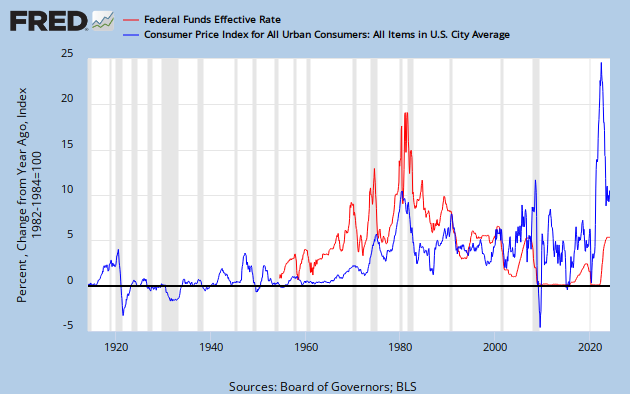
There isn’t definitive evidence supporting either the MMT or MS position, though there are some hints. There actually is something of a parallel between higher Fed Funds rates and higher inflation, which at first glance might support the MMT position.

test

However, because the Fed raises interest rates in anticipation of inflation, this parallel is to be expected. Timing is key. If high rates fight inflation, one would expect to see rates rise as inflation rises, with the highest rates followed by reductions in inflation. The above graph seems to show a Fed raising interest rates in anticipation of inflation, then reducing rates as inflation moderates.

(Unfortunately, the picture is blurred by the Fed’s use of interest rates not just to cure inflation but in a misguided attempt to stimulate the economy.)

In any event, the Fed’s following of the raise-rates-to-prevent/cure-inflation prescription seems to have been successful. Despite massive deficits in the past, particularly during and after the Reagan administration, and despite significant increases in the price of oil (the prime driver for inflation) the Fed has been able to keep inflation close to its 2%-3% annual goal. Tax policy has not been involved.

Though substantial reductions in deficits could cut inflation (by causing recessions or depressions), I’ve encountered no good arguments this would be a wise strategy. Recessions and depressions are a poor solution for inflation.

I do see historical evidence that interest rate control has been an effective means for inflation control.

Rodger Malcolm Mitchell
http://www.rodgermitchell.com


==========================================================================================================================================
No nation can tax itself into prosperity, nor grow without money growth. It’s been 40 years since the U.S. became Monetarily Sovereign, and neither Congress, nor the President, nor the Fed, nor the vast majority of economists and economics bloggers, nor the preponderance of the media, nor the most famous educational institutions, nor the Nobel committee, nor the International Monetary Fund have yet acquired even the slightest notion of what that means.

Remember that the next time you’re tempted to ask a dopey teenager, “What were you thinking?” He’s liable to respond, “Pretty much what your generation was thinking when it screwed up the economy.”

MONETARY SOVEREIGNTY

–The G7’s backwards thinking about the Japanese yen. Save Japan from its friends.

The debt hawks are to economics as the creationists are to biology. Those, who do not understand Monetary Sovereignty, do not understand economics. If you understand the following, simple statement, you are ahead of most economists, politicians and media writers in America: Our government, being Monetarily Sovereign, has the unlimited ability to create the dollars to pay its bills.
========================================================================================================================================================================================================

Once again, the mainstream economists have things backwards. I recently came across this article:

Is G7 yen intervention a good idea? by MICHAEL SCHUMAN, 3/18/2011
In a highly unusual step, the G7 agreed on Friday morning to coordinate their efforts to control the sharp rise in the Japanese yen. The decision today was prompted by a sudden surge of strength by the yen that by Thursday morning (in Tokyo) had pushed the Japanese currency to a record high against the U.S. dollar. Though the yen had subsequently pulled back a bit, it was still at a level worrying to Japanese policymakers. Japan freaks out when the yen strengthens, because it makes Japanese exports more expensive in international markets and thus can dampen economic growth.

Last week, I posted about why charitable contributions to Japan were meaningless. Now, the economists want to facilitate Japanese exports. Before you read any further, stop and think about this question: What is the purpose of Japanese exporting? The answer is not what you may have been told.

The purpose of Japanese exporting is to import yen. Japan doesn’t want to expend massive amounts of time, energy, labor an raw materials just so they can supply us with cars, computers and television sets. The Japanese are a nice people, but they’re not that generous. No, the sole purpose of expending time, energy, labor and raw materials is to acquire yen.

But, Japan is Monetarily Sovereign. It has the unlimited ability to create its sovereign currency, the yen. Even were Japan’s exports to fall to zero, the Japanese government could create sufficient yen to support its economic growth. Japan has no need to import yen (i.e. export goods and services).

The G7 (soon to be overtaken by the E7, but that’s another story) is using an obsolete gold-standard philosophy in a post-gold-standard world. Today, Monetarily Sovereign nations do not need to import their sovereign currencies. Stimulating Japan’s yen imports is like stimulating rain over the ocean.

And in any event, Japan soon will create and spend trillions of yen to rebuild its nation. That massive influx of yen will weaken the yen, and the G7 can breathe a sigh of relief. It also will engage in an orgy of back patting, for accomplishing something not only unnecessary, but something that would have happened naturally.

But what can you expect from a group that still has no concept of Monetary Sovereignty, perhaps partly because three of the “7” (France, Germany, Italy) were foolish enough to surrender their own Monetary Sovereignty.

Rodger Malcolm Mitchell
http://www.rodgermitchell.com

No nation can tax itself into prosperity, nor grow without money growth.

MONETARY SOVEREIGNTY

–Interview with Abby Romaine on WNZF. Is she the smartest lady on the air?

The debt hawks are to economics as the creationists are to biology. Those, who do not understand Monetary Sovereignty, do not understand economics. If you understand the following, simple statement, you are ahead of most economists, politicians and media writers in America: Our government, being Monetarily Sovereign, has the unlimited ability to create the dollars to pay its bills.
==========================================================================================================================================================

Today, Abby Romaine again interviewed me on her WNZF show, Center: Uncensored. From what I can tell, Abby is the only radio broadcaster in existence who understands Monetary Sovereignty. This is particularly frightening, as Monetary Sovereignty is the basis for all modern economics.

The two things I puzzle about: How did she come to understand, and why is she the only one? Yes, there are MMT economists who get it, but if anyone out there knows of another media person, whether radio, TV or newspaper, who understands Monetary Sovereignty I sure would like to know his/her name. The editors of the WSJ and the Chicago Tribune don’t get it. No newsperson gets it. No columnist gets it. But Abby does.

Those interested in writing to this brilliant lady can reach her at: abby.romaine@gmail.com

Anyway, today she and I discussed Ron Paul, perhaps the nation’s leading architect of economic ignorance, and the Tea Party (formerly known and the Republican Party) and John (“America is broke”) Boehner, and the deficit and the debt.

I enjoy talking with Abby, because I like talking with smart people, but I probably mouthed off too much (Old people do that). My only concern is that Abby gets it. She understands that a growing economy requires a growing money supply, and federal deficits are the federal government’s method for growing the economy. She understands that federal debt could be eliminated tomorrow, simply by crediting the bank accounts of T-security holders. She understands that federal debt is not the accumulation of federal deficits, but rather that debt could exist without deficits and vice versa. And she understand that a nation with the unlimited power to create money never can be “broke.”

Why am I concerned? Because not being a radio guy, I don’t know if listeners would rather hear two people argue, and she and I don’t argue. She does play excerpts from Tea Party speeches, and perhaps that provides enough counterpoint. But Ron Paul? This guy is so ridiculous, even staunch conservatives find him an embarrassment. Maybe she should play some excerpts from an Obama speech. He at least sounds more rational, though he too is ignorant about our economy.

By the way, I thought Obama, coming from the rough ‘n’ tumble of Chicago politics would be endowed with major testosterone. But, he seems to be wimping out. The Tea (Republican) Party has a plan: Cut federal spending, which will slow the economy. Obama and the Democrats will be blamed for the poor economic performance, and in 2012, the Teas will be able to foist their own guy or gal on the American public, which by the way is exactly how the Teas won the House last year.

Never mind that executing this plan will hurt America. That isn’t a Tea concern. Cynically, they are interested solely in power. Paraphrasing my question of Abby: “What do you call American citizens who knowingly hurt America?” Then I answered my own question: “I’d call them traitors.” The irony is, the Teas love to wrap themselves in the America flag.

Second thought: That’s not irony; it’s marketing. Address the negative head-on, and turn it into a positive. Remember when cigarette advertising featured doctors telling us how healthful smoking is? Or Volkswagon bragging about how ugly the Beetle was? The Teas make a virtue out of cutting the benefits Americans enjoy.

Anyway, Obama has allowed the Teas to define the discussion. He doesn’t argue, as he should, that cutting federal spending is the dopiest idea since taxing Social Security benefits. Instead, he forlornly whines that yes, the deficit is too big, and we should cut it — only please cut it less. Just when we need leadership, we get groveling. As a Chicagoan, I’m embarrassed. Mayor Daley never groveled. He lied (They all do), but he never groveled.

If Daley were president, I suspect he’d look the reporters in the eye and say, “To cut federal spending is just, plain stupid.” And he’d be right.

Rodger Malcolm Mitchell
http://www.rodgermitchell.com

No nation can tax itself into prosperity, nor grow without money growth.

MONETARY SOVEREIGNTY