–Debt is bad; debt is good. Take your pick.

The debt hawks are to economics as the creationists are to biology.

There is no functional difference between a federal tax cut and a federal spending increase. Some might argue that federal spending is superior or inferior to private spending, though evidence for either is slim, and either has the same result. They both increase the amount of federal money in the economy. (Mistakenly called the federal “debt.”)

Further, increasing the federal money supply stimulates the economy, and decreasing the money supply depresses the economy. So it is both laughable and sad to see how debt hawks squirm between wanting a lower debt, higher taxes and lower taxes, along with less federal spending, more spending and improved GDP. As the song says, “Something’s gotta give.”

Here are quotes from the always confused editors of the Chicago Tribune, in the editorial dated 8/1/10, titled “Out of debt.”

“. . . Democrats and Republicans are very good at doing one thing: running up the debt. That’s the reason for the National Commission on Fiscal Responsibility . . . to find ways to stem the red ink.” O.K., so federal deficits are bad.

“. . . at this stage (a tax increase) would be a terrible mistake, not only for the health of the economy, but for the nation’s long-term fiscal health.” O.K., so federal deficits are good, in both the short term and in the long term.

“More likely, Congress and the president would spend every nickel (from a tax increase) – and then spend some more.” Oh, oh. Now federal deficits are bad, again.

“Nor does it make sense to place a new (tax) weight on the economy when it is already struggling to grow.” Woops, deficits are good, again.

“Congress can’t afford to indulge the notion that endless borrowing is a sustainable strategy.” So deficits are bad.

“The wisest option is to extend tax cuts for a year . . . “ Deficits are good

“. . . then see what the deficit commissions proposes to curtail our addiction to debt.” Deficits are bad.

“ . . . Erskine Bowles suggests a healthy ratio of $3 dollars in spending cuts for every $1 in tax increases . . . it’s essential if we hope to foster lasting prosperity . . . “ Deficits now are awful. Mr. Bowles “scientific” suggestion equals $4 in spending cuts or $4 in tax increases, or anywhere in between. Guarantee: He has zero data to support his 3/1 ratio, but hey, who need facts?

“ . . . while sparing the taxpayers of tomorrow an unsupportable debt burden.” Deficits are bad.

And here is my favorite: “Coupled with spending discipline, revenue measures can be on leg of the journey back to fiscal sanity. But if they are the first and only leg, they will be a fatal detour.” Huh? They are saying spending cuts and tax increases are good, but first we should have spending increases and tax cuts!

All of the above is classic debt hawk double talk. Federal debt is a taxpayer “burden,” but necessary to grow the economy, but “unsupportable,” even though taxpayers don’t pay for federal debt, and the government has the unlimited ability to service its debt.

That kind of muddy thinking is what needlessly has extended this recession and the unemployment that goes with it. Ignorance may be bliss, but it sure is harmful. As the theme at the top of this post reads, “The debt hawks are to economics as the creationists are to biology.”

Rodger Malcolm Mitchell
http://www.rodgermitchell.com

No nation can tax itself into prosperity
–Four lessons about Congress and our economy

The debt hawks are to economics as the creationists are to biology.

What lessons does the following article provide?

7/31/10: (AP) “WASHINGTON (AP) – Tucked into the new health care law is a requirement that could become a paperwork nightmare for nearly 40 million businesses. They must file tax forms for every vendor that sells them more than $600 in goods.

“Business groups say it will swamp their members in paperwork. “This foolish policy hammers our business community when we should be supporting their job growth,” Sen. Mike Johanns of Nebraska said. The requirement would hit about 38 million businesses, charities and tax-exempt organizations, many of them small businesses already swamped by government paperwork . It would also create an avalanche of paperwork that could strain the IRS.

“Republicans want to repeal the filing requirement and pay for it by changing other parts of the new health care law. Democrats want to repeal the filing requirement and pay for it by raising taxes on international corporations and limiting taxpayers’ ability to use special trusts to avoid gifts taxes.”

Four lessons:

#1. Federal taxes represent the single most damaging factor in our economy – far more damaging than bankers’ greed or speculators’ law-breaking. Taxes not only remove massive amounts of money from our economy, but they waste millions of hours for preparation, and enforcement.

#2. Congress does not understand the fundamentals of government finance. Federal taxes do not pay for federal spending, and tax reductions do not need to be “paid for” by increases in other taxes.

#3. Taxing business, while simultaneously trying to stimulate employment, makes no sense. Every tax on business hurts the economy, while increasing unemployment.

#4. Senators and Representatives are far worse than the “greedy” businessmen Congress loves to criticize. Congress’s greed is both for money and for votes. Members of Congress have one concern, and it is not the best interests of America. It is re-election. In that sense, Congresspersons are the least patriotic people in America, often taking actions they know will hurt the country, merely to assure themselves of ongoing personal power. Each day, Congress does more damage to America than have Al Qaeda, the Taliban and oil spills combined.

Rodger Malcolm Mitchell
http://www.rodgermitchell.com

No nation can tax itself into prosperity

–Politics vs. people

Mitchell’s laws:
●Those, who do not understand the differences between Monetary Sovereignty and monetary non-sovereignty, do not understand economics.
●The more federal budgets are cut and taxes increased, the weaker an economy becomes. .
Liberals think the purpose of government is to protect the poor and powerless from the rich and powerful. Conservatives think the purpose of government is to protect the rich and powerful from the poor and powerless.
●The single most important problem in economics is
the gap between rich and poor.
●Austerity is the government’s method for widening
the gap between rich and poor.
●Until the 99% understand the need for federal deficits, the upper 1% will rule.
To survive long term, a monetarily non-sovereign government must have a positive balance of payments.
●Everything in economics devolves to motive,
and the motive is the Gap.

=========================================================================================================================================================================================================================

Today’s headline: “Fears grow as millions lose jobless benefits
Body copy: Senate Republican leader, Mitch McConnell of Kentucky, said: “The fastest-growing parts of this Democrat economy aren’t jobs — they’re the crushing burden of the national debt and the size of the federal government.

The “crushing burden” is not national debt, which crushes no one. The crushing burden is the false belief the national debt is a crushing burden.

As a result of this false belief, millions will lose jobless benefits, taxes will be increased, Medicare doctors will receive less than they should, Social Security payments will begin later, Medicaid payments will be cut, defense spending will be reduced, federal funding of K-12 education and school breakfast programs will be cut, mass transit funding will be cut and federal assistance to the states will be reduced — all because of a myth with no factual support.

So you, dear reader, will suffer a significantly degraded life style, all because the debt hawks say the federal debt is a crushing burden and the debt causes inflation, neither of which is supported by any data.

Go to any debt hawk web site and ask them for data proving the U.S. federal debt is unsustainable or causes inflation. If they answer you at all (unlikely), they merely will give you statistics regarding the size of the debt, but no evidence it has a negative effect on America.

Here are a couple debt hawk sites you can visit:
Concord Coalition
The Cato Insitute
The Heritage Foundation
The Manhattan Institute
The Hoover Institution

Go ahead. Contact any of them. Despite impressive doctoral credentials, and oodles of statistics, they have no evidence to back their claims. Why? No such evidence exists, though massive evidence shows the misnamed “debt” (should be called “net money created”) is necessary for economic growth.

Rodger Malcolm Mitchell
http://www.rodgermitchell.com

No nation can tax itself into prosperity

–Anthropomorphic economics disease

An alternative to popular faith

Fundamental to debt hawk beliefs is the idea that monetarily sovereign nations are like you and me. Thus, debt hawks practice “anthropomorphic economics.”

A monetarily sovereign nation is the monopoly supplier of its currency, which currency is not tied to any asset (like gold) or to a foreign currency. A monetarily sovereign nation has the unlimited ability, and the monopoly power, to create its currency.

The U.S., Canada, Australia, China and India are monetarily sovereign. The EU nations are not. That is why so many of the comparisons between Greece and the U.S. are false.

Specifically, here are a few of the assumptions debt hawks have about the U.S. — assumptions that might be correct for individuals, but not for the U.S.

1. The U.S. government must borrow or tax in order to spend.
You and I must obtain money, either by borrowing or by income, before we spend. The reverse is true for the U.S. government. U.S. spending creates money. So-called federal “borrowing” is not like personal borrowing. The U.S. creates T-securities from thin air, then exchanges them for dollars it previously created from thin air. Then it destroys the dollars. When the government repays its ‘debt,” the situation is reversed. It creates dollars, which are exchanged for T-securities, and the T-securities are destroyed. The whole process became obsolete in 1971.

2. Servicing the federal debt is a burden on the U.S.
Because the U.S. pays all its bills by creating money ad hoc, paying its debts never is a burden. Unlike you and me, the government simply credits the bank accounts of its creditors and debits its own balance sheet, which it can do endlessly. The “debt” carried on the government balance sheet is an accounting of the T-securities created by the government. Rather than “debt,” this balance sheet entry should be called “T-securities open.”

3. Federal debt is a burden on future taxpayers
Unlike you and me, the government does neither needs nor uses income in order to spend. There is no relationship between federal taxes and spending. Even were taxes dropped to zero or raised to $100 trillion, neither event would affect the federal government’s ability to spend by one penny. In fact, tax money is destroyed upon receipt, as a credit in a government balance sheet. The government does not spend tax money.

4. Federal surpluses are more prudent than deficits
For you and me, net income is more prudent than net outgo. Not so for the U.S. government. Federal taxes destroy money; federal spending creates money. To grow, an economy must have a growing supply of money. Federal spending is the most reliable, controllable source of money. Federal surpluses are imprudent, because by destroying money, they create recessions and depressions.

5. If U.S. debt is “too big,” nations will refuse to lend to us.
A credit rating is based on the past and future ability and willingness to service debt. You and I need a good credit rating in order to borrow. But, the federal debt has grown 1500% in only 30 years, and no nation has refused to buy our T-securities (not that it would matter, because we no longer need to sell T-securities).

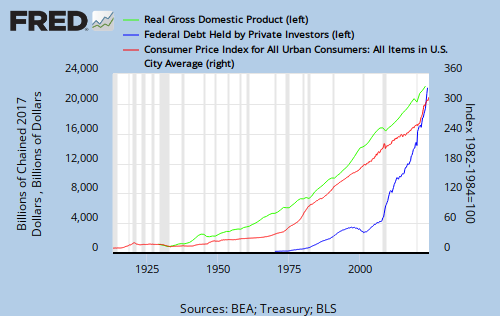
Debt hawks have made the intuitive argument that federal debt is like personal debt – anthropomorphic economics – but are unable to supply data to substantiate their intuition. One person told me the proof is that costs have risen (inflation) and the federal debt also has risen, therefore federal debt must cause inflation. The problem with this cause-effect conclusion is that through time, many things in addition to debt have risen: population, real GDP, the miles of paved roads, satellites in orbit, M3, the number of schools in the Big Ten, the number of cell phones and the years since the Cubs won the World Series. For example:

rising thingsGRAPH

If federal debt caused inflation, we would expect to see greater inflation when deficits are greater and less inflation when deficits are smaller. But, as we have seen at INFLATION there is no historical relationship between deficits and inflation.

In short, debt hawks suffer from anthropomorphic economic disease, the unsubstantiated intuition that the federal government’s finances are like personal finances, where debt must be minimized and spending must follow the acquisition of money.

As I have so often in the past, I again suggest you write to one of the debt hawk web sites – Concord Coalition, the Committee For A Responsible Federal Budget et al – and ask for data to substantiate their claim that federal debt has an adverse effect on our economy. In the unlikely event they answer you, they will supply data showing the debt is large and growing, but no data showing it hurts then economy. The reason: No such data exists. Growing federal debt is economically necessary.

Rodger Malcolm Mitchell
http://www.rodgermitchell.com

No nation can tax itself into prosperity