–Anthropomorphic economics disease

An alternative to popular faith

Fundamental to debt hawk beliefs is the idea that monetarily sovereign nations are like you and me. Thus, debt hawks practice “anthropomorphic economics.”

A monetarily sovereign nation is the monopoly supplier of its currency, which currency is not tied to any asset (like gold) or to a foreign currency. A monetarily sovereign nation has the unlimited ability, and the monopoly power, to create its currency.

The U.S., Canada, Australia, China and India are monetarily sovereign. The EU nations are not. That is why so many of the comparisons between Greece and the U.S. are false.

Specifically, here are a few of the assumptions debt hawks have about the U.S. — assumptions that might be correct for individuals, but not for the U.S.

1. The U.S. government must borrow or tax in order to spend.
You and I must obtain money, either by borrowing or by income, before we spend. The reverse is true for the U.S. government. U.S. spending creates money. So-called federal “borrowing” is not like personal borrowing. The U.S. creates T-securities from thin air, then exchanges them for dollars it previously created from thin air. Then it destroys the dollars. When the government repays its ‘debt,” the situation is reversed. It creates dollars, which are exchanged for T-securities, and the T-securities are destroyed. The whole process became obsolete in 1971.

2. Servicing the federal debt is a burden on the U.S.
Because the U.S. pays all its bills by creating money ad hoc, paying its debts never is a burden. Unlike you and me, the government simply credits the bank accounts of its creditors and debits its own balance sheet, which it can do endlessly. The “debt” carried on the government balance sheet is an accounting of the T-securities created by the government. Rather than “debt,” this balance sheet entry should be called “T-securities open.”

3. Federal debt is a burden on future taxpayers
Unlike you and me, the government does neither needs nor uses income in order to spend. There is no relationship between federal taxes and spending. Even were taxes dropped to zero or raised to $100 trillion, neither event would affect the federal government’s ability to spend by one penny. In fact, tax money is destroyed upon receipt, as a credit in a government balance sheet. The government does not spend tax money.

4. Federal surpluses are more prudent than deficits
For you and me, net income is more prudent than net outgo. Not so for the U.S. government. Federal taxes destroy money; federal spending creates money. To grow, an economy must have a growing supply of money. Federal spending is the most reliable, controllable source of money. Federal surpluses are imprudent, because by destroying money, they create recessions and depressions.

5. If U.S. debt is “too big,” nations will refuse to lend to us.
A credit rating is based on the past and future ability and willingness to service debt. You and I need a good credit rating in order to borrow. But, the federal debt has grown 1500% in only 30 years, and no nation has refused to buy our T-securities (not that it would matter, because we no longer need to sell T-securities).

Debt hawks have made the intuitive argument that federal debt is like personal debt – anthropomorphic economics – but are unable to supply data to substantiate their intuition. One person told me the proof is that costs have risen (inflation) and the federal debt also has risen, therefore federal debt must cause inflation. The problem with this cause-effect conclusion is that through time, many things in addition to debt have risen: population, real GDP, the miles of paved roads, satellites in orbit, M3, the number of schools in the Big Ten, the number of cell phones and the years since the Cubs won the World Series. For example:
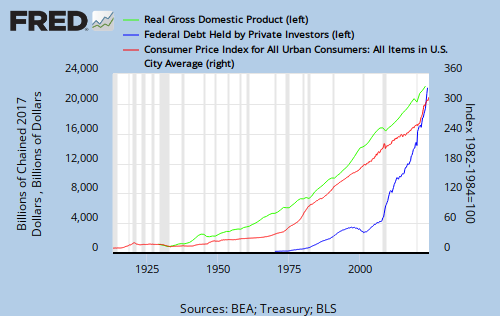
rising thingsGRAPH

If federal debt caused inflation, we would expect to see greater inflation when deficits are greater and less inflation when deficits are smaller. But, as we have seen at INFLATION there is no historical relationship between deficits and inflation.

In short, debt hawks suffer from anthropomorphic economic disease, the unsubstantiated intuition that the federal government’s finances are like personal finances, where debt must be minimized and spending must follow the acquisition of money.

As I have so often in the past, I again suggest you write to one of the debt hawk web sites – Concord Coalition, the Committee For A Responsible Federal Budget et al – and ask for data to substantiate their claim that federal debt has an adverse effect on our economy. In the unlikely event they answer you, they will supply data showing the debt is large and growing, but no data showing it hurts then economy. The reason: No such data exists. Growing federal debt is economically necessary.

Rodger Malcolm Mitchell
http://www.rodgermitchell.com

No nation can tax itself into prosperity

–Taxing banks to pay for bailouts

An alternative to popular faith

“By MARTIN CRUTSINGER, AP Economics Writer Martin Crutsinger, WASHINGTON – Treasury Secretary Timothy Geithner says the world’s major economies disagree over taxing banks to pay for future bailouts.”

Thank goodness this “one-size-fits-all” idea isn’t flying. The EU nations, which are not monetarily sovereign, use tax money to pay for bail outs. The monetarily sovereign nations — U.S., Canada, Australia, Japan, China, South Korea et al — do not use tax money, but rather pay for bailouts by creating money ad hoc.

A tax, specifically to pay for bailouts, may make sense for the EU, but not for the others. Of course, this all begs the question of whether banks should be bailed out, or whether bank creditors should be saved, while the banks are allowed to fail.

Rodger Malcolm Mitchell
http://www.rodgermitchell.com

No nation can tax itself into prosperity

–China buying bonds. Who cares.

An alternative to popular faith

5/17/2001: WASHINGTON (AFP) – China boosted its massive US Treasury bond holdings in March for the first time in six months as foreign buying of long-term US assets set a new record high, official data showed Monday.

So, as always, the debt hawks have been proven wrong. Here we are, running huge deficits probably for many years into the future, and despite debt hawk predictions, other nations continue to buy our bonds.

Why? Are they being charitable? Just nice guys? No.

The interest rate is good, considering the U.S. never will default, and we will fight inflation. In short, our bonds are a good investment (although as a monetarily sovereign nation, China does not need to profit from investment), which is the sole reason countries ever buy them.

Of course, none of this really matters, since the U.S. does not need to create and sell T-securities, nor should we. The U.S. can create dollars at will, without bonds. Creating and selling bonds does not help the economy, nor does it affect inflation or any other economic problem.

The notion that we need to borrow the money that we exclusively can create, is obsolete — as dead as the gold standard.

But, for a while, at least, we won’t have to listen to uninformed pundits worrying that nobody will buy our bonds.

Rodger Malcolm Mitchell
http://www.rodgermitchell.com

No nation can tax itself into prosperity

–Isabel Sawhill and the Brookings Institution

An alternative to popular faith

The Chicago Tribune reported, in its April 25, 2010 article “A tsunami of red ink,” that Isabel Sawhill, a senior fellow in economic studies at the Brookings Institution in Washington, gave five reasons why the federal debt is too high. Her reasons were: “higher interest rates, higher taxes, inflation, impact on foreign affairs and reduced flexibility in crisis.”

Sadly, these are common myths, based on intuition, not facts. Let’s examine each of these myths:

Myth #1: Federal deficits cause higher interest rates

Facts: In 1980, the Fed Funds rate was 15%. At the time, the federal debt was $800 million. Now, it is estimated the federal debt will reach $14 trillion by the end of this year – a 1,650% increase in only 30 years. Yet the Fed Funds rate has gone down, essentially to zero. How is this possible, if deficits cause higher interest rates? You have seen the repeated headlines “Fed lowers rates.” It is the Fed that sets interest rates, not the market for Treasury Securities and not the federal debt.

Japan’s national debt is proportionately 400% of ours, and they have a poor credit rating. Yet their interest rates are near zero.

Conclusion: Federal deficits do not and have not caused higher interest rates.

Myth #2: Federal deficits cause higher taxes

Facts: The government does not spend tax money. The government spends by crediting the bank accounts of its vendors. If you sell something to the government for $1,000, the government will reach into your checking account and credit it by $1,000, while debiting its balance sheet by the same $1,000. No tax money is involved. The government can do this endlessly. If taxes were reduced to $0, and the deficit doubled, this would not affect, by even one cent, the government’s ability to credit bank accounts.

So, what happens to tax money? It is destroyed and merely marked as a credit on the government’s balance sheets. There is no vault holding tax money. Ever since 1971, the end of the gold standard, government has had the unlimited ability to create money, i.e. credit bank accounts. Ms. Sawhill neglects the historical fact that despite the increases in federal debt, tax rates have gone down.

Conclusion: Federal deficits do not cause higher taxes.

Myth #3: Federal deficits cause inflation

Facts: This is only a partial myth. Some believe that once a nation reaches full employment, additional federal deficit spending can cause inflation. However, we are nowhere near that point. The highest inflation we have had in the past 30 years came in the first quarter of 1980 – about 14% – after which it began a decline to about 2% today, paralleling our government’s 1,650% debt growth. Two years after our highest inflation, President Reagan ran the highest deficits since WWII, while inflation declined.

Conclusion: Federal deficits do not cause inflation.

Myth #4: Federal deficits impact foreign affairs

Facts: Ms. Sawhill’s explanation is: “While it’s unlikely that a country like China, the largest single foreign holder of U.S. debt, would abruptly dump its stake in U.S. treasuries, its nearly $880 billion investment gives it a degree of leverage when the two nations sit down to talk trade, for example.” It’s hard to know what Ms. Sawhill means by “a degree of leverage,” but let’s examine the underlying principle.

Each nation, including China, has two accounts at the Federal Reserve Bank – a checking account (aka a “reserve” account), and a savings account, which consists of U.S. Treasury Securities.

When China exports its goods to us, it is paid in dollars. Those dollars are just credits to China’s checking account. Then, when China buys Treasury securities (which the government has created out of thin air), the Fed transfers the dollars in China’s checking account to its savings account.

Some people call that “borrowing,” but it actually consists of nothing more than a simple transfer of China’s own dollars from its checking account to its savings account.

When China’s T-securities mature, the Fed transfers the money (plus interest) from China’s savings account back to its checking account. That is the way America pays its debts to China. This easy transfer — nothing more than data entry — is not constrained in any way by the federal debt or taxes or by anything else.

If China wished to “dump its stake” in every single U.S. Treasury security, no problem. The Fed merely would credit China’s checking account and debit the account of whomever bought the securities. This has nothing to do with taxes, deficits or debt. The government can do this endlessly.

Conclusion: Federal deficits do not negatively impact our ability to deal with foreign governments

Myth #5: Federal deficits reduce flexibility in crisis

Facts: Ms. Sawhill explains this means it “constrains the federal government’s ability to respond to a crisis such as the September 11 attacks or Hurricane Katrina.” She forgets the historical fact that despite huge deficits, the federal government indeed did respond to these crises, not to mention paying for two wars and now paying to end the recession.

But, let’s discuss the underlying principal, which I suspect can be stated: “The federal government has a limited amount of money, and if it spends too much money on one thing, it can’t spend money on something else.” This relates to the myth that the federal government is like you and me. In order for us to spend, we first need to acquire money, either by saving or borrowing. The federal government is under no such constraints.

The Federal government does not have any money. It creates money by spending. As we said earlier, the government spends by crediting the bank accounts of vendors. This credit adds money to the economy. While the government has no money, there is no limit to the government’s ability to credit bank accounts.

If suddenly, a vendor presented the government with an invoice for $100 trillion, the government simply would credit the vendor’s checking account by $100 trillion, and debit its own balance sheet by the same amount. Done. There would be no need to increase taxes or to take any other action.

Conclusion: Federal deficits do not reduce government flexibility in crisis.

In summary, Ms. Sawhill subscribes to common myths about our economy, without providing any evidence as to her conclusions. She misinterprets the data, presumably because she wrongly believes the federal government is just like her – the “anthropomorphic principle — with limited resources and needing to acquire money before it spends. She fails to understand that the government is the issuer of the currency and she is the user. And she fails to look at the historical facts.

Rodger Malcolm Mitchell
http://www.rodgermitchell.com

No nation can tax itself into prosperity