–John Mauldin, debt hawk pushing on a string

The debt hawks are to economics as the creationists are to biology.

John Mauldin makes a living writing about economics. He posts a blog called “The Big Picture” One of his more recent posts (9/28/10), titled, “Pushing on a string,” contained this observation: “What is needed is fiscal austerity (slowly) before debt spirals out of control. . . “

I entered the following comment to his post:

It’s nice to see that John remains a typical debt-hawk. He never says what “out of control” means, because debt hawks never offer specifics. So let’s speculate:

Does it mean the federal government will be unable to service its debt (the normal meaning for “out of control”)? Nope. Couldn’t be that. As a monetarily sovereign nation since 1971, the U.S. federal government has the unlimited ability to service its debt.

So, does it mean we’ll have inflation? Nope. Since that fateful August 1971 date, there has been no relationship between federal deficits and inflation. Since that time, the cause of inflation has been energy prices.

So, does it mean taxes will be higher or our grandchildren will owe the debt? No, there is no modern (post-1971) relationship between tax rates and inflation or deficits. Our grandchildren actually benefit from federal spending. So what does “out of control” mean. No one knows. I suspect it means something like, “It’s big and I don’t like the word ‘debt.’”

Oh, then there is the “problem” of banks not lending, which is another way of saying, adding to private debt. Does it strike anyone as curious that the pundits want the private sector to borrow more, while these same pundits want the federal government to borrow less? Here is the private sector, where bankruptcies are rampant, and the pundits want more borrowing. And here is the government, which can service a debt of any size, and functionally is incapable of bankruptcy, and the debt hawks want to restrict debt.

And then there is the debt hawk call for less federal spending and more taxes (the only way to get the federal debt down), while being vaguely aware that federal spending is stimulative and taxes hurt the economy.

Oh, you don’t like stimuli because they “don’t work.” Then you will enjoy the story of the man whose roof was on fire. His neighbor showed up with a garden hose and actually was able to reduce the flames, but only somewhat. The neighbor wanted to call the fire department, who would bring out the big hoses, but the man told him to stop, because “The fire still is burning, so obviously, water doesn’t put out fires.” And just as “obviously,” adding money doesn’t cure a recession.

The reason debt hawks continually call for conflicting actions is they begin with a false assumption. The assumption: Federal debt has an adverse effect on the economy. The truth: Federal debt is absolutely necessary for economic growth. Without it, we would have no economy at all.

But try telling facts to a debt hawk.

John has not and will not respond, which is a debt hawk custom. They don’t respond because they have no facts with which to respond. But I’ll give them this: Even with no facts they have managed to convince the world. I’m envious.

Rodger Malcolm Mitchell
http://www.rodgermitchell.com

No nation can tax itself into prosperity.

–Bank closings from 2008 through 2010

The debt hawks are to economics as the creationists are to biology.

I saw these two graphs on a good blog by noted debt-hawk Barry Ritholtz, called The Big Picture. You can see the post at http://www.ritholtz.com/blog/2010/09/fdic-bank-failures-7/comment-page-1/#comment-412084

Bank Failures since June 2008

These graphs brought to mind a few of the questions I’d like to ask those who keep demonstrating for “less government”:

1. How many bank depositors have been saved by FDIC?
2. How much depositor money has been protected by FDIC?
3. Do you feel there is too much regulation of banks?
4. Would you like to deposit your money in a bank that is not insured by FDIC?

Every time you hear someone say there is too much government, ask specific questions about what he/she would like to give up. Less Social Security? Less Medicare? Less military? Fewer roads and bridges, or less maintenance thereof? Eliminate the Supreme Court? Fewer national parks? Less inspection of our food and drugs? Less research? Where exactly should the cuts be made? (And don’t let them get away with “Eliminate waste.” That’s a cop out).

Rodger Malcolm Mitchell
http://www.rodgermitchell.com

No nation can tax itself into prosperity

–A partial solution for the gap between rich and poor: Education

Mitchell’s laws:
●Those, who do not understand the differences between Monetary Sovereignty and monetary non-sovereignty, do not understand economics.
●The more federal budgets are cut and taxes increased, the weaker an economy becomes. .
Liberals think the purpose of government is to protect the poor and powerless from the rich and powerful. Conservatives think the purpose of government is to protect the rich and powerful from the poor and powerless.
●The single most important problem in economics is
the gap between rich and poor.
●Austerity is the government’s method for widening
the gap between rich and poor.
●Until the 99% understand the need for federal deficits, the upper 1% will rule.
To survive long term, a monetarily non-sovereign government must have a positive balance of payments.
●Everything in economics devolves to motive,
and the motive is the Gap.

=========================================================================================================================================================================================================================

The debt hawks are to economics as the creationists are to biology.
==========================================================================================================================
AFASDF
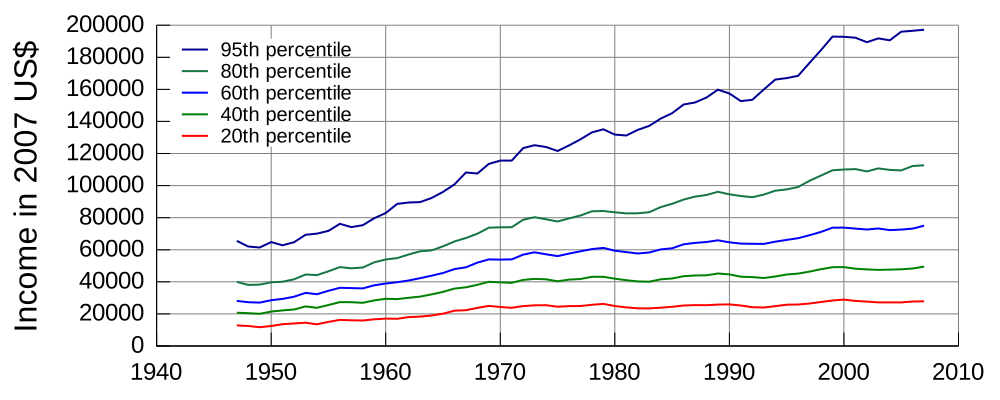
Graph of United States income distribution from 1947 through 2007 inclusive, normalized to 2007 dollars. The data source is “Table F-1. Income Limits for Each Fifth and Top 5 Percent of Families (All Races): 1947 to 2007”, U.S. Census Bureau, Current Population Survey, Annual Social and Economic Supplements.

In Closing the financial gap, I showed how direct money transfers don’t close the gap, and I asked, “Is closing the gap economically wise? That is, would our economy grow better, and would our population live better, happier, more rewarding lives overall, if there were little or no gap?

I believe attention paid to closing the gap, by bringing down the rich, is a diversion from the real economic and moral questions that surround poverty. Concern about the rich feeds on that commonly felt class jealousy to which politicians respond with counter-productive laws, which do nothing for the poor or for the economy.

Classic example: Inheritance taxes. They have little effect on tax collections, and to the degree they would affect tax collections, they also would reduce economic growth. And they do nothing to improve the lot of the poor. These, and all other attempts to reduce the gap, by punishing the rich, tend to hurt the economy and the people who most want the gap reduced.

Punishing the rich should not be the goal, but rather we should try to lift our poorest, regardless of whether or not that closes or even opens the gap. In the previous post I suggested that just as government pays for elementary school, middle school and high school, why not have the government pay for college and even advanced degrees? This would give the poor a better opportunity to lift themselves.

One reader expressed concern this actually could have an adverse effect on the economy: “The world still needs ditch diggers,” he wrote.

My response: “The world does not need ditch diggers. The world needs ditches to be dug. Slowly, inexorably, society is moving away from dumb human labor and toward smart machine labor. Those people who do not have an education will not just be relegated to the lowest jobs. They will have no jobs at all. There simply will be no ditch-digging work available.”

While I agree with Modern Monetary Theory (MMT) in many ways, one of my disagreements is its dual goal of price stability and full employment. MMT calls for the government to be the employer of last resort, so that everyone who wants a job, has a job. But MMT ignores job quality in its quasi-charity approach. Giving jobs to everyone surely would devolve to giving money to everyone for little or no work at all.

While unemployment seems to correspond with recessionary times, I see no evidence that unemployment causes recessionary times. Some might even say that unemployment helps stimulate the prevention and cure of recessions just as hunger feelings help stimulate the prevention and cure of starvation. In fact, that is the very purpose of hunger feelings.

In short, unemployment may be only a symptom, just as hunger is a symptom of starvation. Curing the hunger symptom does not cure the starvation disease, as any anorexic should know. Focusing on the symptom may divert attention from the fundamental problem, which is acquisition ability (AA)– people’s ability to acquire what they want.

MMT may claim full employment is not a symptom, but rather a path toward the AA goal. MMT wants the government to achieve full employment by providing a job to anyone who wants one, and apparently the job can be anything. But I suspect a nation of Walmart greeters is not desirable.

So what about a nation of college grads? Is that better? Despite the typical “Who-will-dig-the-ditches?” questions, the answer may be, “Yes.”

A college grad, digging ditches, may be more likely to think of better ditch-digging methods, to the benefit of society. This is an extreme example, and I’ve left the psychology of job satisfaction out of the mix, but I speculate that education will lift the economy, meaning MMT’s focus on jobs is fundamentally wrong.

Rather than the government being the employer of last resort, perhaps the government should be the educator of first resort. That might do more to lift the poor and lift America, than giving people low level, dead-end jobs.

In summary, the problem is not specifically the gap, but poverty. The partial solution is not low end jobs, but education.

Rodger Malcolm Mitchell
http://www.rodgermitchell.com

No nation can tax itself into prosperity