–Failing U.S. transportation system will imperil prosperity, report finds

The debt hawks are to economics as the creationists are to biology.

Failing U.S. transportation system will imperil prosperity, report finds
The Washington Post, 10/4/10

Read this article, then ask the Tea Partyers (You know – those clever people who want less taxes and government) how they plan to handle this.

The United States is saddled with a rapidly decaying and woefully underfunded transportation system that will undermine its status in the global economy unless Congress and the public embrace innovative reforms, a bipartisan panel of experts concludes in a report released Monday.

U.S. investment in preservation and development of transportation infrastructure lags so far behind that of China, Russia and European nations that it will lead to “a steady erosion of the social and economic foundations for American prosperity in the long run.”

That is a central conclusion in a report issued on behalf of about 80 transportation experts who met for three days in September 2009 at the University of Virginia. Few of their conclusions were ground-breaking, but the weight of their credentials lends gravity to their findings.

Co-chaired by two former secretaries of transportation – Norman Y. Mineta and Samuel Skinner – the group estimated that an additional $134 billion to $262 billion must be spent per year through 2035 to rebuild and improve roads, rail systems and air transportation.

“We’re going to have bridges collapse. We’re going to have earthquakes. We need somebody to grab the issue and run with it, whether it be in Congress or the White House,” Mineta said Monday during a news conference at the Rayburn House Office Building.

The key to salvation is developing new long-term funding sources to replace the waning revenue from federal and state gas taxes that largely paid for the construction and expansion of the highway system in the 1950s and 1960s, the report said.
ad_icon

“Infrastructure is important, but it’s not getting the face time with the American people,” Skinner said. “We’ve got to look at this as an investment, not an expense.”

A major hike in the federal gas tax, which has remained unchanged since it bumped to 18.4 cents per gallon in 1993, might be the most politically palatable way to boost revenue in the short term, the report said, but over the long haul, Americans should expect to pay for each mile that they drive.

“A fee of just one penny per mile would equal the revenue currently collected by the fuel tax; a fee of two cents per mile would generate the revenue necessary to support an appropriate level of investment over the long term,” the report said.

Fuel tax revenues, including state taxes that range from 8 cents in Alaska to 46.6 cents in California, have declined as fuel efficiency has grown. President Obama mandated that new cars get 35.5 miles on average per gallon by 2016, and government officials said last week that they are considering raising the average to 62 miles per gallon by 2025.

Facing mid-term elections this fall, Congress has lacked the will to tackle transportation funding. Efforts to advance a new six-year federal transportation plan stalled on Capitol Hill after the previous one expired last year.

If Congress were to do the report’s bidding, the task would be far broader in scope than simply coming up with trillions of dollars in long-term funding to rebuild a 50-year-old highway system.

The experts also advocated adoption of a distinct capital spending plan for transportation, empowering state and local governments with authority to make choices now dictated from the federal level, continued development of high-speed rail systems better integrated with freight rail transportation, and expansion of intermodal policies rather than reliance on highways alone to move goods and people.

But Mineta noted that 42 days after an eight-lane bridge collapsed into the Mississippi River in Minneapolis a survey found that 53 percent of respondents were against an emergency gas tax increase to pay for infrastructure repairs.

“The shelf life of a tragedy like [I-35W] was 42 days,” he said. Thirteen people died in the collapse and more than a hundred were injured.

The report emphasized that federal policy should be crafted to address congestion by providing incentives that encourage land use that reduces single-occupant commutes and promotes “liveable communities.”

“Creating communities conducive to walking and alternate modes of transportation . . . should be an important goal of transportation policy at all levels of government,” the report said.

It also encouraged expansion of innovative public-private partnerships to further transportation goals, citing the high-occupancy toll lane project in Northern Virginia as an example.
ad_icon

“The one option that’s not in this report is throwing up our hands,” said Jeff Shane, a former Transportation Department official and a member of the panel. “That seems to be the option that Congress chooses.”

Congress does not want to ask for tax money, so the problems do not get solved. But there is a solution: Federal deficit spending without taxes. Sadly, the debt-hawks’ mistaken belief that deficits are harmful to our children and us, prevents curing our problems. There is a long list of problems our children suffer today, and will suffer in the future, because of the debt hawks. (See: Debt Hawk Problems )

Rodger Malcolm Mitchell
http://www.rodgermitchell.com

No nation can tax itself into prosperity
–Does China need to export as much as it does?

The debt hawks are to economics as the creationists are to biology.

It widely is believed China must continue to increase its exports to maintain its economic growth and to pay its massive population. The desire for growing exports is what drives China’s reluctance to revalue the yuan upward.

But, does China’s economy really rely on ever-increasing exports? China is a Monetarily Sovereign nation. As such it has the unlimited ability to create its own sovereign currency.

Think of what happens when Chinese Factory “A” exports to the United States. Factory “A” receives dollars, a foreign currency it cannot use to pay its workers. So how does Factory “A” pay its workers? It exchanges these dollars for the yuan China creates from thin air.

This means, for every dollar Chinese Factory “A” receives, the Chinese government creates 6.7 yuan (current exchange rate), which it gives to Factory “A” in exchange for U.S. dollars. Factory “A” pays its workers with yuan, created by the Chinese government, while the Chinese government amasses dollars.

The Chinese government can use some of those dollars for international trade (oil purchases, etc.), but many become T-securities held in China’s account at the Federal Reserve Bank. In short, China’s economic growth requires the Chinese government to create yuan from thin air.

If Chinese factories exported less and received fewer dollars, the Chinese government could continue to create and distribute the same number or yuan as now. The only difference: Instead of giving these yuan to its people in exchange for many dollars, it merely would give those same yuan to the people, while receiving fewer dollars.

There would be less accumulation of T-securities at the FRB, a difference that has scant effect on the Chinese worker or on the Chinese economy.

How would the Chinese government give yuan to its people, if it were not exchanging yuan for dollars? Answer: More domestic deficit spending on things like roads, health care, retirement benefits, etc. A case might be made that the Chinese population would be better off receiving salaries for building domestic roads, providing domestic health care, etc., than receiving salaries for creating toys, clothing and other export items of no domestic value.

Without exports, the Chinese government would create about the same number of yuan as it now creates with exports. The entire domestic process would be affected very little. Yes, China can use U.S. dollars for certain imports, but I suspect it already has stockpiled enough dollars for that purpose to last several lifetimes, so the question becomes: Does China need to export as much as it does?

Monetarily non-sovereign nations like the PIIGS, which cannot produce unlimited amounts of money, need to have a positive balance of payments. So the other question is: Why does the U.S., which is monetarily sovereign, want to increase exports?

Rodger Malcolm Mitchell
http://www.rodgermitchell.com

No nation can tax itself into prosperity

–What will cause the next inflation?

The debt hawks are to economics as the creationists are to biology.

The debt hawks say federal deficit spending will cause inflation. History says they are wrong. There is no post-1971 (end of the gold standard) relationship between federal deficits and CPI. (See: INFLATION) In fact, despite massive deficit spending, the Fed today is most worried about deflation.

Nevertheless, I now believe inflation has become a threat.

In a letter dated October 1, 2010, John Mauldin said:

“John Hofmeister is the former president of Shell Oil and now CEO of the public-policy group Citizens for Affordable Energy. He paints a very stark picture of the future of energy production in the US unless we change our current policies. First, because of the aftereffects of the moratorium. It is his belief that the drilling moratorium will effectively still be in place until at least the middle of 2012. There won’t even be new rules until the end of 2011, and then the lawsuits start.

“Gulf oil production will be down by up to 1 million barrels a day. Imported oil is now 67% of oil usage but will go to 75% by 2012. He thinks crude oil will be up to $125 and gasoline between $4-$5 at the pump. And it will only get worse.

“He describes the problem with the electricity from coal production. The average coal plant is 38 years old, with a planned-for life of 50 years. Our energy production capability is rapidly aging, and we are not updating it fast enough.

“He argues that the fight between the right and the left has given us 37 years without a realistic energy policy, as policy gets driven by two-year political cycles but good energy planning takes decades. There are 13 government agencies that regulate the energy industry, with conflicting mandates that change very two years. There are 22 congressional committees that have some level of involvement and oversight of the energy industry.”

Why is this important for inflation? Because although federal deficits do not correlate with inflation, energy prices do. And if we have the shortages Mr. Hofmeister suggests (a big “if” as oil supply is notoriously difficult to predict), they will translate into higher overall consumer prices. Yes, new oil sources are being discovered daily. And yes, progress is being made in developing alternative energy. But the modernization of huge populations in China, India, Russia and other less developed countries, is sure to increase world oil consumption, massively.

Inflation can be prevented and cured by raising interest rates. But our government is fixated on the false, debt-hawk belief that federal deficits cause inflation. So the political “cure” will be to reduce federal spending and/or to increase federal taxes, either of which, history shows, will devastate our economy.

In summary, the next inflation will come from energy shortages, which the debt hawk government will deal with by causing a recession.

Rodger Malcolm Mitchell
http://www.rodgermitchell.com

No nation can tax itself into prosperity. There is widespread belief the stimuli didn’t work. I am reminded of the man whose house was burning. His neighbor showed up with a garden hose and actually was able to reduce the flames, but only somewhat. The neighbor wanted to call the fire department, who would bring out the big hoses, but the man told him to stop, because “Obviously, water doesn’t put out fires.”

–John Mauldin defines “too much debt”

The debt hawks are to economics as the creationists are to biology.

John Mauldin responded to my comment on his post, “Pushing on a String”

“I don’t know why you think I would not respond. Just happened to see this on Google alerts.

I have been quite clear on what is too much debt. I have done whole e-letters on it. It is debt growth above nominal GDP on a consistent basis, which ends up in a Greece like state. In fact, I will have a book out in January called The Endgame which goes into hundreds of pages of detail about the problems with debt and debt crises.

Now, I do not want private businesses or people borrowing beyond their own means or banks lending if they do not think there is reason to believe they will be repaid. And there is a limit to how much countires can borrow. To assert that the US can borrow without limit is rather absurd. You write:
‘And here is the government, which can service a debt of any size, and functionally is incapable of bankruptcy, and the debt hawks want to restrict debt.’

Go read Rogoff and Reinhart. 266 crises in 60 countries over the last few hundred years, from countries that can print their own money to gold standard currencies. Everything was fine until the last moment. There are more than one ways to default on debt, and one way is to print the money and debase the money supply. Inflation ruins pensioners and savers. If that is your ideal future, then by all means, run up that debt!

John”

First John, you have my apology. You responded, and did so without name-calling, which not only is commendable, but a rarity in the debt hawk world. Unfortunately, you didn’t offer any facts, so I will supply one.

Again, you said,“I have been quite clear on what is too much debt . . . It is debt growth above nominal GDP on a consistent basis, which ends up in a Greece like state.”

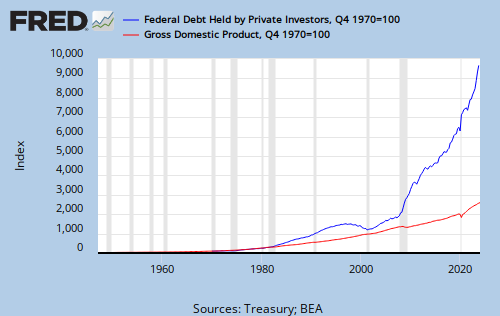
Here is a graph you might find interesting:

Graph

It shows that in the past 40 years GDP has risen less than 1,400% while federal debt has risen 3,500% — well more than double the rate. I would call that “debt growth above nominal GDP on a consistent basis,” wouldn’t you? Yet, where is the inflation?

The last big inflation was in 1979, at a time when debt growth did not exceed GDP growth.

Also, ” . . . ends up in a Greece like state . . .” makes no sense, whatsoever. The U.S. is monetarily sovereign. Greece is not. It functionally is impossible for a monetarily sovereign nation magically to transform itself into a “Greece like state.”

The debt hawk inflation bogeyman emerges every time deficit spending is mentioned. I’m surprised you didn’t offer pre-war Germany or Zimbabwe as examples. But that bogeyman has hurt the lives of real people. It has prevented universal health care. It has restricted Social Security and Medicare benefits. It has given us a monster, wasteful, unnecessary federal tax system. And all because the debt hawks tell us that eventually — eventually — we will have inflation.

Yet, money debasement is not related only to money supply, but more importantly to money demand (interest rates), which is why in the past 40 years, there has been no relationship between federal deficits and inflation.

Again, I do appreciate your comments and your courage, but because you do not understand monetary sovereignty, you simply are wrong.

Rodger Malcolm Mitchell
http://www.rodgermitchell.com

No nation can tax itself into prosperity.