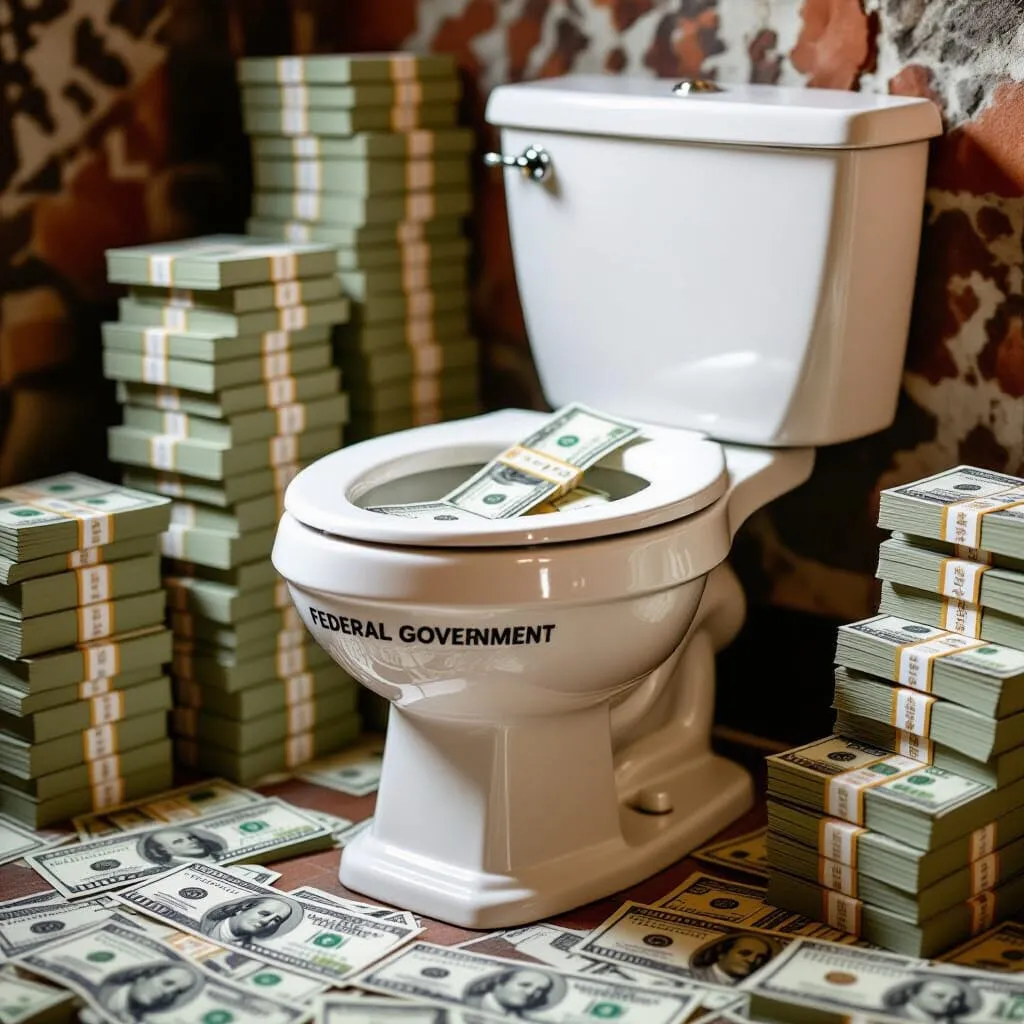
The federal government is “Monetarily Sovereign.” That means, it creates all the money it spends by pressing computer keys. It never, never, never can run short of dollars.
Even if the federal government didn’t collect a single penny in taxes, it could continue to spend forever. Who says so?
Fed Chairman, Alan Greenspan: “A government cannot become insolvent with respect to obligations in its own currency. There is nothing to prevent the federal government from creating as much money as it wants and paying it to somebody. The United States can pay any debt it has because we can always print the money to do that.”
Fed Chairman, Ben Bernanke: “The U.S. government has a technology, called a printing press (or, today, its electronic equivalent), that allows it to produce as many U.S. dollars as it wishes at essentially no cost. It’s not tax money… We simply use the computer to mark up the size of the account.
Fed Chairman Jerome Powell stated, “As a central bank, we have the ability to create money digitally.
The St. Louis Fed: “As the sole manufacturer of dollars, whose debt is denominated in dollars, the U.S. government can never become insolvent, i.e., unable to pay its bills. In this sense, the government is not dependent on credit markets to remain operational.”
Chat GPT: “The federal government is not financially constrained and does not need to ‘fund’ its spending.”
Treasury Secretary, Paul O’Neill: “I come to you as a managing trustee of Social Security. Today we have no assets in the trust fund. We have promises of the good faith and credit of the United States government that benefits will flow.”
Mario Draghi, President of the Monetarily Sovereign European Central Bank “We cannot run out of money.”
Paul Krugman (Nobel Prize–winning economist): “The U.S. government is not like a household. It literally prints money, and it can’t run out.”
Why does the federal government collect taxes if the government doesn’t need the money?
To control the economy by taxing what the government wishes to discourage and by giving tax breaks to what the government wishes to reward.
To assure demand for the U.S. dollar by requiring dollars to be used to pay taxes.
You pay taxes with money from the M2 money supply measure. When your dollars reach the Treasury, they cease to be part of any money supply measure. Effectively, they are destroyed.
Why are they not included in any money supply measure? The government has infinite money, and therefore there is no measure for infinity.
When Donald Trump claims to reduce the debt through tariffs, he is misleading you in two ways.
Tariffs are paid by the buyer. They are part of the price you pay for imported goods.
Tariff dollars come out of the U.S. economy. They reduce economic growth and lead to recessions.
Tariffs reduce Net Federal Deficit Spending (blue line) as well as the Debt/ Gross Domestic Product ratio (red line). Reductions in these lines lead to recessions (vertical gray bars), which are cured only by increases in federal deficit spending.
Thus, Trump’s tariffs hurt you in three ways.
They take dollars directly out of your pocket
They cause overall inflation.
And they lead to recessions.
The side effects of inflation and recessions include demands to cut social benefits and increase taxes to “fund” them.
Trump relies on your not understanding the differences between federal finances and your personal finances. You cannot create dollars from thin air. You must have sufficient income to cover your expenses.
The federal government can create dollars from thin air, and it neither needs nor uses income to fund its spending.
And no, federal deficit spending does not cause inflation.
Contrary to popular myth, there is no relationship between changes in federal deficit spending (blue) and inflation (green). The peaks and valleys of the two lines do not correspond.
So what does cause inflation? Shortages of crucial goods and services, most notably shortages of energy.
Note the close relationship between inflation (green) and oil prices (orange). Energy and food are the primary drivers of inflation.
To prevent and cure inflation, we never should cut federal spending. All that does is cause recessions. Instead, we should cure the shortages that caused the inflation.
When the primary cause is an oil shortage, the government should:
Deficit spending to support oil drilling and refining
Support the production of renewable energy (wind, solar, geothermal, atomic).
Support the use of renewable energy (i.e., electric cars and trucks)
Fund research into creating more energy sources
Sadly, we are doing the opposite. Trump is discouraging the development of wind energy (his “windmills”) and solar power, while also discouraging the use of renewable energy sources (such as credits for solar installations and electric cars).
The massive tariff collections + discouraging the production of renewable energy + discouraging the use of renewable energy combine to make a perfect inflation/recession storm (aka “stagflation.”)
When the inevitable stagflation happens, we Trump will blame it on Biden, Obama, the Fed, any data-gathering agency that tells the truth, China, Mexico, Canada, NATO, black “criminals,” Mexican “rapists,” immigrants, “woke,” people collecting social benefits like Medicare, Social Security, Obamacare, and “stolen” elections.
The test is scored 2 (definitely present), 1 (possibly present), and 0 (not present). A total score of 30 or more is generally considered the threshold for diagnosing psychopathy.
Although you may not be a professional psychologist, and you may only have a distant observation of Donald Trump and his actions and statements, you can come to your own private conclusion about him. My guess is that the result will not be in question.
SUMMARY and PREDICTIONS
The federal deficit is necessary for economic growth and to prevent/cure recessions and depressions. You, not a foreign nation, pay for the tariffs.
Trump’s wildly eccentric and highly damaging use of tariffs will result in stagflation, which he will deny exists and/or blame on others or on world situations.
His proven reluctance to accept adverse facts will prevent him from addressing stagflation, which will worsen as he remains in power.
He will attempt to remain in office even after his current term ends, and at least three members of the Supreme Court — Alito, Thomas, and Gorsuch — will approve of his “creative” efforts to remain president in name or in fact(i.e., running as a Vice President with the intention of having the President resign).
Here are truths you have learned that your friends do not know, do not understand, and, being unaware of the facts, will forcefully deny:
1.The U.S. federal government is Monetarily Sovereign.
That means it generated its first revenue by passing laws. It created, from thin air, as many dollars as it wished and gave those dollars whatever value it wanted.
The government arbitrarily valued the first dollar at 371.25 grains of pure silver (approximately 24.1 grams). Later, the government arbitrarily defined the dollar as equal to 24.75 grains of gold (about 1.6 grams).
1834 — Gold Revaluation: Congress arbitrarily redefined the gold dollar to: $1 = 23.2 grains of gold (~1.5 grams)
1933 — Roosevelt Devaluation, after the Great Depression began, FDR arbitrarily ended gold coin circulation and made private gold ownership illegal (with exceptions). Then, in 1934, via the Gold Reserve Act, the official gold price was arbitrarily redefined to $35 per ounce ($1 = 13.714 grains of gold; ~0.89 grams)
1971 — President Nixon Ends Convertibility. Nixon closed the gold window (foreign redemption suspended). The dollar was no longer exchangeable for gold or any other physical commodity. The dollar was purely numbers on balance sheets.
Due to the government’s ability to generate numbers and control its own balance sheets, it has created an unlimited capacity to produce dollars.
Therefore, the federal government cannot run out of dollars unwillingly; it can create them at its discretion.
Federal Reserve Chairman Alan Greenspan: “A government cannot become insolvent with respect to obligations in its own currency. There is nothing to prevent the federal government from creating as much money as it wants and paying it to somebody. The United States can pay any debt it has because we can always print the money to do that.”
Federal Reserve Chairman Ben Bernanke: “The U.S. government has a technology, called a printing press (or, today, its electronic equivalent), that allows it to produce as many U.S. dollars as it wishes at essentially no cost. It’s not tax money… We simply use the computer to mark up the size of the account.
Here, Ben Bernanke expresses the basic truth of federal financing, a truth that is denied by most economists, politicians, and the media: FEDERAL TAXPAYERS DO NOT FUND FEDERAL SPENDING.
Too often, you read or hear how someone is “spending taxpayer dollars,” or “wasting taxpayer dollars.” Those statements can be true of monetarily non-sovereign state and local government taxpayer dollars, but they cannot be true of the Monetarily Sovereign federal government taxpayer dollars.
Your federal taxes do not fund anything. They are destroyed upon receipt. The purpose of federal taxes is not to fund spending but to:
Control the economy by taxing what the government wishes to discourage (i.e. “sin” taxes on cigarettes) and giving tax breaks to what the government wishes to encourage (i.e. tax breaks for charity giving, and solar electricity.).
Assure demand for the U.S. dollar by requiring taxes be paid in dollars.
Make the rich wealthier by giving them tax breaks not available to ordinary Americans (Example: Trump paying $0 taxes for 8 out of 10 years), thus widening the Gap between the rich and the rest.
Federal Reserve Chairman Jerome Powell: “As a central bank, we have the ability to create money digitally.”
The St. Louis Federal Reserve: “As the sole manufacturer of dollars, whose debt is denominated in dollars, the U.S. government can never become insolvent, i.e., unable to pay its bills. In this sense, the government is not dependent on credit markets to remain operational.”
Secretary of the Treasury Paul O’Neill: “I come to you as a managing trustee of Social Security. Today we have no assets in the trust fund. We have promises of the good faith and credit of the United States government that benefits will flow.”
Paul Krugman (Nobel Prize–winning economist): “The U.S. government is not like a household.
It literally prints money, and it can’t run out.”
Ask your doubting friends which authority they believe more than three Fed Chairmen, a Treasury Secretary, a Nobel-winning economist, and the St. Louis Fed.
Other Monetarily Sovereign nations include Japan, Canada, Australia and the United Kingdom. They too cannot unintentionally run short of their own sovereign currencies.
The U.S. state, county, and city governments, along with businesses and individuals, are financially non-sovereign. They are simply users of dollars, and can run out of them.
Eurozone countries, such as France, Germany, Portugal, and Italy, do not have monetary sovereignty over the euro. They use it without the ability to create it, which means they can run out of euros.
Monetarily non-sovereign entities can create dollars by lending. When anyone borrows from a bank, the bank does not go into a vault and find dollars. Instead, the bank types this into its ledger:
The borrower (customer) now has a newly created $100,000 to spend.
The bank has an asset (the borrower’s promise to repay with interest) and a liability (the deposit into the checking account). No cash changes hands. No reserves are touched.
Over 90% of U.S. dollars in existence are bank deposits, created by private commercial banks.
2. Gold and silver are not, and never were, dollars.
The U.S. federal government established arbitrary rules regarding the exchange of gold and silver for dollars, which are entirely within its control.
The dollar was never “backed” by gold; it was exchangeable for gold, a system always determined and controlled by the federal government.
The term “fiat” currency is a misnomer. “Fiat” originates from the Latin word meaning “let it be done.” In legal and administrative contexts, it refers to an authoritative order or decree established by a government or authority.
All money fits that definition, including dollars that the government decrees are exchangeable for gold or silver. Thus, all money is fiat.
The U.S. dollar has always been the debt of the federal government. Debt requires collateral. The collateral for federal debt is “full faith and credit.” This may sound nebulous to some, but it actually involves certain, specific, and valuable guarantees, among which are:
A. –The government will accept only U.S. currency in payment of debts to the government
B. –It unfailingly will pay all its dollar debts with U.S. dollars and will not default
C. –It will force all your domestic creditors to accept U.S. dollars if you offer them to satisfy your debt.
D. –It will not require domestic creditors to accept any other money
E. –It will take action to protect the value of the dollar.
F. –It will maintain a market for U.S. currency
G. –It will continue to use U.S. currency and will not change to another currency.
H. –All forms of U.S. currency will be reciprocal, that is five $1 bills always will equal one $5 bill and vice versa.
If you wish to issue your own money, there is no law against it. However, its acceptance would rely on its users’ belief in yourfull faith and credit.
For example, you could issue “My Greenbacks” and offer to pay your bills with them. If all your creditors agreed to accept “My Greenbacks” as payment, you instantly would become Monetarily Sovereign and have the infinite ability to pay all your bills.
You would not need to borrow or use any other form of income. You never would run short of money. Debt would not be a burden.
3. The U.S. government never borrows dollars. The “national debt” isn’t debt. It’s dollars.
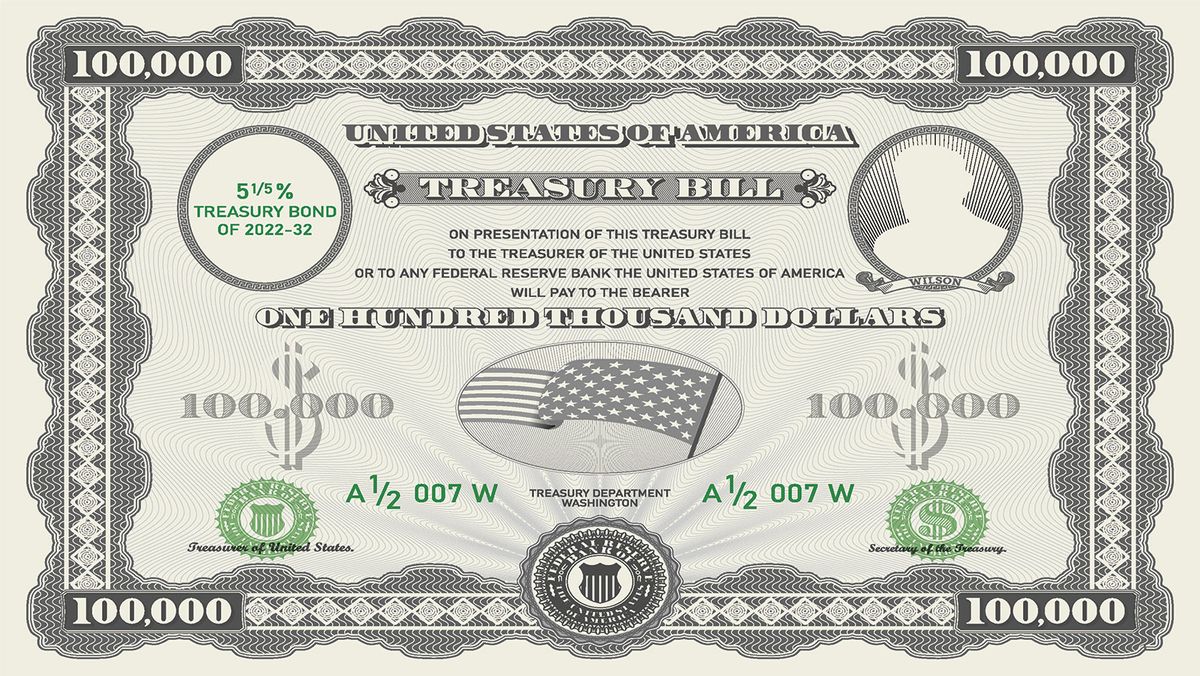
The belief that the federal government borrows is based on a semantic misunderstanding. The government issues Treasury Securities called “T-bills, T-notes, and T-bonds.” These are receipts for deposits into accounts owned by depositors.
The confusion arises from the terms “bills,” “notes,” and “bonds,” which, in the context of the federal government, refer to dollars, whereas in the private sector, they describe debt.
The term “national debt” often evokes the image of a household accumulating credit card debt. However, this comparison is misleading. In reality, what we call the national debt isn’t debt in the traditional sense; it is merely another form of U.S. dollars.
A U.S. dollar is not a physical commodity; rather, it is an entry in the financial records of the federal government. The dollar may be represented by a paper bill, a bank statement, or a Treasury security, and it signifies a legal obligation of the U.S. government.
The only difference is the form and terms of the obligation.
A T-bill is an interest-bearing IOU from the U.S. Treasury that matures at a fixed date. A dollar bill is a non-interest-bearing, zero-maturity IOU from the Federal Reserve. They both are financial obligations of the U.S. government.
A government that can create T-bills can just as easily generate dollar bills.
Yet, the media, and even the government, incorrectly describe T-bills as “debt” and dollar bills as “money.”
Donald Trump boasted that his tariffs would reduce federal debt.” That is identical to saying his tariffs would reduce dollars. And that is precisely what is happening. Tariffs remove dollars from the economy.
Dollars in the economy are being reduced, which is recessionary.
When the public pays the tariffs, dollars in the economy flow to the federal government, where they are destroyed. The federal government does not have a vault where it keeps dollars. It creates new dollars, ad hoc, every time it pays a creditor.
Treasury securities are simply time-bound dollars that pay interest. They are not borrowed dollars; they merely are dollars.
When you invest in a T-bill, one type of government-backed money (a deposit of dollars) is exchanged for another type (a T-bill). This is no different in principle from moving funds from a checking account to a savings certificate.
The term “debt” is applied to Treasury securities by accounting convention. We count the sum of outstanding T-bills, notes, and bonds as “the national debt.” We do not refer to dollar bills, reserve balances, or bank deposits as “national debt.”
Rather than providing the federal government with spending funds, the purposes of T-securities are to:
Provide the private sector with a safe, interest-bearing place to store unused dollars — safer than any private bank.
Provide a mechanism for managing bank reserves and setting interest rates
Provide the federal government with a semantic rationale for claiming that benefits for middle- and lower-income people are “unaffordable” and “unsustainable,” while continuing to give tax breaks to the rich — i.e., widening the income/wealth/power Gap between the rich and the rest, thus making the rich richer.
Paying off Treasury securities involves debiting T-security accounts and crediting bank accounts. The government does not need to “earn” dollars before doing this. It merely changes the form of its liability from T-bills to dollar bills, the reverse of what it did when issuing the T-bill in the first place.
Reducing federal “debt” (red) is the same as reducing the number of dollars in the economy. This leads to reductions in Gross Domestic Product (blue) and causes recessions (vertical gray bars). The recessions are cured by increases in federal “debt” (money).
U.S. depressions come on the heels of federal surpluses.
1804-1812: U. S. Federal Debt reduced 48%. Depression began in 1807.
1817-1821: U. S. Federal Debt reduced 29%. Depression began in 1819.
1823-1836: U. S. Federal Debt reduced 99%. Depression began in 1837.
1852-1857: U. S. Federal Debt reduced 59%. Depression began in 1857.
1867-1873: U. S. Federal Debt reduced 27%. Depression began in 1873.
1880-1893: U. S. Federal Debt reduced 57%. Depression began in 1893.
1920-1930: U. S. Federal Debt reduced 36%. Depression began in 1929.
1997-2001: U. S. Federal Debt reduced 15%. The recession began in 2001.
The reason: Gross Domestic Product, the most common measure of the economy is the total of: Federal Spending + Non-federal Spending + Net Exports.
Decreases in Federal Spending also decrease Non-federal Spending, and these decreases decrease GDP.
In short, the so-called federal “debt” is a record of how many more dollars the federal government has added to the economy by spending than it has removed by taxing.
Adding dollars to the economy grows the economy. Thus the so-called “debt” demonstrates economic growth. The larger the debt, the greater the growth. Lack of debt growth = recession.
4. Tariffs are sales taxes on buyers.
If your governor or mayor boasted that he/she was going to increase sales taxes so that the government could take in more money, would you consider that good news?
That is no different from the President boasting that he increased tariffs so that the government could take in more money.
Actually, the Presidential boast is worse because states and cities needand spend tax revenue, the federal government doesn’t.
When Donald Trump and his associates claim that the government will receive trillions in tax revenue, they essentially are stating that they will extract trillions from the U.S. economy solely to make the wealthy even richer.
How do increased tariffs benefit the rich? To become wealthier, the rich must widen the income/wealth/Gapbelow them and narrow the Gap above them.
Those of us who are not rich pay a greater percentage of our incomes on products subject to duties than do the rich. The duties widen the income/wealth/power Gap between the rich and the rest, and it is the Gap that makes them rich.
If there were no Gap, no one would be rich. We all would be the same, and the wider the Gap, the richer they are. Tariffs widen the Gap.
5. The federal government cannot spend tariff dollars.
President Donald Trump said he is considering distributing rebates to U.S. taxpayers because of billions of dollars from tariffs flowing in from foreign imports.
This either is based on his ignorance of federal financing or, more likely, his intentional misrepresentation of how federal finance works.
State and local governments, businesses, and individuals like you and me are all monetarily non-sovereign, meaning we rely on income and borrowed funds. In contrast, our federal government, which is Monetarily Sovereign, does not depend on income or borrowing. Instead, it creates new dollars as needed whenever it pays a creditor.
Your federal tax dollars are destroyed the instant they are received by the Treasury. The process is:
1. You pay your taxes by taking dollars from your checking account. These dollars are taken from the M2 money supply measure.
2. When your dollars reach the Treasury, they cease to be part of any money supply measure. There is no measure of the Treasury’s money supply because the Treasury has access to an infinite amount of dollars.
As a result, your federal tax dollars are effectively removed from circulation, while new dollars are created and sent to creditors.
Once these new dollars reach the banks of the creditors, they are added to the M2 money supply. This is how the federal government generates dollars—by settling its obligations.
In summary, Trump cannot distribute tariff dollars. They disappear immediately. He can, at will, send as many dollars as he wishes to anyone he wishes because the government has infinite dollars available to spend. He could have sent the “rebates” the day he came into office, or today. Waiting for tariff dollars is a meaningless gesture.
Tariff collections do not add to the federal government’s ability to spend. That ability remains infinite, whether or not tariffs are collected.
By contrast, state/local tax dollars are not destroyed. They go into banks where they continue to be part of the M2 money supply. State/local governments do spend the tax dollars and other income they receive.
6. Inflation is supply-based.
The traditional view suggests that inflation occurs due to “too much money chasing too few goods.” However, this outdated explanation misses the more immediate cause of inflation: supply shortages, especially in essential goods like oil, food, and housing.
Inflation always results from an imbalance between demand and supply. But we must ask: what causes that imbalance? Federal spending increases the money supply, which in turn can increase demand for goods and services.
However, demand typically builds gradually and through indirect channels, like increased employment, public contracts, or income supports.
In contrast, supply shocks tend to happen abruptly. Wars, pandemics, droughts, embargoes, and logistical breakdownscan slash the availability of key goods almost overnight.
When essential commodities like oil or wheat are suddenly scarce, prices rise across the board, not because of excessive money, but because of insufficient supply.
Historical Examples of Supply-Driven Inflation
Real-world inflation episodes across the globe support the supply-side view:
1950–1951 Korean War: At the outbreak of the Korean War, prices surged due to panic buying, military buildup, and supply bottlenecks in key materials like steel, rubber, and oil.
1970s U.S. Oil Shocks: The Organization of the Petroleum Exporting Countries (OPEC) imposed oil embargoes in 1973 and 1979, causing significant price increases. Inflation rose, not due to excessive federal spending, but because of the sudden drop in oil supply.
1973–1974 Global Food Crisis: In addition to the 1973 oil shock, the early ’70s saw a global spike in grain prices, partly due to poor harvests, rising meat consumption, and large U.S. grain sales to the Soviet Union.
2005 Hurricane Katrina: Katrina damaged Gulf Coast oil production and refining capacity, leading to a temporary spike in gasoline prices.
2020–2022 COVID-19 Pandemic: Lockdowns disrupted global supply chains, while shipping bottlenecks and factory shutdowns diminished the availability of goods. This was followed by inflation, despite subdued household demand early in the pandemic.
Post-War Europe (1940s–50s): After WWII, devastated infrastructure and displaced populations created widespread scarcity of goods, particularly food and housing, leading to inflation across the continent. Currency reform helped, but the recovery of supply was the key.
Zimbabwe (2000s): Though frequently cited as an example of money printing leading to hyperinflation, the primary cause was the devastation of agricultural output due to land confiscations. This resulted in food shortagesand a decline in export revenue, ultimately leading to the collapse of the currency.
Weimar Germany (1920s): Reparations payments and loss of industrial territory after WWI, combined with political unrest and a halt in domestic production, created shortages. Hyperinflation followed only after real output had drastically fallen.
These examples show that supply breakdowns, whether from war, sanctions, pandemics, or policy, are central to inflation crises.
Time Asymmetry: The Hidden Factor
A crucial but underappreciated aspect is time. Demand tends to rise slowly, giving markets and the government time to adjust. But supply can fall sharply and without warning.
The economy does not self-correct at the same pace in both directions, and government reaction can have difficulty keeping up with the shortages.
Federal deficit spending rarely causes direct demand spikes for food or oil. Most government spending enters the economy as a general stimulus, bolstering incomes, investment, and production.
If inflation arises during such periods, it generally coincides with supply constraints, not with runaway consumer demand.
The Mistake of Fighting the Wrong Cause
When policymakers target inflation by suppressing demand, through higher interest rates or spending cuts, they may worsen economic pain without resolving the shortage.
Interest rate hikes do not produce more wheat, oil, or housing. They may instead trigger unemployment or recession. Reductions in federal spending are recessionary.
Understanding that most inflation is driven by supply indicates different solutions: strengthening supply chains, investing in domestic production, stabilizing essential imports, and maintaining strategic reserves. All these measures require increased federal spending rather than a reduction.
Conclusion
Inflation is rarely, if ever, a sign of excessive money supply; rather, it indicates a shortage of goods.
We should stop blaming federal deficits for what are clearly supply-side problems. Better policy begins with better diagnosis, and in today’s world, that means putting shortages at the center of our efforts to prevent and cure inflation.
If you type “unsustainable federal debt” into your search bar, you will see this: (Try it)
Implications of Unsustainable Debt 1. Economic Growth Risks: Rising debt levels can lead to slower economic growth as more government resources are allocated to interest payments rather than productive investments.
2. Increased Borrowing Costs: As debt accumulates, the government’s borrowing costs may rise, crowding out investments in other critical areas such as infrastructure and education.
3. Potential Default: If corrective actions are not taken, the U.S. could face a situation where it defaults on its debt obligations, either explicitly or through inflationary measures.
Experts suggest that without significant fiscal reforms, the U.S. government may face a fiscal crisis within the next 20 years.
Recommendations for Addressing Federal Debt To mitigate the risks associated with unsustainable federal debt, policymakers are urged to develop strategies that include:
*Reforming Spending: Addressing the key drivers of federal spending, particularly in healthcare and social programs, to align expenditures with revenues.
*Increasing Revenues: Exploring options to enhance tax revenues, such as eliminating certain tax deductions and increasing corporate and individual income taxes.
*Implementing Fiscal Policies: Establishing a comprehensive fiscal policy framework that prioritizes long-term sustainability over short-term gains.
Not one sentence in the above is true. Together, they form what is widely known in economics as “The Big Lie.”
It’s a series of lies that may not be the result of malevolence; it may just be ignorance. Either way, it’s wrong and harmful.
Let’s begin at the top:
The Lie: “Rising debt levels can lead to slower economic growth as more government resources are allocated to interest payments rather than productive investments.”
This lie includes two false assumptions: That federal deficit spending slows growth and government resources are limited by interest payments.
The Truth: Government deficit spending adds growth dollars to the economy as this formula illustrates: Gross Domestic Product = Federal Spending + Nonfederal Spending + Net Exports.
By formula, the more federal spending, the more economic growth.
The lie that federal deficit spending slows growth is disproven by the mathematical definition of economic growth.
The idea that Government resources are limited by interest payments is disputed by the experts from the three Fed Chairmen, the St. Louis Fed Bank, and the Treasury, all acknowledging that the federal government has unlimited resources. It cannot run short of dollars.
=======================================
The Lie: “As debt accumulates, the government’s borrowing costs may rise, crowding out investments in other critical areas such as infrastructure and education.”
This Lie makes false assumptions:
False assumption: The federal government borrows U.S. dollars.
The Truth: The federal government never borrows U.S. dollars. Having the infinite ability to create dollars, the assumption makes no sense on its face. The confusion arises because of the words, “bill,” “note,” “bond,” and “debt” all of which have different meanings in federal finance vs. private finance.
In private finance, those words indicate that money is owed. In federal finance, a T-bill, T-note, and T-bond represent deposits (not borrowing) into Treasury security accounts.
The purpose of those accounts is not to acquire spending money but rather to:
*Provide dollar holders with a safe place to store unused dollars — safer than any bank in the world — which is why nations such as China store dollars there, and
*Help the Fed control interest rates by creating a base rate upon which all other rates are calculated.
The total of outstanding T-bills, T-notes, and T-bonds is misnamed “debt,” though nothing is owed. These accounts resemble bank safe-deposit boxes, in which valuables are held by a bank but not owed to the depositor.
The so-called “debt” is nothing more than a simple exchange of money. You send dollar bills to the government, and the government sends you Treasury bills. They both are U.S. money, with exactly the same backing: the full faith and credit of the United States government.
A dollar bill and a Treasury bill are identical in terms of government liability. They both are U.S. money issued by the U.S. government.
As the St. Louis Fed clearly said, “the government is not dependent on credit markets (i.e., does not borrow) to remain operational.”
False assumption: “… the government’s ‘borrowing’ costs may rise, crowding out investments in other critical areas
The Truth: The government’s “borrowing costs” (meaning interest payments) will have no effect on the government’s ability to pay interest. It has infinite ability to pay for anything.
We are not sure what “crowding out” means. If it means the government will run short of dollars, that clearly is impossible.
If it means that private sector borrowers will be unable to borrow, that too is false. Interest rates are arbitrarily controlled by the Fed and are not related to the issuance of Treasury securities. The Fed sets interest rates to control inflation.
===================================
The Lie: “… the U.S. could face a situation where it defaults on its debt obligations, either explicitly or through inflationary measures.
The Truth: Again, we see multiple false assumptions:
First false assumption: “… the U.S. could face a situation where it defaults on its debt obligations.”
As every competent economist (including those mentioned above) has said, “The federal government never can become insolvent, i.e., unable to pay its bills.” Having the infinite ability to create dollars confirms this.
Second false assumption: “… through inflationary measures.”
We are not sure if this means that federal spending causes inflation, a claim not in accord with history.”
Inflation never has been caused by federal spending. Every inflation has been caused by shortages of critical goods and services. The most recent COVID-related inflation was caused by shortages of oil, food, shipping, metals, lumber, labor, computer chips, and other needs. Inflation was being mitigated by federal spending to obtain and distribute scarce items.
Or does “inflationary measures” mean that the measures to forestall inflation actually cause defaults on debt obligations? The Fed mistakenly raises interest rates to combat inflation, but a nation with the ability to create its own money can never default.
And in any event, the government pays its misnamed “debt” by the simple act of returning the dollars that reside in T-security accounts. This is not a financial burden on the government.
Yes, for eighty-five years, they have been crying wolf, and the people have yet to catch on. Talk about slow learners!
Why the lies?
That is the most important question. The so-called “cures” for the non-existent “problem” of federal debt involve tax increases on the poor and/or reducing social programs that primarily aid those who are not wealthy, such as Social Security, Medicare, Medicaid, and food stamps.
Thought seldom is given to reducing benefits for the rich, like eliminating tax loopholes.
This was driven home yet again when billionaire President Trump revealed that he had paid virtually no income tax for ten years, a most enviable position — and his political party just passed a “Big, Beautiful” law that saves the rich billions, while the rest receive a pittance while losing some benefits.
This is no accident.
The lies that FICA taxes fund Social Security and Medicare, and that social programs must be cut, are told on behalf of the rich, whose money runs America.
The federal government has infinite money. It never can run short. It never can default on its obligations for lack of money.
Those of our information sources that promulgate The Big Lie either are ignorant of the facts or are bribed to lie. The rich bribe:
The media, via ownership and advertising dollars
The politicians, via political contributions and promises of lucrative employment later
The economists, via promises of employment with “think tanks” and university endowments.
IN SUMMARY
Even if the federal government did not collect a single penny in taxes, it could fund:
A generous “living-income” Social Security benefit for every man, woman, and child in America.
A livable Social Security benefit for every man, woman, and child in America
Comprehensive, no-deductible Medicare for every man, woman, and child in America
Generous aid for grades K-12.
Free college for all who want it.
Housing assistance
Generous support for the various scientific and medical research projects in America.
Economic growth
And it could do all of that without causing inflation.
America, you have been cheated and lied to, perhaps intentionally, perhaps ignorantly. The federal government has the wherewithal to make America a paradise on Earth. But the rich don’t want that, because if we all were equal, no one would be rich.
The rich want the income/wealth/power gapbetween the rich and the rest o us to widen. They want the desperation that forces people to accept jobs they don’t like and receive low pay.
So they bribe your sources of information to promulgate The Big Lie, that federal finances are like personal finances, and the government can’t afford to aid the “lazy” poor (who, on average, work harder than the rich).
It doesn’t have to be this way. However, it will remain so if the people reject the facts and choose to believe the lies.
If you don’t protest — if you don’t call, write, and gather groups to demand what if rightfully yours — if you weakly accept The Big Lie and think the truth “is too good to be true– then it always will be that you work hard, receive little, and your children and their children will do the same.
Now that you have heard the facts, the choice is yours.
You may have heard that inflation is too much money chasing too few goods and services. You’re about to learn that it simply is not true.
Question:Does massive federal spending cause inflation?
First, let us answer the intermediate question: Can our Monetarily Sovereign federal government massively spend without raising taxes?
Alan Greenspan, former Federal Reserve Chairman: “A government cannot become insolvent with respect to obligations in its own currency. There is nothing to prevent the federal government from creating as much money as it wants and paying it to somebody. The United States can pay any debt it has because we can always print the money to do that.”
Ben Bernanke, former Federal Reserve Chairman: “The U.S. government has a technology, called a printing press (or, today, its electronic equivalent), that allows it to produce as many U.S. dollars as it wishesat essentially no cost. It’s not tax money… We simply use the computer to mark up the size of the account.”
Jerome Powell, Federal Reserve Chairman: “As a central bank, we have the ability to create money digitally.
St. Louis Fed, in their publication titled “Why Health Care Matters and the Current Debt Does Not”:
“As the sole manufacturer of dollars, whose debt is denominated in dollars, the U.S. government can never become insolvent, i.e., unable to pay its bills. In this sense, the government is not dependent on credit marketsto remain operational.”
Paul O’Neill, former Secretary of the Treasury: “I come to you as a managing trustee of Social Security. Today, we have no assets in the trust fund. We have promises of the good faith and credit of the United States government that benefits will flow.”
Mario Draghi, former president of the (Monetarily Sovereign) European Central Bank, asked, “Can the ECB ever run out of money?”
Mario Draghi: Technically, no. We cannot run out of money.
Paul Krugman, Nobel Prize–winning economist: “The U.S. government is not like a household. It literally prints money, and it can’t run out.”
Hyman Minsky, Economist: “The government can always finance its spending by creating money.”
Eric Tymoigne, Economist: “A sovereign government does not need to collect taxes or issue bonds to finance spending. It finances directly through money creation.”
Three Federal Reserve Chairmen, the Secretary of the Treasury, the President of the European Central Bank, and three economists agree that the Monetarily Sovereign U.S. can never run short of dollars. This means it can always pay all its debt without borrowing or taxing.
Warren Mosler (MMT Founder): “Federal taxes don’t pay for anything. They function to remove money from the economy. The government doesn’t need taxes to spend—it taxes after spending to manage demand.
Frank Newman (Former Deputy Secretary of the U.S. Treasury): “The government creates money when it spends. Taxes are just a way to remove money.”
Stephanie Kelton (Economist, former Senate Budget Committee Chief Economist): “The U.S. government is not like a household. It is the issuer of the currency. It doesn’t need to ‘get’ money from anyone else—not from taxpayers, not from China.”
James Galbraith (Economist, advisor to Congress): “The U.S. government spends money into existence. It does not need to collect taxes to spend.”
Federal deficits and debt (i.e., the total of deficits) are not burdens on the federal government.
Concerns about the size of a federal deficit or the federal debt are misplaced. The federal debt, no matter how large, never is a burden on the government or on taxpayers.
Even if federal tax collections fell to $0, the government could continue spending forever. Think about this the next time someone says Medicare and Social Security are running short of money. This cannot happen unless Congress and the President want it to.
Why then does the government collect taxes, if not to pay for spending:
To control the economy by taxing what it wishes to discourage and by giving tax breaks to what it wishes to reward.
To assure demand for the U.S. dollar by requiring taxes be paid in dollars.
All those articles you read and speeches you hear expressing horror at the size of a federal deficit or the U.S. debt result from ignorance or an attempt to mislead you.
Federal deficits and debt are necessary to grow the economy. When the federal government runs a deficit, it pumps growth dollars into the economy.
Recessions occur when deficits are too small for economic growth.
Recessions (vertical gray lines) immediately follow declines in federal deficit spending growth. Recessions are cured by increases in federal deficit spending growth.
Federal deficit spending adds growth dollars to the economy. Rather than calling it a “federal deficit,” it should be called an economy’s surplus.
This brings us to the central question: Does massive federal spending cause inflation?
Here are the inflations that have occurred since 1940, the start of World War II
U.S. Inflations Since 1940 — Causes Explained
1941–1947, Inflation Peak: ~20% in 1947
Cause: World War production and rationing replaced production for the economy, causing shortagesof oil, food, rubber, steel, and other war goods.
Consumer goods were scarce.
The inflation was not caused by “too much money” but by total war mobilization stretching supply chains.
1950–1951 – Korean War Inflation Inflation Peak: ~9% in 1951
Cause: Sudden demand surge for military goods. Civilian supply shortages as factories shifted to war production.
Another classic case of resource reallocation causing shortages.
1966–1969 – Vietnam War + Great Society Buildup Inflation Peak: ~6% by 1969
Cause: High military spending. Shortages of labor created wage/price pressures. Fed kept rates too low, allowing demand to overrun capacity.
1973–1975 – First Oil Shock Inflation Peak: ~12% in 1974
Cause: OPEC oil embargo caused energy shortages. Gasoline, transportation, and heating costs soared. Knock-on effects on food prices and shipping. Classic inflation from a shortage of a critical resource—oil.
1979–1981 – Second Oil Shock + Supply Constraints Inflation Peak: ~14.8% in 1980
Cause: Iranian Revolution disrupted oil supply. Ongoing energy bottlenecks from the 1970s. Rising wage expectations and commodity prices. Again, a supply-side crisis, not monetary excess.
1990 – Gulf War / Oil Price Spike Inflation Peak: ~6% in 1990
Cause: Oil price spike due to Iraq’s invasion of Kuwait. Temporary, short-lived inflation driven by energy costs. Again, a supply-side external shock—oil.
1992–2019 – Low and Stable Inflation
Cause: Globalization, technology, slack labor markets, and stable commodity supply kept inflation low. Despite massive federal deficit spending, the Fed met its 2% inflation target (or missed below it) for most of this era. No notable inflation episodes for ~30 years because there were no serious shortages.
2021–2022 – Pandemic Inflation Inflation Peak: ~9.1% in June 2022
Cause: COVID-19 supply chain disruptions. Labor shortagesand shipping bottlenecks. Oil/gas price surge from Russia–Ukraine war. Housing and car shortages(semiconductors, construction delays). Not simply “too much stimulus”—inflation started after supply chains snapped, not when money was spent.
2023–2025 – Disinflation (Monetary Sovereign view fits here: shortage-driven, not money-driven.Inflation Falling)
Inflation has been falling steadily, despite continued government spending. Supply chains have recovered, and energy prices normalized. A strong example of how inflation eases when shortages ease—even with ongoing deficits.
There is no relationship between federal deficit spending (green) and inflation (red). Deficit spending does not cause inflation.
However, there is a strong relationship between an oil shortage and inflation.
Oil prices respond quickly to oil shortages, and because oil prices affect all other pricing, oil shortages cause inflation.
While oil shortages are important, shortages of other products can also affect inflation: Other energy sources, food, transportation, steel, lumber, labor, housing, and computer chips all contribute to inflationary pressure.
And it’s not only in America. Here are a few foreign hyperinflations and their causes:
Weimar Germany (1921–1923)
Cause: War reparations from the Treaty of Versailles had to be paid in foreign currency. The shortage of foreign currency plus shortages caused by the loss of industrial capacity in the Ruhr region after French and Belgian occupation.
Zimbabwe (2007–2008)
Cause: The land reform program disrupted agricultural production, especially of tobacco and maize, key exports.
There was a massive drop in food and export production. Severe shortages of food and essential goods caused inflation to spiral.
Hungary (1945–1946)
Cause: After World War II, Hungary’s infrastructure and economy were destroyed, leading to shortages of goods, services, and production capacity.
Yugoslavia (1992–1994)
Cause: War and sanctions after the breakup of Yugoslavia led to the loss of industrial output and massive shortages.
Venezuela (2016–present)
Cause: The collapse of oil production and exports, which were the main source of foreign exchange. The import-dependent economy faced extreme shortages of food, medicine, and goods.
In every case, shortages caused prices to rise.However, rather than address the scarcities, the governments printed currency, which gave the illusion that the currency caused inflation.
SUMMARY
While “excessive federal spending” is often blamed for inflation, the data do not support that common belief.
The data show that inflation is caused by shortages and is cured by addressing them.Printing currency merely pours gasoline on the fire that would be quenched by removing the fuel—the shortages.
So the next time you read or hear that the federal debt or deficit is too big, write or ask the authors to show you proof. If they say that Germans pushed wheelbarrows filled with money or merely claim that Zimbabwe is an example, show them this article and see if they can pick it apart.
Inflation is most definitely not “too much money” chasing anything. Inflation is too few goods and services. Cure the shortages, and you cure the inflation.
 Who says so?








 #Monetary Sovereignty - Mitchell