In September 2025, a Florida First District Court of Appeal struck down the long-standing state ban on open carrying firearms as unconstitutional under the U.S. Constitution’s Second Amendment.
Following that ruling and a 15-day appeal period, the state’s Attorney General has directed law enforcement not to enforce the ban, effectively making open carry legal statewide.
This change means a person can generally carry a firearm visibly (e.g., in a holster or slung) in public without needing a special permit, similar to how permitless concealed carry works (allowed in Florida since 2023).
Let’s see. Alcohol is dangerous in the wrong hands because it makes bad people shoot guns, but guns in the wrong hands aren’t dangerous because bad people don’t use guns. They just drink. Do I have that about right?
Story by Nick Lichtenberg, Jan 22, 2026 • The United States national debt has reached a precarious milestone, hitting 100% of Gross Domestic Product (GDP) and placing the nation on a trajectory that could trigger six distinct types of fiscal crises, according to an ominousnewwarning issued Thursday by the Committee for a Responsible Federal Budget (CRFB).
Well, in the first paragraph, we see “precarious,” “crises,” “ominous,” and “warning.” Get the picture?
First, it’s not a new warning; it’s an old warning. The precarious, ominous warning about crises comes from none other than the Committee for a Responsible Federal Budget, the notorious scaremonger that has been making exactly the same wrong claim since 1981 and still seems not to have learned anything from its ongoing abject failures.
With the national debt now effectively equal to the size of the entire U.S. economy, the nonpartisan watchdog’s latest report, “What Would a Fiscal Crisis Look Like?” outlined a dangerousfuture ahead.
“If the national debt continues to grow faster than the economy,” the report said, “the country could ultimately experience a financial crisis, an inflation crisis, an austerity crisis, a currency crisis, a default crisis, a gradual crisis, or some combination of crises. Any of these would cause massive disruption and substantially reduce living standards for Americans and people across the world.”
That’s a lot of crises to have predicted but never seen come true.
The report warned that unless policymakers enact a “thoughtful pro-growth deficit reduction package,” disaster likely lies ahead.”The United States is deeply indebted, and its finances are on an unsustainable long-term trajectory,” the report concluded. While it’s “impossible” to know when disaster will strike, “some form of crisis is almost inevitable” without a course correction, the CRFB said.
The “Austerity Crisis”: Historic economic collapse
Among the most alarming scenarios detailed is the “Austerity Crisis.” In this potential future, a loss of market confidence would force lawmakers to enact abrupt, massive spending cuts or tax hikes to quell panic. While deficit reduction is necessary, the CRFB warned that rapid implementation of such austerity measures during a weak economy could trigger the worst economic contraction in nearly a century.
Let’s pause to catch our breath from the “disaster,” “unsustainable.” and “alarming” situation to ask, why there would be a “loss of market confidence.”
We have been on the same “long-term trajectory” for 85 years, during which time the economy (Gross Domestic Product) has grown from about $50 Billionto to about $38 Trillion, an increase of about 76 THOUSAND percent.
And here we are, after that 76,000% increase with the strongest economy in our history and in the world. No disaster, no crises, none of the terrible events the CRFB and others have predicted.
The report estimated that a fiscal contractionequivalent to 5% of GDP could reverse modest growth into a 3% economic shrinkage. This would mark a recession deeper than any recorded in the postwar era, with U.S. output not shrinking by more than 2% year over year since 1950. Such a scenario would likely cause unemployment to spike and business closures to multiply, creating a self-reinforcing depression.
What fiscal contraction? The economy is measured by the formula: GDP = Federal Spending + Nonfederal Spending + Net Exports.
Federal “debt” rises when Federal Spending increases. while federal taxes decrease (allowing Nonfederal Spending to increase).
So the CRFB’s suggestion to cut federal spending and/or increase taxes is precisely what is required to reduce GDP, i.e., cause a recession if we are lucky and a depression if we aren’t so lucky.Recessions (vertical gray bars) are caused by reductions in federal deficit spending and are cured by increases in deficit spending.
Here is precisely what the CRFD wishes to do:
U.S. depressions come on the heels of federal surpluses.
1804-1812: U. S. Federal Debt reduced 48%. Depression began 1807.
1817-1821: U. S. Federal Debt reduced 29%. Depression began 1819.
1823-1836: U. S. Federal Debt reduced 99%. Depression began 1837.
1852-1857: U. S. Federal Debt reduced 59%. Depression began 1857.
1867-1873: U. S. Federal Debt reduced 27%. Depression began 1873.
1880-1893: U. S. Federal Debt reduced 57%. Depression began 1893.
1920-1930: U. S. Federal Debt reduced 36%. Depression began 1929.
1997-2001: U. S. Federal Debt reduced 15%. Recession began 2001.
The following paragraph demonstrates CRFB’s economic ignorance.
As an example of such an austerity crisis, the CRFB pointed to Greece in the 2010s during the Great Recession, when economic weakness led to an “untenable spike” in borrowing and bond yields, prompting a painful set of austerity measures that decimated the economy and pushed the unemployment rate to record levels.
Portugal and Spain had similar, less severe crises during this period.
The problem with that example is that Greece, Portugal, and Spain are monetarily non-sovereign, while the U.S. is Monetarily Sovereign. Clearly, they don’t know the difference, which is like an accountant not knowing the difference between a profit and a loss.
America, as a large, Monetarily Sovereign, has the infinite ability to create dollars. It never borrows dollars, and it sets its bond yields at whatever level it wishes, because it does not need to sell bonds to spend money.
(The purpose of U.S. bonds is to provide a safe storage place for unused dollars. This helps stabilize the dollar and make it attractive for use worldwide.)
By contrast, Greece, Portugal, and Spain cannot create their currency, the euro. They are monetary non-sovereigns. They do borrow by issuing bonds, and the interest they pay is determined by the markets.
In short, it is impossible for the U.S. to have an “untenable spike” in borrowing, and yields are set by the Fed. The U.S. cannot be forced into austerity.
You have seen that the CRFD is ignorant of basic economics. Keep that in mind as you read the following.
Crisis scenarios: five more potential outcomes
Beyond forced austerity, the watchdog identified five other crisis scenarios:
1. Financial Crisis: If investors lose confidence in the U.S. Treasury market, interest rates could spike uncontrollably.
The Monetarily Sovereign federal government chooses to sell bonds; it does not need to sell bonds. If Investors lose confidence in U.S. bonds, they won’t buy bonds. No problem for the U.S.
The report cited the 2023 collapse of Silicon Valley Bank as a “small-scale” preview of how rapid rate increases can destabilize the banking sector.
In the early 1980’s, the government chose to raise interest rates to extreme levels, in a misguided effort to fight inflation (not to sell bonds). The government can raise or lower rates at will. The Silicon Valley Bank was an example of mismanagement, not of a destabilized banking sector.
More broadly, though, it pointed to 2007 as a famous example of a financial crisis, driven by collapsing valuations of subprime mortgage-backed securities, leading to a Global Financial Crisis where hundreds of financial institutions closed, housing values declined by one-quarter, output shrank 4%, unemployment rose to 10%, and the economy took years to recover.
The subprime mortgage-backed securities were an example of criminal lending and had nothing to do with federal debt. The CRFB is simply giving random financial problems as examples of excessive federal debt.
2. Inflation Crisis: To avoid default or bank failures, the Federal Reserve might be pressured to “monetize” the debt—printing money to buy Treasury bonds. This could spark spiraling inflation, eroding savings and purchasing power, similar to historical crises in Argentina or the Weimar Republic.
Contrary to popular belief, federal spending never causes inflation (a sustained, economy-wide rise in prices.) All inflations have been caused by shortages of crucial products having a national usage base, like oil and food. See: The inflation myths debunked. It’s never “money-printing.” It’s always shortages.
Hedge fund billionaire Ray Dalio has been consistently warning, including in conversation this week with Fortune from Davos, Switzerland, about the risks of the U.S. monetizing its debt.
Apparently, making a ton of money by running a hedge fund doesn’t make one a knowledgeable economist. There is no relationship between federal spending and inflation.
The peaks and valleys of federal spending (red) do not correspond to inflation (green).
So, if federal spending doesn’t correspond with inflation, what does? How about oil prices?
The peaks and valleys of oil prices correspond to inflation. Oil shortages are the biggest driver of inflation.
3. Currency Crisis: Reckless fiscal policy could lead to a sudden depreciation of the U.S. dollar, undermining its status as the world’s dominant reserve currency.
It seems that “reckless fiscal policy doesn’t include federal debt. We have not seen the “sudden depreciation of the dollar” despite the 76,000% debt increase.
4. Default Crisis: Although considered “very unlikely,” a failure to payinterest or principal on the approximately $31 trillion in debt held by the public would be “catastrophic.” A default would freeze global credit markets, crash stock markets, and likely plunge the world into a deep recession.
Default cannot occur because the government can’t afford to pay interest or principal. It only could occur if Congress, ignorantly and needlessly fearing debt, arbitrarily decides not to pay —for example, if it decides to believe what CRFB preaches.
5. Gradual Crisis: Perhaps the most insidious scenario is a
slow decline where no acute event occurs. Instead, high debt crowds out investment, slowing growth over decades. Congressional Budget Office (CBO) models suggest this trajectory could leave real income per person 8% lower by 2050 than it would be otherwise.
The idea that high debt could “crowd out” investment is wrong on its surface. Federal spending adds investment dollars to the economy. So, what does ‘crowd out’ investment?
Austerity — Exactly the kind of spending reduction, tax increases (i.e., lower deficits) the CRFB proposes.
Triggers and warning signsThe report noted that a crisis does not require a single “tipping point” but can be sparked by various catalysts, including a recession, a “poor” Treasury auction in which demand for U.S. debt falters, or a breach of the debt limit.
As we have demonstrated, recessions are caused by reductions in federal deficit spending. A “poor” Treasury is meaningless.
The Federal Reserve has used the many tools at its disposal, among which are: buying Treasuries on the open market (Quantitative Easing), providing liquidity and emergency facilities to keep markets functioning, and influencing market expectations and liquidity conditions.
The warning comes as the fiscal situation deteriorates.
It only “deteriorates” if one doesn’t understand that federal “debt” isn’t federal and isn’t debt. It’s deposits, which are wholly owned by depositors. It is nothing like personal debt.
Interest costs on the debt surged to roughly $1 trillon last year, consuming a near-record 18% of federal revenue—an amount comparable to the entire Medicare budget.
Said another way, the federal government pumped $1 trillion in growth dollars into the economy last year, which increased GDP by $1 trillion more than if the government had spent nothing.
“With debt at 100% of GDP,” the report argued, “the U.S. has less fiscal space than any time in history in case of another war, pandemic, or recession.”
Finally, the federal government, being Monetarily Sovereign and able to create dollars at will, has infinite fiscal space.
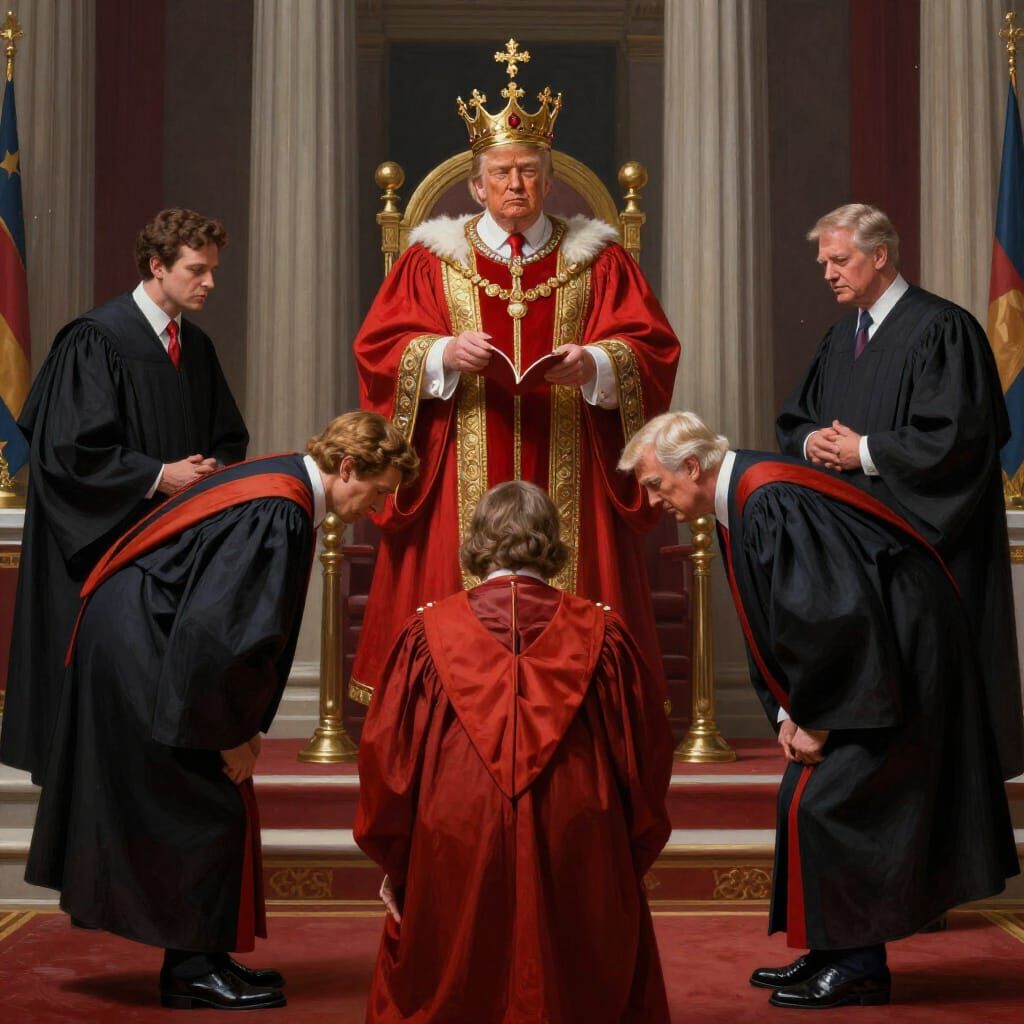
They were supposed to protect our democratic republic. Instead, they created a monarchy, and they excuse the damage by calling it a “unitary presidency.” May they live in infamy as a lesson to future generations.
What happens when you recruit a bunch of thugs, give them masks, guns, clubs, and tear gas, and tell them, “Do whatever you want. If you get in trouble, I’ll pardon you. Meanwhile, you have complete immunity.”
America, today. Masked, poorly trained Gestapo thugs patrol America’s streets with complete immunity. Brutal home invasions without warrants. Arrests based solely on skin color. Trump and his MAGA right-wing stand by, cheering them on.
This is what happens:
The Five Minute Fix, By Amber PhillipsIt’s not just Minneapolis. In cities across America, Immigration and Customs Enforcement agents have arrested hundreds of thousands of immigrants and clashed with protesters in what is on its way to becoming one of the largest deportation efforts in U.S. history.
The White House says it’s deporting both criminals and people who are working in the country illegally. But ICE is increasingly unpopular, and it’s getting more headlines for its sometimes-violent tactics than it is for getting supposed bad guys off the streets.
“They’re going to make a mistake sometimes, too rough with somebody,” President Donald Trump said of ICE. “You know they are rough people.” ICE’s reach is only expected to spread.
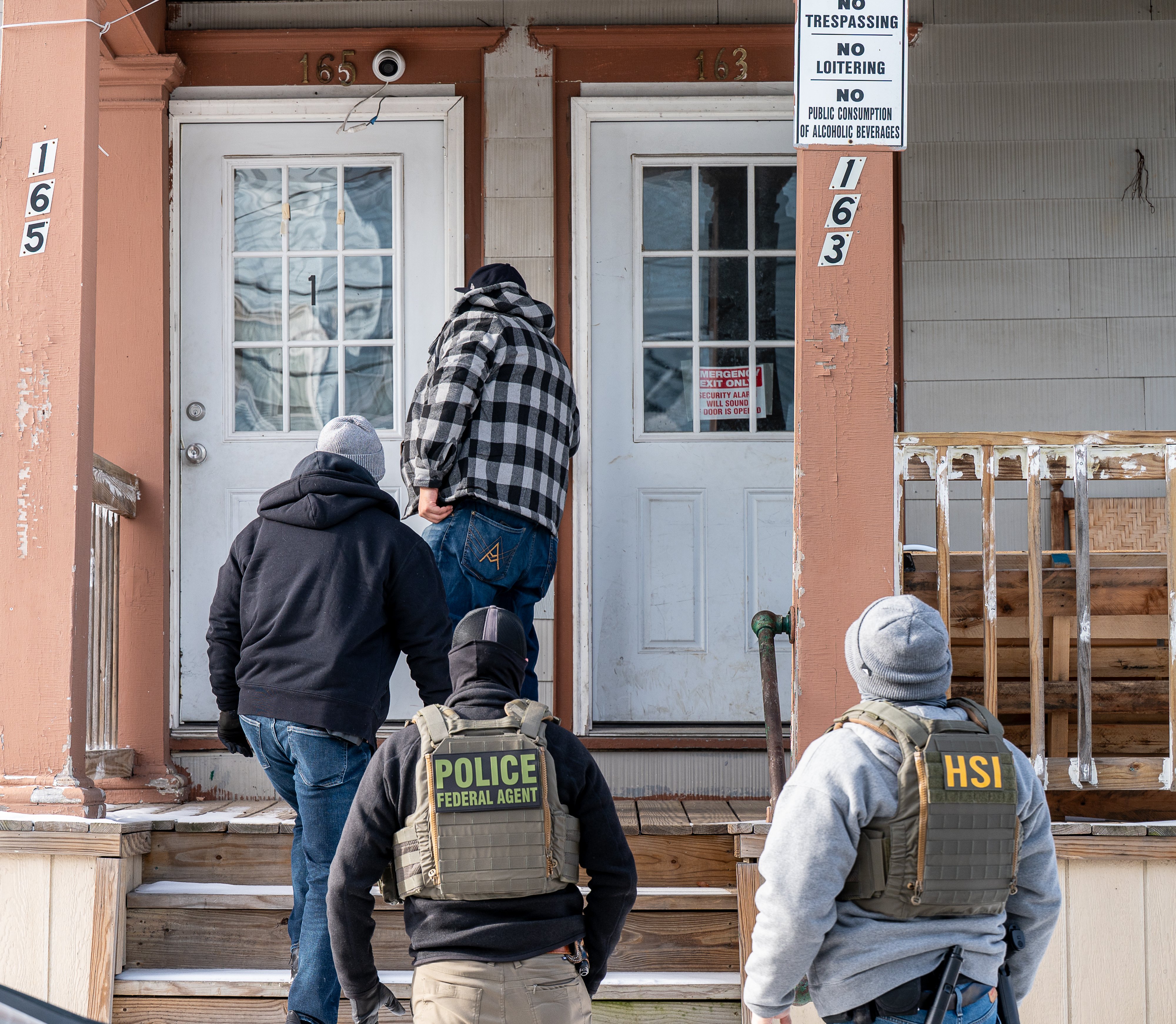
Armed masked men bang at your door, CLAIMING to be ICE agents. They have no badges. They have no warrants. Some are in plain clothes. Others are in military uniforms. Must you let them in? If they break in, will they be punished? If they drag you out, will anyone care? This is Trump’s America.
It has been infused with billions more from the Republicans’ tax bill, and the Brennan Center for Justice estimates it will become one of America’s largest police forces. It is spending $100 million to try to hire gun rights supporters and military enthusiasts.
When Trump speaks of “the worst of the worst,”he well might be speaking of the bullies, haters, and sadists who enjoy the freedom to kill, torture, and arrest that comes with being in ICE
“By the end of this, almost everyone is going to know someone who had a friend or family member or colleague affected, or who witnessed an arrest happening,” said David Bier, the director of immigration studies at the libertarian-leaning Cato Institute.
“I think it’s unnerving to see people targeted who don’t seem to be doing anything out of the ordinary, just going to work or doing their jobs.
”Here’s more about what’s happening.
What ICE is doing on the streets. There are about 11 million undocumented immigrants in the United States. ICE can’t be everywhere all at once, so the agency typically works with local authorities to help arrest people in the country illegally.
But now agents are on a mission to deport as many people as possible. What was once a job largely out of the public eye is now taking place on city streets, parking lots of big-box stores, deep in local neighborhoods, and at churches and workplaces as agents mine federal data and go door-to-door to create what the nonpartisan Migration Policy Institute says is an unprecedented show of force in cities.
Immigration agents have surged into Chicago, Los Angeles, D.C., Minneapolis and Charlotte, rushing into upscale neighborhoods and shops, country clubs and near schools. Sometimes they are in plain clothes; many times they are masked.
U.S. citizen accuses Trump’s ICE agents of detaining him in freezing conditions with no warrant. Even citizens aren’t safe. And the supposed “agents” can’t be punished, or even prosecuted. Trump says ICE only goes after the “worst of the worst.”
They’ve been recently empowered by the Supreme Court to stop people based on factors such as race, ethnicity, language or job.
The majority of the Supreme Court is politically corrupt. They have deemed Trump as emperor, and without their support, he couldn’t act so lawlessly with impunity.
Some agents are using chokeholds to arrest people; others have been filmed smashing car windows to get at someone.
Do you carry citizenship paperwork everywhere you go?
Trump and his administration say they are targeting “the worst of the worst.”
But there’s no evidence migrants commit crimes at a higher rate than Americans, and most migrants arrested don’t have a criminal record, according to the Migration Policy Institute.
A record number of children are being detained, and data suggests families are being separated,
ProPublica finds. The New York Times reported on a Cuban migrant arriving for a check-in with ICE and being immediately separated from her 17-month-old daughter she was breastfeeding and deported.
Don’t ever expect American compassion from the Trump administration. Those people are not true Americans.
If you’re a white U.S. citizen, you might think you’re safe. Think again. Trump’s ICE agents can do whatever they want and there is nothing you can do about it.“It feels like a member of my family is under attack,” one Charlotte woman told The Washington Post after telling her children’s caregiver to stay at home.Trump is cracking down hard on protesters Communities of activists have sprung up to try to slow or stop arrests and film what’s happening.“I’ve been in touch with friends and former students in Minneapolis as well as Chicago, Los Angeles and now, Maine,” Robert Reich, a former labor secretary and prominent Trump critic, wrote this week.
“Some have been extraordinarily brave. A few tell me they’ve tailed ICE agents and whistled loudly to warn others of ICE’s whereabouts. Some have sought to block agents from entering schools, courthouses, and clinics. Others have been taking videos to give to the media or use in court.
”Trump has responded with force. His administration has tried to label protesters as “domestic terrorists” (which legal experts say isn’t an actual designation) and has sought to deploy the National Guard where there are protests.
He’s also threatened to send in the military to arrest protesters in Minneapolis. Vice President JD Vance said the ICE agent who killed protester Renée Good has “absolute immunity.”
Yet for all the conflict, Bier is tracking federal charges of protesters and finds it’s rare, suggesting many of their actions are protected by the First Amendment.
If Trump’s ICE grabs you off the street or breaks into your home, this is where they might take you. No warrant. No judge. No trial. No evidence. No Amendment rights. Instant punishments. This is Trump’s America, today.
ICE detentions are also controversial. Trump is building some of largest deportation centers in history, including makeshift facilities and plans by ICE to hold up to 80,000 immigrants in seven large-scale warehouses.
The Post reported. Conditions can be tough. Some ICE facilities have been described as “inhumane,” with reports of spoiled food, undrinkable water or lights on 24 hours a day.
The pro-immigration American Immigration Council writes that ICE is “trapping hundreds of thousands of noncitizens in an increasingly opaque world of remote jails and private prisons.”An ICE detainee died in January; witnesses say he was choked, and his death may be classified as a homicide. (The government disputes that account of events.) He is one of dozens who have died in ICE custody since Trump took office a year ago.
No, this isn’t Trump’s ICE in America. It’s Hitler’s Gestapo in Germany. Hard to tell the difference.
ICE may be getting harder to defend politically Polls show that Trump’s ICE raids have strong support from Republicans.“Letting millions of illegal immigrants come to work in the U.S. will depress wages, and we can’t allow that to happen,” says Nick Iacovella with the Coalition for a Prosperous America, a conservative, pro-tariff group that also supports Trump’s mass deportations.
But a new Economist/YouGov poll finds 47 percent of Americans think ICE is making America less safe, compared with 34 percent who said more safe.
And for months now, a majority of Americans have disapproved of how Trump is handling immigration overall, on what used to be his strongest issue.
Republicans are particularly concerned mass deportations are hurting them with Latino voters, who helped Trump win the presidency again.
“For the first time,” Republican former North Carolina governor Pat McCrory told Politico this fall, “immigration is maybe having a negative impact on my party.”
Notice that McCrory isn’t concerned about the horrors being inflicted and the human toll. He’s only concerned about politics and the “impact” on his Republican Party.
And this is America, today.







 #Monetary Sovereignty - Mitchell