The right wing denies it will cut Social Security. But then, there’s this:

The rich retire at will. The rest of us . . . we’ll work ’til we drop. The right-wing denies it will cut Social Security. But then, there’s this:

America’s retirement age of 65 is “crazy,” BlackRock CEO says Story by Aimee Picchi, BLACKROCK, INC., © Bloomberg

With Americans living longer and spending more years in retirement, the nation’s changing demographics are “putting the U.S. retirement system under immense strain,” according to BlackRock CEO Larry Fink in his annual shareholder letter.

One way to fix it, he suggests, is for Americans to work longer before they head into retirement.

The backstory: “Rich” is a comparative term. A person owning $100 thousand would be rich if everyone else had $10,000, but that person would be poor if everyone else had $1 million. The income/wealth/power Gap is the key. The way to become richer is to accumulate more for yourself or to ensure that everyone else has less (i.e., widen the income/wealth/power Gap between you and those below you).
scissors on dollar bills
The illogic of cutting Social Security
The very rich, who run America, have chosen both paths. They bribe politicians to carve out income tax breaks for themselves so they can accumulate more money, while they insist that everyone else pay more taxes to widen the Gap.

“No one should have to work longer than they want to.

But I do think it’s a bit crazy that our anchor idea for the right retirement age — 65 years old — originates from the time of the Ottoman Empire,” Fink wrote in his 2024 letter, which largely focuses on the retirement crisis facing the U.S. and other nations as their populations age.

Rich man Fink begins with the pseudo-compassionate phrase, “No one should have to work longer than they want to.” He cluelessly forgets that our finances require many of us to work longer than want to. It’s the “Let ’em eat cake” syndrome. And what is Fink’s definition of the “retirement crisis facing the U.S.”?

Fink’s suggestions about addressing the nation’s retirement crisis come amid a debate about the future of Social Security, which will face a funding shortfall in less than a decade.

Some Republican lawmakers have proposed raising the retirement age for claiming Social Security benefits, arguing, like Fink, that because Americans live longer, they should work longer, too.

Suddenly, Fink’s claim that No one should have to work longer than they want to” disappears. Now it’s, “If you live longer, you should work longer” — uh, except if you’re rich, in which case you can retire any time you damn well please. Money has its privileges.  This is based on the preposterous notion that the Monetarily Sovereign U.S. government is running short of its own sovereign currency — a currency it creates at will by simply pressing a few computer keys.

Ben Bernanke: “The U.S. government has a technology, called a printing press (or, today, its electronic equivalent), that allows it to produce as many U.S. dollars as it wishes at essentially no cost.”

Note that Mr. Fink’s implied claim of federal government poverty does not extend to setting a high minimum age for benefitting from tax shelters and other tax avoidance devices available to the rich. See: Ten Ways Billionaires Avoid Taxes on an Epic Scale (Read these and you’ll be shocked and angered at the desire to cut your Social Security benefits.)

the rich taking money from the rest of us
Why should the poor be allowed to retire at age 65? That’s reserved for us,
For example, At least 18 billionaires received stimulus checks in 2020, because their tax returns placed them below the income cutoff ($150,000 for a married couple). Incredible, huh? How about this suggestion: Change the laws so that none of these “ways” would be available to anyone under the age of, say 85? Does that sound reasonable to protect our government from the phony insolvency the rich like to claim is imminent?

However, that ignores the reality of aging in the workplace, with the AARP finding in a 2022 survey that the majority of workers over 50 say they face ageism at work.

Many older Americans stop working before they plan to because of ill health or an unexpected job loss.

In fact, the median age of retirement in the U.S. is 62—even lower than the “traditional” retirement age of 65.

Did all those folks “want” to retire and live their remaining years in poverty? Fink must think so.

Fink is right in saying that the retirement system isn’t working for most households, noted retirement expert and New School of Research professor Teresa Ghilarducci told CBS MoneyWatch.

But his assessment that people should work longer misses the mark, she added.

“After a 40-year-old experiment of a voluntary, do-it-yourself-based pension system, half of workers have no easy way to save for retirement,” she said.

“And in rich nations, why isn’t age 65 a good target for most workers to stop working for someone else?”

She added, Working longer won’t get us out of this. Most people don’t retire when they want to, anyway.”

“Get us out of this?” What is the “this” we have to get out of? Social Security is a federal agency. No federal agency can run short of U.S. dollars unless that is what Congress and the President want. Congress, the White House, and SCOTUS all are federal agencies. Where are the fake “trust funds” that supposedly support (i.e. limit) them?

Alan Greenspan: “A government cannot become insolvent with respect to obligations in its own currency. There is nothing to prevent the federal government from creating as much money as it wants and paying it to somebody. The United States can pay any debt it has because we can always print the money to do that.”

For you folks who have been indoctrinated with the twin false notions that . . .
  1. Federal taxes fund federal spending, and
  2. Money “printing” causes inflation,
. . . why aren’t you screaming about the benefits to the rich rather than “getting out of this” by cutting benefits to the non-rich?

To be sure, America’s retirement gap, or the gulf between what people need to fund their golden years versus what they’ve actually saved, isn’t new, nor is Social Security’s looming funding emergency.

Social Security doesn’t have a “funding emergency.” It has a fake emergency based on ignorance of Monetary Sovereignty and promulgated by stooges for the rich. There. Is. No. Funding. Emergency. Period. The U.S. government has infinite money. Even if the federal government didn’t collect a single penny in taxes, it still could continue funding Social Security and Medicare and everything else, forever. Federal taxes have two purposes, and neither of them is to fund federal spending:
  1. To control the economy by taxing what the government wishes to limit (like your ability to acquire more wealth, unless you’re already wealthy) and
  2. To assure demand for the U.S. dollar by requiring you to pay taxes in dollars.

    The u.s. treasury has infinite money
    The federal government has run out of money. You have plenty. We need to raise your taxes.
There is a third, unofficial purpose.

3. To make you believe the Big Lie that federal benefits to you are “unsustainable” and imprudent. (Federal benefits to the rich are O.K., however)

Yet Fink’s comments are noteworthy because of his status as the head of the world’s largest asset manager, with more than $10 trillion in assets, including many retirement accounts.

Gee, you think that wealth affects his ‘Qu’ils mangent de la brioche’ attitude?

Of course, Fink has a vested interest in Americans boosting their retirement assets, given that his firm collects fees from those accounts.

And in his letter, he also promotes a new target-date fund from BlackRock called LifePath Paycheck, which will roll out in April.

“He’s steering the conversation toward BlackRock — and a lot of people who talk about Social Security reform on Wall Street want to privatize it in some manner and make money,” Boston University economist Laurence Kotlikoff, an expert on Social Security, told CBS MoneyWatch.

Sure, privatize Social Security, so the rich, who never have enough, can have even more, thus widening the Gap. It’s already begun with the deceptive Medicare Advantage plans, which are being promulgated by the rich as a new way to make money off of Medicare.
Uncle Sam covered in dollars
I’m broke. Send me money.
For no financial reason whatsoever, Medicare only covers 80%, and doesn’t cover things like dental care, weight loss drugs, and many other health care services. So in step the rich, to provide what Medicare doesn’t, and thus make money: Medicare Advantage But there is a kicker. When you need something really expensive, you run into the Medicare prior authorization scam.  Gotcha! Yes, your $100 dental bill may be covered, but that $50,000 surgery will require you to jump through hoops, and even then you may not be covered. Surprised? You shouldn’t be. The profit motive in healthcare is ruthless and unnecessary.

To be sure, Fink also praises public policy success stories for addressing retirement savings, such as Australia’s system, which began in the early 1990s and requires employers to put a portion of a worker’s income into a fund.

Today, Australia has the world’s 54th largest population but the 4th largest retirement system, he noted.

That’s better than America’s system, but it still is divorced from reality. Australia’s government is Monetarily Sovereign. It could have an infinitely large retirement system without taking a penny from workers’ income. The U.S. could do the same.

“As a nation, we should do everything we can to make retirement investing more automatic for workers,” he noted.

Sorry, we can't operate on you until your insurance company gives us permission.
Your doctor may say, “Yes, ” but our computers say, “No.”
Oh, how pious. Apparently, “everything we can” doesn’t include a federally funded Social Security benefit for every man, woman, and child in America. The rich already are able to self-fund such a plan, but have convinced the not-rich that we don’t deserve that kind of help from an infinitely wealthy government. Yeah, yeah, “too good to be true,” “it’s unsustainable,” “unaffordable,” “causes inflation,” “people won’t work if you give them benefits,” and all the other BS excuses the rich throw at you. In America, we have 70 million + suckers who believe the idiocy a proven liar like Donald Trump tells them, but scant few who believe actual facts about our government. We suckers don’t demand Social Security for All and Medicare for All. We argue against our own best interests. That’s what makes us suckers. By contrast, the rich never argue against their own best interests.

Fink, who was born in 1952, said that his generation has an obligation to help fix the nation’s retirement problems.

The financial insecurity facing younger Americans, such as millennials and Gen Z, are creating generations of disillusioned, anxious workers, he noted.

How noble of Fink. How will he “face his obligation”? By cutting your benefits.

“They believe my generation — the baby boomers — have focused on their own financial well-being to the detriment of who comes next. And in the case of retirement, they’re right,” Fink wrote.

He added, “And before my generation fully disappears from positions of corporate and political leadership, we have an obligation to change that.”

Oh, they’ll change it . . .  by applying leeches to cure our anemia. Sure, Mr. Fink, we suckers accept your premise that the best way to cure our lack of money is to take money from us. We believe it because it’s what everyone tells us, and we are too dense to understand reality. But don’t worry that any of us will see the irony in all that. For 25 years I’ve been preaching the idiocy of an infinitely wealthy government taking dollars from the populace, and what has that accomplished? Nada.
Aged poor American workers
We couldn’t save enough to retire.
The vast majority still accept the obvious Big Lie that federal benefits are limited by federal taxes (except for benefits to the rich.) It never occurs to us that though federal deficits have grown from 40 Billion in 1940 to 32 Trillion in 2023, we still believe deficit spending is unsustainable, unaffordable, and will cause the sky to fall. We follow that up by laughing at the stupid public, except we are the stupid public. (If life is like a poker game, and you’ve been playing for a while, but don’t know who the patsy is, you’re the patsy.)

Boomer (and older) lawmakers and politicians often don’t see eye-to-eye on how to fix the retirement crisis.

But failing to fix the issue damages not only the retirements of individual Americans, but the country’s collective belief in the future of the U.S., Fink noted.

“We risk becoming a country where people keep their money under the mattress and their dreams bottled up in their bedroom,” he noted.

How true. I just turned 89 and am growing weary of telling you not to answer Emails from Nigeria, not to touch hot stoves, not to tell strangers your Social Security number, and not to believe a government that created the U.S. dollar from thin air can become insolvent. This blog has posted more than 3,000 articles, most of which make two fundamental points.
  1. The U.S. government can afford anything, without collecting money from you.
  2. If you’re not screaming like hell at the Big Lie, if you’re not demanding that your politicians tell you the truth, you deserve what you get.
Or do nothing and let the rich continue to screw you. Rodger Malcolm Mitchell Monetary Sovereignty Twitter: @rodgermitchell Search #monetarysovereignty Facebook: Rodger Malcolm Mitchell

……………………………………………………………………..

The Sole Purpose of Government Is to Improve and Protect the Lives of the People.

MONETARY SOVEREIGNTY

When a belief is ingrained, no evidence is wanted

It is widely believed, especially among conservatives, that:
  1. Federal finances are like state/local government finances, business finances, and personal finances.
  2. It makes no difference whether a government is Monetarily Sovereign or monetarily non-sovereign.
  3. The “federal debt” is a debt of the federal government.
  4. The federal debt is owed by, and will be paid by, taxpayers.
  5. The federal debt and deficits are too large and are “unsustainable.”
  6. Federal spending should be reduced.
  7. The federal government should run a balanced budget or surplus. The federal government has borrowed and owes trillions of dollars via T-bills, T-notes, and T-bonds.
  8. The purpose of federal taxes is to fund federal spending.
    SIDE VIEW of a PLATTER WITH A MAP OF EARTH
    Once, people strongly believed the earth was flat. A few still do, despite the evidence.
  9. Medicare and Social Security will run short of funds unless taxes are increased and/or benefits are reduced.
  10. Many federal programs, for instance, poverty aid, foreign aid, global warming prevention, immigration, education, etc., are unaffordable and unsustainable.
  11. The rich don’t get richer by making you poorer.
  12. Undocumented immigrants bring crime and drugs into our country.
  13. Federal spending causes inflation.
How many of these beliefs do you have? Every one of them is wrong, proven wrong by readily available data (here, here, here, here, and elsewhere in this blog). Yet most people strongly defend one or more of these wrong beliefs, even without any evidence to support them. Here is an example of the widespread belief that immigrants harm our economy, and our way of life.

Immigration fuels US economic growth while politicians rage. Augusta Saraiva and Enda Curran, Bloomberg News While the rising number of immigrants in the U.S. has sowed division among politicians across the country — and stoked angst among a swath of voters — there’s one place where almost everyone seems on the same, upbeat page: Wall Street.

Last month, the nonpartisan Congressional Budget Office (CBO) calculated that immigration will generate a $7 trillion boost to gross domestic product over the next decade. The agency came to that conclusion after incorporating the recent surge in immigration.

The CBO release spurred a flurry of fresh number-crunching among investment bank economists to account for the boost those newcomers are giving to the labor force and consumer spending. Goldman Sachs Group Inc. revised up its near-term economic growth forecasts Sunday.

JPMorgan Chase & Co. and BNP Paribas SA were among banks that acknowledged the economic impact from surging immigration in recent weeks.

We’ll pause to remind you that Gross Domestic Product (the most common measure of our economy) = Federal Spending + Non-federal Spending + Net Exports.
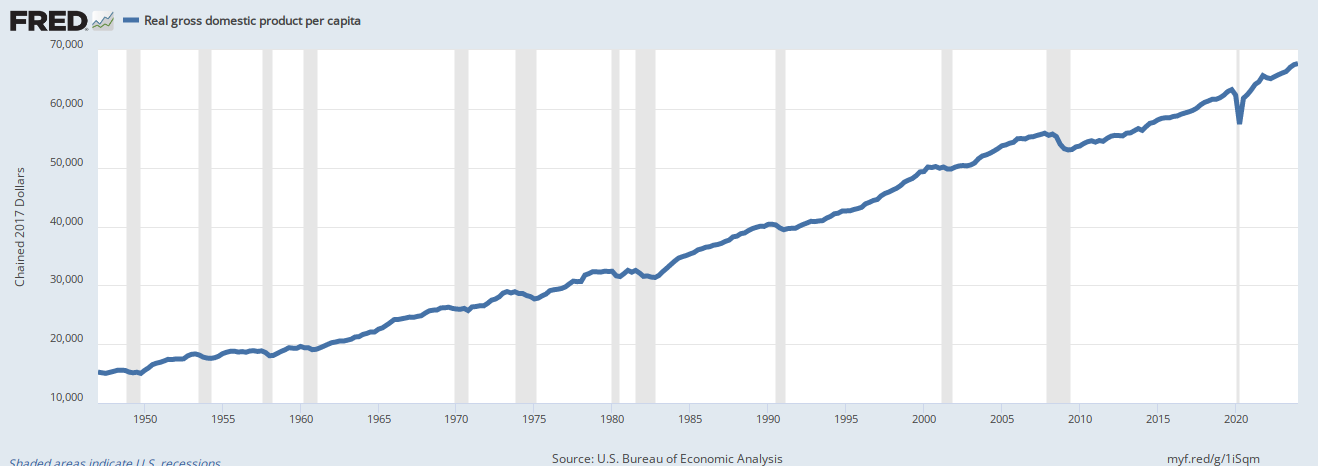
Inflation-Adjusted, Per Capita, Gross Domestic Product
Spending by immigrants increases per capita (including yours and mine) inflation-adjusted GDP. In short, immigrants make us all wealthier by working, paying local taxes, and creating and buying stuff. That is what immigrants have done for decades, and it is what has made America prosperous.

“Immigration is not just a highly charged social and political issue, it is also a big macroeconomic one,” Janet Henry, global chief economist at HSBC Holdings Plc, wrote in a note to clients Tuesday.

No advanced economy benefits from immigration quite like the U.S., and “the impact of migration has been an important part of the U.S. growth story over the past two years.”

“Two years”? More like two hundred years.

Morgan Stanley economists Sam Coffin and Ellen Zentner noted this month that faster population growth fueled by immigration leads to stronger employment and population estimates than initially thought, though they added that the full effect might not be captured by official data.

It’s hard to pin down the exact scale of the inflows of foreign-born people, thanks to many entering without visas or other documentation. But CBO statisticians incorporated data from U.S. Customs and Border Patrol to come up with their higher projected net immigration, according to Morgan Stanley analysis.

Goldman estimates that immigration was around 2.5 million in 2023, a figure that is far above the 1.6 million implied by the change in the foreign-born population in the official household survey from the Census Bureau.

The positive tone among economists contradicts that seen on the campaign trail, as a surge in the number of undocumented immigrants entering the U.S. through the southern border stokes political strife.

The share of Americans who see immigration as the most important problem facing the U.S. is now matching a record high in data going back four decades, according to a recent Gallup poll.

The recent boost from immigration is the result of both more legal immigrants as the U.S. goes through unprecedented visa backlogs and the surge in illegal border crossings.

The nation’s 32.5 million immigrant workers now account for roughly one in five U.S. workers, a record-high in government data going back almost two decades.

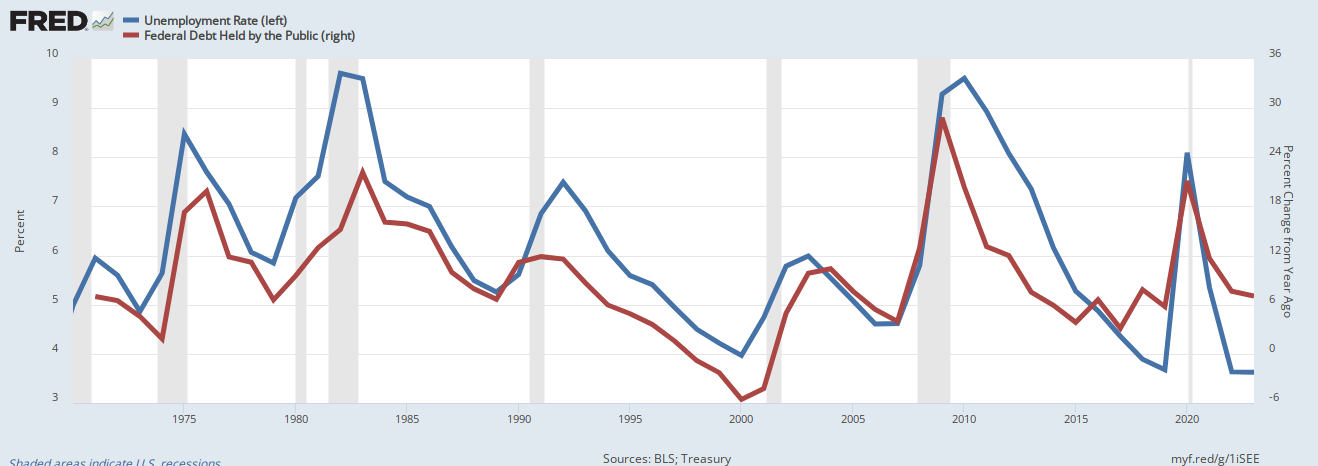
They not only are working, but their buying creates jobs. They aren’t stealing jobs as America’s xenophobes often claim. The proof: Unemployment is low “despite” (because of?) massive immigration:
Red line is federal deficits. Blue line is Unemployment. Vertical gray bars are recessions.
This interesting graph reveals several facts:
  1. When federal deficit spending declines, we have recessions.
  2. The recessions are cured by increases in federal deficit spending.
  3. The recessions cause unemployment.
  4. The unemployment, which is caused by decreases in federal deficit spending is cured by increased federal deficit spending.
Thus, unemployment is not caused by immigrants taking jobs. Quite the opposite. Unemployment and recessions have the same cause: Insufficient federal deficit spending, exactly what the conservatives want us to do.

To be sure, the connection between the higher influx of foreign workers and the rapid post-pandemic recovery has been noted by economists and policymakers alike for some time now.

The Trump GOP’s main election focus is to deport undocumented immigrants, the people who help grow America’s economy.

Federal Reserve Chair Jerome Powell has repeatedly cited immigration as one of the reasons behind strong economic growth.

In a reference to the role being played by higher labor supply, Powell pointed on Wednesday to “a strong pace” of immigration as helping on that front.

“The overall picture is a strong labor market — the extreme imbalances we saw in the early parts of the pandemic recovery have mostly been resolved, you’re seeing high job growth, you’re seeing big increases in supply,” Powell said in his press conference Wednesday.

Fed policymakers lifted their growth forecast for this year to 2.1% from 1.4%, their median estimate showed.

Businesses are ramping up calls for changes to bring in more workers through legal channels.

Almost 9 million positions are open across the economy, equal to 1.4 jobs for every job-seeker. Foreign-born workers made up a record 18.6% of the civilian workforce in 2023 and the U.S. approved a record number of work authorizations in the fiscal year through last September.

Immigration is “very policy sensitive,” Feroli cautioned, advising against extrapolating out bigger numbers beyond the end of this year. After all, policy could change after the November election, he noted.

Why does Trump and his GOP harp on immigration as America’s biggest “problem”? His success is as a fear-mongering hate-mongerer. When he preaches hatred toward Muslims, Mexicans, gays, blacks, people from “shithole” countries — when he lies that they bring crime, drugs to America, he is preaching to people he has frightened with his bigotry. He creates scapegoats, and then claims he will deal with them. Hitler did it. All dictators do it. The facts are:
  1. Immigrants are less likely to commit crimes than are citizens.
  2. Illegal drugs enter the U.S. through legal channels, not via undocumented immigration.
False beliefs, especially those repeated for months and years, are difficult to dislodge with facts. But ultimately, that is all you can do. Just as a lie gains strength the more it is repeated, so does the truth. Learn the truths and repeat them again and again. It’s the only way to defeat the Hitlers of the world. Rodger Malcolm Mitchell Monetary Sovereignty Twitter: @rodgermitchell Search #monetarysovereignty Facebook: Rodger Malcolm Mitchell

……………………………………………………………………..

The Sole Purpose of Government Is to Improve and Protect the Lives of the People.

MONETARY SOVEREIGNTY
The “National Debt” isn’t national and it isn’t a debt. Eric Boehm remains clueless.

The problem with Libertarians like Eric Boehm . . . where do I begin? They have so many issues. First, they don’t understand this equation: Gross Domestic Product = Federal Spending + Non-federal Spending + Net Exports. Gross Domestic Product (GDP) is the most commonly used measure of the economy. The equation tells you that the more the federal government spends, the more the economy grows. But Libertarians don’t like government spending. How does one reason with such people? Mainly, how does one acquaint them with Monetary Sovereignty, which says, “Federal financing is different from non-federal financing.” If they can’t understand, or more accurately, refuse to understand, those two concepts—GDP and Monetary Sovereignty—how can their opinions be respected? Here is the latest “Boehmism,” which, remarkably, may exceed all his previous work in ignorance and/or deception (It’s hard to know which:

The National Debt Is a National Security Issue The growing debt will “slow economic growth, drive up interest payments,” and “heighten the risk of a fiscal crisis,” the CBO warns. ERIC BOEHM | 3.21.2024 1:50 PM

It’s a dangerously addictive habit that threatens to ruin our children’s lives and undermine America’s national security—and this week, Congress finally acknowledged as much. However, it remains unclear if lawmakers have the guts to do anything substantial.

No, I’m not talking about TikTok. I’m talking about the $34.6 trillion national debt.

The Senate unanimously approved a resolution on Wednesday calling the debt “a threat to the national security of the United States” and calling expected future budget deficits “unsustainable, irresponsible, and dangerous.”

Ticking Time Bomb Images – Browse 1,847 Stock Photos, Vectors, and Video | Adobe Stock
1940 “Debt” was called a “ticking time bomb.”
The Senate votes to please voters, and sadly, most voters believe anything called “debt” should not be large. They don’t understand that federal “Debt” is not federal and it isn’t debt.

“We have more than doubled our national debt in just ten years,” said Sen. Mike Braun (R–Ind.), who sponsored the resolution.

“America is moving down a dangerous and unsustainable path of reckless spending, and the federal government has yet to take it seriously.”

“Unsustainable” is the Libertarian’s favorite word when describing the so-called national (or federal) debt, which is neither national, federal, nor debt. They use that word because it has no specific meaning. They don’t say precisely what is “unsustainable” about it. The federal government, being uniquely Monetarily Sovereign (Libertarians don’t understand that concept, either), can pay any debt denominated in U.S. dollars.
Ticking Time Bomb Images – Browse 1,847 Stock Photos, Vectors, and Video | Adobe Stock
1950 “Debt” was called a “ticking time bomb.”
Whether a debt is $100 or $100 trillion, the federal government could pay it instantly by pressing computer keys. The federal government pays all its debts the same way. It creates new dollars ad hoc. To pay any creditor, the government sends instructions, not dollars, to the creditor’s bank, instructing the bank to increase the balance in the creditor’s checking account. Those instructions are electronic or paper (a check), saying, “Pay to the order of _____. ” The instant the bank does as instructed, new dollars are created and added to the M2 money supply measure.

Alan Greenspan: “A government cannot become insolvent concerning obligations in its own currency. There is nothing to prevent the federal government from creating as much money as it wants and paying it to somebody. The United States can pay any debt it has because we can always print the money to do that.”

That is how the federal government creates dollars and pays its bills. There is no limit to the government’s ability to send instructions, and thus no limit to the government’s ability to create dollars. No debt is “unsustainable.”
Ticking Time Bomb Images – Browse 1,847 Stock Photos, Vectors, and Video | Adobe Stock
1960 “Debt” was called  a “ticking time bomb.

The passage of a nonbinding resolution on the Senate floor is several steps short of addressing the federal government’s addiction to borrowing—but, as they say, recognizing that you have a problem is the first step toward solving it.

The federal (or national) debt is not a debt because the federal government does not borrow. Why would it? Given its infinite ability to create dollars, why would the federal government borrow dollars? It wouldn’t, and it doesn’t. Those things called T-bills, T-notes, and T-bonds do not represent borrowing. Although “notes” and “bonds” are evidence of borrowing in the private sector, federal finance is different.
Ticking Time Bomb Images – Browse 1,847 Stock Photos, Vectors, and Video | Adobe Stock
1970 “Debt” was called a “ticking time bomb.
T-securities are evidence of deposits into savings accounts at the Federal Reserve, the contents of which are wholly owned by the depositors. The government neither needs nor uses those deposits. It merely holds them in safekeeping for the depositors. The federal government’s main purpose in offering T-security accounts is to provide the public and other nations with a safe, interest-paying place to store unused dollars, which helps stabilize the dollars. By paying interest, these accounts help the federal government control interest rates.
Ticking Time Bomb Images – Browse 1,847 Stock Photos, Vectors, and Video | Adobe Stock
1980 “Debt” was called a “ticking time bomb.
The government does not owe the dollars deposited in T-security accounts. The government merely stores them for the depositors. Upon maturity of any T-security, the government merely gives the dollars, that never had left the account, back to their owner, the depositor. It’s not a federal debt, just as the contents of a bank safe deposit box are not a bank debt.

And the approval of that resolution was timely. Later on Wednesday, the Congressional Budget Office (CBO) published its latest long-term budget projections. The report shows that annual budget deficits are on pace to grow from an expected $1.6 trillion this year to $2.6 trillion in 2034, $4.4 trillion in 2044, and $7.3 trillion in 2054.

A federal budget deficit is much different from a personal budget deficit.
Ticking Time Bomb Images – Browse 1,847 Stock Photos, Vectors, and Video | Adobe Stock
1990 “Debt” was called a “ticking time bomb.
If you or I were to run a budget deficit, we would have to obtain the money to pay our bills, either by borrowing or from our income or savings. The federal deficit merely is the bookkeeping difference between taxes and spending. The spending has already been paid for by money creation. Here again, one must understand Monetary Sovereignty. State and local taxes do fund state and local taxes. The state and local governments are monetarily non-sovereign, like you and me.
Ticking Time Bomb Images – Browse 1,847 Stock Photos, Vectors, and Video | Adobe Stock
2000 “Debt” was called a “ticking time bomb.
So what is the purpose of federal taxes, if not to fund federal spending?
  1. To help the federal government control the economy by taxing what the government wishes to discourage and by giving tax breaks to what the government wishes to reward/
  2. To assure demand for the U.S. dollar by requiring federal taxes to be paid in dollars.
  3. To make the public believe that federal benefits are limited by tax receipts or borrowing. (This last is at the behest of the very rich, who get wealthier by widening the income/power Gap between them and the rest of us.)

As a result of those rising budget deficits, the national debt will continue to accelerate upward.

The misnamed “national debt” is not a threat or a burden on anyone- not the government or taxpayers. Even if the “debt” were hundreds of trillions of dollars, the federal government could continue paying its bills without collecting a penny more in taxes, nor borrowing a single dollar.
Ticking Time Bomb Images – Browse 1,847 Stock Photos, Vectors, and Video | Adobe Stock
2010 “Debt” was called a “ticking time bomb.

The CBO projects that the federal government’s debt will total $114 trillion by 2054. The debt is already roughly the size of the nation’s economy and is expected to surpass the all-time high of 106.4 percent of gross domestic product (GDP) by 2028.

By the end of the 30-year projection, the debt is estimated to reach 166 percent of GDP.

The oft-mentioned “Debt”/GDP ratio is meaningless for several reasons:
  1. The government does not owe or pay the “debt.”
  2. GDP does not owe or pay the “Debt.”
  3. The ratio says nothing about the health of the U.S. economy.
  4. The ratio says nothing about the federal government’s ability to pay its bills.

“Such large and growing debt would have significant economic and financial consequences,” the CBO warns. “

Among its other effects, it would slow economic growth, drive up interest payments to foreign holders of U.S. debt, heighten the risk of a fiscal crisis, increase the likelihood of other adverse outcomes, and make the nation’s fiscal position more vulnerable to an increase in interest rates.”

The above paragraph is wrong in every respect:
Ticking Time Bomb Images – Browse 1,847 Stock Photos, Vectors, and Video | Adobe Stock
2220 “Debt” was called a “ticking time bomb.
  1. A large and growing “Debt” merely means our Monetarily Sovereign federal government is pumping more growth dollars into the economy. The larger the “Debt,” the more growth dollars and the faster the economic growth. Remember: GDP = Federal Spending + Non-federal Spending + Net Exports. Federal Spending even increases Non-federal Spending
  2. Our Monetarily Sovereign U.S. federal government has the infinite ability to create the dollars that pay foreign holders of U.S. debt. Paying dollars to foreign nations increases foreigners’ ability to purchase our goods and services (Net Exports).
  3. No “fiscal crisis” has been or can be caused by the growing federal debt. The federal government always will be able to pay all its bills.
  4. The large and growing “Debt” causes no “other adverse outcomes. The Debt/GDP ratio is fiscally meaningless for a Monetarily Sovereign nation.
  5. Our Monetarily Sovereign government’s fiscal position is vulnerable only to the ignorance of those who do not understand the differences between Monetary Sovereignty and monetary non-sovereignty. The government can pay any amount of interest simply by pressing computer keys.
In 1940, the federal “Debt” was only $43 billion. Those who are ignorant about federal finances called it a “ticking time bomb.” Today, the “Debt” totals more than $33 trillion, and that phony time bomb is still a dud—and always will be.

Higher interest rates are already significantly affecting the federal budget. This year, payments on the existing debt will total an estimated $870 billion, which is more than the Pentagon’s budget. Thanks to higher interest rates and a larger debt load, debt payments have jumped by 32 percent since 2023.

Interest payments have indeed had an effect on the federal budget. They have forced the federal government to spend more, which pumps more growth dollars into the economy and increases GDP. Again, the Libertarians seem to have forgotten: GDP = Federal Spending + Non-federal Spending + Net Exports. Not only does Federal Spending directly lift GDP, but it also lifts Non-federal Spending, which, in turn, lifts GDP
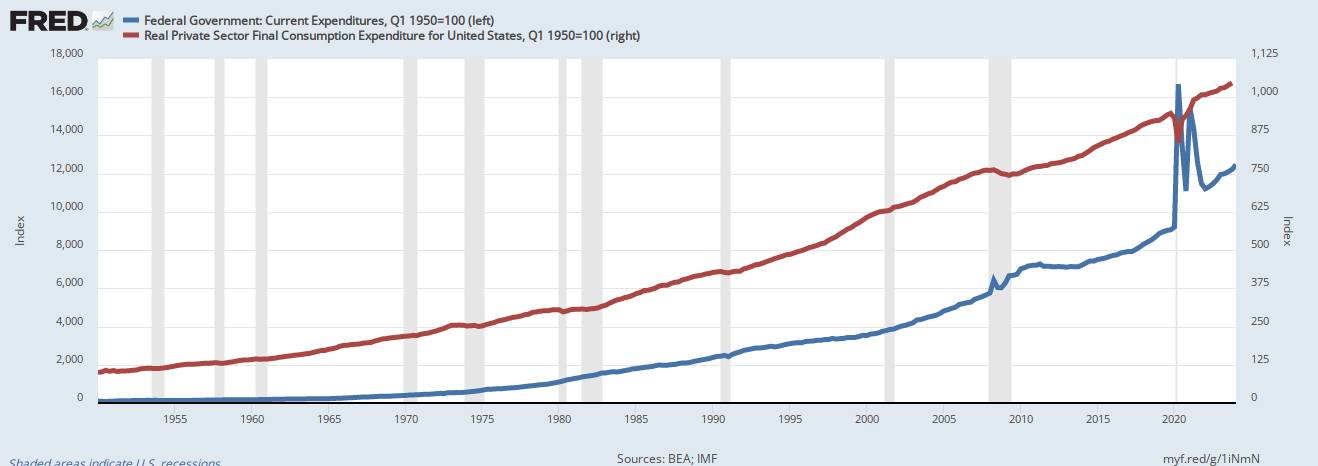
As federal “Debt” has grown, so has the economy (GDP).
As federal spending has grown, so has the economy (GDP).
There seems to be no sign that federal spending or federal “Debt” is “unsustainable,” “slows economic growth,” “heightens the risk of a fiscal crisis,” “causes other adverse outcomes,” or makes the nation’s fiscal position more vulnerable to an interest rate increase.” On the contrary, increases in federal “Debt,” yield all positive outcomes, while decreases in debt cause depressions and recessions:

U.S. depressions tend to come on the heels of federal surpluses.

1804-1812: U. S. Federal Debt reduced 48%. Depression began 1807. 1817-1821: U. S. Federal Debt reduced 29%. Depression began 1819. 1823-1836: U. S. Federal Debt reduced 99%. Depression began 1837. 1852-1857: U. S. Federal Debt reduced 59%. Depression began 1857. 1867-1873: U. S. Federal Debt reduced 27%. Depression began 1873. 1880-1893: U. S. Federal Debt reduced 57%. Depression began 1893. 1920-1930: U. S. Federal Debt reduced 36%. Depression began 1929. 1997-2001: U. S. Federal Debt reduced 15%. Recession began 2001.

Deficit reductions (purple line) lead to recessions (vertical gray bars) which are cured by deficit increases.
GDP = Federal Spending + Non-federal Spending + Net Exports. Not only does Federal Spending increase GDP directly, but it also increases Non-federal Spending by providing the private sector with money.

The new CBO report shows that debt payments will be one of the fastest-growing parts of the budget for the foreseeable future, along with the twin old-age entitlement programs of Social Security and Medicare.

By 2051, interest payments will be the single largest line item in the federal budget.

If there’s a sliver of good news to be found in the new CBO projections, it is that the situation looks slightly less dire than it did last year. That improvement is due to higher expected levels of immigration and stronger estimates of future economic growth—not because of anything that policy makers in Washington have done.

(If anything, they seem determined to prevent those improvements from coming to pass, whether by limiting immigration or regulating the economy more strictly.)

This is the ultimate of ignorance. The data stare him in the face, but instead of reevaluating his position, he claims the good news comes despite the data. In essence, Boehm has two conclusions:
  1. If the data support his belief, he calls attention to that.
  2. If the data do not support his belief, he ignores the data.
Thus, he is incapable of learning.

We should also keep in mind the usual caveats here: The CBO does not account for the possibility of recessions, natural disasters, wars, or other unpredictable events that could cause the federal government to borrow more heavily than current law expects.

The past 30 years have included 9/11, the war on terror, the Great Recession, and the COVID-19 pandemic, so it seems pretty likely that the next three decades will include at least a few emergencies that drive deficits higher.

Boehm doesn’t stop to think about why emergencies drive deficits higher: Emergencies, in of themselves, tend to impede economic growth, so the government increases deficit spending to save the troubled economy. Why does the government need to wait for emergencies before it stimulates economic growth. Why not stimulate growth during non-emergency times, too? This is a question the Libertarians and the right wing never asks, because the answer goes against their beliefs.

“There is no way to look at these eye-popping numbers without realizing we need to make a change,” Maya MacGuineas, president of the Committee for a Responsible Federal Budget, which advocates for lower deficits, said in a statement about the CBO report.

“And yet we have lawmakers promising what they won’t do: I won’t raise taxes, I won’t fix Social Security, I won’t pay for all the things I do want to do. And so we continue on this dangerous path.”

MacGuineas has been president of the CRFB for many years. She and her group are bought and paid for by the rich, so they espouse beliefs that would make the rich righer by widening the Gap between the rich and the rest.
  1. “I won’t raise taxes.” That is a good thing. Federal taxes remove growth dollars from the economy.
  2. “I won’t fix Social Security.” To MacGuineas, “fix” means cut benefits or raise taxes, both of which are unnecessary and harmful to the economy. The federal government has infinite money to pay for Social Security.
  3. “I won’t pay for all the things I want to do.” The government is perfectly capable of paying for anything and everything. It’s people like Boehm and MacGuimeas who hinder the government from doing what it was created to do: Protect and improve the lives of the people.

Indeed, on Thursday, Speaker of the House Mike Johnson (R–La.) told reporters that he supports plans for a so-called “fiscal commission”—which could propose some solutions to Congress’ budgeting problems—but only if the agency could not suggest tax increases or cuts to entitlement programs.

Obama had a “fiscal commission.” Its “increase- taxes, cut-spending” recommendations would have sent the economy into a depression. Fortunately, Congress didn’t listen.

That approach guarantees that the federal government will have to continue borrowing heavily to make ends meet.

Again, the U.S. government never borrows its own sovereign currency. Boehm does not recognize the differences between a Monetarily Sovereign entity and a monetarily non-sovereign entity. Either he is paid to act ignorant or he does it without pay.

Despite the Senate’s declaration that the national debt is a national security risk and the CBO’s attempts to sound the alarm about the federal government’s fiscal trajectory, there’s still a major shortage of elected officials who want to take the problem seriously.

He is correct that there’s “a major shortage of elected officials who want to take the problem seriously.” Without that shortage, the government could fund such benefits to America as:
  1. Comprehensive, no-deductible healthcare insurance or every American.
  2. More medical personnel at all levels, plus more hospitals with advanced equipment
  3. Social Security for Americans of all ages.
  4. The reduction of poverty and homelessness in America
  5. With the reduction of poverty, there would be a significant reduction in crime.
  6. A greater ability to accept fully vetted immigrants, whose work and intelligence would help America grow.
  7. Education, including advanced degrees, for all those who want it.
  8. More scientific innovation in disease prevention and cure.
  9. More efforts to reduce global warming.
  10. A dramatic reduction in federal taxes, which do nothing but remove growth dollars from the economy.
  11. Pay students a salary so that families would not need to favor dropping out of school to help support the family.
The government can pay for all of it, without taxes and without inflation. Anyone not want it? Rodger Malcolm Mitchell Monetary Sovereignty Twitter: @rodgermitchell Search #monetarysovereignty Facebook: Rodger Malcolm Mitchell

……………………………………………………………………..

The Sole Purpose of Government Is to Improve and Protect the Lives of the People.

MONETARY SOVEREIGNTY
Even Warren Buffett gets MS wrong. Is it so hard to understand?

Because the populace has been pumped with wrong information about Monetary Sovereignty (MS), what should be easily understood is widely misunderstood. Does even the great Warren Buffett not get it? He understands federal finance and strongly favors Social Security, yet does even he not know how that program is financed? We have tried to make the simple even simpler with such posts as:
  1. “Airlines are 3 trillion in debt. The Monetary Sovereignty of Airline Loyalty Programs.”  
  2. “The genius of the board game, Monopoly®”,
  3. “Historical claims the Federal Debt is a “ticking time bomb.” OK, it’s just a week after the last update, but you simply must read the last entry (2/8/2024).”
The Miles and Points Roller Coaster - Trips With Tykes
Airlines are sovereign over their mileage points. They cannot run short of points and can give them any value they choose. They are in “points debt” because they issue more points than they receive back from customers.
At its core, Monetary Sovereignty is dead simple. It merely says:
  1. The U.S. federal government created an arbitrary number of dollars and gave them an arbitrary value by passing laws.
  2. The government retains the power to pass infinite laws, create infinite dollars, and give dollars any values it chooses.
  3. Because of these powers, the government cannot run short of dollars. It pays all its obligations with newly created dollars and does not need tax dollars.
  4. Even if the federal government didn’t collect a penny in taxes, it could continue spending forever. No payment, however large, is a burden on the federal government or on federal taxpayers.
The posts gave examples of Monetary Sovereignty with airline mileage points, Monopoly dollars, and store coupons. In each case, the issuer cannot run short of the points/dollars/coupons because all are numbers on computers typed at the creator’s whim.
Warren Buffett | Biography, Books, Worth, & Facts | Britannica
Warren Buffett
Yet, despite that simplicity, even great financial brains seem confused:

A shareholder once asked Warren Buffett and Charlie Munger if Social Security is a ‘government-sponsored Ponzi scheme for retirees’ — their answer was received with laughter and applause. Story by Jing Pan

Social Security has long been a subject of intense discussion in America, but investing legend Warren Buffett’s position on the issue is unmistakably clear.

During Buffett’s company, Berkshire Hathaway’s annual shareholders meeting in 2005, an audience member posed a blunt question: “I’m asking for your opinion on Social Security. Shall we call it the government-sponsored Ponzi scheme for retirees?”

Buffett’s answer was wrong.

He explained that, while it was proposed as insurance because that was “the only way [President Franklin] Roosevelt could get it passed,” Social Security is essentially a “transfer payment by the people who are in their productive years to the people who are past their productive years.” 

And Buffett liked that mechanism.

“I think that the obligation for the people who do well in this society is to provide a reasonable level of sustenance for those beyond their productive years,” he said.

No, no, no. Social Security is nothing like “a transfer payment from people in their productive years to people past their productive years.” And while he may imply there is a moral obligation for the productive people to aid those past productive years, that is not how Social Security operates.
No, Target Is Not Giving You A 50% Off Everything Coupon For Liking A Page On Facebook – Consumerist
Target is sovereign over its coupons. It cannot run short of coupons; it makes all the rules re. its coupons, and it runs “coupon deficits” (receives fewer coupons than it issues) and is in “coupon debt” (the total coupons issued is more than the coupons received.)
If it did, two things would be necessary:

1. Social Security would have to be supported by more affluent people, which it is not. Even the FICA tax, which ostensibly supports SS, is collected mostly from medium-to-lower salaried people  — and only from the first $160K of salary.

I wonder whether Mr. Buffett collects any salary at all. If he obtains all his income via stock gains, dividends, interest, and other non-salary sources, he doesn’t pay FICA. No “transfer” there.

2. More importantly, and contrary to popular belief, FICA does not fund Social Security (or Medicare.) All federal spending is funded by newly created dollars.

Tax dollars, which begin, in the M2 money supply measure, suddenly disappear from any money supply measure when they hit the U.S. Treasury. They effectively are destroyed.

Ask yourself , “How much money can the federal government spend in any given year? Given that the government has the infinite ability to create dollars, how many dollars can it spend? Right, it can spend infinite dollars. It never can run short. What is any number added to infinity? Infinity. Those FICA dollars disappear into an infinite dollar hole, never heard from again. The fake Social Security and Medicare Trust Funds, which supposedly receive FICA dollars and spend those dollars on benefits, do no such thing. In fact, they aren’t even trust funds. They are bookkeeping mechanisms that only record inflows and outflows. They aren’t “trust funds” if the federal government can add to them, take from them, or revise them in any way and at any time it chooses? If you go to any federal finance website, you will see how the government implies or even states outright that federal taxes fund federal spending. Yet, clearly, this isn’t true. Even if the federal government collected zero taxes, it could continue spending forever. That is the reality of all large Monetarily Sovereign entities. Consider the European Union, which is sovereign over the euro:

Press Conference: Mario Draghi, President of the ECB, 9 January 2014 Question: I am wondering: can the ECB ever run out of money? Mario Draghi: Technically, no. We cannot run out of money.

United States one-dollar bill - Wikipedia
The federal government is sovereign over its “coupons,” aka dollars. It cannot run short of dollars; it makes all the rules re. its dollars, and it runs “dollar deficits” (receives fewer dollars than it issues) and is in ” debt” (the total dollars issued is more than the dollars received.)
No large Monetarily Sovereign nation can run short of its own sovereign currency — unless it wants to. Why would it want to? To foster the false belief that benefits to the middle- and lower-income groups are unaffordable and unsustainable without benefit cuts or tax increases. That is the basis for the Big Lie: “Social Security and Medicare can’t continue unless we cut your benefits or increase your taxes.” Who benefits from the Big Lie: The rich who run America. They are rich because of a wide financial Gap between them and the rest of us. The wider the Gap, the richer they are. There are two ways the rich widen the Gap:
  1. They increase their net income with tax dodges for which they bribe politicians.
  2. They reduce your net income by falsely claiming that benefits are unaffordable and unsustainable. They bribe the media and politicians to tell that lie.
Although Mr. Buffett seems to try to claim the high ground by “complaining” that his secretary pays a higher tax rate than he does, it’s hard to believe he doesn’t understand the realities of Monetary Sovereignty. Therefore, I believe he intentionally lies about Social Security being a “transfer payment by the people who are in their productive years to the people who are past their productive years.” Sadly, you receive the Big Lie from three groups the rich bribe: Politicians, news media, and educators. And there are the lies coming from the rich, themselves. That Niagara Falls of false information drowns out the truth, which is why the simplicity of Monetary Sovereignty is so difficult for many people to understand. Rodger Malcolm Mitchell Monetary Sovereignty Twitter: @rodgermitchell Search #monetarysovereignty Facebook: Rodger Malcolm Mitchell

……………………………………………………………………..

The Sole Purpose of Government Is to Improve and Protect the Lives of the People.

MONETARY SOVEREIGNTY