The day Joe Biden lost the November 2024 election

Admirably, President Bident wishes to narrow the income/wealth/power Gap between the rich and the rest of us. I agree with this sentiment because the current Gap, very simply, is bad economics and bad for humanity. Wide Gaps negatively affect health and longevity, education, housing, law and crime, war, leadership, ownership, bigotry, supply and demand, GDP, international relations, scientific advancement, the environment, human motivation and well-being, freedom, and virtually every other issue in economics and the human condition. To narrow the Gaps, Biden proposes changes to federal law.  In broad strokes, he has just three options:
  1. Increase taxes on the rich (“rich” by any arbitrary measure).
  2. Reduce taxes on those who are not rich.
  3. Provide supplementary income and benefits to those who are not rich.
All three would narrow the Gap, though in different ways. From the standpoint of the U.S. economy, as measured by Gross Domestic Product, #1 would have a dramatically different effect than #2 and #3. Increasing taxes on the rich (if the rich actually paid those increased tax levels) would take dollars out of the economy. #2 and #3 would add dollars to the economy). In short, #1 is recessive, and #s 2 and 3, would grow the economy. This is demonstrated by the formula:

GDP = Federal Spending + Nonfederal Spending – Net Imports.

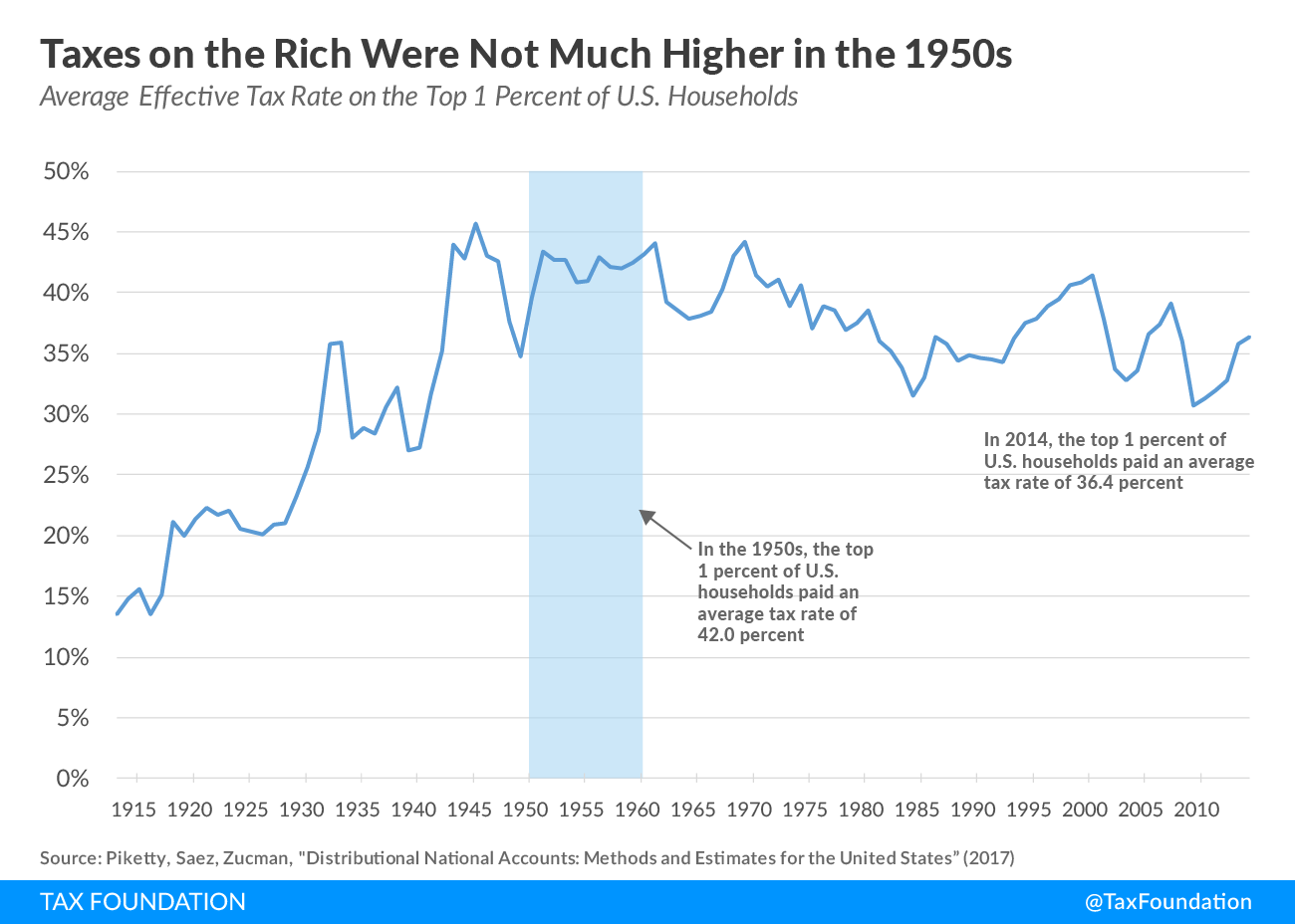
If the rich paid more taxes (#1), Nonfederal Spending would decline. The amount of the decline would be determined by various factors, most having to do with how much the rich actually pay. History indicates that payment would be less than anticipated because of existing loopholes and/or new loopholes the rich would bribe Congress to enact. Average Effective Tax Rate on the Top 1 Percent of U.S. Households Considering that the top tax rate in the 1950s was 90%, the rich did not pay much more in that period than they do now. And some of the richest among us pay little if anything. For example, Donald Trump paid no income taxes at all, during ten of the fifteen years, 2000-2015, despite being a billionaire. Tax laws, favorable to the rich, gave him the ability to claim losses on investments that an ordinary taxpayer may not look at as “losing” money. In summary, using federal taxation of the rich to narrow the Gap is bad economics. History shows the rich would find ways to avoid paying higher rates. But, even if the rich were forced to pay more, the higher rates would take dollars out of the economy and recess the economy. Option #1 is a “heads-you-lose (the rich don’t pay more), tails-you-lose” (GDP falls) plan. Sadly, that is the plan Biden seems to have chosen, and it will cost him the November election. The electorate may be ignorant about economics, but the rich would make sure the voters understood that raising taxes — anyone’s taxes — would hurt the economy. It’s simple math. The more the federal government takes out of the economy, the less the economy (GDP) has. Reducing federal taxes and/or providing supplementary benefits to those who are not rich, (#2 and #3) are the sole economically sensible ways to narrow the income/wealth/power Gap. Sadly this sensible approach is blocked by the non-sensible belief that federal deficit spending is “unsustainable.” That’s associated with the equally wrong belief that “excessive” federal spending or an “overheated” economy cause inflation. The fact: Inflation is not caused by “heat” (whatever that is) or by federal spending. All inflations are caused by shortages of critical goods and services, most often oil and food. Inflation can be cured by additional federal spending to acquire and distribute the scarce goods and services. Here is what the right-leaning Tax Foundation thinks:Details and Analysis of President Biden’s Fiscal Year 2025 Budget Proposal
March 22, 2024, By: Garrett Watson, Erica York, William McBride, Alex Muresianu, Huaquin Li, Alex Durante

11-Year Revenue (Trillions) Long-run GDP Long-Run Wages Long-Run FTE Jobs

+$2.2T

-2.2%

-1.6%

-788k

In plain English, the government would remove from the economy, an additional $2,2 Trillion. This would cause GDP to fall by 2.2%, wages to fall by 1.6%, and Full-Time Equivalent Jobs to shrink by 788 thousand.

Because the Tax Foundation has a right-wing agenda, one may doubt the specifics of their calculations, but I believe they are on the right track. When the federal government collects more taxes, the economy loses money. When the economy loses money, the GDP, wages, and jobs all shrink. It’s straightforward math.

The tax changes Biden proposes fall under three main categories: additional taxes on high earners, higher taxes on U.S. businesses—including increasing taxes that Biden enacted with the Inflation Reduction Act (IRA)—and more tax credits for a variety of taxpayers and activities.

The combination of policies would move the tax code further away from simplicity, transparency, and neutrality while making the U.S. economy less competitive.

The increase in the corporate tax rate and the additional taxes on top earners would result in U.S. top marginal tax rates on income that are among the highest in the developed world.

I urge you to read the entire Details and Analysis of President Biden’s Fiscal Year 2025 Budget Proposal as this post offers you the barest outline. Everything Biden may propose is based on two false assumptions:
  1. The federal government is running short of money while the private sector has too much money.
  2. The middle- and lower-income taxpayers will not understand that taking dollars from the economy is recessive, and instead will happily vote for a “soak-the-rich” administration.
The ignorance and cynicism of these beliefs cannot be overstated. Biden seems to believe that taking the populist approach will gain him votes. But, it is such government deceit that keeps you from:
  1. The end of the FICA tax deduction from your salary
  2. Comprehensive, no deductible Medicare for every adult and child.
  3. Social Security benefits for everyone of all ages
  4. Food cost aid
  5. Free college for those who want it
  6. Free public transportation
  7. Housing aid
  8. And a myriad of other benefits our Monetarily Sovereign government easily could afford, while preventing recessions and inflations.
Biden could beat Trump in a “truth vs. lies” competition, but he will not be able to out-lie Trump. If he tries, he will lose. Narrowing the Gap is good economics, but doing it by taxing businesses and the rich is a lie. It may be a good time to repeat a few facts:

•Those, who do not understand the differences between Monetary Sovereignty and monetary non-sovereignty, do not understand economics. •Any monetarily NON-sovereign government — be it city, county, state or nation — that runs an ongoing trade deficit, eventually will run out of money. •The more federal budgets are cut and taxes increased, the weaker an economy becomes. •Liberals think the purpose of government is to protect the poor and powerless from the rich and powerful. Conservatives think the purpose of government is to protect the rich and powerful from the poor and powerless. •The single most important problem in economics is the Gap between rich and poor. •Austerity is the government’s method for widening the Gap between rich and poor. •Until the lower 99% understand the need for federal deficits, the upper 1% will continue to rule. •Everything in economics devolves into motive, and the motive is the Gap between the rich and the rest.

Rodger Malcolm Mitchell Monetary Sovereignty Twitter: @rodgermitchell Search #monetarysovereignty Facebook: Rodger Malcolm Mitchell; MUCK RACK: https://muckrack.com/rodger-malcolm-mitchell

……………………………………………………………………..

The Sole Purpose of Government Is to Improve and Protect the Lives of the People.

MONETARY SOVEREIGNTY

A riptide of econimic ignorance

The following article appeared in the June 7 edition of THIS WEEK Magazine:

A riptide of economic ignorance Americans can’t possibly be this ignorant about the economy, can they? Asked Catherine Rampbell of the Washington  Post. 

According to a recent Harris-Guardian poll most Americans (55%) think that the country is currently in a recession.

The poll “also found that roughly half (49%) of Americans believe the unemployment rate is a day 50-year high“ and that the stock market has been down since the beginning of the year.

On all three issues, the truth is almost completely the opposite. The economy isn’t shrinking: “by virtually every benchmark, we’re exceeding grow expectations“ and outperforming most other advanced economies.

Unemployment hasn’t been this low for this long since the Nixon administration and the S&P 500 is up more than 10% is year.

Why are the bad “vibes“ still here? Commentators are quick to “blame the media for the public’s economic illiteracy, “and I agree that the journalist “generally give more play to bad economic numbers than good ones,“ but if the media has a bad news, bias is because our audiences do, too.

“People are more likely to click, watch, listen to, and share content that induces outrage“ – a bias for negative news amplified by social media.

The most useful thing you can do to help the general public grow more informed is to reward good news with your attention.

The conclusion is partly correct. People do pay more attention to negative news. The old, “If it bleeds, it leads” expression has been a mainstay of newsrooms for eons. But there is more to it. Who are the people most likely to believe we’re in a recession, unemployment is up, and the stock market is down? The same people also believe:Following Capitol Attack, FRONTLINE Documentary Special Traces President Trump's Incitement of Division, Violence and Ultimately Insurrection Throughout His Term | FRONTLINE
  • the election was stolen
  • January 6 was not an insurrection; it was a normal tourist day
  • Obama is not a citizen
  • vaccinations cause disease and death
  • vaccines implant microchips
  • Trump helped create vaccines
  • Biden orchestrated NY case against Trump
  • Trump is innocent of all lawsuits
  • COVID was a Chinese hoax, then a Chinese plot
  • Wearing a COVID mask is unpatriotic
  • Hillary Clinton runs a sex-trafficking ring in the basement of a fast-food restaurantProtesters outside White House demand 'Pizzagate' investigation - The Washington Post
  • global warming is a Chinese hoax
  • FBI was ordered to kill Trump
  • Biden/Ukraine/Shokin/ Burisma false scandal
  • the deep state and the New World order are threats to America
  • QAnon postings
  • Population control via secret methods — Agenda 21 death map
  • The claims of Alex Jones, David Icke, Jim MarrsJudy Mikovits, Jerome Corsi, Rudy Giuliani,  Mike Lindell, Tucker Carlson
  • The honesty and impartiality claims of Clarence Thomas, Neil Gorsuch, and Sam Alito.
  • Every judge in Trump’s trials is dishonest and takes orders from Biden to weaponize the law (while Trump himself has claimed a long list of people who should be investigated, convicted, jailed, or worse.)
These are just a few of the crazy ideas believed by the conservatives in America, particularly the  MAGA branch.Trump Falls Asleep During First Morning of Criminal Trial: Reports Why is the right wing susceptible to so many obvious lies? They follow a leader like this one.

Forteen Characteristics of Cult  Leaders

1. They’re narcissistic Cult leaders believe they’re special and are on a special mission to lead humanity to the light. They have fantasies of unlimited success and power. They’re constantly seeking the admiration of others and enjoy being the center of attention.

2. They’re charismatic Charisma is the ability to draw people to you by your charms and personality. Cult leaders tend to be highly charismatic. They’re masters at expressing their feelings and making their followers relate to them. Their social skills are above par.

3. They’re dominant As discussed earlier, projecting dominance is key to becoming a cult leader. Nobody wants to follow a submissive leader. A big part of dominance is putting down other dominant figures of society so you can look better than them.

This is why politicians, who share a lot of traits with cult leaders, demonize, belittle, and defame their competitors.

4. They demand obedience Projecting dominance helps cult leaders create a power imbalance between them and their followers. They’re high status, and their followers are of low status. If the followers obey and do as they’re told, they can raise their status too. They can be in a better place too.

In this way, cult leaders prey upon the low self-esteem of their followers.

5. They claim to have supernatural powers Cult leaders do this to highlight the power imbalance. “I’m special. You’re not special.” Cult leaders may claim magical powers like talking to aliens, healing, or telepathy. 

(Or having special influence over dictators like Putin and Kim.)

6. They’re arrogant and boastful Again, to remind their followers that they’re above them and to reinforce their high status.

7. They’re sociopaths/psychopaths (See: “A psychopath slipped into the White House . . .“) Lack of empathy is the hallmark of sociopathy/psychopathy. These tendencies make it easier for cult leaders to harm their followers without remorse.

8. They’re delusional Some cult leaders may suffer from mental illnesses like schizophrenia or temporal lobe epilepsy. These mental health conditions can induce psychosis or hallucinations. So, when they say they can talk to aliens, they may genuinely believe they do.

What’s interesting about this is that they can pull other people into their psychosis. As a result, the followers, driven by the conviction of their beliefs, may also see things that aren’t there. This condition is called shared psychotic disorder.

9. They’re persuasive Cult leaders are excellent marketers. They have to be, or they won’t be able to gain followers and raise their status. They know what makes people tick. They know how to cater to the basic needs of their followers.

10. They’re authoritative and controlling Cult leaders tend to control every little aspect of their followers’ lives. What to wear, what to eat, what to say, what not to say to keep the followers in line and reinforce their low status and power.

Some cult leaders also use fear and blackmail to control and retain followers.

Jim Jones, a cult leader responsible for 900 deaths, forced his followers to sign fake confession documents of criminal acts to blackmail them and deter them from leaving.

11. They’re exploitative The goal of all that authoritativeness and control is exploitation. Cult leaders make their followers submissive and weak to exploit them easily. Intelligent cult leaders exploit their followers that the followers don’t see as exploitation.

For instance, a cult leader may demand sexual access to female followers, making a ridiculous claim such as “This will purify our souls” or “It will bring us to a higher plane of existence”.

12. They’re underdogs Who is desperate to boost their status in society? Of course, low-status people. This is why cult leaders are often underdogs. They are rejects who failed multiple attempts to raise their status and are now resorting to desperate and unethical measures.

Who can relate to an underdog? Of course, other underdogs. Other low-status people. This is a big reason why cult leaders attract so many followers.

Cult leaders and followers band together to ‘overthrow the system’. For this to happen, the cult leader must act like an underdog so his followers can relate to him, but he must project dominance at the same time. An unusual mixture of being low status but projecting high status.

13. They’re intolerant of criticism Cult leaders can become enraged when they’re criticized. To them, criticism is a threat to their high status. That’s why they resort to extreme measures to prevent any criticism. Those who criticize are severely punished, humiliated, or even eliminated.

14. They’re visionaries Cult leaders infuse their followers with inspiration and hope for a better future (high status). They claim to take their followers to a better place, blissful and better off than non-followers.

Donald Trump meets the criteria for a cult leader and for a psychopath. See The Shared Psychosis of Donald Trump and His Loyalists. Are you a cult follower? Cult followers exhibit a range of traits and behaviors. Here are some common characteristics:
  • Unwavering devotion to the cult and its leadership.
  • Willingness to sacrifice personal well-being or relationships for the group.
  • Social withdrawal, often isolating themselves from non-members.
  • Obedience to the leader, following the leader’s commands without question.
  • Justification of contradictory beliefs and lies
  • Suppression of independent, critical thinking
  • Familial isolation: Relationships outside the cult are minimized.
  • Obsession with the leader, intense focus on the leader
SUMMARY To be a right-winger — a Republican today — requires one to be a Trump follower. There are no current Republicans who will admit to opposing Trump, for any such are banished from the Republican party (See: Liz Cheney) Thus, the entire GOP has taken on the characteristics of Trump: Psychopathic, dishonest, and illogical. They have become cult followers, who subscribe to the most ridiculous conspiracy theories, beliefs that normal people would laugh at, but are ardently accepted by the right wing. Before World War II, and during its early stages, the  German people adopted Adolf Hitler as their cult leader. His claims were similar to, and no less ridiculous, than Donald Trump’s. His followers were no less devoted and hypnotized. They claim devotion to America, espouse patriotism, and wave the American flag. Simultaneously, Trump says soldiers are “suckers,” his followers attack Congress, and defend monuments to the ultimate unpatriotic act in American history: The rebellion by the southern states. Today, sanity has returned to Germany. There are no statues of Hitler in Germany, and very few Germans will admit that they and their families worshipped that psychopath. Eventually, sanity will happen here, too. One only can pray it won’t be too late. There is a penalty for ignorance, and our fragile democracy is paying for it. Rodger Malcolm Mitchell Monetary Sovereignty Twitter: @rodgermitchell Search #monetarysovereignty Facebook: Rodger Malcolm Mitchell; MUCK RACK: https://muckrack.com/rodger-malcolm-mitchell

……………………………………………………………………..

The Sole Purpose of Government Is to Improve and Protect the Lives of the People.

MONETARY SOVEREIGNTY

Don’t lend money to friends and relatives and NEVER, NEVER lend to your children

You are a good person. You feel compassion for those less fortunate than you. You give to charity, even when it isn’t tax deductible (Under current law, charity only is tax deductible if you itemize, and if your total deductions exceed your standard deduction.)
one child asking two parents for his allowance
You are accustomed to doing for them. It’s what you always have done. 
If a friend or relative asks you for help with a project, you’re ready to get your hands dirty. You are a good parent. You supported your children during the first 18, or 21, or 25 years of their lives. You love them and you do your best to make their lives even better than yours was at their age. Now, they are adults. They are out in the real world, and they want to start a business or improve the business they already own. Or they want to buy a house or a car or furniture. Or perhaps take an expensive vacation, go to a school, or invest in something. They don’t have enough money right now, but soon will. They ask you for a loan to tide them over. You hesitate for only a second before you agree. After all, they are your children. You can trust them. They’re sure to pay it back in a month or a year, or over time. You know they will do it. You love them. You would do anything for them. You write the check. It’s for $1,000, or $10,000, maybe even a million or more — whatever they need. Your children are so grateful. They smother you in “Thank yous” and hugs and kisses. You’re the best. Eventually, repayment time arrives. You ask about the promised repayment, but things don’t work out as they had planned and promised. They don’t have the money. The repayment doesn’t turn out to be affordable. They need more time. You understand and agree to wait a while longer. Time passes. You ask again. They still don’t have the money, and now they are upset with you. “Why do you keep asking? Surely you must realize that if we could pay you we would.” And anyway, you have more money than we do, so why are you pressuring us?” The “Thank yous,” hugs, and kisses are forgotten. Now your children don’t even want to talk about it. You are the worst. The family is split. You don’t even get to see your grandchildren, who have been told you are selfish and mean. What you thought was a loan has become a gift. Had you simply given them the gift in the first place, they still would love you, but because the loan became a gift, they resent you. If you lend money to strangers, it’s documented in a loan agreement, and if they fail to pay, you can sue them. But they probably won’t fail to pay, because the vast majority of people pay their loans on time. People generally pay their mortgages and their credit card debt without objection. It’s what people do. And when they don’t pay their debt, the bank or credit card company charges penalties and then sues. Credit ratings plunge. It’s expected. Only when loans are given to family and friends, and especially to children, does not paying become a viable option. Only then does the borrower take umbrage that the lender dares to even ask about payment. And that, dear friends, is why you shouldn’t lend money to friends and relatives, and never, never, ever lend money to your children. If they ask you for a loan, decide whether you wish to make it a gift. If not, don’t do it, because it may become a gift whether you like it or not. If you don’t mind it being a gift, you can be magnanimous and say, “Why don’t I simply give you the money. That way you won’t have a debt hanging over your head.” Rather than the loan becoming a gift, you took charge of your money and made the loan a gift. Oh, how the “Thank yous,” hugs and kisses will flow. You’ll feel good. They’ll feel good. And your family will bond even closer. Yes, I know. You’re one of the few who had a good experience lending to your child. But, trust me, on this one: Don’t lend to family and friends, and especially don’t lend to your children. The risk isn’t worth the reward. Rodger Malcolm Mitchell Monetary Sovereignty Twitter: @rodgermitchell Search #monetarysovereignty Facebook: Rodger Malcolm Mitchell; MUCK RACK: https://muckrack.com/rodger-malcolm-mitchell

……………………………………………………………………..

The Sole Purpose of Government Is to Improve and Protect the Lives of the People.

MONETARY SOVEREIGNTY

The fight against inflation: To succeed the Fed must fail

Inflation is not an increase in one commodity’s price. It is a general increase in prices. Inflations tend to begin quickly and end slowly. 
  • Fiscal policy is enacted by the legislative branch of government and deals with tax policy and government spending.
  • Monetary policy is enacted by a government’s central bank and deals with changes in the money supply by adjusting interest rates, reserve requirements, and open market operations.
  • Monetary policy involves changing interest rates and influencing the money supply.
  • Fiscal policy involves changing tax rates and levels of government spending to influence aggregate demand in the economy.
Congress and the President have given the Federal Reserve a mandate for maximum employment and price stability. Given the Fed’s limited control over consumer and business pricing, this is akin to giving the shortstop a mandate for the team to win the World Series. Any single business will raise its prices based on several factors, which include:
  1. Increased costs
  2. Reduced competition
  3. Product improvements
  4. New markets open up
Chair Jerome H. Powell
Fed Chair Jerome Powell
The Federal Reserve, being a monetary organization, views inflation as being a monetary problem. So, it attempts to fight inflation with a monetary solution: Increased interest rates. The Fed’s hypothesis is that increasing interest rates will discourage buyers, thus reducing demand. The demand reduction supposedly forces businesses to reduce prices to capture the remaining customers. This, in turn, forces a reduction in business profits available to spend on employment, marketing, production, and research/development. The formula for Gross Domestic Product (GDP), one of the most important measures of our economy is:

GDP = Federal Spending + Non-federal Spending – Net Imports

The United States is a huge consumer of goods and services so it tends to import more than it exports. Thus, for real (inflation-adjusted) GDP  to grow, either Federal Spending or Non-federal Spending must grow enough to overcome inflation and Net Imports. However, if the Fed’s interest rate increases are successful in reducing demand, two things will happen:
  1. Non-federal Spending will decline and
  2. Business costs will rise
The first will cause a recession unless Federal Spending increases enough to overcome inflation and the dollar losses from Net Imports. The second will exacerbate inflation. However, the consensus among economic pundits — including the Fed —  is that increased Federal Spending causes inflation. No matter what the Fed’s interest rate hikes do — raise business costs or cut consumer spending — the result will be inflation and/or recession. Only if the Fed’s rate cuts don’t work will we be spared inflation and/or recession — unless Congress and the President keep pumping growth dollars into the economy. To cure inflation, without recession, the economy needs more growth dollars that address the true cause of inflation: Shortages of critical goods and services. The Fed’s website says, “The Federal Reserve The Federal Open Market Committee (FOMC) judges that an annual increase in inflation of 2 percent in the price index for personal consumption expenditures (PCE), produced by the Department of Commerce, is most consistent over the longer run with the Federal Reserve’s mandate.” Two inflation measures, the Consumer Price Index (CPE-red), and Personal Consumption Expenditures (PCE-blue) track similarly. It’s not clear why the blue line is more “consistent with the Federal Reserve’s mandate.” Another strange comment from the Fed: “Although food and energy make up an important part of the budget for most households–and policymakers ultimately seek to stabilize overall consumer prices–core inflation measures that leave out items with volatile prices can be useful in assessing inflation trends.” Really? Look at this graph and see if you can see why so-called “core inflation” is useful.
The red line is Personal Consumption Expenditures. The blue line is “Core” Personal Consumption Expenditures.
Does anyone believe the Fed’s predictions are so precise that the blue line is more “useful in assessing inflation trends”? I mention this only to demonstrate how the Fed’s historical beliefs sometimes ignore facts. No matter which measure the Fed leans toward, one thing is clear: To succeed, the Fed must fail.
  1. Its interest rate increases must fail to increase business costs (or prices will increase).
  2. Its interest rate increases must fail to reduce Non-federal Spending (or GDP will decrease).
  3. Its cajoling of Congress to reduce Federal Spending must fail to cause a recessionary reduction in GDP
In short, the Fed must fail in everything it does, and if it fails, and the recession ends despite what the Fed does, Chairman Powell will boast that he took the economy to a “soft landing.” Powell is the player who after he strikes out, the catcher drops the ball, and the winning run scores. So he brags about his winning the game. The facts:
  1. The best way to cure a problem is to cure the cause of the problem.
  2. Inflation is caused by shortages, most often shortages of oil, food, and/or labor.
  3. The cure for shortages is Federal Spending to encourage the production of, and/or access to, the scarcities that cause inflation.
  4. Federal deficit Spending adds growth dollars to GDP, thereby curing inflation while preventing recession.
Oil shortages are the most common cause of inflation. Oil supply changes quickly. OPEC can affect supply in a day, Oil demand changes slowly. Oil prices (green) parallel inflation (purple), which generally comes on quickly, but can leave slowly if oil shortages are not cured. Oil prices affect the prices of nearly every other product.
No “soft landing” was necessary. No “landing” at all was needed. Congress and the President control the fiscal policy that controls supply. The economy does not need or want increased interest rates. The federal government should:
  1. Increase Federal Spending to support oil drilling and refining. and increase support for research, development, production, and distribution of such renewables as wind, solar, geothermal, tidal, and nuclear fusion (not fission).
  2. Increase Federal support for businesses raising wages by making hiring cheaper. Federal funding of all health care insurance by instituting comprehensive, no-deductible Medicare for every adult and child in America. This would relieve businesses of the payroll cost and reduce the expense of illness-related absences.
  3. Reduce payroll costs by eliminating FICA and funding more generous Social Security benefits for every American. This also would reduce the payroll cost of employer-funded retirement plans.
  4. Stop fobbing off the responsibility for inflation on the Fed. Instead, take responsibility for preventing/curing the shortages that cause inflation.
  5. Stop pretending that the federal government “can’t afford” to pay for benefits or that the federal deficits and debt are dangers to our Monetarily Sovereign economy.
Federal deficit spending is necessary to prevent/cure inflations and for economic growth. The Fed’s interest rate increases must fail to succeed. Rodger Malcolm Mitchell Monetary Sovereignty Twitter: @rodgermitchell Search #monetarysovereignty Facebook: Rodger Malcolm Mitchell; MUCK RACK: https://muckrack.com/rodger-malcolm-mitchell

……………………………………………………………………..

The Sole Purpose of Government Is to Improve and Protect the Lives of the People.

MONETARY SOVEREIGNTY