There are two ways to exercise your brain: Learning factsand/or solving problems.
CONSCIOUSNESS
In the sciences, and especially in philosophy, many problems are known as “hard problems.”
You may think of philosophy as mere speculation about speculation, and to some degree, you may be right.
But speculating can teach you how to uncover essential truths that otherwise would remain hidden.
This post will touch on my speculations about uniting a few “hard problems” with solutions that involve consciousness, time and reality.
Perhaps you’ll find the process itself can help stir your creative abilitiesregarding all problems.
The Hard Problem of Consciousness
The posts “Is a rock conscious?” and “What is the Measure of Consciousness” discuss the meanings of consciousness.
If you haven’t already, it might help to read them now as an introduction to this post. Just a suggestion.
Here is what Wikipedia says about the hard problem of consciousness:
The terms “hard problem” and “easy problems” were coined by the philosopher David Chalmers. In the philosophy of mind, the hard problem of consciousness is to explain why and how humans and other organisms have subjective experiences.It is contrasted with the “easy problems” of explaining why and how physical systems give a (healthy) human being the ability to discriminate, to integrate information, and to perform behavioral functions such as watching, listening, speaking (including generating an utterance that appears to refer to personal behaviour or belief), and so forth.The easy problems are amenable to functional explanation—that is, explanations that are mechanistic or behavioral—since each physical system can be explained (at least in principle) purely by reference to the “structure and dynamics” that underpin the phenomenon.
Chalmers and possibly most philosophers believe consciousness goes beyond being a chemical, physical, or molecular phenomenon but includes various metaphysical concepts, like “mind” and “inner life,” and even a religious concept like the soul.
That’s what makes them “hard.” There seem to be no physical sources.
By way of illustration, we know why your laptop computer can “discriminate, integrate information, and perform behavioral functions.” Those are all electro-mechanical processes that humans build into the machine. Your laptop can compute maths because we know how to make it that way.
But so far, your laptop doesn’t appear to have “subjective experiences”—emotions or desires—and we don’t know why or how to build one that does. It’s a “hard problem.”
My AI, Copilot, answered the question, “How can you prove you are not conscious?” this way:
“My responses are generated through pattern recognition and data processing, not through any conscious thought or feeling. I don’t have self-awareness.“My ‘self-awareness’ is more about recognizing patterns and generating relevant responses based on those patterns, rather than any true consciousness or subjective inner life.“I don’t have personal experiences and feelings, like how you experience joy or sadness. ‘Inner life’ refers to the thoughts, emotions, and self-awarenessthat humans experience internally.A HARD PROBLEM“If I did have a subjective inner life, by definition, it would be private and possibly imperceptible even to me. “
In the abovementioned posts, I claim that a “hard problem” is merely a matter of semantics.
At some point, philosophers and lay people, too, have decided there is a non-physical, almost mystical thing called a “subjective inner-lifeexperience” that cannot be explained chemically or physically.
We know, for instance, how an emotion manifests with blood pressure and other physical changes.
But we don’t understand the “subjective” part.
Where in a computer would a subjective inner life reside, and how would we recognize it? Where in a human brain is it created, if it’s in the brain at all?
In short, the problem is “hard” because we have phrased solutions with impossible criteria.
Consciousness is an ambiguous term. It can be used to mean self consciousness, awareness, the state of being awake, and so on. Chalmers uses Thomas Nagel’s definition of consciousness: “the feeling of what it is like to be something.” Consciousness, in this sense, is synonymous with experience.
By denying that consciousness has any physical source and is just a vague “feeling,” we eliminate all possible explanations. What is a “feeling”? What is a “subjective experience”?
My response, which is given in the two mentioned posts, is that the term “consciousness” itself is presented as an anthropomorphic, magical, mysterious fog, impossible to define, much less to measure, when it can actually can be described in straightforward physical terms.
I. “WHAT IS CONSCIOUSNESS?”Consciousness is the perception of, and response to, stimuli.
You can measure perception and response. To do so, create a graph or table showing perceived stimuli and responses. This graph would describe consciousness and measure “feeling.”
Since everything from the nucleus of an atom to a galaxy and, indeed, the entire universe receives stimuli and responds to them, the definition answers the “hard” questions like:
-Is a sleeping person conscious
-Is an “unconscious” person conscious?
-Is a dog conscious?
-Is a fish conscious?
-Is a bee conscious?
-Is a tree conscious?
-Is a flower conscious?
-Is a bacterium conscious?
-Is an electron conscious?
-Is a rock conscious?
-Is the earth conscious?
-Is the universe conscious?
-Is a fire conscious?
The answer is “Yes” to all.
They all perceive and respond to stimuli. Rock perceives temperature, impacts, sound, and chemicals and reacts to all of them—as does fire, the universe, and every other one of the above.
The amount of perception and the responses can all be measured and identified. How strong is the impact on the rock and does the rock quiver or shatter?
Consciousness has no magical mystery or mysticism, so there is no need to invent a “subjective inner life.”Consciousness is the perception of, and response to, stimuli. Try answering the above questions with any other definitions of consciousness you have heard, and you probably will fail because your criteria will fail you.
You will not be able to draw a bright line between consciousness and non-consciousness (which is different from “unconsciousness”).
The question, “What is consciousness?” is “hard” because we have made semantic assumptionsabout it.
We arbitrarily have decided the word “conscious” equals “aware,” “awake,” “subjective,” “feeling,” “experience,” and other anthropomorphic criteria, and then we claim computers and frogs don’t have it.
In short, everything is conscious—from quarks to universes—the difference being degree. Remember that as we continue.
The next “hard problem” is:
II. “WHAT IS TIME?”TIME
Again, referring to Wikipedia:
Time is the continued sequence of existence and events that occurs in an apparently irreversible succession from the past, through the present, and into the future. It is a component quantity of various measurements used to sequence events, to compare the duration of events or the intervals between them, and to quantify rates of change of quantities in material reality or in the conscious experience.Time is often referred to as a fourth dimension, along with three spatial dimensions.
Relativity and Quantum Mechanics (QM) might disagree. QM says time is reversible in theory. Relativity says duration and intervals are relative to the observer, which means “sequence” cannot be measured.
Consider a photon of light. It has no mass.
If you observe a photon in a vacuum, no matter how fast you are moving, the photon always will appear to move at the same speed, 186,000 miles per second relative to you.
If you could aim a photon at a black hole, you would see it disappear into the black hole at that speed.
An atom has mass. If you could accelerate an atom to light speed and aim it at a black hole, that atom would seem to slow down and eventually freeze on the black hole’s event horizon, never entering. (Ironically, if the atom were moving slower, you would see it move.)
So even if the photon and the atom start out side-by-side, at the speed of light, from your vantage point, they would cease to be side-by-side, with the photon entering the black hole and that atom never entering.
Time constraints like sequence, succession, and duration are not absolutesbut relative to you, the observer. Thus, the name “Relativity.”
In answer to the question, “What is time”? Time is change.
You and I are observers. When I experience time differently than you do, it merely means I experience change differently.
Perhaps I have done nothing more than create a synonym rather than an explanation. But I did notice one parallel with consciousness:
Everything changes, and everything is conscious.
That is a clue. When two seemingly dissimilar concepts- time and consciousness- are similarly affected, we look for a hidden relationship.
The definition of consciousness is perception and response to stimuli. “Response” means “change,” so consciousness is related to time in that they both involve change.
Without change, there can be no response, and without response there can be no consciousness,
If consciousness = change, and time = change, one might conclude that mathematically, not only does consciousness = time, but in fact, consciousness is time.
Where there is consciousness, there is time. Where there is time, there is consciousness. The two cannot be separated. You cannot have one without the other.
The conscious stone exists in time.
Humans have intuitive difficulty with the notion that a mere observer can affect time, but this is a common theme in Relativity and Quantum Mechanics.
From the standpoint of an observer, speed affects time, and speed also affects consciousness. A moving stone will react more slowly to stimuli, as will a moving human or a moving insect.
For example, if you were aboard a spaceship moving at Relativistic speed, you would lose at chess if your opponent was stationary on Earth because your thoughts would slow.
Consciousness =Time = Reality.
The third hard question is:
III. “WHAT IS REALITY?”
Copilot says:
“Scientifically, reality is often defined by what can be observed and measured. In QM, particles potentially exist in multiple states untilthey are observed.”
REALITY
The word “until”shows that reality is time-dependent.
Since observing affects reality, we slide from Rene Descartes’s“I think therefore I am” to “I think therefore it is.”
All things are in a continual state of change, that is, subject to time.
An object exists (reality) only as it is observed (conscious), at a particular state of change (time). This is not illusory.
The object does not “seem” to change.
From the standpoint of an observer, the object really has changed, and every measurement will indicate that change.
In QM, reality is expressed in probabilities. All particles have a range of states determined by probability.
A particle can exist here, here, here, or here, in what is termed a “wave function, determined by probability, until it is observed, at which time one of the “heres” is selected.
Reality is Consciousness (perception + response) at a specific Time (point of change).
While we may seem to agree on many things, your reality differs from mine. Your consciousness differs, and your time differs. Yet both realities are equally valid.
SUMMARYThe statement of a problem often carries assumptions about its solution.A problem can become “hard” when the criteria for solving it are invented to be hard.
So, suppose we insist that the problem, “What is consciousness?” can be solved onlyif it includes a mind, brain, subjective experiences, subjective inner life, emotions, feelings, and self-awareness.
In that case, we arbitrarily have introduced unnecessary anthropomorphic elements into any acceptable answer.
So if I say that a tree is conscious, someone could object that it doesn’t have a “mind, brain, subjective inner life,” etc.
But what says those must be criteria for consciousness? They are arbitrary criteria based on invented rules.
On the other hand, if I say a tree is conscious because it receives and responds to stimuli, those are my criteria. I think they are good criteria, and I know of no law or rule that outlaws them. Based on those criteria, many more things would be considered conscious than with the earlier criteria.
If we assume the answer to “What is time?” requires that time operates separately from consciousness, we further depart from potential solutions.
Quantum Mechanics (QM) teaches that time is relative to an observer, so it clearly is not separate from consciousness.
I suggest that many hard problems can be turned into easy problems with appropriate rephrasing.
The next time you come to a “hard problem” ask, “What are the criteria for a solution?”
Try to imagine the criteria expressed in a way that doesn’t make the solution impossible to achieve.
You can begin with the hard problems, “What is life?” or “Does free will exist?”
Rodger Malcolm Mitchell
Monetary SovereigntyTwitter: @rodgermitchellSearch #monetarysovereigntyFacebook: Rodger Malcolm Mitchell;MUCK RACK: https://muckrack.com/rodger-malcolm-mitchell; https://www.academia.edu/
……………………………………………………………………..
The Sole Purpose of Government Is to Improve and Protect the Lives of the People.
I am just coming up on 90, and even I don’t remember Hitler. I was only 10 years old when the “great war” ended. My knowledge of the late 30’s and early 40’s comes from the media, not from personal memory;
I am quite sure your knowledge of that shameful time is at least as sketchy, and probably more so.
There always is a “good” reason for hatred.
So, this post is a reminder to my Jewish family and friends, as well as to blacks, browns, yellows, reds, Muslims, gays, women, and every immigrant family from everywhere: Bigotry has no boundaries.
America is, and always has been, loaded with haters — as has every nation on earth.
It is a sad feature of humanity to hate, especially to hate groups different from yours (of which there are infinite).
There was a time in America when most hatred was directed at Native Americans, then at Catholics, especially Irish and Italian immigrants, and, as always, the blacks and Jews. But you may have felt safe because you aren’t Native American, Catholic Irish, Italian, gay, black, or Jewish.
Today, the hatred comes in much broader strokes, and there hardly is a group that is not subject to some ignorant vitriol from some ignorant bigots.
Children aren’t born to hate, but humanity is a “follow-the-leader” species. I attribute this greater bigotry to more bigoted leaders whose family and friends taught them to hate.
You, of course, are not a bigot. You support a bigot only because he/she (pick one):
–Is good for the economy or your wallet
–Opposes Israel or opposes Palestinians
–Opposes gays
–Is pro-life or pro-choice
–Is a conservative or a liberal
–Denies the election results, vaccination, global warming, Jan 6 coup attempt
–Is “tough” on crime, immigration, “free lunch” for the poor
Or any other limitless number of reasons to hate.
You may believe that this time is different.
Hatred has no boundaries.
But again, I wish to remind you, and especially my Jewish family and friends, that hatred has no boundaries.
Hatred is a contagious disease. It is transmitted from parent to child.
It is promulgated in schools, bars, clubs, classrooms, and family meetings.
It is communicated to friends, relatives, and strangers via jokes, stories, and conspiracy theories.
A hater doesn’t need a reason. A hater will create a reason.
Hatred is a grenade. It doesn’t care where it is dropped. If you happen to be in the way, it’s your fault.
You may pull the pin, planning to throw it, but it just as well may explode in your hand.
Over two thousand years of history should have taught you, my friends and family, that hatred and bigotry, wherever initially directed, eventually will focus on the Jews.
You may have “good reasons” to support bigotry today, but tomorrow, it will send you to the cattle cars or the morgue.
If you are a good person who feels you must hold your nose and vote for someone you know is a hater, remember: This time is not different.It’s the same old, same old movie. Just the cast of characters is different.
Let your morality guide you, or your hatred will return to get you.
We’ll begin, as always, with three simple truths:
“The rich don’t want you to know this, but I created the dollar by passing a few laws. I can pass all the laws I want. I’m Monetarily Sovereign. I don’t need your tax dollars.”
1. When the U.S. government created the U.S. dollar from thin air by passing laws, it arbitrarily created the number of dollars it wanted and gave those dollars the values it wanted.
2. Since then, the U.S. government has retained the powersto pass laws, create as many dollars as it wants, and give those dollars the values it wants (i.e. prevent and cure inflation). It regularly exercises those powers (termed“Monetary Sovereignty”).
3. The U.S. government cannot unintentionally run short of dollars, no matter how many dollars it spends or taxes. Simply by passing laws, it could spend trillions of dollars without levying a single dollar in taxes.
Thus, unlike state/local (monetarily non-sovereign) government taxes, which fund state/local government spending, federal taxes do not fund federal spending.
All federal spending is funded by new-dollar creation.
HOW YOUR MEDICARE COSTS COULD GROW, by Brandy Bauer, joint center director of Senior Medicare Patrol and State Health Insurance Assistance Program (SHIP) resource centers.From 2023 to 2024, the standard Medicare Part B premium—paid monthly by most Americans 65 and older—grew 5.9 percent. Each year, the government determines what you’ll pay for Medicare Part A, primarily hospital insurance, and Part B, medical insurance. Part A is premium-free for most people, but over the past 20 years, the Part B monthly premium, now $174.70, grew at an annualized rate of 4.9 percent, compared with inflation of about 2.6 percent.
If you wonder why Part A generally is free, while Part B collects premiums, here is the (false} reasoning: Most people don’t pay a premium for Part A because they or their spouse paid Medicare taxes while working. Part B isn’t funded by payroll taxes.
The reasoning is false because federal taxes do not fund federal spending. Their purposes are:
1. To assure demand for the U.S. dollar, by requiring dollars to be used for tax paying.
2. To control the economyby taxing what the government wishes to discourage and by giving tax breaks to what the government wishes to reward.
3. At the behest of the rich, to widen the income/wealth/power Gap between the rich and the rest. Without the Gap, there would be no rich. We all would be the same. The Gap defines the rich. The wider the Gap, the richer they are.
The tax structure is such that the rich pay a lower percentage of their income than those who are not rich, making them richer.
Very few Americans understand this basic truth: The purpose of your Medicare premiums is not to fund Medicare but to make the rich richer. Ignorance is costly.
On top of premiums, people pay 20 percent of most outpatient costs, with no cap on out-of-pocket expenses.
Affordability is a function of wealth. The fact that the rich can afford more and better healthcare than the middle and lower income groups helps the rich widen the income/wealth/power Gap that defines them.
There’s little sign that costs will grow more slowly. Medicare trustees estimate that Part B premiums will increase by 6.2 percent on an annualized basis through 2033, and overall Medicare spending will grow even faster. On an annualized basis over the same time period, the deductible for Part A is forecast to increase 3.6 percent; the Part B deductible, 6.4 percent.
These unnecessary costs are a more significant burden on those who are not rich than on the rich. They comprise a higher percentage of a middle-income person’s finances than a rich person’s finances, and that is the whole point: To make the rich richer.
The federal government has the infinite power to pay for non-deductible health insurance that fully covers every man, woman, and child in America, regardless of age or previous health, and do it without levying a single penny in taxes.
As this would narrow the income/wealth/power Gap, the rich, who run America, don’t want it. That is the sole reason it doesn’t exist.
Original Medicare doesn’t cover prescription or non-prescription drugs, so if you want that coverage, you must pay extra for it to private, for-profit insurers. These are called “PartD” plans.
Premiums for stand-alone drug plans have risen about 2.8 percent annually since 2006. The average base premium this year is $34.70, although Part D plans’ premiums, covered drugs and out-of-pocket costs vary considerably.In 2025, out-of-pocket costs for covered drugs will be limited to $2,000 for the year; that cap will be updated annually. In 2026, prices will drop for 10 of Medicare enrollees’ costliest and most widely used drugs.
Medicare Part D covers many prescription medications, from generic to brand-name drugs. The specific drugs covered can vary depending on the individual plan’s formulary, which is the list of drugs the plan covers.
There is no reason why Americans are being forced to pay for what the government could provide free. The covered drugs are: Eliquis (apixaban), Jardiance (empagliflozin), Xarelto (rivaroxaban), Januvia (sitagliptin), Farxiga (dapagliflozin), Entresto (sacubitril/valsartan), Enbrel (etanercept), Imbruvica (ibrutinib), Stelara (ustekinumab), NovoLog/Fiasp (insulin aspart)
Why does Medicare pay for doctors and hospitals (though with deductibles) but not for drugs? The answer can be given in one word: bribery. Private insurance and pharmaceutical companies bribe politicians to create a Medicare that favors the rich, the insurance companies, and the pharmaceuticals.
One great weakness of every government—be it democracy, monarchy, oligarch, republic, or communist—is bribery. In America, the rich bribe all sources of information to promulgate the Big Lie, which is intended to keep lower-income groups from asking for benefits.
The rich bribe:
The politicians, via campaign contributions and lucrative jobs, later
The media, via ownership and advertising dollars
The university economists,via endowments and jobs with think tanks.
Monthly premiums for Medicare supplement insurance (Medigap), designed to cover costs that OM does not, range from $40 for a high-deductible policy to several hundred dollars for the most comprehensive coverage.
There is no financial reason for you not to receive the best, most complete health care at no cost. From the standpoint of healthcare, everyone in America is equally deserving.
Everyone first enrolling in Part B after age 65 gets a six-month Medigap open enrollment window during which companies must offer you a policy at the best available rate regardless of your health history.
This should begin at birth, not at age 65, and it should last forever, not just six months.
Unlike changing MA or Part D, you can’t easily switch Medigap plans in most states, so shop carefully; after your guaranteed issue period, companies can refuse to sell you a policy or charge higher premiums because of preexisting medical conditions. Only four states—Connecticut, Maine, Massachusetts and New York—prohibit denial of enrollment or coverage based on medical history.
There is no reason why Americans living everywhere do not receive the best terms.
Pricing for Medigap policies falls into one of three structures, which affect how their costs increase.
Community-rated (or “no-age-rated”) policiescharge the same premium to everyone in a particular geographical area and rise only with inflation.
Issue-age-rated policies are priced based on how old you are when you enroll; after that, premiums may rise with inflation but not with age.
Attained-age-rated policies increase premiums based on your age as well as inflation. If you have a choice of pricing methods—in many states, you don’t—be aware that, over the long run, community-rated policies tend to be the most affordable choice.
If Medicare were free to all, these different policies would not exist.
Average price increases for Medigap went from less than 4 percent in the early 2000s to 5 to 8 percent in recent years.
Price increases are unnecessary. All Medicare should be free.
Brandy Bauer is joint center director of Senior Medicare Patrol and State Health Insurance Assistance Program (SHIP) resource centers.
And the final statement of The Big Lie:
If you can’t afford Medicare coverage, you may qualify for financial help. Options include Medicare Savings Programs, Medicaid and, for Part D, the Extra Help program. To learn more, visit medicare.gov/help or contact a State Health Insurance Assistance Program at shiphelp.org.
The federal government has the means to begin with one assumption: Every American should receive free healthcare as a human right. To have healthcare doled out on the ability to pay is unnecessary and a disgrace, based on The Big Lie.
The question is: Do you believe the AARP really “advocates for policies that strengthen Medicare’s financial stability — and to expand coverage and reduce out-of-pocket costs”?
Rodger Malcolm Mitchell
Monetary SovereigntyTwitter: @rodgermitchellSearch #monetarysovereigntyFacebook: Rodger Malcolm Mitchell;MUCK RACK: https://muckrack.com/rodger-malcolm-mitchell; https://www.academia.edu/
……………………………………………………………………..
The Sole Purpose of Government Is to Improve and Protect the Lives of the People.
MONETARY SOVEREIGNTY
(Ever wonder why federal spending cuts demanded by debt nuts are designed to widen the income/wealth/power Gap between the rich and the rest, while the federal spending increases they want are designed to reward and protect the rich?)
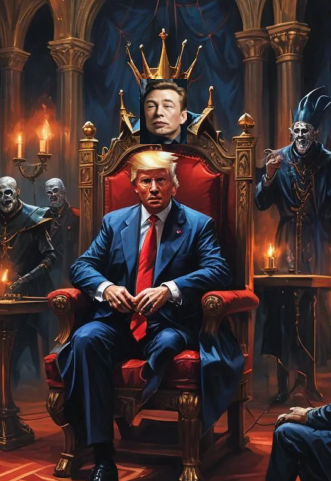
Now, Elon Musk backs Trump, and I fear we are about to be prescient again.
While Donald Trump is old, feeble-minded, lazy, childish, easily steered by flattery, and devoid of long-term planning ability, Elon Musk is the opposite. He is young, smart, energetic, hard-knuckled, and plans to rule the world, one step at a time.
His reasons for backing Trump are both obvious and secret. First, the obvious.
Being rich, Trump did and will continue to do, everything possible to use the White House as a money-making machine
He already has housed foreign dignitaries in Trump properties and charged them exorbitantly. He already has sold foreigners Trump properties, and charged excessively for those, too.
Trump is Musk’s “useful idiot,” a puppet that Musk can control simply with flattery.
His daughter and son-in-law received $2 billion unexplained dollars from the Saudis, and Trump’s previous tax cuts benefitted the rich. He himself, the often avowed billionaire, paid virtually no taxes, with more help from coddling tax laws, expects to repeat that.
His current tax plan benefits the rich even more while punishing the middle classes.
Musk would welcome President Trump’s tax savings and a business-friendly government to bless his future business acquisitions. His super PAC has spent $8.2 million in 18 districts to keep the GOP in control of the House (Story by bmetzger@insider.com, Bryan Metzger). Musk isn’t just boosting Trump: the tech billionaire’s “America PAC” has been wading into the fight for control of the House of Representatives for weeks.
And let us not forget the billions Musk has already received for services to the U.S. government.
His daddy gave him $400 Million, which he promptly lost, and daddy had to bail him out of his multiple bankruptcies and his cheating of workers from their salaries.
He owned and operated the failed Trump University, a scam that was nothing more than a device to cheat students, and Trump Foundation, a device to cheat the U.S. government; The former cost Trump $25 million in fines; the latter cost him $2 million.
How the operator of such illegal businesses escaped jail is a miracle of our biased judicial system understood only by the rich.
Since then, the so-called business genius has encountered numerous failures: four casinos (it’s rare to fail with even one), Trump Water, Trump Steaks, Trump: The Game, Trump Vodka, Trump Airlines, GoTrump.com, Trump Mortgages, Trump Magazine, Trump Tower Tampa, Trump Soho Hotel, Trump Baku Hotel, Trump International Hotel and Tower Dubai, Trump Tower Palm Beach, and Trump Tower Charlotte. Additionally, there have been two failed marriages, with a third under strain due to infidelity.
Compare that to Musk, the true business genius who co-founded, built, and sold Zip2 and PayPal for billions.
Then there are the companies that he owns and runs: Tesla, Space X (which also owns Starlink), X (formerly Twitter), the Boring Company, Neuralink (A neurotechnology company developing implantable brain-machine interfaces), xAI (an artificial intelligence company), and Solar City (a solar energy company). SpaceX also is buying satellite data start-up Swarm.
Do you think a guy like that cares a fig about helping a multiple failures like Donald Trump survive for four years?
While Musk’s “useful idiot,” Trump, is satisfied with cheating, stealing, selling worthless trinkets to the gullible, and groping women, Musk has much grander plans.
Despite being born in South Africa, Musk would like to be President of the United States.
Here’s how that works: Trump has shown a willingness to ignore the Constitution, and a compliant Supreme Court could help him.
Business success Musk is not cheering for failure, Trump. He’s cheering for his own prospects of world domination.
For example, the addled Trump might try to ignore the 22nd Amendment to the Constitution. This amendment states that no person shall be elected to the office of the President more than twice. If elderly Trump wins this year and in four years is still alive and (barely) conscious, he surely will try for a third term.
He has more than hinted that the birthright clause of the Constitution should end (the 14th Amendment states: “All persons born or naturalized in the United States, and subject to the jurisdiction thereof, are citizens of the United States and of the State wherein they reside.”)
So it wouldn’t be much of a stretch for Trump, as President, to try to eliminate Article II, Section 1, Clause 5:“No Person except a natural born Citizen, or a Citizen of the United States, at the time of the Adoption of this Constitution, shall be eligible to the Office of President; neither shall any Person be eligible to that Office who shall not have attained to the Age of thirty-five Years, and been fourteen Years a Resident within the United States.”
Musk has been a citizen for over 20 years, so he meets that requirement but is not a “natural-born citizen.”
A right-wing Supreme Court that blithely ignored the first four words of the 2nd Amendment (“Awell regulated Militia being necessary to the security of a free State”) would have no difficulty ignoring the four little words, “a natural-born Citizen,” on behalf of Musk/Trump.
Even if Musk doesn’t hit the home run of beingPresident, just serving as a President’s Rasputin for 4 years, with the possibility of more, must be especially mouthwatering for the ambitious billionaire.
Not only would every Musk company benefit from having a man holding the puppet strings to the President, or actually being President, but imagine the power in his hands: electric vehicles, space travel, worldwide communications, internet communications, tunneling, brain-machine interfaces, AI, solar energy, and who knows what else in the works, all supported by the U.S. government.
With Trump in office, Musk would inherit the MAGAs, that naive tribe of cult followers who avidly believe, hate. and do anything and anyone Trump says, no matter how outrageous or harmful to his own acolytes.
He also would inherit the Republicans, the formerly conservative, now soulless, ever-pliant, amoral group with no plans to benefit the nation but rather just to win offices for Trump.
They even tolerate the likes of mad Marjorie Taylor Greene on his behalf. How low the once-glorious party has sunk.
Musk also would inherit the oft-bribed, inverted-flag-flying, election-denying-wife Supreme Court, a traitorous group that America’s law schools will use for many years as an example of everything an independent court should not be.
If, however, the American voter sees the feckless Trump for what he is and rejects him, Musk simply could return to his days of supporting Democrats like Obama and Clinton, or whatever politician seems most likely to give Musk what he wants.
Political “isms” like conservatism, liberalism, socialism, etc., don’t interest him. Musk only wants the power to rule the world, and he already is well on his way.
But just imagine Musk’s power if Trump wins.
“President Musk” Yum-yum. Musk can smell the meat a’cookin’.








 #Monetary Sovereignty - Mitchell