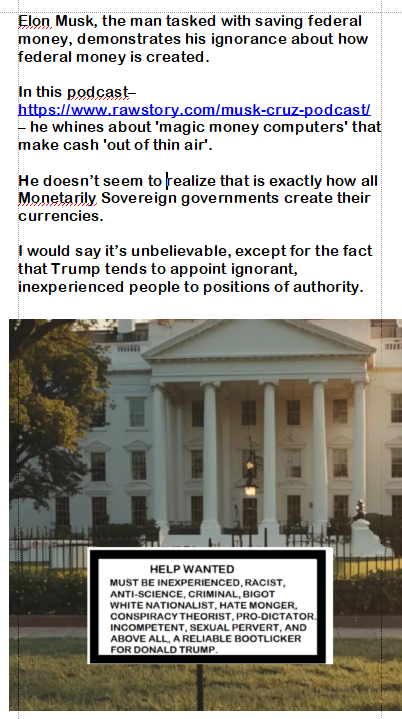
Musk doesn’t know how the federal government creates dollars — but he’s in charge of saving those dollars!

https://www.rawstory.com/musk-cruz-podcast/

Thank you, reader Justin M. for calling our attention to this mind-blowing article.

Rodger Malcolm Mitchell

Why federal deficits are necessary.

You often read and hear warnings about the federal “debt” and “deficit.” Let me assure you that you do not owe any part of the federal “debt, ” and your taxes will not be raised to pay the federal “debt.

You have seen articles where the so-called “debt” amounts to a certain number of dollars per American taxpayer, implying that the federal “debt” is your debt. It isn’t.

You don’t owe it, and you will never pay it. In fact, that thing called “federal debt” isn’t federal and isn’t debt.

The federal “debt” is two separate things united by law. It is the total of federal deficits and the total of outstanding Treasury securities, united semantically but not in reality.

The Federal government pays its bills from the “General Fund,” known as “America’s checkbook.”

You should understand what money is and isn’t. Money isn’t paper, gold, silver, or any other physical thing.

Money is nothing more than numbers on a balance sheet that, by law, lists money.

If, for instance, you keep money in a bank, that bank does not have any physical entity called “money.” All of your money is merely numbers on the bank’s balance sheets.

Many laws, primarily federal but some state and local, determine these numbers. Ultimately, in America, federal laws reign supreme over how the numbers are handled.

The U.S. is Monetarily Sovereign. It is sovereign over the U.S. dollar. It can do anything it wishes regarding the dollar. It can (and does) create and destroy dollars at will and give them any value it chooses.

There were times when dollars were valued at a certain amount of silver, and others were valued as amounts of gold. Today, dollars “float free.” They have market value, and the government can change this at will.

Dollars exist because of federal laws. We do not mine, grow, or build dollars. All dollars are just balance sheet numbers. Congress and the president determine the numbers on the federal government’s balance sheets.

If, for instance, the Social Security Trust Fund (which isn’t a real trust fund), holds about $2.7 trillion. Assume that Congress and the President wanted it to have $5 trillion.

Congress simply could vote that the trust fund would now hold $5 trillion, and presto, there would be $5 trillion in the trust fund’s books.

There would be no need to borrow, tax, or do anything else but pass a law, and the dollars would suddenly exist. So long as Congress doesn’t lose the ability to pass laws, the federal government and its agencies can never unintentionally run short of dollars.

The federal government creates dollars by passing laws, which it can do endlessly. It destroys dollars by accepting payments.

To pay your taxes, you or your employer probably withdraw dollars from checking accounts. These dollars are part of the “M2 money supply measure.”

The M2 dollars are sent to the IRS or the U.S. Treasury. When they reach the Treasury, they cease to be part of any money supply measure. The Treasury already has the infinite ability to create dollars, and no money supply measure describes an infinite supply.

When any amount is added to infinity, the total still is infinity, so adding any number of tax dollars to the Treasury’s supply is not different from adding $0 to the Treasury’s supply. Incoming dollars simply cease to exist. Effectively, they are destroyed.

Because federal taxes cease to exist upon receipt, they cannot fund federal spending.

The federal government creates all the dollars it spends ad hoc, which means that the payroll tax (FICA) does not fund Social Security or Medicare. Like all other federal agencies, those agencies are funded by laws created by Congress.

Being Monetarily Sovereign, The federal government does not borrow dollars. The so-called “federal debt” isn’t federal; it isn’t debt and does not come from borrowing. It is merely a record of dollars flowing in and out.

It isn’t federal because the dollars are owned by owners of individual Treasury Securities. It isn’t debt for the same reason. The owners never lose ownership of the dollars, and the federal government never touches those dollars. They remain the property of T-security holders.

The so-called “debt” is simply an accounting number.ng number.under Congressional control. Congress could easily pay off the debt simply by passing a law adding $35 trillion to the Federal Reserve’s books. Or it could pass a law adding $70 trillion to the books, thereby giving the Fed a huge surplus.

This is what happens when the “debt” increases or decreases:


Because of timing and data definition factors, the Federal Reserve presents federal “debt” in at least three different ways. No method is “better” than the others, and all three demonstrate parallel changes.

A recession (vertical gray bars) is usually defined as a reduction in gross domestic product (GDP), employment, and consumer spending.

The graph demonstrates that:
  1. Recessions (the vertical gray bars) occur following a period of reduced debt growth.
  2. Recessions are cured during a period of increased debt growth.
  3. In most years, there was some debt growth (2000 was a notable exception) but not enough for sustained economic growth.
This makes mathematical sense because GDP = Federal Spending + Non-Federal Spending + Net Exports.

Increased federal Spending adds dollars to the economy, and adding dollars increases non-federal spending.

When faced with the algebraic certainty that decreased federal dollar input yields recessions and increased federal dollar input cures recessions, Libertarians and other anti-deficit, anti-debt proponents switch to agreeing—but now claim that federal debt growth causes inflation.

Their reasoning is that adding dollars increases demand, which, with all other things being held equal, would cause prices to rise. The problem with that philosophy is that when the federal government adds dollars to the economy, all other things are not equal.

When demand increases, the economy responds quickly by increasing production to meet the demand.

Here is the same graph as above, but with the addition of inflation (purple line):


You see no relationship between changes in federal debt and inflation. The reason is that historically, inflations and hyper-inflations have been caused by supply issues, not by demand issues.

When the supply of certain products, notably oil and food, is reduced, the economy cannot reduce demand to meet the new lower supply. We can’t quickly eat less, heat and cool our homes less, and/or drive less. So prices increase.

The most recent severe inflation was COVID-related. We had shortages of food, oil, computer chips, metals, transportation, labor, and other needs. The problem was not one of increased demand or caused by federal spending. It was a supply-related shortage, which is the norm.

Increased federal spending to cure the shortages helped us escape that severe inflation.

THE BOTTOM LINE

Despite widespread beliefs that federal spending should be reduced and causes inflation, those beliefs are diametrically wrong.

Reduced federal spending causes recessions. And federal spending to prevent and cure shortages prevents and cures inflation.

Today, the federal government, laboring under false beliefs, is causing havoc by doing precisely the wrong things: Cutting staff to reduce spending.

While that may be an appropriate approach for a private sector, monetarily non-sovereign entity, it is exactly the wrong path for a Monetarily Sovereign federal government.

Not understanding the difference is a sign of economic ignorance and an approaching recession, if not a depression.

  Rodger Malcolm Mitchell

Monetary Sovereignty

Twitter: @rodgermitchell

Search #monetarysovereignty

Facebook: Rodger Malcolm Mitchell;

MUCK RACK: https://muckrack.com/rodger-malcolm-mitchell;

https://www.academia.edu/

……………………………………………………………………..

A Government’s Sole Purpose is to Improve and Protect The People’s Lives.


MONETARY SOVEREIGNTY

How To Make America a 3rd World Nation

Dear MAGAs, is this how you “Make America Great, Again”? (Article ran in the March 14th Florida Sun-Sentinel.)

NIH funding cuts are creating a lost generation of scientists
Lisa Jarvis, Bloomberg Opinion

The Trump administration’s attacks on science and funding at the National Institutes of Health will set research and training for future scientists back a generation.

This might sound melodramatic to anyone not intimately familiar with the world of academic training and research. But in just two months the administration has cut off opportunities at every phase in a scientist’s career.

Unless funding and the freedom to pursue science without political bias are restored, biomedical research in the U.S. will become less ambitious, less competitive and result in fewer breakthroughs.

To recap: In his first days in office, President Donald Trump targeted the NIH, which spends more than 80% of its $48 billion budget on grants and other funding to universities and hospitals around the country.

That funding ground to a halt, and damage was amplified two weeks later when the administration excised $4 billion in overhead costs from NIH grants — money that institutions rely on to run their facilities and pay support staff.

That was followed by job cuts at the agency — reportedly nearly 1,200 of them, in areas spanning Alzheimer’s research to cancer. (Some of these moves have been halted, at least temporarily, by the courts.)

More recently, scores of NIH grants were terminated because they didn’t align with the administration’s political ideology. Flagged topics include research on LGBT+ health, gender identity, diversity, equity and inclusion; vaccine hesitancy; and mRNA vaccines.

Now, Trump seems to be using the NIH to punish universities that he feels have defied him. On Monday, the agency said it was terminating $250 million in grants to Columbia University, a move that will have a seismic impact on study and researchers there.

Summer research programs at NIH and in university labs — experiences that help pull undergraduates into science careers — have been canceled.

Graduate school admissions are being paused or cut back. Widespread hiring freezes are leaving postdoctoral researchers, on the cusp of launching their careers, in limbo.

Assistant professors awaiting the NIH’s final approval on their first major grant, known as an R01, a critical step toward securing tenure, are worried their once promising careers are being snuffed out.

Even well-established scientists tell me they’ve made lists of people in their labs to cut if the money doesn’t flow soon. I’m told some in the twilight of their careers are cutting back hours to preserve funding or are considering retirement.

The entire pipeline of biomedical scientists, supported in one way or the other by the funding at NIH, is being culled.

Unsurprisingly, morale — both at NIH and at the long list of institutions the agency funds — is in the basement. One researcher at a prominent New York-based cancer hospital told me he hasn’t been sleeping. A health equity researcher at Northwestern University, whose work hits on all of the buzzwords that Trump wants eradicated from federal government, teared up when describing what the situation means for the students she mentors.

Making a career in science has always been exceptionally hard, she says, “and in this environment, it’s just making it impossible. I’m afraid we’re going to lose some of the best minds.”

(Many researchers asked not to be named out of fear about the status of funding under review at NIH.)

Ashley de Marchena, an autism expert at Drexel University, said the funding uncertainty led one of her trainees to look for a job rather than pursue a doctoral degree.

Not only is the time and taxpayer investment in building their research skills lost, but the student, who is neurodivergent, is someone whose unique perspective should be nurtured, not pushed into another career path.

“So many entry points (to research) are gone now,”says Julianne Meisner, an epidemiologist in the University of Washington’s Department of Global Health.

She recently advised a student finishing her master’s degree to consider applying to PhD programs abroad. They might offer less money, but they bring more certainty. And those institutes clearly see an opportunity to siphon some of America’s brightest: at least one French university is advertising itself to U.S. students as a “safe place for science.”

Meanwhile, those who persist are shrinking their ambitions to fit a more hostile environment. A theme I heard over and over again is that researchers will do less bold science, ask fewer questions, make fewer discoveries.

There’s little sign that the damage will be repaired once new leadership is in place at NIH. During his Senate confirmation hearing last week, Jay Bhattacharya, Trump’s pick to lead the agency, seemed unruffled by the turmoil. If anything, his equivocation about the upheaval suggests he’s on board with whatever changes those above him demand next.

Bhattacharya dodged questions about restoring fundingand instead emphasized the need to restore trust in public health, a project he believes requires “freedom” and “transparency.”

It’s hard to imagine a less trustworthy or transparent process, or one less attuned to academic freedom than what’s unfolding. Sidelining and muzzling a generation of scientists, dismantling the nation’s research apparatus and ultimately ceding scientific supremacy to China and Europedoes not seem like the right way to restore trust.

For the public, all of this might seem hard to grasp — or even care about. But eventually we will all be affected.

It’ll show up as a hit to the local economy when scientists and staff lose their jobs. It’ll take the form of a widening gap in access to equitable health care. It’ll be the Alzheimer’s treatment or cancer vaccine that never quite makes it over the finish line.
_____
Lisa Jarvis is a Bloomberg Opinion columnist covering biotech, health care and the pharmaceutical industry. Previously, she was executive editor of Chemical & Engineering News.

Did you ever wonder why some nations are “third world” and others are leaders? The reason is not size or language. Israel, for instance, is a first-world nation despite its tiny population and unique use of Hebrew.

The difference between a first-world nation and a third-world nation is that the third-world nations don’t practice or believe in science. It’s that simple.

And that is where the Republican party is taking us.

Rodger Malcolm Mitchell


Twitter: @rodgermitchell

Search #monetarysovereignty

Facebook: Rodger Malcolm Mitchell;

MUCK RACK: https://muckrack.com/rodger-malcolm-mitchell;

https://www.academia.edu/

……………………………………………………………………..

A Government’s Sole Purpose is to Improve and Protect The People’s Lives.

MONETARY SOVEREIGNTY

WELCOME TO THE WORLD OF DEPRESSION DONALD