Six Truths You May Know That Your Friends Don’t

Here are truths you have learned that your friends do not know, do not understand, and, being unaware of the facts,  will forcefully deny: 1. The U.S. federal government is Monetarily Sovereign.

That means it generated its first revenue by passing laws. It created, from thin air, as many dollars as it wished and gave those dollars whatever value it wanted.

The government arbitrarily valued the first dollar at 371.25 grains of pure silver (approximately 24.1 grams). Later, the government arbitrarily defined the dollar as equal to 24.75 grains of gold (about 1.6 grams).

1834 — Gold Revaluation: Congress arbitrarily redefined the gold dollar to: $1 = 23.2 grains of gold (~1.5 grams)

1933 — Roosevelt Devaluation, after the Great Depression began, FDR arbitrarily ended gold coin circulation and made private gold ownership illegal (with exceptions). Then, in 1934, via the Gold Reserve Act, the official gold price was arbitrarily redefined to $35 per ounce ($1 = 13.714 grains of gold; ~0.89 grams)

1971 — President Nixon Ends Convertibility. Nixon closed the gold window (foreign redemption suspended). The dollar was no longer exchangeable for gold or any other physical commodity. The dollar was purely numbers on balance sheets.

Due to the government’s ability to generate numbers and control its own balance sheets, it has created an unlimited capacity to produce dollars.

Therefore, the federal government cannot run out of dollars unwillingly; it can create them at its discretion.

Federal Reserve Chairman Alan Greenspan: “A government cannot become insolvent with respect to obligations in its own currency. There is nothing to prevent the federal government from creating as much money as it wants and paying it to somebody. The United States can pay any debt it has because we can always print the money to do that.”

Federal Reserve Chairman Ben Bernanke: “The U.S. government has a technology, called a printing press (or, today, its electronic equivalent), that allows it to produce as many U.S. dollars as it wishes at essentially no cost.  It’s not tax money… We simply use the computer to mark up the size of the account.

Here, Ben Bernanke expresses the basic truth of federal financing, a truth that is denied by most economists, politicians, and the media: FEDERAL TAXPAYERS DO NOT FUND FEDERAL SPENDING.

Too often, you read or hear how someone is “spending taxpayer dollars,” or “wasting taxpayer dollars.” Those statements can be true of monetarily non-sovereign state and local government taxpayer dollars, but they cannot be true of the Monetarily Sovereign federal government taxpayer dollars.

Your federal taxes do not fund anything. They are destroyed upon receipt. The purpose of federal taxes is not to fund spending but to:

  1. Control the economy by taxing what the government wishes to discourage (i.e. “sin” taxes on cigarettes) and giving tax breaks to what the government wishes to encourage (i.e. tax breaks for charity giving, and solar electricity.).
  2. Assure demand for the U.S. dollar by requiring taxes be paid in dollars.
  3. Make the rich wealthier by giving them tax breaks not available to ordinary Americans (Example: Trump paying $0 taxes for 8 out of 10 years), thus widening the Gap between the rich and the rest.

Federal Reserve Chairman Jerome Powell: “As a central bank, we have the ability to create money digitally.”

The St. Louis Federal Reserve: “As the sole manufacturer of dollars, whose debt is denominated in dollars, the U.S. government can never become insolvent, i.e., unable to pay its bills. In this sense, the government is not dependent on credit markets to remain operational.”

Secretary of the Treasury Paul O’Neill: “I come to you as a managing trustee of Social Security. Today we have no assets in the trust fund. We have promises of the good faith and credit of the United States government that benefits will flow.”

Paul Krugman (Nobel Prize–winning economist): “The U.S. government is not like a household.

It literally prints money, and it can’t run out.”

Ask your doubting friends which authority they believe more than three Fed Chairmen, a Treasury Secretary, a Nobel-winning economist, and the St. Louis Fed.

Other Monetarily Sovereign nations include Japan, Canada, Australia and the United Kingdom. They too cannot unintentionally run short of their own sovereign currencies.

The U.S. state, county, and city governments, along with businesses and individuals, are financially non-sovereign. They are simply users of dollars, and can run out of them.

Eurozone countries, such as France, Germany, Portugal, and Italy, do not have monetary sovereignty over the euro. They use it without the ability to create it, which means they can run out of euros.

Monetarily non-sovereign entities can create dollars by lending. When anyone borrows from a bank, the bank does not go into a vault and find dollars. Instead, the bank types this into its ledger:

Customer checking account: +$100,000 Customer loan account: –$100,000

The borrower (customer)  now has a newly created $100,000 to spend.

The bank has an asset (the borrower’s promise to repay with interest) and a liability (the deposit into the checking account). No cash changes hands. No reserves are touched.

Over 90% of U.S. dollars in existence are bank deposits, created by private commercial banks.

2. Gold and silver are not, and never were, dollars.

The U.S. federal government established arbitrary rules regarding the exchange of gold and silver for dollars, which are entirely within its control.

The dollar was never “backed” by gold; it was exchangeable for gold, a system always determined and controlled by the federal government.

The term “fiat” currency is a misnomer. “Fiat” originates from the Latin word meaning “let it be done.” In legal and administrative contexts, it refers to an authoritative order or decree established by a government or authority.

All money fits that definition, including dollars that the government decrees are exchangeable for gold or silver. Thus, all money is fiat.

The U.S. dollar has always been the debt of the federal government. Debt requires collateral. The collateral for federal debt is “full faith and credit.” This may sound nebulous to some, but it actually involves certain, specific, and valuable guarantees, among which are:

A. –The government will accept only U.S. currency in payment of debts to the government

B. –It unfailingly will pay all its dollar debts with U.S. dollars and will not default

C. –It will force all your domestic creditors to accept U.S. dollars if you offer them to satisfy your debt.

D. –It will not require domestic creditors to accept any other money

E. –It will take action to protect the value of the dollar.

F. –It will maintain a market for U.S. currency

G. –It will continue to use U.S. currency and will not change to another currency.

H. –All forms of U.S. currency will be reciprocal, that is five $1 bills always will equal one $5 bill and vice versa.

If you wish to issue your own money, there is no law against it. However, its acceptance would rely on its users’ belief in your full faith and credit.

For example, you could issue “My Greenbacks” and offer to pay your bills with them. If all your creditors agreed to accept “My Greenbacks” as payment, you instantly would become Monetarily Sovereign and have the infinite ability to pay all your bills.

You would not need to borrow or use any other form of income. You never would run short of money. Debt would not be a burden.

3. The U.S. government never borrows dollars. The “national debt” isn’t debt. It’s dollars.

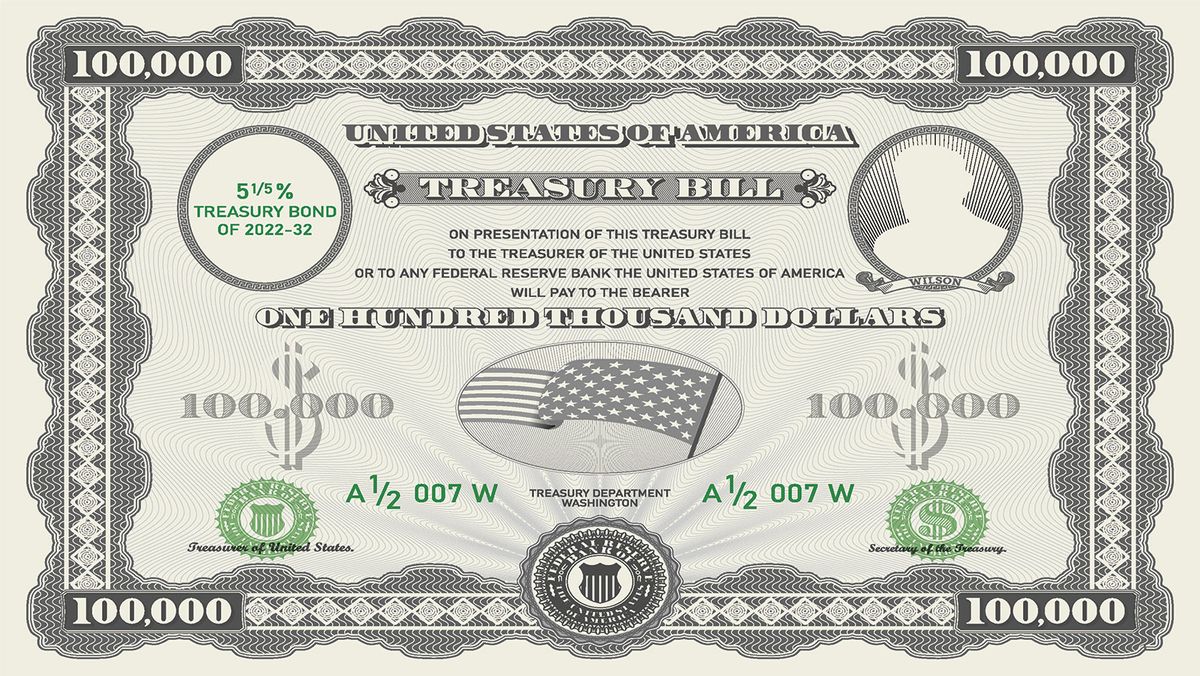
The belief that the federal government borrows is based on a semantic misunderstanding. The government issues Treasury Securities called “T-bills, T-notes, and T-bonds.” These are receipts for deposits into accounts owned by depositors.

The confusion arises from the terms “bills,” “notes,” and “bonds,” which, in the context of the federal government, refer to dollars, whereas in the private sector, they describe debt.

The term “national debt” often evokes the image of a household accumulating credit card debt. However, this comparison is misleading. In reality, what we call the national debt isn’t debt in the traditional sense; it is merely another form of U.S. dollars.

A U.S. dollar is not a physical commodity; rather, it is an entry in the financial records of the federal government. The dollar may be represented by a paper bill, a bank statement, or a Treasury security, and it signifies a legal obligation of the U.S. government.

The only difference is the form and terms of the obligation.

A T-bill is an interest-bearing IOU from the U.S. Treasury that matures at a fixed date. A dollar bill is a non-interest-bearing, zero-maturity IOU from the Federal Reserve. They both are financial obligations of the U.S. government.

A government that can create T-bills can just as easily generate dollar bills.

Yet, the media, and even the government, incorrectly describe T-bills as “debt” and dollar bills as “money.”

Donald Trump boasted that his tariffs would reduce federal debt.” That is identical to saying his tariffs would reduce dollars. And that is precisely what is happening. Tariffs remove dollars from the economy.

Dollars in the economy are being reduced, which is recessionary.

When the public pays the tariffs, dollars in the economy flow to the federal government, where they are destroyed. The federal government does not have a vault where it keeps dollars. It creates new dollars, ad hoc, every time it pays a creditor.

Treasury securities are simply time-bound dollars that pay interest. They are not borrowed dollars; they merely are dollars.

When you invest in a T-bill, one type of government-backed money (a deposit of dollars) is exchanged for another type (a T-bill). This is no different in principle from moving funds from a checking account to a savings certificate.

The term “debt” is applied to Treasury securities by accounting convention. We count the sum of outstanding T-bills, notes, and bonds as “the national debt.” We do not refer to dollar bills, reserve balances, or bank deposits as “national debt.”

Rather than providing the federal government with spending funds, the purposes of T-securities are to:

    1. Provide the private sector with a safe, interest-bearing place to store unused dollars — safer than any private bank.
    2. Provide a mechanism for managing bank reserves and setting interest rates
    3. Provide the federal government with a semantic rationale for claiming that benefits for middle- and lower-income people are “unaffordable” and “unsustainable,” while continuing to give tax breaks to the rich — i.e., widening the income/wealth/power Gap between the rich and the rest, thus making the rich richer.

Paying off Treasury securities involves debiting T-security accounts and crediting bank accounts. The government does not need to “earn” dollars before doing this. It merely changes the form of its liability from T-bills to dollar bills, the reverse of what it did when issuing the T-bill in the first place.

Reducing federal “debt” (red) is the same as reducing the number of dollars in the economy. This leads to reductions in Gross Domestic Product (blue) and causes recessions (vertical gray bars). The recessions are cured by increases in federal “debt” (money).

U.S. depressions come on the heels of federal surpluses.

1804-1812: U. S. Federal Debt reduced 48%. Depression began in 1807.

1817-1821: U. S. Federal Debt reduced 29%. Depression began in 1819.

1823-1836: U. S. Federal Debt reduced 99%. Depression began in 1837.

1852-1857: U. S. Federal Debt reduced 59%. Depression began in 1857.

1867-1873: U. S. Federal Debt reduced 27%. Depression began in 1873.

1880-1893: U. S. Federal Debt reduced 57%. Depression began in 1893.

1920-1930: U. S. Federal Debt reduced 36%. Depression began in 1929.

1997-2001: U. S. Federal Debt reduced 15%. The recession began in 2001.

The reason: Gross Domestic Product, the most common measure of the economy is the total of: Federal Spending + Non-federal Spending + Net Exports.

Decreases in Federal Spending also decrease Non-federal  Spending, and these decreases decrease GDP.

In short, the so-called federal “debt” is a record of how many more dollars the federal government has added to the economy by spending than it has removed by taxing.

Adding dollars to the economy grows the economy. Thus the so-called “debt” demonstrates economic growth. The larger the debt, the greater the growth. Lack of debt growth = recession.

4. Tariffs are sales taxes on buyers.

If your governor or mayor boasted that he/she was going to increase sales taxes so that the government could take in more money, would you consider that good news?

That is no different from the President boasting that he increased tariffs so that the government could take in more money.

Actually, the Presidential boast is worse because states and cities need and spend tax revenue, the federal government doesn’t.

When Donald Trump and his associates claim that the government will receive trillions in tax revenue, they essentially are stating that they will extract trillions from the U.S. economy solely to make the wealthy even richer.

How do increased tariffs benefit the rich? To become wealthier, the rich must widen the income/wealth/Gap below them and narrow the Gap above them.

Those of us who are not rich pay a greater percentage of our incomes on products subject to duties than do the rich. The duties widen the income/wealth/power Gap between the rich and the rest, and it is the Gap that makes them rich.

If there were no Gap, no one would be rich. We all would be the same, and the wider the Gap, the richer they are. Tariffs widen the Gap.

5. The federal government cannot spend tariff dollars.

President Donald Trump said he is considering distributing rebates to U.S. taxpayers because of billions of dollars from tariffs flowing in from foreign imports.

This either is based on his ignorance of federal financing or, more likely, his intentional misrepresentation of how federal finance works.

State and local governments, businesses, and individuals like you and me are all monetarily non-sovereign, meaning we rely on income and borrowed funds. In contrast, our federal government, which is Monetarily Sovereign, does not depend on income or borrowing. Instead, it creates new dollars as needed whenever it pays a creditor.

Your federal tax dollars are destroyed the instant they are received by the Treasury. The process is:

1. You pay your taxes by taking dollars from your checking account. These dollars are taken from the M2 money supply measure. 2. When your dollars reach the Treasury, they cease to be part of any money supply measure. There is no measure of the Treasury’s money supply because the Treasury has access to an infinite amount of dollars.

As a result, your federal tax dollars are effectively removed from circulation, while new dollars are created and sent to creditors.

Once these new dollars reach the banks of the creditors, they are added to the M2 money supply. This is how the federal government generates dollars—by settling its obligations.

In summary, Trump cannot distribute tariff dollars. They disappear immediately. He can, at will, send as many dollars as he wishes to anyone he wishes because the government has infinite dollars available to spend. He could have sent the “rebates” the day he came into office, or today. Waiting for tariff dollars is a meaningless gesture.

Tariff collections do not add to the federal government’s ability to spend. That ability remains infinite, whether or not tariffs are collected.

By contrast, state/local tax dollars are not destroyed. They go into banks where they continue to be part of the M2 money supply. State/local governments do spend the tax dollars and other income they receive.

6. Inflation is supply-based.

The traditional view suggests that inflation occurs due to “too much money chasing too few goods.” However, this outdated explanation misses the more immediate cause of inflation: supply shortages, especially in essential goods like oil, food, and housing.

Inflation always results from an imbalance between demand and supply. But we must ask: what causes that imbalance? Federal spending increases the money supply, which in turn can increase demand for goods and services.

However, demand typically builds gradually and through indirect channels, like increased employment, public contracts, or income supports.

In contrast, supply shocks tend to happen abruptly. Wars, pandemics, droughts, embargoes, and logistical breakdowns can slash the availability of key goods almost overnight.

When essential commodities like oil or wheat are suddenly scarce, prices rise across the board, not because of excessive money, but because of insufficient supply.

Historical Examples of Supply-Driven Inflation

Real-world inflation episodes across the globe support the supply-side view:

1950–1951 Korean War: At the outbreak of the Korean War, prices surged due to panic buying, military buildup, and supply bottlenecks in key materials like steel, rubber, and oil.

1970s U.S. Oil Shocks: The Organization of the Petroleum Exporting Countries (OPEC) imposed oil embargoes in 1973 and 1979, causing significant price increases. Inflation rose, not due to excessive federal spending, but because of the sudden drop in oil supply.

1973–1974 Global Food Crisis: In addition to the 1973 oil shock, the early ’70s saw a global spike in grain prices, partly due to poor harvests, rising meat consumption, and large U.S. grain sales to the Soviet Union.

2005 Hurricane Katrina: Katrina damaged Gulf Coast oil production and refining capacity, leading to a temporary spike in gasoline prices.

2020–2022 COVID-19 Pandemic: Lockdowns disrupted global supply chains, while shipping bottlenecks and factory shutdowns diminished the availability of goods. This was followed by inflation, despite subdued household demand early in the pandemic.

Post-War Europe (1940s–50s): After WWII, devastated infrastructure and displaced populations created widespread scarcity of goods, particularly food and housing, leading to inflation across the continent. Currency reform helped, but the recovery of supply was the key.

Zimbabwe (2000s): Though frequently cited as an example of money printing leading to hyperinflation, the primary cause was the devastation of agricultural output due to land confiscations. This resulted in food shortages and a decline in export revenue, ultimately leading to the collapse of the currency.

Weimar Germany (1920s): Reparations payments and loss of industrial territory after WWI, combined with political unrest and a halt in domestic production, created shortages. Hyperinflation followed only after real output had drastically fallen.

These examples show that supply breakdowns, whether from war, sanctions, pandemics, or policy, are central to inflation crises.

Time Asymmetry: The Hidden Factor

A crucial but underappreciated aspect is time. Demand tends to rise slowly, giving markets and the government time to adjust. But supply can fall sharply and without warning.

The economy does not self-correct at the same pace in both directions, and government reaction can have difficulty keeping up with the shortages.

Federal deficit spending rarely causes direct demand spikes for food or oil. Most government spending enters the economy as a general stimulus, bolstering incomes, investment, and production.

If inflation arises during such periods, it generally coincides with supply constraints, not with runaway consumer demand.

The Mistake of Fighting the Wrong Cause

When policymakers target inflation by suppressing demand, through higher interest rates or spending cuts, they may worsen economic pain without resolving the shortage.

Interest rate hikes do not produce more wheat, oil, or housing. They may instead trigger unemployment or recession. Reductions in federal spending are recessionary.

Understanding that most inflation is driven by supply indicates different solutions: strengthening supply chains, investing in domestic production, stabilizing essential imports, and maintaining strategic reserves. All these measures require increased federal spending rather than a reduction.

Conclusion

Inflation is rarely, if ever, a sign of excessive money supply; rather, it indicates a shortage of goods.

We should stop blaming federal deficits for what are clearly supply-side problems. Better policy begins with better diagnosis, and in today’s world, that means putting shortages at the center of our efforts to prevent and cure inflation.

Rodger Malcolm Mitchell

Monetary Sovereignty

Twitter: @rodgermitchell

Search #monetarysovereignty

Facebook: Rodger Malcolm Mitchell;

MUCK RACK: https://muckrack.com/rodger-malcolm-mitchell;

https://www.academia.edu/

……………………………………………………………………..

A Government’s Sole Purpose is to Improve and Protect The People’s Lives.

MONETARY SOVEREIGNTY

The scam even YOU will fall for

Here is a scam that even those who understand Monetary Sovereignty will fall for:

News article: President Donald Trump says the government might start cutting checks again, but this time, not for COVID-19 relief or tax refunds. Instead, the money could come straight from the tariffs his administration has slapped on foreign imports.

In his words, “We have so much money coming in, we’re thinking about a little rebate.”

And by “little,” he means from a pool of more than $100 billion in tariff revenue already collected this year.

Sounds good, right? Some of the dollars those tariffs are taking out of your pocket will come back in the form of rebates. What could be wrong with that?
Dripping only ONE drop of water into the ocean. Not more than one drop.
This illustration actually exaggerates the impact of tariffs on the federal government’s ability to spend. The ocean doesn’t contain an infinite amount of water, but the government can create an infinite number of dollars.

It’s 100% misleading.

There is no “pool of tariff revenue.” The federal government has infinite dollars.

Every dollar that comes to the government disappears into an infinite pool of funds.

Fed Chairman Alan Greenspan: “A government cannot become insolvent with respect to obligations in its own currency. There is nothing to prevent the federal government from creating as much money as it wants and paying it to somebody. The United States can pay any debt it has because we can always print the money to do that.”

Fed Chairman Ben Bernanke: “The U.S. government has a technology, called a printing press (or, today, its electronic equivalent), that allows it to produce as many U.S. dollars as it wishes at essentially no cost. It’s not tax money… We simply use the computer to mark up the size of the account.

Fed Chairman Jerome Powell stated, “As a central bank, we have the ability to create money digitally.

The St. Louis Fed: “As the sole manufacturer of dollars, whose debt is denominated in dollars, the U.S. government can never become insolvent, i.e., unable to pay its bills. In this sense, the government is not dependent on credit markets to remain operational.” 

If Trump wanted to send a “rebate” to Americans, he could do it tomorrow, simply by having his acquiescent Congress vote for it.

There, quite literally. is no limit to how much the federal government can send to anyone and everyone, today, tomorrow, or any time.

Then there is this nonsense:

The US government is raising record-high revenue from tariffs, thanks to President Donald Trump’s embrace of new import levies. The White House may exaggerate the potential, but independent budget analysts agree the new tariffs may bring trillions of additional dollars into government coffers over a decade.
The United States government has the potential to collect US$2trn or more in tariff revenue for its coffers in the next decade from President Donald Trump’s new import levies, according to economic and budget researchers.

Since his second presidential term began in January, Trump has ordered a series of new import tariffs on a global, per-country and per-item basis. Among the president’s stated goals is to raise enough money to offset, or even eliminate, federal income taxes.

The independent analyses do not envision any possibility that tariffs, even under the highest plausible outcome, can replace the income tax. The US collects approximately US$2trn in income taxes annually.

There are no “coffers.”

This situation is similar to the ocean boasting about a tiny thimbleful of water being added to it.

However, that analogy isn’t quite accurate because even the ocean doesn’t have an infinite supply of water, while the U.S. government has an unlimited capacity to create dollars.

The government has the power to create a trillion, trillion, trillion dollars today, if it chooses to, simply by pressing a computer key.

Therefore, the government does not need to “raise” money to eliminate federal income taxes; it could eliminate those taxes immediately.

And this:

Howard Lutnick: “The tariff revenues are amazing — $700 BILLION a year. That’s just net new money the government never had before. You take that for ten years, that’s $7 TRILLION.”

An abject lie. The federal government has infinite money. The mythical $7 TRILLION would be taken from the private sector and disappear.

The purpose of federal income taxes is not to supply the federal government with money. Instead, the purposes of federal taxes are:

  1. To control the economy by taxing what the government wishes to discourage (Examples: “Sin taxes on cigarettes, liquor, etc.)  and by giving tax breaks to what the government wishes to reward (Examples: Tax breaks for charitable contributions, and tax loopholes for the rich.)
  2. To assure demand for the U.S. dollar by requiring dollars to be used for tax payments.

Unlike state and local governments, which rely on tax dollars, the federal government does not need or use tax revenue.

Rather than taking tariff dollars from the public, the federal government should simply vote to eliminate poverty by funding comprehensive, no-deductible health care insurance and generous Social Security benefits for every man, woman, and child in America.

No, this wouldn’t cause inflation any more than Trump’s so-called “rebates” would. Inflation is caused by a shortage of essential goods and services, and it can be alleviated through federal spending to address those shortages.

At long last, when will the media, the politicians, and the economists acknowledge the federal government’s infinite supply of dollars?

God, this is so frustrating.

Rodger Malcolm Mitchell

Monetary Sovereignty

Twitter: @rodgermitchell

Search #monetarysovereignty

Facebook: Rodger Malcolm Mitchell;

MUCK RACK: https://muckrack.com/rodger-malcolm-mitchell;

https://www.academia.edu/

……………………………………………………………………..

A Government’s Sole Purpose is to Improve and Protect The People’s Lives.

MONETARY SOVEREIGNTY

An evaluative prediction from 9 years ago, spot on.

Nine years ago, I wrote the following posts: Will our next President be a psychopath?  and A psychopath slipped into the White House . . .

They showed you that Donald Trump was (and still is) a clinical psychopath.

The second post covered the Robert Hare Checklist of Psychopathy Symptoms, which includes 20 symptoms rated on a scale from 0 to 2.

(Spoiler alert: I concluded that Trump exhibits all 20 symptoms.) If you go to the post, you can examine those symptoms and see whether you agree with my analysis.

I just read, “What If We Could Treat Psychopathy in Childhood?” in the July/August edition of Scientific American Magazine (New strategies help to reduce callous and unemotional traits in children, guiding them toward productive lives) By Maia Szalavitz edited by Madhusree Mukerjee

Here are a few excerpts, along with my comments.

Lillyth Quillan knew almost immediately that something was wrong with her baby. At around eight months old with eight sharp new teeth, he began deliberately biting her breast as she fed him, then looking her in the eyes and laughing.

Even though she cried out and pulled him away for significant stretches of time, whenever she returned to nursing, he’d bite again—and then snicker. Within days she had to switch to bottle feeding.

Quillan’s son, Alex (his name has been changed for privacy), was almost expelled from preschool because he repeatedly hurt other children. In middle school he began stealing and selling his parents’ electronics. He would pretend to hug his mom, then headbutt her instead.

“I remember hitting my mom as a kid,” Alex says. “I know I shouldn’t have enjoyed it, but at the time, I did.” He adds, “If you’re looking for a reason, I wish I had it.” By high school he was using a gun to commit armed robberies.

According to Donald Trump’s own accounts and biographies, he was disruptive, aggressive, and hard to control as a child. He reportedly misbehaved frequently, and his parents became concerned about his behavior and lack of discipline.

At age 13, after some behavioral problems, his parents decided to send him to a military boarding school to instill discipline and structure.

The couple tried all types of discipline short of corporal punishment. They saw counselors, psychologists and psychiatrists; wasted thousands of dollars on brain scans; got diagnoses of attention deficit hyperactivity disorder and Asperger’s syndrome; and tried medications, therapies and special education.

Nothing worked.

Finally, when Alex was 14, Quillan told her own therapist that she thought her son was a sociopath. The therapist said such terms weren’t used to describe children—but she diagnosed him with conduct disorder, which can be a precursor to psychopathy in adults.

Conduct disorder is characterized by defiance of rules, aggression toward people or animals, and ongoing cruelty such as bullying.

These three characteristics — defiance of rules, aggression toward people or animals, and ongoing cruelty such as bullying — perfectly define Trump.
The type that Alex turned out to have comes with so-called callous-unemotional (CU) traits and is seen in up to 2 percent of children. CU traits—a lack of empathy and generally low emotional response—can be caused or exacerbated by child abuse or neglect, but genetic predispositions alone can also spur their development.

Separating children from their parents and reveling in the harshness of the “Alligator Auschwitz” (Alcatraz) symbolize Trump’s lack of empathy.

When they appear as early as they did in Alex’s case, they are overwhelmingly driven by genetics and more likely to develop into adult psychopathy. (At least one relative on each side of Alex’s biological family seems to have some of these traits.)

According to reports, Donald’s father, Fred Trump, modeled ruthlessness and dominance, teaching Donald to view kindness as a sign of weakness.

He was hard-driving, ambitious, controlling, authoritarian, and demanding.

Success was measured almost entirely in financial or competitive terms, emotionally cold, practical to the point of ruthlessness, and not nurturing.

Fred promoted a clean image but was involved in questionable practices (e.g., racial discrimination in housing). This duality may have influenced Donald’s flexible morality and image obsession.

Donald’s mother, Mary Anne, reportedly prioritized appearances and social status.

She was emotionally distant. Her fascination with status and pageantry helped shape Donald’s later obsession with fame, wealth, and image.

Psychopathy sits at the uncomfortable intersection of mental illness and morality, with symptoms such as cruel behavior and remorselessness that inherently raise questions about the line between medicine and criminal law.

Television serials may dwell on the sadistic criminal, but research suggests executives and politicians also have high rates of psychopathic traits.

People with psychopathy can carry out cold, calculated crimes and cons that require significant planning, but they may also engage in wildly impulsive aggressive behavior.

They can understand the perspectives of other people well enough to manipulate their emotions but lack the intuitive emotional empathy that would help them care about causing harm.

Most disturbing, unlike people with classic psychiatric illnesses such as schizophrenia, people with CU traits appear socially typical and may even be charismatic.

Trump has become the MAGA cult leader, not because of his intellect but because of his personal charisma.

Most MAGAs, know he is a liar, a cheat, and an incompetent, but they don’t care, because they feel they need him (even when he is hurting them, personally.)

That hypnotic spell is beginning to wear thin, as more people begin to resent looking like fools for supporting Trump.

According to a study published in 2021, among people imprisoned in the U.S., up to one quarter of men and up to 17 percent of women meet the criteria for psychopathy.

The condition is typically diagnosed based on a measure developed by psychologist Robert D. Hare.

Psychologist Christopher Patrick of Florida State University and his colleagues, divides psychopathic traits into three domains: boldness, meanness and disinhibition. The combination of fearlessness, callousness and remorselessness is unique to psychopathy.

Callous and unemotional traits are associated with alterations in the brain that impair the individual’s ability to experience sensations and emotions—especially negative ones—in themselves and in others. People with these characteristics have a reduced ability to feel pain.

Trump's campaign has given no official info about his medical care following assassination attempt | PBS News
The bullet took part of his ear, but he didn’t feel the pain. He doesn’t feel other people’s pain and suffering, either.

In 2012 Jean Decety and his colleagues at the University of Chicago first showed that teens with CU traits have higher thresholds for their own pain and abnormal brain responses to images of other people in pain.

The researchers also measured brain-wave responses using electroencephalography (EEG) as these teens viewed pictures of others in painful situations.

Those with high levels of CU traits perceived others as having less pain than the other participants estimated. 

Alex says that when he was a child, he sometimes saw hitting his mother as being “playful.”

But, he adds, “If you flick my hand, I’m going to say ‘ow,’ but obviously it doesn’t hurt.” He literally did not perceive her pain.

He shows cruelty towards immigrants and political opponents, which does not bother him. He lacks empathy and compassion for others.

Psychopaths, despite their callous and unemotional traits easily make friends and—at least initially—seem charming.

Attention and focus are also aberrant in people with psychopathy.

Once CU children or psychopaths zero in on something they want to obtain or achieve, they tend to have an extremely restricted view of the world—so much so that they lose awareness of the potential for harm to themselves or others.

Trump appears indifferent to the people he hurts; their well-being does not seem to concern him.

“It’s like this ultrafocused attention on reaching a goal,” says neuropsychologist Inti Brazil of Radboud University in the Netherlands.
Trump Visits ‘Alligator Alcatraz’ Migrant Facility in Florida
Ron, Alligator Alcatraz is a mosquito-infested oven of a hell hole. Who cares that these guys haven’t been convicted of a crime. It’s perfect.

Viding, the developmental psychopathologist at University College London, for example, recalls working with a child who ritually killed ducks.

She describes it as a kind of habit for the child, resembling the type of obsessive interest and rigidly patterned behavior seen in some autistic children.

Those with CU traits easily make friends. They tend, however, to see relationships as ways to exert poweror get other things they want, not as reciprocal connections.

Callous-unemotional (CU) children deliberately violate laws and conventions. It is extraordinarily difficult to lovingly parent a child who doesn’t care about harming you or even enjoys it.

Yes, Donald Trump meets all the criteria for psychopathy. He is open about his callous disregard for human life.

However, what do psychologists say about his supporters—the voters, Republicans, and administration officials who lie on his behalf? What kind of individuals are most likely to follow a psychopath?

I posed this question to ChatGPT, and here is the response I received:

Psychologist Bob Altemeyer researched what he called Right-Wing Authoritarianism (RWA) — not necessarily politically right-wing, but referring to people who: Submit to strong leaders, aggressively support those leaders against perceived enemies, and conform rigidly to group norms.

These followers tend to prefer black-and-white thinking, be uncomfortable with ambiguitym feel threatened by outsiders or change, and are especially vulnerable to charismatic, manipulative leaders—including psychopaths.

Translation: Followers look to Trump to save them from “evil” (his favorite epithet) immigrants and Democrats.

Latino children crammed in a box car
We don’t know where our parents are.

They believe the world is a competitive place where some groups should dominate others.

Translation: “My group should dominate all other groups.”

They are more likely to support leaders who show dominance, even cruelty, express contempt for the weak, violate norms to achieve power, and see psychopathic traits (e.g. ruthlessness, lying, manipulation) as signs of strength, not pathology.

Kidnap people ruthlessly from the streets, without trials, tear apart families, separate children, and imprison them in “Alligator Auschwitz” (or Alcatraz), then mock their suffering.

Some voters rationalize obvious lies, cruelty, or incompetencefrom a leader because they have committed their identity to that leader or movement. Admitting the truth would create psychological pain (cognitive dissonance).

They reinterpret facts to preserve self-image (“He’s a strong leader,” “The media is lying”), and this makes them stick with psychopaths even when confronted with overwhelming evidence.

Despite his losing over 60 trials, with no credible evidence found, Trump’s followers continue to repeat the false claim that the election was stolen.

Psychopathic leaders often create closed information loops: “Don’t trust the press.” “Only I tell the truth.” “We’re under attack.”

This isolates followers from alternative viewpoints, fostering cult-like loyalty. Social media algorithms, propaganda outlets, and partisan bubbles all intensify this.

Translation: Their only news comes from echo chambers like Fox News. Any news source that presents facts contradicting the party line is met with anger: “Immigrants (especially black- or brown-skinned) rape your women. They take your jobs. They commit violent crimes. I will Make America Great Again.”

Disempowered or economically anxious people may seek a “savior” figure who promises to punish the elites, break rules, restore lost status or identity.

Psychopathic leaders often position themselves as outsiders who will smash the system. This appeals to the alienated or resentful.

Examples: I will “drain the swamp” (despite him actually being the swamp). “They will not replace us.”
The “dark triad” in culture (Psychopathy, narcissism, and Machiavellianism) can become normalized or valorized, especially when media (i.e. Fox News et al) glamorizes antiheroes and rule-breakers. political culture rewards dominance over cooperation.

Followers mistake pathology for power, and cruelty for competence.

SUMMARY

Psychopathic leaders need willing followers. The psychology of those followers is shaped by fear, group identity, desire for order, emotional manipulation, and greed.

Followers are psychologically primed to respond to authority, charisma, threats, and promises of glory.

Sources: Chat GT; Bob Altemeyer – The Authoritarians; Erich Fromm – Escape from Freedom; Martha Stout – The Sociopath Next Door; Philip Zimbardo – The Lucifer Effect; Karen Stenner – The Authoritarian Dynamic; John Dean – Conservatives Without Conscience
 

Rodger Malcolm Mitchell

Monetary Sovereignty

Twitter: @rodgermitchell

Search #monetarysovereignty

Facebook: Rodger Malcolm Mitchell;

MUCK RACK: https://muckrack.com/rodger-malcolm-mitchell;

https://www.academia.edu/

……………………………………………………………………..

A Government’s Sole Purpose is to Improve and Protect The People’s Lives.

MONETARY SOVEREIGNTY

The “unsustainable” federal debt

If you type “unsustainable federal debt” into your search bar, you will see this: (Try it)

Implications of Unsustainable Debt
1. Economic Growth Risks: Rising debt levels can lead to slower economic growth as more government resources are allocated to interest payments rather than productive investments.

2. Increased Borrowing Costs: As debt accumulates, the government’s borrowing costs may rise, crowding out investments in other critical areas such as infrastructure and education.

3. Potential Default: If corrective actions are not taken, the U.S. could face a situation where it defaults on its debt obligations, either explicitly or through inflationary measures.

Experts suggest that without significant fiscal reforms, the U.S. government may face a fiscal crisis within the next 20 years.

Recommendations for Addressing Federal Debt To mitigate the risks associated with unsustainable federal debt, policymakers are urged to develop strategies that include:
*Reforming Spending: Addressing the key drivers of federal spending, particularly in healthcare and social programs, to align expenditures with revenues. 
*Increasing Revenues: Exploring options to enhance tax revenues, such as eliminating certain tax deductions and increasing corporate and individual income taxes.
*Implementing Fiscal Policies: Establishing a comprehensive fiscal policy framework that prioritizes long-term sustainability over short-term gains. 

Not one sentence in the above is true. Together, they form what is widely known in economics as “The Big Lie.”

It’s a series of lies that may not be the result of malevolence; it may just be ignorance. Either way, it’s wrong and harmful.

Let’s begin at the top:

The Lie: “Rising debt levels can lead to slower economic growth as more government resources are allocated to interest payments rather than productive investments.”

This lie includes two false assumptions: That federal deficit spending slows growth and government resources are limited by interest payments.

The Truth: Government deficit spending adds growth dollars to the economy as this formula illustrates: Gross Domestic Product = Federal Spending + Nonfederal Spending + Net Exports. 

By formula, the more federal spending, the more economic growth.

The lie that federal deficit spending slows growth is disproven by the mathematical definition of economic growth.

The idea that Government resources are limited by interest payments is disputed by the experts from the three Fed Chairmen, the St. Louis Fed Bank, and the Treasury, all acknowledging that the federal government has unlimited resources. It cannot run short of dollars.

=======================================

The Lie:As debt accumulates, the government’s borrowing costs may rise, crowding out investments in other critical areas such as infrastructure and education.”

This Lie makes false assumptions:

False assumption: The federal government borrows U.S. dollars.

The Truth: The federal government never borrows U.S. dollars. Having the infinite ability to create dollars, the assumption makes no sense on its face. The confusion arises because of the words, “bill,” “note,” “bond,” and “debt” all of which have different meanings in federal finance vs. private finance.

In private finance, those words indicate that money is owed. In federal finance, a T-bill, T-note, and T-bond represent deposits (not borrowing) into Treasury security accounts.

The purpose of those accounts is not to acquire spending money but rather to:

*Provide dollar holders with a safe place to store unused dollars — safer than any bank in the world — which is why nations such as China store dollars there, and

*Help the Fed control interest rates by creating a base rate upon which all other rates are calculated.

The total of outstanding T-bills, T-notes, and T-bonds is misnamed “debt,” though nothing is owed. These accounts resemble bank safe-deposit boxes, in which valuables are held by a bank but not owed to the depositor. 

The so-called “debt” is nothing more than a simple exchange of money. You send dollar bills to the government, and the government sends you Treasury bills. They both are U.S. money, with exactly the same backing: the full faith and credit of the United States government.

A dollar bill and a Treasury bill are identical in terms of government liability. They both are U.S. money issued by the U.S. government.


United States one-dollar bill - Wikipedia

How Treasury Bills Work | HowStuffWorks

As the St. Louis Fed clearly said, “the government is not dependent on credit markets (i.e., does not borrow) to remain operational.”


False assumption: “… the government’s ‘borrowing’ costs may rise, crowding out investments in other critical areas

The Truth: The government’s “borrowing costs” (meaning interest payments) will have no effect on the government’s ability to pay interest. It has infinite ability to pay for anything.

We are not sure what “crowding out” means. If it means the government will run short of dollars, that clearly is impossible.

If it means that private sector borrowers will be unable to borrow, that too is false. Interest rates are arbitrarily controlled by the Fed and are not related to the issuance of Treasury securities. The Fed sets interest rates to control inflation.

===================================

The Lie: “… the U.S. could face a situation where it defaults on its debt obligations, either explicitly or through inflationary measures. 

The Truth: Again, we see multiple false assumptions:

First false assumption: “… the U.S. could face a situation where it defaults on its debt obligations.”

As every competent economist (including those mentioned above) has said, “The federal government never can become insolvent, i.e., unable to pay its bills.” Having the infinite ability to create dollars confirms this.

Second false assumption: “… through inflationary measures.”

We are not sure if this means that federal spending causes inflation, a claim not in accord with history.” 

Inflation never has been caused by federal spending. Every inflation has been caused by shortages of critical goods and services. The most recent COVID-related inflation was caused by shortages of oil, food, shipping, metals, lumber, labor, computer chips, and other needs. Inflation was being mitigated by federal spending to obtain and distribute scarce items.

See: “At long last, let’s put this inflation question to bed.”

Or does “inflationary measures” mean that the measures to forestall inflation actually cause defaults on debt obligations?  The Fed mistakenly raises interest rates to combat inflation, but a nation with the ability to create its own money can never default.

And in any event, the government pays its misnamed “debt” by the simple act of returning the dollars that reside in T-security accounts. This is not a financial burden on the government. 

Did you know that the federal “debt” has been called “unsustainable” for the past eighty-five years? (See: “A trip down memory lane, or proof ignorance is hard to conquer if the ignorant want to remain that way.”) 

Yes, for eighty-five years, they have been crying wolf, and the people have yet to catch on. Talk about slow learners!

Why the lies?

That is the most important question. The so-called “cures” for the non-existent “problem” of federal debt involve tax increases on the poor and/or reducing social programs that primarily aid those who are not wealthy, such as Social Security, Medicare, Medicaid, and food stamps. 

Thought seldom is given to reducing benefits for the rich, like eliminating tax loopholes.

This was driven home yet again when billionaire President Trump revealed that he had paid virtually no income tax for ten years, a most enviable position — and his political party just passed a “Big, Beautiful” law that saves the rich billions, while the rest receive a pittance while losing some benefits.

This is no accident.

The lies that FICA taxes fund Social Security and Medicare, and that social programs must be cut, are told on behalf of the rich, whose money runs America.

An infinite pile of dollars rising high into space
The federal government has infinite money. It never can run short. It never can default on its obligations for lack of money.

Those of our information sources that promulgate The Big Lie either are ignorant of the facts or are bribed to lie. The rich bribe:

  1. The media, via ownership and advertising dollars
  2. The politicians, via political contributions and promises of lucrative employment later
  3. The economists, via promises of employment with “think tanks” and university endowments.

IN SUMMARY

Even if the federal government did not collect a single penny in taxes, it could fund:

  1. A generous “living-income” Social Security benefit for every man, woman, and child in America.
  2. A livable Social Security benefit for every man, woman, and child in America
  3. Comprehensive, no-deductible Medicare for every man, woman, and child in America
  4. Generous aid for grades K-12.
  5. Free college for all who want it.
  6. Housing assistance
  7. Generous support for the various scientific and medical research projects in America.
  8. Economic growth

And it could do all of that without causing inflation.

America, you have been cheated and lied to, perhaps intentionally, perhaps ignorantly. The federal government has the wherewithal to make America a paradise on Earth. But the rich don’t want that, because if we all were equal, no one would be rich.

The rich want the income/wealth/power gap between the rich and the rest o us to widen. They want the desperation that forces people to accept jobs they don’t like and receive low pay.

So they bribe your sources of information to promulgate The Big Lie, that federal finances are like personal finances, and the government can’t afford to aid the “lazy” poor (who, on average, work harder than the rich).

It doesn’t have to be this way. However, it will remain so if the people reject the facts and choose to believe the lies.

If you don’t protest — if you don’t call, write, and gather groups to demand what if rightfully yours — if you weakly accept The Big Lie and think the truth “is too good to be true– then it always will be that you work hard, receive little, and your children and their children will do the same.

Now that you have heard the facts, the choice is yours. 

Rodger Malcolm Mitchell

Monetary Sovereignty

Twitter: @rodgermitchell

Search #monetarysovereignty

Facebook: Rodger Malcolm Mitchell;

MUCK RACK: https://muckrack.com/rodger-malcolm-mitchell;

https://www.academia.edu/

……………………………………………………………………..

A Government’s Sole Purpose is to Improve and Protect The People’s Lives.

MONETARY SOVEREIGNTY